
Items related to Blackface: Reflections on African-Americans and the...
Synopsis
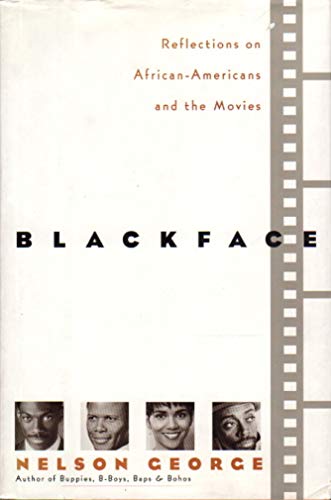
An examination of African-American imagery and participation in American movies includes a timeline of important African-American events in film history and discusses the achievements of noted celebrities. $20,000 ad/promo. Tour.
"synopsis" may belong to another edition of this title.
Reviews
According to the publisher, this book caps George's trilogy on black popular culture, after Elevating the Game, on basketball, and The Death of Rhythm and Blues, on music. But even the author acknowledges that Blackface is "more a memoir than a critique," and although his observations are often worthy and his style entertaining, his take is too scattershot to do his subject justice. He begins with memories of his Brooklyn youth, offering pointed reflections on Sidney Poitier and The Godfather. George became a music journalist and wound up in Brooklyn's Fort Greene, where he met Spike Lee and soon segued into the burgeoning 1980s world of black film as a writer and producer. He devotes a chapter to comments on early 1990s black films, from New Jack City to Daughters of the Dust, then a long chapter to the making of the "rapumentary" CB4, which he produced. George sums up by suggesting that innovations-through independent distribution or a "direct-to-home-video market"-are needed to get more black films to their targeted audience. Interspersed amid the chapters is a lengthy, annotated time line on black film. Photos not seen by PW.
Copyright 1994 Reed Business Information, Inc.
A textured personal exploration of the last 30 years of African-American cinema. The latest from Village Voice columnist George (Urban Romance, 1992, etc.) finishes his unofficial trilogy on black popular culture from basketball to buppies and film. The most personal of the three, this book is classified by George as ``more a memoir than a critique.'' His youth coincided with the explosion of black film in the 1970s and it is through his experienced vantage point as consumer of, critic of, and participant in the movie industry that he gives his reader this detailed guide. By interspersing time lines that include both history and commentary with an exploration of some of the most important players and themes in black film, George conveys a profound wealth of cinematic and cultural knowledge. He places Sidney Poitier (``his authority as an icon had been eroded by blaxploitation's baaad bold brothers''), Richard Pryor (whose movie Which, he points out, was reviled by white critics but popular with black youth), and Eddie Murphy in the context of American cinema; he analyzes diverse topics such as Motown and the role of class in Spike Lee's Jungle Fever. George also gives a chronicle of his own often trying involvement in the movie industry--especially his role as a writer and producer of the rap parody CB4 and the vicissitudes of working with a large studio on a film aimed at black youth. Despite George's thoroughness, there are some gaps in his discussion of gender: He acknowledges filmmaker Julie Dash (Daughters of the Dust) for her contribution to black cinema, yet he only hints at the important role women play in the consumption of film. He also gratuitously comments on Janet Jackson's weight while recounting a visit to the set of John Singleton's Poetic Justice. A savvy, revealing insider's view of the struggle for films created and controlled by African-Americans in Hollywood. (b&w photos, not seen) -- Copyright ©1994, Kirkus Associates, LP. All rights reserved.
Music critic, novelist, and filmmaker George offers a personal survey of African Americans' image on the silver screen. Among his early film-going experiences, he recalls admiring the poise of Sean Connery as 007; "cool wasn't limited to black men," he thought. Watching Planet of the Apes, he cheered for the apes, and he was in awe of the regal Sidney Poitier. Yet, he points out, blacks remained underrepresented in films. The 1970s introduced blaxploitation, most notably Melvin Van Peebles' unrepentantly angry Sweet Sweetback's Baadasssss Song, the success of which made studios aware of a large African American audience. In the mid-1980s, George met young independent filmmaker Spike Lee and invested a few thousand dollars he'd earned from a Michael Jackson bio in Lee's groundbreaker, She's Gotta Have It. Around this time George himself got into the biz and eventually coproduced the box-office bomb CB4. By his admission, "more a memoir than a critique," George's account is filled with keen observations and sharp analyses of the development of black cinema. But the part about making CB4 is far too long. Benjamin Segedin
Critic George (Buppies, B-Boys, Baps, & Bohos, LJ 1/93) presents a lively history of the African American film scene. [Reviewed on p. 78.]
Copyright 1994 Reed Business Information, Inc.
"About this title" may belong to another edition of this title.
Search results for Blackface: Reflections on African-Americans and the...

Stock Image
Blackface: Reflections on African-Americans and the Movies
Seller: Orion Tech, Kingwood, TX, U.S.A.
Seller rating 5 out of 5 stars

hardcover. Condition: Very Good. Seller Inventory # 0060171200-2-37314640
Stock Image
Blackface Reflections on Afric
Seller: World of Books (was SecondSale), Montgomery, IL, U.S.A.
Seller rating 5 out of 5 stars
Condition: Good. Item in good condition. Textbooks may not include supplemental items i.e. CDs, access codes etc. Seller Inventory # 00109359167
Stock Image
Blackface: Reflections on African-Americans and the Movies
Seller: ThriftBooks-Atlanta, AUSTELL, GA, U.S.A.
Seller rating 5 out of 5 stars
Hardcover. Condition: Good. No Jacket. Pages can have notes/highlighting. Spine may show signs of wear. ~ ThriftBooks: Read More, Spend Less. Seller Inventory # G0060171200I3N00
Stock Image
Blackface: Reflections on African-Americans and the Movies
Seller: ThriftBooks-Atlanta, AUSTELL, GA, U.S.A.
Seller rating 5 out of 5 stars
Hardcover. Condition: Very Good. No Jacket. May have limited writing in cover pages. Pages are unmarked. ~ ThriftBooks: Read More, Spend Less. Seller Inventory # G0060171200I4N00
Stock Image
Blackface: Reflections on African-Americans and the Movies
Seller: Atlantic Books, Mars Hill, NC, U.S.A.
Seller rating 4 out of 5 stars

Hardcover. Condition: As New. Dust Jacket Condition: Like New. Like New. Remainder mark on bottom. Seller Inventory # 08222111
Stock Image
Blackface
Published by
HarperCollins Publishers, 1994
ISBN 10: 0060171200
ISBN 13: 9780060171209
Used
Hardcover
First Edition
Seller: Better World Books, Mishawaka, IN, U.S.A.
Seller rating 5 out of 5 stars
Condition: Good. 1st. Former library copy. Pages intact with minimal writing/highlighting. The binding may be loose and creased. Dust jackets/supplements are not included. Includes library markings. Stock photo provided. Product includes identifying sticker. Better World Books: Buy Books. Do Good. Seller Inventory # 5368563-6
Stock Image
Blackface; Reflections on African-Americans and the Movies
Seller: Jeff Stark, Barstow, CA, U.S.A.
Seller rating 5 out of 5 stars
Hardcover. Condition: Near Fine. 1st. First edition stated on copyright page also first printing with correct year and number 1 in copyright line. Has a remainder mark on bottom edge otherwise fine in a lightly used jacket. Seller Inventory # 042325
Stock Image
Blackface: Reflections on African-Americans and the Movies
Seller: ANARTIST, New York, NY, U.S.A.
Seller rating 5 out of 5 stars
Hardcover with dustjacket, 224 pages; very good condition; clean and crisp; previous owner's name on first blank page; no other internal marks. Seller Inventory # BlGeHa7
Stock Image
Blackface: Reflections on African-Americans and the Movies
Published by
HarperCollins October 1994, 1994
ISBN 10: 0060171200
ISBN 13: 9780060171209
Used
Hardcover
Seller: Montclair Book Center, Montclair, NJ, U.S.A.
Seller rating 4 out of 5 stars
Hardcover. Condition: USED Fair. Seller Inventory # 512220
Stock Image
Blackface: Reflections on African-Americans and the Movies
Published by
HarperCollins, New York, NY, 1994
ISBN 10: 0060171200
ISBN 13: 9780060171209
Used
Hardcover
Seller: Hourglass Books, Vancouver, BC, Canada
Seller rating 5 out of 5 stars
Hardcover. Condition: Very Good. Dust Jacket Condition: Very Good, Not Price Clipped. American First. Complete number line from 1 to 10; some edge wear to boards and dust jacket; otherwise a solid, clean copy with no marking or underlining; collectible condition; illustrated with black and white photographs. Book. Seller Inventory # 018181