
Items related to From Dawn to Decadence: 1500 to the Present: 500 Years...
Synopsis
"A stunning five-century study of civilization's cultural retreat." — William Safire, New York Times
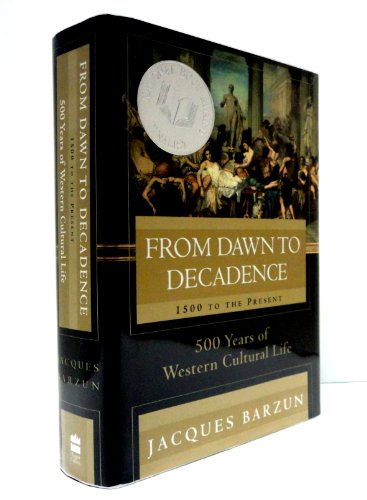
Highly regarded here and abroad for some thirty works of cultural history and criticism, master historian Jacques Barzun has set down in one continuous narrative the sum of his discoveries and conclusions about the whole of Western culture since 1500.
Barzun describes what Western Man wrought from the Renaissance and Reformation down to the present in the double light of its own time and our pressing concerns. He introduces characters and incidents with his unusual literary style and grace, bringing to the fore those that have been forgotten or obscured. His compelling chapters—such as "Puritans as Democrats," "The Monarchs' Revolution," and "The Artist Prophet and Jester"—show the recurrent role of great themes throughout the era.
The triumphs and defeats of five hundred years form an inspiring saga that modifies the current impression of one long tale of oppression by white European males. Women and their deeds are prominent, and freedom (even in sexual matters) is not an invention of the last decades. And when Barzun rates the present not as a culmination but a decline, he is in no way a prophet of doom. Instead, he shows decadence as the normal close of great periods and a necessary condition of the creative novelty that will burst forth—tomorrow or the next day.
Only after a lifetime of separate studies covering a broad territory could a writer create with such ease the synthesis displayed in this magnificent volume.
"synopsis" may belong to another edition of this title.
About the Author
Born in France in 1907, Jacques Barzun came to the United States in 1920. After graduating from Columbia College, he joined the faculty of the university, becoming Seth Low Professor of History and, for a decade, Dean of Faculties and Provost. The author of some thirty books, including the New York Times bestseller From Dawn to Decadence, he received the Gold Medal for Criticism from the American Academy of Arts and Letters, of which he was twice president. He lived in San Antonio, Texas, before passing away at age 104.
From the Back Cover
Highly regarded here and abroad for some thirty works of cultural history and criticism, master historian Jacques Barzun has now set down in one continuous narrative the sum of his discoveries and conclusions about the whole of Western culture since 1500.
In this account, Barzun describes what Western Man wrought from the Renaisance and Reformation down to the present in the double light of its own time and our pressing concerns. He introduces characters and incidents with his unusual literary style and grace, bringing to the fore those that have "Puritans as Democrats," "The Monarch's Revolution," "The Artist Prophet and Jester"--show the recurrent role of great themes throughout the eras.
The triumphs and defeats of five hundred years form an inspiring saga that modifies the current impression of one long tale of oppression by white European males. Women and their deeds are prominent, and freedom (even in sexual matters) is not an invention of the last decades. And when Barzun rates the present not as a culmination but a decline, he is in no way a prophet of doom. Instead, he shows decadence as the creative novelty that will burst forth--tomorrow or the next day.
Only after a lifetime of separate studies covering a broad territory could a writer create with such ease the synthesis displayed in this magnificent volume.
Reviews
Now 92, Barzun, the renowned cultural critic, historian and former Columbia provost and professor, offers much more than a summation of his life's work in this profound, eloquent, often witty historical survey. A book of enormous riches, it's sprinkled with provocations. For example, Barzun contradicts Max Weber, arguing that the Protestant Reformation did not galvanize the capitalist spirit. With feminist ardor, he depicts the 16th century as molded and directed by women "as brilliant as the men, and sometimes more powerful" (e.g., Queens Elizabeth and Isabella). His eclectic synthesis is organized around a dozen or so themes--including emancipation, abstraction and individualism--that in his judgment define the modern era. Barzun keeps up the momentum with scores of snappy profiles, including of Luther, Erasmus, Cromwell, Mozart, Rousseau and Byron, as well as of numerous unsung figures such as German educator Friedrich Froebel, inventor of kindergarten, and turn-of-the-century American pioneer ecologist George Marsh. Other devices help make this tome user-friendly--the margins are chock-full of quotes, while vignettes of Venice in 1650, Weimar in 1790 and Chicago in 1895 give a taste of the zeitgeist. In Barzun's glum estimate, the late 20th century has brought decadence into full bloom--separatism in all forms, apathetic electorates, amoral art that embraces filth or mere shock value, the decline of the humanities, the mechanization of life--but he remains hopeful that humanity will find its way again. This is a book to be reckoned with. First serial to American Scholar; BOMC selection. (May)
Copyright 2000 Reed Business Information, Inc.
Others have written about the end of Western culture, but none with more cogent erudition than Barzun. With a poise borne of decades of distinguished scholarship, Barzun recounts the religious, political, artistic, and social revolutions that shaped Western culture. But far more than a chronicle of events, this magisterial history highlights the earliest emergence of seminal new ideas and impulses. Thus, though Barzun offers deft and often shrewd portrayals of such giants as Luther, Montesquieu, and Shaw, it is concepts--including individualism, emancipation, primitivism, and self-consciousness--that form the unifying threads running through the tapestry of the centuries. In scrutinizing the last few decades, Barzun sees the threads unraveling, and the weavers despairing. No new ideas inspire fresh or meaningful patterns. Signs of decadence abound. Absurdity pervades the arts. Empty slogans dominate politics. Violence replaces thought. Barzun expects and even invites disagreement. But he advances his views with an intellectual capaciousness that will win admiration even from those who reject his conclusions. An impressive culmination to a lifetime of serious reflection. Bryce Christensen
Nearly 100, the noted thinker contemplates the last half-millennium.
Copyright 1999 Reed Business Information, Inc.
"About this title" may belong to another edition of this title.
Other Popular Editions of the Same Title

Search results for From Dawn to Decadence: 1500 to the Present: 500 Years...

Stock Image
From Dawn to Decadence 500 Yea
Seller: World of Books (was SecondSale), Montgomery, IL, U.S.A.
Seller rating 5 out of 5 stars

Condition: Acceptable. Item in acceptable condition! Textbooks may not include supplemental items i.e. CDs, access codes etc. Seller Inventory # 00092942332
Stock Image
From Dawn to Decadence 500 Yea
Seller: World of Books (was SecondSale), Montgomery, IL, U.S.A.
Seller rating 5 out of 5 stars
Condition: Good. Item in good condition. Textbooks may not include supplemental items i.e. CDs, access codes etc. Seller Inventory # 00093870741
Stock Image
From Dawn to Decadence: 1500 to the Present: 500 Years of Western Cultural Life
Seller: Evergreen Goodwill, Seattle, WA, U.S.A.
Seller rating 5 out of 5 stars
hardcover. Condition: Acceptable. This is a former library/ rental copy with stickers, inserts, and markings. Seller Inventory # mon0000722709
Stock Image
From Dawn to Decadence: 1500 to the Present: 500 Years of Western Cultural Life
Seller: Once Upon A Time Books, Siloam Springs, AR, U.S.A.
Seller rating 4 out of 5 stars

Hardcover. Condition: Acceptable. This is a used book. It may contain highlighting/underlining and/or the book may show heavier signs of wear . It may also be ex-library or without dustjacket. This is a used book. It may contain highlighting/underlining and/or the book may show heavier signs of wear . It may also be ex-library or without dustjacket. Seller Inventory # mon0003553765
Stock Image
From Dawn to Decadence: 1500 to the Present: 500 Years of Western Cultural Life
Seller: SustainableBooks.com, Amherst, NY, U.S.A.
Seller rating 5 out of 5 stars
Condition: Good. Book is in Used-Good condition. Pages and cover are clean and intact. Used items may not include supplementary materials such as CDs or access codes. May show signs of minor shelf wear and contain limited notes and highlighting. Seller Inventory # 0060175869-2-4
Stock Image
From Dawn to Decadence: 1500 to the Present: 500 Years of Western Cultural Life
Seller: More Than Words, Waltham, MA, U.S.A.
Seller rating 5 out of 5 stars
Condition: Good. A sound copy with only light wear. Overall a solid copy at a great price! Seller Inventory # BOS-D-14d-00932
Stock Image
From Dawn to Decadence: 1500 to the Present: 500 Years of Western Cultural Life
Seller: ThriftBooks-Reno, Reno, NV, U.S.A.
Seller rating 5 out of 5 stars
Hardcover. Condition: Good. No Jacket. Missing dust jacket; Pages can have notes/highlighting. Spine may show signs of wear. ~ ThriftBooks: Read More, Spend Less. Seller Inventory # G0060175869I3N01
Stock Image
From Dawn to Decadence: 1500 to the Present: 500 Years of Western Cultural Life
Seller: ThriftBooks-Dallas, Dallas, TX, U.S.A.
Seller rating 5 out of 5 stars
Hardcover. Condition: Good. No Jacket. Pages can have notes/highlighting. Spine may show signs of wear. ~ ThriftBooks: Read More, Spend Less. Seller Inventory # G0060175869I3N00
Stock Image
From Dawn to Decadence: 1500 to the Present: 500 Years of Western Cultural Life
Seller: ThriftBooks-Atlanta, AUSTELL, GA, U.S.A.
Seller rating 5 out of 5 stars
Hardcover. Condition: Good. No Jacket. Former library book; Missing dust jacket; Pages can have notes/highlighting. Spine may show signs of wear. ~ ThriftBooks: Read More, Spend Less. Seller Inventory # G0060175869I3N11
Stock Image
From Dawn to Decadence: 1500 to the Present: 500 Years of Western Cultural Life
Seller: ThriftBooks-Phoenix, Phoenix, AZ, U.S.A.
Seller rating 5 out of 5 stars
Hardcover. Condition: Good. No Jacket. Missing dust jacket; Pages can have notes/highlighting. Spine may show signs of wear. ~ ThriftBooks: Read More, Spend Less. Seller Inventory # G0060175869I3N01