
Synopsis
"Magnificent! The best how-to manual ever published." — Kevin Kelly, Cool Tools
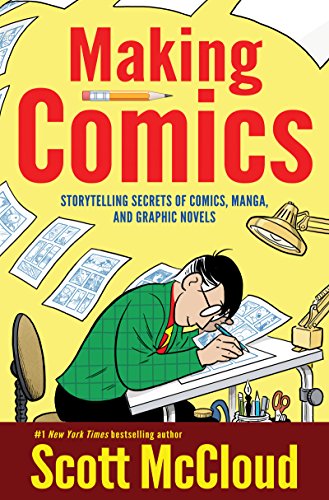
The renowned author of Understanding Comics offers brilliant instruction on how to actually create this widely beloved art form.
Scott McCloud tore down the wall between high and low culture in 1993 with Understanding Comics, a massive comic book about comics, linking the medium to such diverse fields as media theory, movie criticism, and web design. In Reinventing Comics, McCloud took this to the next level, charting twelve different revolutions in how comics are generated, read, and perceived today. Now, in Making Comics, McCloud focuses his analysis on the art form itself, exploring the creation of comics, from the broadest principles to the sharpest details (like how to accentuate a character's facial muscles in order to form the emotion of disgust rather than the emotion of surprise.) And he does all of it in his inimitable voice and through his cartoon stand–in narrator, mixing dry humor and legitimate instruction. McCloud shows his reader how to master the human condition through word and image in a brilliantly minimalistic way. Both comic book devotees and the uninitiated will marvel at this journey into a once–underappreciated art form.
"synopsis" may belong to another edition of this title.
About the Author
Scott McCloud has been writing, drawing, and examining comics since 1984. Winner of the Eisner and Harvey awards, his works have been translated into more than sixteen languages. Frank Miller (Sin City, 300) called him "just about the smartest guy in comics." He lives with his family in southern California. His online comics and inventions can be found at scottmccloud.com.
From the Back Cover
Learn How to . . .
- Choose the right moments to clarify and strengthen your stories.
- Frame actions and guide your readers’ eyes through each comics page.
- Choose words and pictures that communicate together.
- Create varied and compelling new characters.
- Master body language and facial expressions.
- Create rich, believable worlds for your readers to explore.
- Pick the tools that are right for you.
- Navigate the vast world of comics styles and genres.
Reviews
Adult/High School–A follow-up to the author's Understanding Comics (Kitchen Sink, 1993) and Reinventing Comics (DC Comics, 2000), this volume uses the same graphic style and narrator to explain the technical aspects of creating comics. From the layout of each frame and the placement of words and characters to creating facial expressions, symbolism, and more, this highly detailed resource is for serious artists wishing to gain further technical knowledge. Every concept is broken down into its individual elements and thus is probably more than most casual readers would want to know. The book is well organized with a specific table of contents and an annotated bibliography and suggested reading list.–Corinda J. Humphrey, Los Angeles Public Library
Copyright © Reed Business Information, a division of Reed Elsevier Inc. All rights reserved.
Starred Review. Every medium should be lucky enough to have a taxonomist as brilliant as McCloud. The follow-up to his pioneering Understanding Comics (and its flawed sequel Reinventing Comics) isn't really about how to draw comics: it's about how to make drawings become a story and how cartooning choices communicate meaning to readers. ("There are no rules," he says, "and here they are.") McCloud's cartoon analogue, now a little gray at the temples, walks us through a series of dazzlingly clear, witty explanations (in comics form) of character design, storytelling, words and their physical manifestation on the page, body language and other ideas cartoonists have to grapple with, with illustrative examples drawn from the history of the medium. If parts of his chapter on "Tools, Techniques and Technology" don't look like they'll age well, most of the rest of the book will be timelessly useful to aspiring cartoonists. McCloud likes to boil down complicated topics to a few neatly balanced principles; his claim that all facial expressions come from degrees and combinations of six universal basic emotions is weirdly reductive and unnerving, but it's also pretty convincing. And even the little ideas that he tosses off—like classifying cartoonists into four types—will be sparking productive arguments for years to come. (Sept.)
Copyright © Reed Business Information, a division of Reed Elsevier Inc. All rights reserved.
To his earlier comics primers, Understanding Comics (1993) and Reinventing Comics (2000), McCloud adds an equally enlightening book demonstrating to aspiring comics artists "how words and pictures can combine to create effects that neither could create separately." Whereas similar instruction manuals focus on honing illustration techniques and give only a nod to storytelling basics, McCloud's systematic approach encompasses every aspect of comics creation, from character design and facial expression to the effective use of words and of tools, including computer technology. McCloud illustrates points with his own clear drawings as well as panels by dozens of the medium's esteemed artists. Three concluding essays on comics styles discuss Japanese manga, genres ranging from superhero tales to autobiography, and comics culture. The volume covers a lot of ground and always in comic-strip format that McCloud's mastery makes easy going. There's plenty of practical value here for neophyte and veteran artists alike; meanwhile, those content to just read other peoples' comics will have their appreciation of the medium enhanced. Gordon Flagg
Copyright © American Library Association. All rights reserved
"About this title" may belong to another edition of this title.
Search results for Making Comics: Storytelling Secrets of Comics, Manga...

Seller Image
Making Comics: Storytelling Secrets of Comics, Manga and Graphic Novels
Published by
William Morrow Paperbacks, 2006
ISBN 10: 0060780940
ISBN 13: 9780060780944
Used
Softcover
Seller: Goodwill Books, Hillsboro, OR, U.S.A.
Seller rating 5 out of 5 stars

Condition: acceptable. Fairly worn, but readable and intact. If applicable: Dust jacket, disc or access code may not be included. Seller Inventory # GICWV.0060780940.A
Stock Image
Making Comics: Storytelling Secrets of Comics, Manga and Graphic Novels
Published by
William Morrow Paperbacks, 2006
ISBN 10: 0060780940
ISBN 13: 9780060780944
Used
Paperback
Seller: Half Price Books Inc., Dallas, TX, U.S.A.
Seller rating 5 out of 5 stars
Paperback. Condition: Very Good. Connecting readers with great books since 1972! Used books may not include companion materials, and may have some shelf wear or limited writing. We ship orders daily and Customer Service is our top priority! Seller Inventory # S_470234679
Seller Image
Making Comics: Storytelling Secrets of Comics, Manga and Graphic Novels
Published by
William Morrow Paperbacks, 2006
ISBN 10: 0060780940
ISBN 13: 9780060780944
Used
Softcover
Seller: Goodwill, Brooklyn Park, MN, U.S.A.
Seller rating 4 out of 5 stars

Condition: good. Cover does not match photos; some content may vary from version shown. Seller Inventory # MINV.0060780940.G
Seller Image
Making Comics: Storytelling Secrets of Comics, Manga and Graphic Novels
Published by
William Morrow Paperbacks, 2006
ISBN 10: 0060780940
ISBN 13: 9780060780944
Used
Softcover
Seller: Goodwill Books, Hillsboro, OR, U.S.A.
Seller rating 5 out of 5 stars
Condition: good. Signs of wear and consistent use. Seller Inventory # GICWV.0060780940.G
Stock Image
Making Comics: Storytelling Secrets of Comics, Manga and Graphic Novels
Published by
William Morrow Paperbacks, 2006
ISBN 10: 0060780940
ISBN 13: 9780060780944
Used
Paperback
Seller: HPB Inc., Dallas, TX, U.S.A.
Seller rating 5 out of 5 stars
Paperback. Condition: Very Good. Connecting readers with great books since 1972! Used books may not include companion materials, and may have some shelf wear or limited writing. We ship orders daily and Customer Service is our top priority! Seller Inventory # S_468041677
Stock Image
Making Comics: Storytelling Secrets of Comics, Manga and Graphic Novels
Seller: BookOutlet, Jefferson City, TN, U.S.A.
Seller rating 5 out of 5 stars
Paperback. Condition: New. Paperback. Publisher overstock, may contain remainder mark on edge. Seller Inventory # 9780060780944B
Stock Image
Making Comics : Storytelling Secrets of Comics, Manga and Graphic Novels
Published by
HarperCollins Publishers, 2006
ISBN 10: 0060780940
ISBN 13: 9780060780944
Used
Softcover
Seller: Better World Books: West, Reno, NV, U.S.A.
Seller rating 5 out of 5 stars
Condition: Good. 1 Edition. Pages intact with minimal writing/highlighting. The binding may be loose and creased. Dust jackets/supplements are not included. Stock photo provided. Product includes identifying sticker. Better World Books: Buy Books. Do Good. Seller Inventory # 2189031-6
Stock Image
Making Comics : Storytelling Secrets of Comics, Manga and Graphic Novels
Published by
HarperCollins Publishers, 2006
ISBN 10: 0060780940
ISBN 13: 9780060780944
Used
Softcover
Seller: Better World Books, Mishawaka, IN, U.S.A.
Seller rating 5 out of 5 stars
Condition: Good. 1 Edition. Former library copy. Pages intact with minimal writing/highlighting. The binding may be loose and creased. Dust jackets/supplements are not included. Includes library markings. Stock photo provided. Product includes identifying sticker. Better World Books: Buy Books. Do Good. Seller Inventory # 4362853-6
Stock Image
Making Comics: Storytelling Secrets of Comics, Manga and Graphic Novels
Published by
William Morrow Paperbacks, 2006
ISBN 10: 0060780940
ISBN 13: 9780060780944
Used
Paperback
Seller: HPB-Diamond, Dallas, TX, U.S.A.
Seller rating 5 out of 5 stars
Paperback. Condition: Very Good. Connecting readers with great books since 1972! Used books may not include companion materials, and may have some shelf wear or limited writing. We ship orders daily and Customer Service is our top priority! Seller Inventory # S_466166768
Stock Image
Making Comics: Storytelling Secrets of Comics, Manga and Graphic Novels
Published by
William Morrow Paperbacks, 2006
ISBN 10: 0060780940
ISBN 13: 9780060780944
Used
Paperback
Seller: HPB-Ruby, Dallas, TX, U.S.A.
Seller rating 5 out of 5 stars
Paperback. Condition: Very Good. Connecting readers with great books since 1972! Used books may not include companion materials, and may have some shelf wear or limited writing. We ship orders daily and Customer Service is our top priority! Seller Inventory # S_471802825