
Items related to Ines of My Soul: A Novel
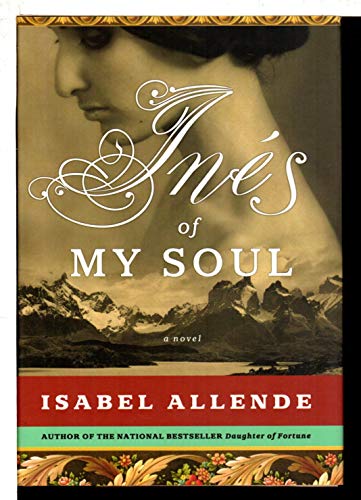
Synopsis
A passionate tale of love, freedom, and conquest from the New York Times bestselling author of The House of the Spirits, Isabel Allende.
Born into a poor family in Spain, Inés Suárez, finds herself condemned to a life of poverty without opportunity as a lowly seamstress. But it's the sixteenth century, the beginning of the Spanish conquest of the Americas. Struck by the same restless hope and opportunism, Inés uses her shiftless husband's disappearance to Peru as an excuse to embark on her own adventure. After learning of her husband's death in battle, she meets the fiery war hero, Pedro de Valdivia and begins a love that not only changes her life but the course of history.
Based on the real historical events that founded Chile, Allende takes us on a whirlwind adventure of love and loss seen through the eyes of a daring, complicated woman who fought for freedom.
"synopsis" may belong to another edition of this title.
About the Author
Isabel Allende, born in Peru and raised in Chile, is a novelist, feminist, and philanthropist. She is one of the most widely read authors in the world, having sold more than eighty million copies of her books across forty-two languages. She is the author of several bestselling and critically acclaimed books, including The House of the Spirits, Of Love and Shadows, Eva Luna, and Paula. In addition to her work as a writer, Isabel devotes much of her time to human rights causes. She has received fifteen honorary doctorates, been inducted into the California Hall of Fame, and received the PEN Center Lifetime Achievement Award and the Anisfield-Wolf Lifetime Achievement Award. In 2014, President Barack Obama awarded her the Presidential Medal of Freedom, the nation’s highest civilian honor, and in 2018, she received the Medal for Distinguished Contribution to American Letters from the National Book Foundation. She lives in California with her husband and dogs.
You can visit Isabel Allende at IsabelAllende.com or follow her on Instagram @AllendeIsabel, on Facebook at Facebook.com/IsabelAllende and on X @IsabelAllende
From the Back Cover
Born into a poor family in Spain, Inés, a seamstress, finds herself condemned to a life of hard work without reward or hope for the future. It is the sixteenth century, the beginning of the Spanish conquest of the Americas, and when her shiftless husband disappears to the New World, Inés uses the opportunity to search for him as an excuse to flee her stifling homeland and seek adventure. After her treacherous journey takes her to Peru, she learns that her husband has died in battle. Soon she begins a fiery love affair with a man who will change the course of her life: Pedro de Valdivia, war hero and field marshal to the famed Francisco Pizarro.
Valdivia's dream is to succeed where other Spaniards have failed: to become the conquerer of Chile. The natives of Chile are fearsome warriors, and the land is rumored to be barren of gold, but this suits Valdivia, who seeks only honor and glory. Together the lovers Inés Suárez and Pedro de Valdivia will build the new city of Santiago, and they will wage a bloody, ruthless war against the indigenous Chileans—the fierce local Indians led by the chief Michimalonko, and the even fiercer Mapuche from the south. The horrific struggle will change them forever, pulling each of them toward their separate destinies.
Inés of My Soul is a work of breathtaking scope: meticulously researched, it engagingly dramatizes the known events of Inés Suárez's life, crafting them into a novel full of the narrative brilliance and passion readers have come to expect from Isabel Allende.
Reviews
If Inés of My Soul isn't among Isabel Allende's best novels, it still tells a remarkable, ambitious, and heretofore untold story about one of the first female conquistadors of the New World. Allende finds so many surreal subplots in Inés's own story that the author's imagination, rather than magical realism, prevails in her attempt to recreate the 16th-century Americas. All aspects of the story entertain and educate. At the same time, the detractors have some complaints: Allende embarks on too many historical detours; she romanticizes the Spanish conquistadors; she takes a one-sided view of the native Chileans; and, in an attempt to appeal to fans of different genres, she creates a lightweight story from a very serious topic.
Copyright © 2004 Phillips & Nelson Media, Inc.
Isabel Allende's new novel, Inés of My Soul, the 15th book she has published in just over two decades, is in many ways her most ambitious. It is historical fiction, set in Spain, Peru (where she was born) and Chile (where she grew up) in the 16th century, the time of the Spanish conquest of Central and South America, one of the bloodiest periods in human history. Its central character is an actual historical figure, Inés Suárez, "widow of the Most Excellent Gobernador don Rodrigo de Quiroga, conquistador and founder of the kingdom of Chile." She is living in Santiago and is more or less 70 years old -- she doesn't know the exact date of her birth, probably in 1507, in Spain, "in Plasencia, in the north of Extremadura, a border city steeped in war and religion" -- and she is looking back on her life in the certain knowledge that her death cannot be far away.
"This novel is a work of intuition," Allende says in her Author's Note, "but any similarity to events and persons relating to the conquest of Chile is not coincidental." Though "the feats of Inés Suárez noted by the chroniclers of her era were nearly ignored by historians for more than four hundred years," they were both real and significant. Essentially, Allende has "merely strung them together with a fine thread of imagination."
Unfortunately, though, the demands of fidelity to basic historical truth have fettered Allende's imagination more than they have liberated it. The novel's best moments are vivid and convincing -- especially in the early pages, as Inés recounts her marriage to Juan de Málaga, "one of those handsome, happy men no woman can resist at first, but later wishes another woman would win away because he causes so much pain" -- but they are separated by too many long, arid stretches, in some cases literally so, as the conquistadors struggle toward Chile through what is now known as the Atacama Desert.
By the time that happens, in 1540 and 1541, Inés has come from Spain to Peru to find her husband, who had gone to the New World in search of its fabled treasure. She learns of his death and is liberated. She tells her story to Isabel, daughter of her late second husband, "my friend and my confidante, the one person who knows my secrets, including some that, out of modesty, I did not share with your father." She says:
"I beg you to have a little patience, Isabel. You will soon see that this disorderly narrative will come to the moment when my path crosses that of Pedro de Valdivia and the epic I want to tell you about begins. Before that, I had been an insignificant seamstress in Plasencia, like the hundreds and hundreds of hardworking women who came here before and will come after me. With Pedro de Valdivia I lived a life of legend, and with him I conquered a kingdom. Although I adored Rodrigo de Quiroga, your father, and lived with him thirty years, the only real reason for telling my story is the conquest of Chile, which I shared with Pedro de Valdivia."
The trouble with that story, in this novel as in many others that have been written about the Spanish conquest, is that while it may seem heroic from the Spanish point of view, it is anything but heroic from the viewpoint of the indigenous people who were slaughtered, enslaved and otherwise broken to the will of Charles I of Spain and his ambitious, ruthless emissaries.
To say this isn't merely to indulge in present-day political correctness, though perhaps there is a bit of that. The unpleasant historical truth is that the Spanish conquest was an atrocity of almost unimaginable dimensions, carried out by the likes of Francisco Pizarro and Hernando Cortés. Though Allende does not attempt to whitewash the conquistadors -- Pizarro is "a man of about sixty, haughty, with sallow skin, a graying beard, sunken eyes with a suspicious gleam in them, and a disagreeable falsetto voice" -- she cannot resist the temptation to romanticize the feats of the men (and, in this instance, one remarkable woman) who conquered a continent.
The temptation is understandable. In Chile, as in Mexico and Peru, the suppression of the natives -- the Mapuche, the Incas, the Aztecs -- was carried out by extraordinarily small bodies of soldiers who fought against astonishing odds: a hundred men or fewer against thousands. Thus the expedition that set out from Cuzco in southern Peru in January 1540 was "a pathetic group: only eleven soldiers in addition to Pedro de Valdivia -- and me, for I was prepared to wield a sword if the occasion demanded it."
On more than one occasion it did, and Inés rose to the occasion every time. Mainly, though, she served as nurse, cook and miracle worker -- she had a talent for dowsing and found water beneath the desert when the expedition was about to die of thirst -- and as lover and confidante to the charismatic Valdivia. He had served with distinction under Pizarro in Peru, and "in payment for his services, Pizarro had allotted him, for his lifetime, a silver mine in Porco, a fertile and productive hacienda in La Canela Valley, and hundreds of Indians to work them." But money and position don't interest Valdivia. His mission is "to populate Chile with Spaniards and to evangelize the Indians," and "glory, always glory, that was the lodestar of his life." He is as bloodthirsty as the next conquistador, but he has a more tempered view of what the Spanish are up to than most:
"The Chilean Indians called us huincas, which in their language, Mapudungu, means lying people and land thieves. . . . Valdivia was indignant about the stupidity of the Spaniards who were killing off the peoples of the New World. Without the natives, he always said, the land has no value. He died without seeing an end to the slaughter, which has been going on for forty years now. Spaniards keep coming, and mestizos keep being born, but the Mapuche are disappearing, exterminated by war, slavery, and the illnesses brought by the Spaniards, which they cannot withstand."
The relationship between Pedro and Inés is intimate and passionate: "I could not live without him. One day without seeing him and I was feverish. A night without being in his arms was torment. At first, more than love, I felt a blind, reckless passion for him, which fortunately he returned." In time, passion turns into love, but other matters intervene. As Valdivia and his tiny force gain a tenuous hold on the Mapocho Valley and found a settlement there that they call Santiago de la Nueva Extremadura, he becomes infected by the virus of megalomania. He grows more interested in winning other battles and subduing more Indians, and his passion for Inés wanes. Ultimately, she finds her way to Rodrigo, for whom her love "was different from the desire I had felt for Juan de Málaga and my passion for Pedro de Valdivia; it was a mature, joyful sentiment, without conflict, that became more intense with the passing of time . . . until I could not live without him."
As these quotations suggest, the romantic side of Allende scarcely is lost in the battle and blood of this novel. Desire, passion and love between men and women are the essential ingredients of her fiction, and she gives all of these play herein. Somehow, though, the amatory aspects of the novel seem more imposed on the great historical events than flowing naturally out of them. Though the progress that Inés makes from desire for one man to passion for another to genuine love for a third can be viewed as mirroring the progress of Chile itself from an unspoiled state to violent subjugation to nationhood, the connection seems forced. Allende's ambition in taking on the novel's big subjects is admirable, but Inés of My Soul -- the title comes from Valdivia's affectionate term for his lover -- does not fulfill it.
Copyright 2006, The Washington Post. All Rights Reserved.
Starred Review. Only months after the inauguration of Chile's first female president, Allende recounts in her usual sweeping style the grand tale of Doña Inés Suárez (1507– 1580), arguably the country's founding mother. Writing in the year of her death, Inés tells of her modest girlhood in Spain and traveling to the New World as a young wife to find her missing husband, Juan. Upon learning of Juan's humiliating death in battle, Inés determines to stay in the fledgling colony of Peru, where she falls fervently in love with Don Pedro de Valdivia, loyal field marshal of Francisco Pizarro. The two lovers aim to found a new society based on Christian and egalitarian principles that Valdivia later finds hard to reconcile with his personal desire for glory. Inés proves herself not only a capable helpmate and a worthy cofounder of a nation, but also a ferocious fighter who both captivates and frightens her fellow settlers. Inés narrates with a clear eye and a sensitivity to native peoples that rarely lapses into anachronistic political correctness. Basing the tale on documented events of her heroine's life, Allende crafts a swift, thrilling epic, packed with fierce battles and passionate romance. (Nov.)
Copyright © Reed Business Information, a division of Reed Elsevier Inc. All rights reserved.
*Starred Review* Fiction about the conquistador experience in the New World (although a long list does not immediately come to mind) nevertheless can't possibly get better than Allende's treatment of the subject in her latest novel, which is based on the life of a real historical character. Ines Suarez was born in golden-age Spain; she traveled to that glittering country's South American empire in search of her husband, who previously had pulled up stakes and booked passage there in search of riches. In the novel's real time, Ines is 70 years old in the year 1580, and she puts stiffly held pen to paper to compose her memoirs, recording for posterity the events of quite an extraordinary life. Once in the New World, after learning her husband had died, Ines, with her innate smarts and fortitude, takes up with a man (one of Francisco Pizarro's former officers) who not only knocks her socks off (or whatever the equivalent of such an article of clothing was back in those days) but who also, together with her, proceeds to build the city of Santiago and forge the nation of Chile. Allende's novel broadens and deepens into a richly drawn depiction of the harshness of New World colonial life. She is an exquisite handler of historical detail, always conscious of keeping her story line above sinking beneath the particulars. Brad Hooper
Copyright © American Library Association. All rights reserved
"About this title" may belong to another edition of this title.
Search results for Ines of My Soul: A Novel

Stock Image
Ines of My Soul
Seller: World of Books (was SecondSale), Montgomery, IL, U.S.A.
Seller rating 5 out of 5 stars

Condition: Good. Item in good condition. Textbooks may not include supplemental items i.e. CDs, access codes etc. Seller Inventory # 00093557111
Stock Image
Ines of My Soul
Seller: World of Books (was SecondSale), Montgomery, IL, U.S.A.
Seller rating 5 out of 5 stars
Condition: Acceptable. Item in acceptable condition! Textbooks may not include supplemental items i.e. CDs, access codes etc. Seller Inventory # 00094860630
Stock Image
Ines of My Soul: A Novel
Seller: Your Online Bookstore, Houston, TX, U.S.A.
Seller rating 5 out of 5 stars
Hardcover. Condition: Good. Seller Inventory # 0061161535-3-19766600
Stock Image
Ines of My Soul: A Novel
Seller: Gulf Coast Books, Cypress, TX, U.S.A.
Seller rating 5 out of 5 stars
hardcover. Condition: Fair. Seller Inventory # 0061161535-4-37335100
Seller Image
Ines of My Soul: A Novel
Seller: Zoom Books East, Glendale Heights, IL, U.S.A.
Seller rating 5 out of 5 stars
Condition: good. Book is in good condition and may include underlining highlighting and minimal wear. The book can also include "From the library of" labels. May not contain miscellaneous items toys, dvds, etc. . We offer 100% money back guarantee and 24 7 customer service. Seller Inventory # ZEV.0061161535.G
Seller Image
Ines of My Soul: A Novel
Seller: Zoom Books East, Glendale Heights, IL, U.S.A.
Seller rating 5 out of 5 stars
Condition: acceptable. Book is in acceptable condition and shows signs of wear. Book may also include underlining highlighting. The book can also include "From the library of" labels. May not contain miscellaneous items toys, dvds, etc. . We offer 100% money back guarantee and 24 7 customer service. Seller Inventory # ZEV.0061161535.A
Seller Image
Ines of My Soul: A Novel
Seller: Greenworld Books, Arlington, TX, U.S.A.
Seller rating 5 out of 5 stars
Condition: good. Fast Free Shipping â" Good condition. It may show normal signs of use, such as light writing, highlighting, or library markings, but all pages are intact and the book is fully readable. A solid, complete copy that's ready to enjoy. Seller Inventory # GWV.0061161535.G
Stock Image
Ines of My Soul: A Novel
Seller: More Than Words, Waltham, MA, U.S.A.
Seller rating 5 out of 5 stars
Condition: Good. A sound copy with only light wear. Overall a solid copy at a great price! Seller Inventory # BOS-J-13j-01641
Stock Image
Ines of My Soul: A Novel
Seller: Evergreen Goodwill, Seattle, WA, U.S.A.
Seller rating 5 out of 5 stars
hardcover. Condition: Acceptable. Seller Inventory # mon0000630860
Stock Image
Ines of My Soul: A Novel
Seller: Evergreen Goodwill, Seattle, WA, U.S.A.
Seller rating 5 out of 5 stars
hardcover. Condition: Good. Seller Inventory # mon0000353493