
Synopsis
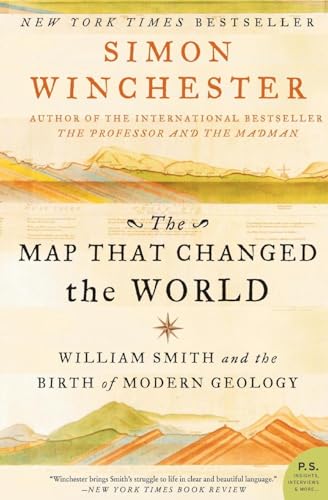
From the author of the bestselling The Professor and the Madman comes the fascinating story of William Smith, the orphaned son of an English country blacksmith, who became obsessed with creating the world's first geological map and ultimately became the father of modern geology.
In 1793 William Smith, a canal digger, made a startling discovery that was to turn the fledgling science of the history of the earth -- and a central plank of established Christian religion -- on its head. He noticed that the rocks he was excavating were arranged in layers; more important, he could see quite clearly that the fossils found in one layer were very different from those found in another. And out of that realization came an epiphany: that by following the fossils, one could trace layers of rocks as they dipped and rose and fell -- clear across England and, indeed, clear across the world. Determined to publish his discovery by creating a map that would display the hidden underside of England, he spent twenty years traveling the length and breadth of the kingdom by stagecoach and on foot, studying rock outcrops and fossils, piecing together the image of this unseen universe.
In 1815 he published his epochal beautiful hand-painted map, more than eight feet tall and six feet wide. But four years after its triumphant publication, and with his young wife going steadily mad to the point of nymphomania, Smith ended up in debtors' prison, a victim of plagiarism, swindled out of his recognition and his profits. He left London for the north of England and remained homeless for ten long years as he searched for work. It wasn't until 1831, when his employer, a sympathetic nobleman, brought him into contact with the Geological Society of London -- which had earlier denied him a fellowship -- that at last this quiet genius was showered with the honors long overdue him. He was summoned south to receive the society's highest award, and King William IV offered him a lifetime pension.
The Map That Changed the World is, at its foundation, a tale of endurance and achievement, of one man's dedication in the face of ruin and homelessness. The world's coal and oil industry, its gold mining, its highway systems, and its railroad routes were all derived entirely from the creation of Smith's first map.; and with a keen eye and thoughtful detail, Simon Winchester unfolds the poignant sacrifice behind this world-changing discovery.
"synopsis" may belong to another edition of this title.
About the Author
Simon Winchester is the acclaimed author of many books, including The Professor and the Madman, The Men Who United the States, The Map That Changed the World, The Man Who Loved China, A Crack in the Edge of the World, and Krakatoa, all of which were New York Times bestsellers and appeared on numerous best and notable lists. In 2006, Winchester was made an officer of the Order of the British Empire (OBE) by Her Majesty the Queen. He resides in western Massachusetts.
From the Back Cover
In 1793, a canal digger named William Smith made a startling discovery. He found that by tracing the placement of fossils, which he uncovered in his excavations, one could follow layers of rocks as they dipped and rose and fell—clear across England and, indeed, clear across the world—making it possible, for the first time ever, to draw a chart of the hidden underside of the earth. Smith spent twenty-two years piecing together the fragments of this unseen universe to create an epochal and remarkably beautiful hand-painted map. But instead of receiving accolades and honors, he ended up in debtors' prison, the victim of plagiarism, and virtually homeless for ten years more.
The Map That Changed the World is a very human tale of endurance and achievement, of one man's dedication in the face of ruin. With a keen eye and thoughtful detail, Simon Winchester unfolds the poignant sacrifice behind this world-changing discovery.
Excerpt. © Reprinted by permission. All rights reserved.
The Map That Changed the World
William Smith and the Birth of Modern GeologyBy Simon WinchesterHarperCollins Publishers, Inc.
Copyright © 2009 Simon WinchesterAll right reserved.
ISBN: 9780061767906
Chapter One
Escape on the Northbound Stage
The last day of August 1819, a Tuesday, dawned gray, showery, and refreshingly cool in London, promising a welcome end to a weeklong spell of close and muggy weather that seemed to have put all the capital's citizens in a nettlesome, liverish mood.
Anyone trying to hurry along the cobbled and granite-paved streets that day was still certain to be frustrated, despite the improvement in the weather: The crowds! The crush! The dirt! The smell! More than a million people had lately been counted as living within and beyond London's city walls, and each day hundreds more, the morning papers reported, were to be found streaming in from the countryside, bent on joining the new prosperity that all hoped might soon be flowering now that the European wars were over. The city's population was well on the way to doubling itself in less than twenty years. The streets were in consequence filled with a jostling, pullulating, dawdling mass of people. And animals, too: It seemed of little matter to some farmers that there had long been laws to keep them from driving cattle through the center of town'so among the throngs one could spot mangy-looking sheep, more than a few head of cattle, the odd black pig, and of course horses, countless horses, pulling carriages and goods vehicles alike. The stench of their leavings, on a hot week such as this had been, was barely tolerable.
Since it was very early in the morning, there were, of course, fewer crowds than usual. Fewer, that is, except in one or two more notorious spots, where a sad and shabby ritual of the dawn tended to bring out the throngs'and where this story is most appropriately introduced.
The better known of the London sites where the morning masses gathered was in the rabbit warren of lanes that lay near Saint Paul's Cathedral, to the east of where the river Fleet had once run. Halfway along the Fleet Market a passerby would have noted, perhaps with the wry amusement of the metropolitan sophisticate, that crowds had gathered outside a rather noble, high-walled building whose address, according to a written inscription above the tall gateway, was simple: Number Nine.
An onlooker would have been amused because the address was a mere euphemism, the building's real purpose only too well known. The streets to the west of Saint Paul's were one of the two districts of nineteenth-century London where a clutch of the capital's many prisons were concentrated: the Newgate, the Bridewell, the Cold Bath Fields, and the Ludgate jails had all been built nearby, in what in winter were the chill gloom and coal-smoke fogs of the river valley. And Number Nine was the site of the best known of them all, the prince of prisons, the Fleet.
There was another, precisely similar, ghetto of prisons on the south side of the Thames, in the area that, then technically beyond London, was the borough of Southwark: another small huddle of grim, high-walled mansion houses of punishment and restraint'the Clink, the Marshalsea, the Bedlam prison-hospital, and, formidable in appearance and reputation, just like its sister establishment back at Number Nine, the infamous barrackslike monstrosity of the Prison of the King's Bench.
The King's Bench, the nearby Marshalsea, and the Fleet were different from most London prisons. They were very old, for a start, and were privately run according to a set of very strange rituals. They had been instituted for a sole purpose'the holding, for as long as necessary, of men and women who could not or would not pay their bills. These three institutions were debtors' prisons'and the reason that crowds formed around their entrances each sunrise is that, every morning just after dawn, it was the policy of their wardens to free those inmates who had discharged their obligations.
Of the three the Fleet had the most intriguing entranceway. On either side of the gate was a caged window, and above it the motto “Remember the Poor Debtors, Having No Allowance.” Through the grate could be seen a small and gloomy chamber, with nothing inside except a wooden bench. A doorway beyond, locked and barred from the outside, gave access to the main cellblock. Each day a new impoverished prisoner would be pushed out into the cage'to spend the next twenty-four hours on begging duty, pleading with passersby for money to help in his or her plight. Debtors were obliged to pay for their time in prison; those who turned out to be totally out of funds were forced to go into the grated room and beg.
The crowds outside the Fleet and the King's Bench prisons on that cool August Tuesday morning, and that so interrupted the progress of men of affairs on their ways along the granite setts with which the road in Southwark and Saint Paul's had recently been paved, were there to see a spectacle. Tourists came to the jails to see the beggars; the merely curious'as well as the small press of family and friends (and perhaps some still-unsatisfied creditors)'came to greet with amiable good cheer the small group of inmates who each day would emerge, blinking, into the morning sunlight.
According to the prison records, one of the half dozen prisoners who stepped free from behind the high walls of the King's Bench Prison on that Tuesday morning was a sturdy-looking yeoman whose papers showed him to have come from Oxfordshire, sixty miles west of London. Those few portraits painted of him in his later years, together with a single silhouette fashioned when he was in his dotage, and a bust sculpted in marble more than twenty years later, show him to be somewhat thickset, balding, with a weatherbeaten face.
Some less charitable souls might call him a rather plain-looking man...
Continues...
Excerpted from The Map That Changed the Worldby Simon Winchester Copyright © 2009 by Simon Winchester. Excerpted by permission.
All rights reserved. No part of this excerpt may be reproduced or reprinted without permission in writing from the publisher.
Excerpts are provided by Dial-A-Book Inc. solely for the personal use of visitors to this web site.
"About this title" may belong to another edition of this title.
Search results for The Map That Changed the World: William Smith and the...

Seller Image
The Map That Changed the World: William Smith and the Birth of Modern Geology
Seller: Zoom Books East, Glendale Heights, IL, U.S.A.
Seller rating 5 out of 5 stars

Condition: acceptable. Book is in acceptable condition and shows signs of wear. Book may also include underlining highlighting. The book can also include "From the library of" labels. May not contain miscellaneous items toys, dvds, etc. . We offer 100% money back guarantee and 24 7 customer service. Seller Inventory # ZEV.0061767905.A
Seller Image
The Map That Changed the World: William Smith and the Birth of Modern Geology (P.S.)
Seller: Zoom Books Company, Lynden, WA, U.S.A.
Seller rating 5 out of 5 stars
Condition: very_good. Book is in very good condition and may include minimal underlining highlighting. The book can also include "From the library of" labels. May not contain miscellaneous items toys, dvds, etc. . We offer 100% money back guarantee and 24 7 customer service. Seller Inventory # ZBV.0061767905.VG
Seller Image
The Map That Changed the World: William Smith and the Birth of Modern Geology
Seller: Goodwill of Colorado, COLORADO SPRINGS, CO, U.S.A.
Seller rating 5 out of 5 stars
Condition: acceptable. All pages and the cover are intact, but shrink wrap, dust covers, or boxed set case may be missing. Pages may include limited notes, highlighting, or minor water damage but the text is readable. Seller Inventory # COLV.0061767905.A
Seller Image
The Map That Changed the World: William Smith and the Birth of Modern Geology (P.S.)
Seller: Zoom Books East, Glendale Heights, IL, U.S.A.
Seller rating 5 out of 5 stars
Condition: good. Book is in good condition and may include underlining highlighting and minimal wear. The book can also include "From the library of" labels. May not contain miscellaneous items toys, dvds, etc. . We offer 100% money back guarantee and 24 7 customer service. Seller Inventory # ZEV.0061767905.G
Seller Image
The Map That Changed the World: William Smith and the Birth of Modern Geology (P.S.)
Seller: Zoom Books East, Glendale Heights, IL, U.S.A.
Seller rating 5 out of 5 stars
Condition: very_good. Book is in very good condition and may include minimal underlining highlighting. The book can also include "From the library of" labels. May not contain miscellaneous items toys, dvds, etc. . We offer 100% money back guarantee and 24 7 customer service. Seller Inventory # ZEV.0061767905.VG
Stock Image
The Map That Changed the World: William Smith and the Birth of Modern Geology (P.S.)
Seller: World of Books (was SecondSale), Montgomery, IL, U.S.A.
Seller rating 5 out of 5 stars
Condition: Good. Item in good condition. Textbooks may not include supplemental items i.e. CDs, access codes etc. Seller Inventory # 00101895970
Stock Image
The Map That Changed the World: William Smith and the Birth of Modern Geology
Seller: ThriftBooks-Atlanta, AUSTELL, GA, U.S.A.
Seller rating 5 out of 5 stars
Paperback. Condition: Good. No Jacket. Pages can have notes/highlighting. Spine may show signs of wear. ~ ThriftBooks: Read More, Spend Less. Seller Inventory # G0061767905I3N00
Stock Image
The Map That Changed the World: William Smith and the Birth of Modern Geology
Seller: ThriftBooks-Atlanta, AUSTELL, GA, U.S.A.
Seller rating 5 out of 5 stars
Paperback. Condition: Fair. No Jacket. Readable copy. Pages may have considerable notes/highlighting. ~ ThriftBooks: Read More, Spend Less. Seller Inventory # G0061767905I5N00
Stock Image
The Map That Changed the World: William Smith and the Birth of Modern Geology
Seller: ThriftBooks-Dallas, Dallas, TX, U.S.A.
Seller rating 5 out of 5 stars
Paperback. Condition: Good. No Jacket. Pages can have notes/highlighting. Spine may show signs of wear. ~ ThriftBooks: Read More, Spend Less. Seller Inventory # G0061767905I3N00
Stock Image
The Map That Changed the World: William Smith and the Birth of Modern Geology
Seller: ThriftBooks-Phoenix, Phoenix, AZ, U.S.A.
Seller rating 5 out of 5 stars
Paperback. Condition: Good. No Jacket. Pages can have notes/highlighting. Spine may show signs of wear. ~ ThriftBooks: Read More, Spend Less. Seller Inventory # G0061767905I3N00