
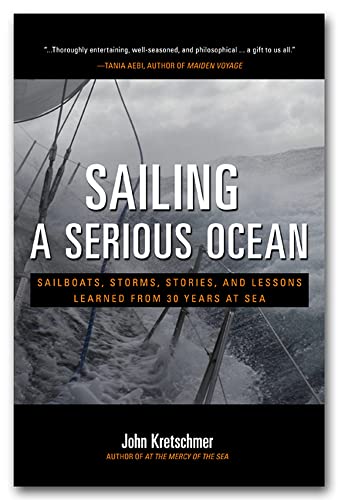
Sailing a Serious Ocean: Sailboats, Storms, Stories and Lessons Learned from 30 Years at Sea - Hardcover
Synopsis
"I know you'll want to read more after you finish Sailing a Serious Ocean. And be warned, you'll very likely want to sail with John, perhaps across an ocean." -- DALLAS MURPHY, AUTHOR OF ROUNDING THE HORN
After sailing 300,000 miles and weathering dozens of storms in all the world's oceans, John Kretschmer has plenty of stories and advice to share. John's offshore training passages sell out a year in advance and his entertaining presentations are popular at boat shows and yacht clubs all over the English speaking world. John's talent for storytelling enchants his audience as it soaks up the lessons he learned during his oftenchallengingvoyages. Now you can take a seat next to John--at a lesser cost--and get the knowledge you need to fulfill your own dream of blue-water adventure.
In Sailing a Serious Ocean, John tells you what to expect when sailing the oceans and shows how to sail safely across them. His tales of storm encounters and other examples of extreme seamanship will help you prepare for your journey and give you confidence to handle any situation―even heavy weather. Through his personal stories, John will guide you through the whole process of choosing the right boat, outfitting with the right gear,planning your route, navigating the ocean, and understanding the nuances of life at sea.
Our oceans are beautiful yet unpredictable―water that is at one moment a natural mirror for the glowing sun can turn into a foamy, raging wall of fury. John knows our oceans, and he is one of the best teachers of taming and enjoying them. Before you set off across the big blue, turn to John for his inspirational stories and hard-learned advice and discover the serious sailor in you.
"synopsis" may belong to another edition of this title.
About the Author
John Kretschmer, a professional sailor and writer, has logged more than 300,000 offshore sailing miles, including 20 transatlantic and two transpacific passages. He is the author of At the Mercy of the Sea, Flirting with Mermaids, and Cape Horn to Starboard, all seagoing classics. He is longtime contributing editor to Sailing magazine, was a sailing/travel columnist for the Miami Herald for 10 years, and writes regularly for Southern Boating and Cruising World. He has weathered several storms at sea, and teaches aspiring bluewater voyagers in seminars, lectures, and training voyages. John lives in Florida.
Excerpt. © Reprinted by permission. All rights reserved.
SAILING A SERIOUS OCEAN
SAILBOATS, STORMS, STORIES AND LESSONS LEARNED FROM 30 YEARS AT SEA
By JOHN KRETSCHMERMcGraw-Hill Education
Copyright © 2014 John Kretschmer
All rights reserved.
ISBN: 978-0-07-170440-3All rights reserved.
Contents
| Foreword by Dallas Murphy, author, Rounding the Horn | |
| Foreword by Tania Aebi, author, Maiden Voyage | |
| one Ferryman | |
| two A Rogue-ish Wave | |
| three Quetzal and Other Sailboat Obsessions | |
| four Launchings | |
| five Departures—Bermuda Bound | |
| six Atlantic Crossings—The Atlantic Circle | |
| seven Storm Strategies | |
| eight Storm Stories | |
| nine Odyssey Redux | |
| ten Survival of the Luckiest | |
| eleven Atlantic Crossings—Part Two, Back Where We Belong | |
| Acknowledgments | |
| Index |
CHAPTER 1
Changes of the Watch | Midnight Watch | True vs. Apparent Wind | What It Takesto Go to Sea | Shipmates | How This Book Works
Ferryman
"The stories of sea voyages, from The Odyssey through Hakluyt, and into today,retain immediacy and freshness because they took place on the never-changingsea, and each one goes to the secret core of a man's joy. It is a pleasure foundnot only in the tale of adventures but in the certitude that here on the sea, aman can reaffirm his human animal self, by the power of his arms, his will andhis skill in a direct encounter with a huge and impersonal element and to do soin close company with chosen companions."
—William Snaith, On the Wind's Way
The cabin looked like a crime scene. Bodies, books, clothes, tools, and assortedfruits and vegetables were scattered haphazardly, rearranging themselves withevery wave. So much for that quaint idea that on a boat there's a place foreverything and everything is in its place.
We were heading south, and the off-watch crew occupied every berth north of thebow and most of the cabin sole. They were desperately trying to catch a bit ofsleep before their next call to duty. The red night-light in the galleyflickered as undermanned electrons faltered against a flood of salt waterpouring in through the leaky vent overhead. The light finally capitulated, butthe eerie darkness did little to disguise where we were. Nothing can muffle thecacophony of a sailboat interior when the sea is raging. Conrad described a galeas "that thing of mighty sound," and as always, he was right on the mark.
It was November: Newport to Bermuda. It was bitterly cold, and winter seemed alot closer than summer. In what was to become an annual rite, I had dubbed thetrip the "Heavy-Weather Offshore Passage," and no one could accuse me of hype.Cresting walls of water arrived on deck with a complete lack of subtlety,shaking Quetzal to its core and making the entire boat shudder. Unused halyardsclattered against the mast, reaching a crescendo in the strongest gusts. Anoverloaded sheet block groaned hoarsely trying to control the tiny staysail.Locker doors flew open and then slammed shut as the boat rolled from gunwale togunwale. Nobody was getting much sleep, except for me. I can always sleep, whichaccording to my grandmother means I have a clean conscience. Unlike Conrad, mygrandmother was not always right, although both shared a deep mistrust—evenhatred—of the sea. Conrad because of its "unfathomable cruelty." My grandmotherbecause it had tried to take her son from her during World War II.
My alarm sounded and put an abrupt end to a lovely dream. I rarely remember mydreams ashore but almost always do at sea. Something about sleeping in a washingmachine allows better access to the subconscious. It was my watch. I wriggledmost of the way out of my sleeping bag and the coffin-like pilot berth where I'dspent the last three hours. Then I decided to let gravity lend a hand. I shouldhave known better. Newton was no sailor; gravity has its own laws at sea.Everything that can fall, will fall, and will continue to fall no matter howmany times you stow the damn thing before you make landfall. I tried toanticipate the next lurch to port, but just as I made my move, an errant wavespanked the hull and we careened hard to starboard instead.
For a long second I was airborne with my sleeping bag draped around my knees, myarms flailing. Clutching the mast, I managed to land on my feet and somehow missChuck, who was sprawled across the sole with a wet sleeping bag pulled over hishead. It was a remarkable landing, and I took that as a good sign. Afterthousands of midnight watches in the North Atlantic, you'd think this routine ofgetting up at all hours would grow old, that the magic would be snuffed out fromsheer exhaustion if nothing else, that omens would turn to curses. But I am hereto report that the magic of a night at sea is remarkably durable. I don't denythat given the slightest opportunity the ocean will rise up and test yourresolve, challenging and occasionally shattering your nicely scripted notion ofjust who you think you are. But no other realm on our planet carves its initialsas permanently into our brain's hard drive as the deep ocean, and I rememberthis night nine years ago, the first of many "heavy-weather" passages aboardQuetzal, like some might recall their wedding night.
As I struggled out of the sleeping bag and directly into my clammy foul-weathergear, I bounced off Mark. He was stuffed into the settee berth, suspended abovethe soggy sole by an overburdened lee cloth. He pretended not to notice myaccidental hip check. He was someplace else, somewhere far away where the worldwas flat, stationary, quiet. I think he was holed up on a farm in Kansas, nearthe geographic center point of the country and as far from the sea as he couldget. I would never have predicted that a few years later he'd cross the Atlanticwith me as a stalwart member of the crew.
After finding a handhold, I slid butt by butt into the galley. I grabbed anorange, a pocket full of saltine crackers, a bottle of water, and my portableshortwave radio before stumbling headfirst into the cockpit. This process tooktwo, maybe three minutes. I rarely tarry when it's my watch.
A blast of cold air shook the lingering image of my girlfriend from my brain.Unfortunately we were still charging before a gale in the North Atlantic and notghosting along the Amalfi Coast, the setting of my rudely interrupted dream.Tadji, the aforementioned girlfriend, was nowhere in sight. Mike and Dirk were,and I greeted them with a smile. Their faces would never be described in alogbook entry, but they told a better story than the dreary weather andnavigation details we typically scribbled down after each watch.
Mike had soft, bulging brown eyes turned down at the ends, curly black hairrefusing to stay sheltered beneath his hood, a defiant moustache. He was coldbut coping, happy to be out here, happy to be one of us (and would go on tobecome a frequent member of Quetzal's crew). Dirk, with bright, serious eyes,was competent but queasy, relieved to see me. My arrival meant that warmth andrespite from the wind and seas were just down the companionway.
In sturdy, Dutch-accented English, Dirk delivered the watch report. "Winds stillfrom the north-northeast, gusting to 40 knots, steady at 30 to 35, course around170 degrees. Speed 7 knots steady. Running down the waves, well that's anotherstory, sometimes 10 knots, sometimes 12 knots, sometimes more ..." His voicetrailed off.
Twelve knots. That explained the hooting and hollering I'd heard below. Althoughthat speed translates into less than 15 miles per hour on land—dead crawlingthrough a school zone in your car—at sea in a 47-foot sailboat, 12 knots putsyou in a churn of adrenaline; it's right on the edge of control.
"Thirty-five knots is the definition of a gale, isn't it?" Dirk, the analyticalone, asked. "Especially 35 knots apparent."
Only sailors would complicate something as simple as wind. We have two winds,true and apparent. Apparent wind factors in boat speed; it's the wind you feelon deck. True wind assumes you're not moving, which of course is rarely thecase. Like a lot of so-called truisms, true wind is not a very usefulmeasurement on a boat. Ours is very much an apparent world at sea.
"Dirk, I think gales are personal. You know one when you're in one, and each isdifferent. It really doesn't matter if the wind is true or apparent; it's justblowing hard and you deal with it. But you're right, officially 35 knotssustained wind is a gale; at least that's what Admiral Beaufort tells us."
"Thought so," Dirk replied, satisfied that he had stood watch in a gale, anotheritem to check off his bucket list. He was getting ready to cross an ocean on hisown one day, and wanted to taste a gale while I was around to reassure him thateverything was okay. As I write these words nine years later, Dirk recently emailedthat he and his wife, Susan, had just made landfall in Scotland,completing a very nice North Atlantic crossing from Newfoundland aboard TideHead, their Outbound 46 sloop.
As I came out on deck, I thanked Mike and Dirk and assured them that they weredoing a fine job on their first offshore passage, and then I sent them below.Mike paused in the galley, snagged a cookie, and then poked his head back outthe companionway hatch. "Need any help, Cap?" he asked dutifully, knowing andhoping that I didn't. By a quirk of crew size, I was afforded the luxury of asolo watch, and I cherished a little time to myself.
"No, I'm okay, Mike. I'll shout if I need you guys. Thanks."
"Sure? Do you want something to eat or drink? Dirk says he'll make tea."
"No, I'm fine, really. Just get some sleep, both of you. Thanks. And goodwatch."
The Atlantic had been corralled into a cave. Visibility was left to theimagination. Occasional foam streaks from cascading waves were the onlyhorizontal references confirming the sanguine notion that our tiny section ofthe planet was, at least for practical purposes, flat and that we were still ontop of it. We were in the Gulf Stream, and Quetzal was slaloming down wavesspawned by the collision of wind and current. We were being hurled forward bythe tiny staysail, a mere 300 square feet of canvas propelling a 30,000-poundboat with all the horsepower she needed. The mainsail was lashed to the boom,and the genoa was securely furled around the headstay. Quetzal was dressed downfor heavy weather and felt right. The Swedes say, "There is no bad weather, justbad clothing," and the same might be said about boats. This was, if there issuch a thing, a perfect gale. There was enough wind to nurture deep respect forthe sea's power, but the large seas were still manageable, and I knewinstinctively that the gale was not going to intensify.
The ride was thrilling, especially when we caught a breaking wave off the sternquarter. At that moment Quetzal would lift slowly, like a whale ruffling thesurface just before breeching, and then surge forward surfing and squirming butstill tracking true, leaving a trail of bioluminescence. When the wave finallyovertook her, stranding her in the suddenly windless trough, she'd wallow for asplit second and then dig her shoulders into the sea like a running backexpecting contact after a nice gain. Soon the wind would return and the staysailwould fill away. The mad rush of water over the rudder would restore steeringcontrol. Then she'd begin climbing another mountain of white ocean, and theroller coaster ride would start all over again.
I may have been captain of this enterprise, but I never doubted who was incharge. Neptune and I had worked out an arrangement years before. He laid out myjob description in clear terms: Keep an eye on things and don't get too full ofyourself. And I was on the job, doing what I do, what I've always done, itseems—sailing in deep water and keeping an eye on things.
But this passage was not about me. It was about my crew. They were an odd mix:an ice cream salesman, an engineer, a nurse, a small-business owner, and apeanut broker. Not an experienced sailor among them, but they all shared apassion to taste the ocean from the spray zone, just a few feet above thesurface of the sea, the place where man and ocean get to know each other on verypersonal terms.
The folks who sail with me shake the world when they're ashore. But on that uglynight at sea, they felt refreshingly small. They knew intuitively that the oceanwas no place for boasting. In a gale, it's a dark alley in a bad neighborhood;you have to look ahead and behind and be ready to react. They had come from allover the country and had never met one another before the passage. They hadsought me out and paid a nice sum. Then they found their way to Quetzal andchecked into my cramped and uncomfortable floating world.
Some had been dreaming about going to sea for years. For others it was anewfound passion. Chuck and Mark had read Patrick O'Brian, all twenty volumes,while Dirk pored over how-to books by Don Casey, Lin and Larry Pardey, and NigelCalder. Mike was enchanted by the beautiful narratives of Bernard Moitessier.They were romantics, if you can call someone searching for something as simpleas an uncluttered horizon a romantic. They wanted some sea stories of their own,to test themselves in a gale, for someone to assure them that it wasn't too lateto launch a dream. They were searching for the sea, and, in the brutal honestythat flows through its currents, hoping to catch a reflection of themselves thatthey could live with. Conrad titled his sailing ship memoir The Mirror of theSea, a perfect metaphor for the searching that takes place out there. Camuswrote, "After a certain age every man is responsible for his face." To thrive atsea, you must be responsible for who you are, not who you want to be.
Cautiously I poked my head above the spray dodger. We had the ocean toourselves, at least the few hundred yards of it that I surveyed beforeretreating reflexively when a wave suddenly broke abeam. I was too late, and thewave soaked me. "Damn," I mumbled and then laughed. Where were we? It didn'tmatter. We were everywhere and nowhere, our position defined by dimly backlitdigits on the GPS, a set of coordinates that meant nothing at that moment. Ourworld was 47 feet long and 13 ½ feet wide, period. In deep water, in a gale, withno land to worry about, the sea has but one position, one address. You're outthere and you've always been out there. Yesterday and tomorrow merge in aconspiracy of wind and waves. You can't reach one and you can't remember theother.
And yes, the boat matters, it really matters. It's not just a slurry of fibers,toxic resins, stainless steel, and teak suspending you above the bottom of thesea; it's a vessel of hope. It's the Holy Grail. You talk to your boat, youreassure her, and she reassures you. You give her a slap on the side. You andthe boat are in the thick of it together and you form a bond that strikes landpeople as weird, maybe even a little creepy, but what do they know anyway?
Before we had shoved off from posh Newport, we had made pacts with our privategods, utterly accepting of whatever came our way. That was the point of thepassage, after all, to contend, to discover, to accept, and to endure. I wrotein my book Flirting with Mermaids, "I make landfalls for a living." That's agood line, and not a bad way to navigate through life. However, as I get older Ihave realized that making landfalls, even dicey ones, is the easy part ofsailing. The tough part is making departures, shedding the shackles of society'sexpectations, kicking the addiction of electronic connections, subverting theguilt of our own obligations, and pushing off the dock physically andmetaphorically. Most of the people who sail with me know that time is no longertheir friend; their biological clocks are ticking. They savor the moments, eventhe unpleasant ones, with an understanding that they've reached a point in theirlives where time is what matters most. They sense that our journey is circular,and with an almost childlike innocence they long to get back to a familiarplace. T. S. Eliot describes the quest, "We shall not cease from exploration,and the end of all our exploring will be to arrive where we started and know theplace for the first time."
Tucked back behind the dodger, I felt something heavy in my jacket pocket—myshortwave receiver. I was going to listen to the National Weather Serviceforecast when my watch started. Imagine that: nine years ago we still listenedto weather reports on the radio. At the time, Internet weather, and the constantpursuit thereof, had not yet taken full possession of a sailor's life. I loveweather, the good, the bad—even the truly ugly. You must love weather to be asailor; it is a core part of the package. I am not a slave to forecasts,however, and I don't worship at the altar of satellite GRIB files. I don'tdispute that GRIB (which stands for gridded information in binary form) modelsare very accurate, but the pursuit of weather information can border onobsession. The more you sail, the more you accept that fact that weather is alsoinfluenced by local phenomena, and forecasts can still be inaccurate. Your ownobservations are often just as important and usually more useful than theprofessional mumbo jumbo. Still, sailors go to great lengths to obtain weatherinformation via radio and satellite and then doggedly believe it, even when theevidence blowing directly in their faces suggests otherwise (see WeatherInformation Sources on page 14). I have seen sailors desperately trying todownload forecasts from their perch at the navigation station below, completelyignoring towering cumulus clouds shrinking the dark horizon abovedeck. Weatherforecasts have become something of a self-fulfilling prophecy; you want tobelieve them, you want to trust them.
(Continues...)
Excerpted from SAILING A SERIOUS OCEAN by JOHN KRETSCHMER. Copyright © 2014 John Kretschmer. Excerpted by permission of McGraw-Hill Education.
All rights reserved. No part of this excerpt may be reproduced or reprinted without permission in writing from the publisher.
Excerpts are provided by Dial-A-Book Inc. solely for the personal use of visitors to this web site.
"About this title" may belong to another edition of this title.
Search results for Sailing a Serious Ocean: Sailboats, Storms, Stories...

Stock Image
Sailing a Serious Ocean Sailbo
Published by
International Marine/Ragged Mountain Press, 2013
ISBN 10: 007170440X
ISBN 13: 9780071704403
Used
Hardcover
Seller: World of Books (was SecondSale), Montgomery, IL, U.S.A.
Seller rating 5 out of 5 stars

Condition: Very Good. Item in very good condition! Textbooks may not include supplemental items i.e. CDs, access codes etc. Seller Inventory # 00103372518
Stock Image
Sailing a Serious Ocean Sailbo
Published by
International Marine/Ragged Mountain Press, 2013
ISBN 10: 007170440X
ISBN 13: 9780071704403
Used
Hardcover
Seller: World of Books (was SecondSale), Montgomery, IL, U.S.A.
Seller rating 5 out of 5 stars
Condition: Good. Item in good condition. Textbooks may not include supplemental items i.e. CDs, access codes etc. Seller Inventory # 00102893916
Seller Image
Sailing a Serious Ocean: Sailboats, Storms, Stories and Lessons Learned from 30 Years at Sea
Published by
International Marine/Ragged Mountain Press, 2013
ISBN 10: 007170440X
ISBN 13: 9780071704403
Used
Hardcover
Seller: Zoom Books Company, Lynden, WA, U.S.A.
Seller rating 5 out of 5 stars
Condition: very_good. Book is in very good condition and may include minimal underlining highlighting. The book can also include "From the library of" labels. May not contain miscellaneous items toys, dvds, etc. . We offer 100% money back guarantee and 24 7 customer service. Seller Inventory # ZBV.007170440X.VG
Seller Image
Sailing a Serious Ocean: Sailboats, Storms, Stories and Lessons Learned from 30 Years at Sea
Published by
International Marine/Ragged Mountain Press, 2013
ISBN 10: 007170440X
ISBN 13: 9780071704403
Used
Hardcover
Seller: Greenworld Books, Arlington, TX, U.S.A.
Seller rating 5 out of 5 stars
Condition: very_good. Fast Free Shipping â" Very Good condition book with a firm cover and clean pages. Shows normal use and some light wear or limited notes markings. A solid, nice copy to enjoy. Seller Inventory # GWV.007170440X.VG
Stock Image
Sailing a Serious Ocean: Sailboats, Storms, Stories and Lessons Learned from 30 Years at Sea
Published by
International Marine/Ragged Moun, 2013
ISBN 10: 007170440X
ISBN 13: 9780071704403
Used
Hardcover
Seller: HPB-Emerald, Dallas, TX, U.S.A.
Seller rating 5 out of 5 stars
Hardcover. Condition: Very Good. Connecting readers with great books since 1972! Used books may not include companion materials, and may have some shelf wear or limited writing. We ship orders daily and Customer Service is our top priority! Seller Inventory # S_467155088
Stock Image
Sailing a Serious Ocean: Sailboats, Storms, Stories and Lessons Learned from 30 Years at Sea
Published by
International Marine/Ragged Mountain Press, 2013
ISBN 10: 007170440X
ISBN 13: 9780071704403
Used
Hardcover
Seller: Great Matter Books, Grand Rapids, MI, U.S.A.
Seller rating 5 out of 5 stars
Hardcover. Condition: Good. No Jacket. Good condition hardcover book, no dust jacket. Shelf wear to covers and spine. Bumping to corners and spine ends. Pages toned and smudged. All books are individually inspected and described. Never X-Library unless specifically described as such. Seller Inventory # 2512-2707
Seller Image
Sailing a Serious Ocean : Sailboats, Storms, Stories and Lessons Learned from 30 Years at Sea
Published by
International Marine/Ragged Mountain Press, 2013
ISBN 10: 007170440X
ISBN 13: 9780071704403
Used
Hardcover
Seller: GreatBookPrices, Columbia, MD, U.S.A.
Seller rating 5 out of 5 stars
Condition: As New. Unread book in perfect condition. Seller Inventory # 12381811
Stock Image
Sailing a Serious Ocean : Sailboats, Storms, Stories and Lessons Learned from 30 Years at Sea
Published by
International Marine/Ragged Mountain Press, 2013
ISBN 10: 007170440X
ISBN 13: 9780071704403
New
Hardcover
Seller: GreatBookPrices, Columbia, MD, U.S.A.
Seller rating 5 out of 5 stars
Condition: New. Seller Inventory # 12381811-n
Stock Image
Sailing a Serious Ocean Format: Hardcover
Seller: INDOO, Avenel, NJ, U.S.A.
Seller rating 5 out of 5 stars
Condition: New. Brand New. Seller Inventory # 9780071704403
Stock Image
Sailing a Serious Ocean: Sailboats, Storms, Stories and Lessons Learned from 30 Years at Sea
Published by
International Marine/Ragged Mountain Press, 2013
ISBN 10: 007170440X
ISBN 13: 9780071704403
New
Hardcover
Seller: Lakeside Books, Benton Harbor, MI, U.S.A.
Seller rating 5 out of 5 stars
Condition: New. Brand New! Not Overstocks or Low Quality Book Club Editions! Direct From the Publisher! We're not a giant, faceless warehouse organization! We're a small town bookstore that loves books and loves it's customers! Buy from Lakeside Books! Seller Inventory # OTF-S-9780071704403