
Items related to The Book of Disquiet (Penguin Classics)
Synopsis
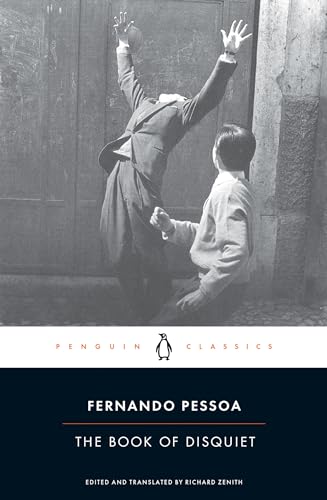
The prizewinning, complete and unabridged translation—“the best English-language version we are likely to see for a long time, if ever” (The Guardian)—of a work of unclassifiable genius: the crowning achievement of Portugal’s modern master
Edited, Translated, and with an Introduction by Richard Zenith, the author of the Pulitzer Prize finalist Pessoa: A Biography
Winner of the Calouste Gulbenkian Translation Prize for Portuguese Translation
A Penguin Classic
Fernando Pessoa was many writers in one. He attributed his prolific writings to a wide range of alternate selves, each of which had a distinct biography, ideology, and horoscope. When he died in 1935, Pessoa left behind a trunk filled with unfinished and unpublished writings, among which were the remarkable pages that make up his posthumous masterpiece, The Book of Disquiet, an astonishing work that, in George Steiner's words, "gives to Lisbon the haunting spell of Joyce's Dublin or Kafka's Prague."
Published for the first time some fifty years after his death, this unique collection of short, aphoristic paragraphs comprises the "autobiography" of Bernardo Soares, one of Pessoa's alternate selves. Part intimate diary, part prose poetry, part descriptive narrative, captivatingly translated by Richard Zenith, The Book of Disquiet is one of the greatest works of the twentieth century.
“Pessoa is a genius.” —André Aciman
"synopsis" may belong to another edition of this title.
About the Author
Fernando Pessoa (1888–1935) was born in Lisbon and brought up in Durban, South Africa. He returned to Lisbon in 1905. A prolific writer, ascribing his work to a variety of personas or heteronyms, Pessoa published little in his lifetime and supported himself by working as a commercial translator. Although acknowledged as an intellectual and a poet, his literary genius went largely unrecognized until after his death.
Richard Zenith (editor, translator, introducer) lives in Lisbon, where he works as a freelance writer, translator, and critic. He was a finalist for the Pulitzer Prize for Pessoa: A Biography. His translations include Galician-Portuguese troubadour poetry; novels by Antonio Lobo Antunes; Pessoa's A Little Larger Than the Entire Universe: Selected Poems; Fernando Pessoa and Co.: Selected Poems, which won the PEN Award for Poetry in Translation; and João Cabral de Melo Neto's Education by Stone: Selected Poems, which won the Academy of American Poets’ Harold Morton Landon Translation Award. In 2012, Zenith was awarded Portugal’s Pessoa Prize.
Reviews
When Pessoa died in 1935, a few years short of 50, he left behind a trunk of mostly unpublished writing in a variety of languages; his Lisbon publishers and variously translators are still sifting them. This perpetually unclassifiable and unfinished book of self-reflective fragments was first published in Portuguese in 1982, and it is arguably Pessoa's masterpiece. Four previous English translations, all published in 1991, were compromised either by abridgement, poor translation or error-laden source texts. While he's now a Pessoa veteran-having edited and translated Fernando Pessoa & Co.: Selected Poems, the 1999 PEN Award for Poetry in Translation winner-Zenith's first pass at this book was one of the four misses. He bases this new translation on his own Portuguese edition of 1998, and has done an admirable job in bringing out the force and clarity in Pessoa's serpentine and sometimes opaque meditations. Pessoa often wrote as various personae (as Pessoa & Co. carefully demonstrated); Disquiet is no exception, being putatively the work of "Bernardo Soares, assistant bookkeeper in the city of Lisbon." Thus it is impossible to ascribe the book's anti-humanist logophilia directly to the author: "I weep over nothing that life brings or takes away, but there are pages of prose that have made me cry." That is just one of many permutations of similar sentiments, but the genius of Pessoa and his personae is that readers are left weighing each and every such sentence for sincerity and truth value.
Copyright 2002 Reed Business Information, Inc.
"About this title" may belong to another edition of this title.
Search results for The Book of Disquiet (Penguin Classics)

Stock Image
Book of Disquiet
Seller: GreatBookPrices, Columbia, MD, U.S.A.
Seller rating 5 out of 5 stars

Condition: New. Seller Inventory # 959788-n
Stock Image
The Book of Disquiet (Penguin Classics)
Seller: Lakeside Books, Benton Harbor, MI, U.S.A.
Seller rating 5 out of 5 stars
Condition: New. Brand New! Not Overstocks or Low Quality Book Club Editions! Direct From the Publisher! We're not a giant, faceless warehouse organization! We're a small town bookstore that loves books and loves it's customers! Buy from Lakeside Books! Seller Inventory # OTF-S-9780141183046
Stock Image
Book of Disquiet
Seller: GreatBookPrices, Columbia, MD, U.S.A.
Seller rating 5 out of 5 stars
Condition: As New. Unread book in perfect condition. Seller Inventory # 959788
Seller Image
THE BOOK OF DISQUIET
Published by
Penguin Books, New York, 2003
ISBN 10: 0141183047
ISBN 13: 9780141183046
Used
Softcover
Seller: Alta-Glamour Inc., Seattle, WA, U.S.A.
Seller rating 5 out of 5 stars
later printing. 508 pp. Intro, notes, appendices, table of heteronyms. Edited and translated by Richard Zenith. "I am, in large measure, the selfsame prose I write." Trade paperback. Light shelfwear. Very Good. Seller Inventory # 112604
Stock Image
The Book of Disquiet (Penguin Classics)
Seller: WorldofBooks, Goring-By-Sea, WS, United Kingdom
Seller rating 5 out of 5 stars
Paperback. Condition: Very Good. The book has been read, but is in excellent condition. Pages are intact and not marred by notes or highlighting. The spine remains undamaged. Seller Inventory # GOR001269998
Buy Used
US$ 13.33
US$ 7.40 shipping
Ships from United Kingdom to U.S.A.
Ships from United Kingdom to U.S.A.
Quantity: 1 available
Stock Image
The Book of Disquiet (Penguin Classics)
Seller: California Books, Miami, FL, U.S.A.
Seller rating 5 out of 5 stars
Condition: New. Seller Inventory # I-9780141183046
Seller Image
The Book of Disquiet (Paperback)
Seller: Grand Eagle Retail, Bensenville, IL, U.S.A.
Seller rating 5 out of 5 stars
Paperback. Condition: new. Paperback. Fernando Pessoa was many writers in one. He attributed his prolific writings to a wide range of alternate selves, each of which had a distinct biography, ideology. and horoscope. When he died in 935, Pessoa left behind a trunk filled with unfinished and unpublished writings, among which were the remarkable pages that make up his posthumous masterpiece, The Book of Disquiet, an astonishing work that, in George Steiner's words, "gives to Lisbon the haunting spell of Joyce's Dublin or Kafka's Prague." Published for the first time some fifty years after his death, this unique collection of short, aphoristic paragraphs comprises the "autobiography" of Bernardo Soares, one of Pessoa's alternate selves. Part intimate diary, part prose poetry, part descriptive narrative, captivatingly translated by Richard Zenith, The Book of Disquiet is one of the greatest works of the twentieth century. Published for the first time 50 years after his death, this unique collection of short, aphoristic paragraphs comprises the "autobiography" of Bernardo Soares, one of Pessoa's alternate selves. Part intimate diary, part prose poetry, part descriptive narrative, captivatingly translated by Richard Zenith. Shipping may be from multiple locations in the US or from the UK, depending on stock availability. Seller Inventory # 9780141183046
Stock Image
Book of Disquiet
Published by
Penguin Group December 2002, 2002
ISBN 10: 0141183047
ISBN 13: 9780141183046
New
Paper Back
Seller: Eagle Eye Books, Decatur, GA, U.S.A.
Seller rating 4 out of 5 stars

Paper Back. Condition: New. Seller Inventory # 847615
Seller Image
The Book of Disquiet
Seller: Rarewaves.com USA, London, LONDO, United Kingdom
Seller rating 5 out of 5 stars
Paperback. Condition: New. A modernist masterwork that has now taken on a similar iconic status to Ulysses, The Trial or In Search of Lost Time, Fernando Pessoa's The Book of Disquiet is edited and translated with an introduction by Richard Zenith in Penguin Modern Classics.'Fernando Pessoa, strictly speaking, doesn't exist,' - so claimed Alvaro de Campos, one of the 'heteronyms', fully-realised substitute personalities invented by Fernando Pessoa to spare himself the trouble of living real life. In this extraordinary book, the putative 'factless autobiography' of an accountant named Bernardo Soares, Fernando Pessoa explores and dismantles the nature of memory, identity, time and narrative, creating one of the greatest - but also the strangest - modernist texts. An assembly of sometimes-linked fragments, The Book of Disquiet is a mesmerising, haunting 'novel' without parallel in any other culture.This edition includes notes on the reconstruction of the text, appendices containing material omitted from the final version and letters which Pessoa intended to incorporate into the text. This edition also includes a table of the 'heteronyms' used by Pessoa in his writing.Fernando Pessoa (1888-1935) was born in Lisbon and brought up in Durban, South Africa. A prolific writer, ascribing his work to a variety of personas or 'heteronyms', Pessoa published little in his lifetime. Although acknowledged as an intellectual and a poet, his literary genius went largely unrecognised until after his death.If you enjoyed The Book of Disquiet, you might like Finnegan's Wake, also available in Penguin Modern Classics.'One of the twentieth century's greatest literary talents . This superb edition of The Book of Disquiet is . a masterpiece' John Lanchester, Daily Telegraph'Must rank as the supreme assault on authorship in modern European literature' John Gray, New Statesman'Portugal's greatest modern poet . deals with the only important question in the world, not less important because it is unanswerable: What am I?' Anthony Burgess, Observer. Seller Inventory # LU-9780141183046
Buy New
US$ 25.24
Free Shipping
Ships from United Kingdom to U.S.A.
Ships from United Kingdom to U.S.A.
Quantity: 1 available
Stock Image
Book of Disquiet
Seller: Eighth Day Books, LLC, Wichita, KS, U.S.A.
Seller rating 4 out of 5 stars
Paper Back. Condition: New. Seller Inventory # 1646