
Synopsis
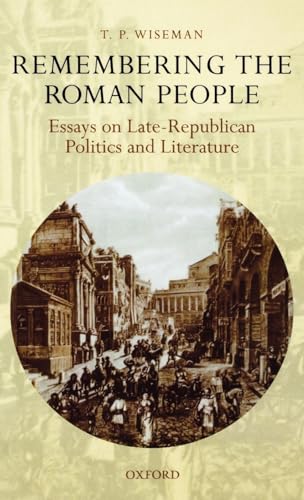
In the Roman republic, only the People could pass laws, only the People could elect politicians to office, and the very word republica meant 'the People's business'. So why is it always assumed that the republic was an oligarchy? The main reason is that most of what we know about it we know from Cicero, a great man and a great writer, but also an active right-wing politician who took it for granted that what was good for a small minority of self-styled 'best people' (optimates) was good for the republic as a whole. T. P. Wiseman interprets the last century of the republic on the assumption that the People had a coherent political ideology of its own, and that the optimates, with their belief in justified murder, were responsible for the breakdown of the republic in civil war.
"synopsis" may belong to another edition of this title.
About the Author
T. P. Wiseman is Emeritus Professor of Classics, University of Exeter.
"About this title" may belong to another edition of this title.
Other Popular Editions of the Same Title

Search results for Remembering the Roman People: Essays on Late-Republican...

Stock Image
Remembering the Roman People: Essays on Late-Republican Politics and Literature
Published by
Oxford University Press, 2009
ISBN 10: 0199239762
ISBN 13: 9780199239764
Used
Hardcover
First Edition
Seller: Antiquariaat Hovingh, Haarlem, Netherlands
Seller rating 5 out of 5 stars

Hardcover. Condition: Fine. 1st Edition. In fine condition. With dust jacket. Seller Inventory # 6213
Buy Used
US$ 70.70
US$ 28.60 shipping
Ships from Netherlands to U.S.A.
Ships from Netherlands to U.S.A.
Quantity: 1 available
Seller Image
Remembering the Roman People: Essays on Late-Republican Politics and Literature.
Published by
Oxford : Oxford University Press, 2009
ISBN 10: 0199239762
ISBN 13: 9780199239764
Used
Hardcover
Seller: Borkert, Schwarz und Zerfaß GbR, Berlin, Germany
Seller rating 5 out of 5 stars
Condition: Gut. 271 p. From the library of Prof. Wolfgang Haase, long-time editor of ANRW and the International Journal of the Classical Tradition (IJCT). - Allover very good. - Remembering the Roman People consists of ten linked studies of the political culture of the late Roman republic, all based on the premise that most recent scholarship has been over-influenced by the ideology of the self-styled optimates, as transmitted above all in the letters and speeches of Cicero, and has largely ignored the interests and ideological standpoint of the Roman People as a whole. Rejecting the assumption that the republic was always and necessarily an oligarchy, and keeping open the possibility that the People had a strong egalitarian ethos of its own, normally in conflict with that of the optimates, T. P. Wiseman investigates a series of political episodes which have not been satisfactorily explained, and brings out, as a counterweight to Cicero, the hitherto unexploited political character of his nearcontemporary Marcus Varro. Among the other themes explored are the attitudes of two lost Roman historians, Licinius Macer and Asinius Pollio; the dramatic nature of Roman satire, consistently ignored by scholars of Latin literature; the inextricable interdependence of performance space and political space in Rome; the extraordinary justification of political murder in Ciceros philosophical dialogues; and the verdicts passed on Cicero and Caesar by a great nineteenthcentury historian who was also an orator and an experienced politician. ISBN 9780199239764 Sprache: Englisch Gewicht in Gramm: 419 Original hardcover with dust jacket. Seller Inventory # 1168023
Buy Used
US$ 69.52
US$ 45.76 shipping
Ships from Germany to U.S.A.
Ships from Germany to U.S.A.
Quantity: 1 available
Seller Image
Remembering the Roman People : Essays on Late-Republican Politics and Literature
Seller: GreatBookPrices, Columbia, MD, U.S.A.
Seller rating 5 out of 5 stars
Condition: New. Seller Inventory # 6116249-n
Stock Image
Remembering the Roman People
Print on DemandSeller: PBShop.store US, Wood Dale, IL, U.S.A.
Seller rating 5 out of 5 stars
HRD. Condition: New. New Book. Shipped from UK. THIS BOOK IS PRINTED ON DEMAND. Established seller since 2000. Seller Inventory # L1-9780199239764
Seller Image
Remembering the Roman People (Hardcover)
Published by
Oxford University Press, Oxford, 2008
ISBN 10: 0199239762
ISBN 13: 9780199239764
New
Hardcover
Seller: AussieBookSeller, Truganina, VIC, Australia
Seller rating 5 out of 5 stars
Hardcover. Condition: new. Hardcover. In the Roman republic, only the People could pass laws, only the People could elect politicians to office, and the very word republica meant 'the People's business'. So why is it always assumed that the republic was an oligarchy? The main reason is that most of what we know about it we know from Cicero, a great man and a great writer, but also an active right-wing politician who took it for granted that what was good for a small minority of self-styled 'best people'(optimates) was good for the republic as a whole. T. P. Wiseman interprets the last century of the republic on the assumption that the People had a coherent political ideology of its own, and that theoptimates, with their belief in justified murder, were responsible for the breakdown of the republic in civil war. A challenging reinterpretation of the political culture of the last century of the Roman Republic. T. P. Wiseman argues that the People had their own egalitarian ethos, usually in conflict with that of the self-styled `best' (optimates), who, with their belief in justified murder, were responsible for the republic's breakdown in civil war. This item is printed on demand. Shipping may be from our Sydney, NSW warehouse or from our UK or US warehouse, depending on stock availability. Seller Inventory # 9780199239764
Buy New
US$ 145.68
US$ 37.00 shipping
Ships from Australia to U.S.A.
Ships from Australia to U.S.A.
Quantity: 1 available
Stock Image
Remembering the Roman People
Print on DemandSeller: PBShop.store UK, Fairford, GLOS, United Kingdom
Seller rating 5 out of 5 stars
HRD. Condition: New. New Book. Delivered from our UK warehouse in 4 to 14 business days. THIS BOOK IS PRINTED ON DEMAND. Established seller since 2000. Seller Inventory # L1-9780199239764
Buy New
US$ 183.88
US$ 6.70 shipping
Ships from United Kingdom to U.S.A.
Ships from United Kingdom to U.S.A.
Quantity: Over 20 available
Stock Image
Remembering the Roman People: Essays on Late-Republican Politics and Literature
Seller: Ria Christie Collections, Uxbridge, United Kingdom
Seller rating 5 out of 5 stars
Condition: New. In. Seller Inventory # ria9780199239764_new
Buy New
US$ 180.80
US$ 16.00 shipping
Ships from United Kingdom to U.S.A.
Ships from United Kingdom to U.S.A.
Quantity: Over 20 available
Stock Image
Remembering the Roman People : Essays on Late-Republican Politics and Literature
Seller: GreatBookPricesUK, Woodford Green, United Kingdom
Seller rating 5 out of 5 stars
Condition: New. Seller Inventory # 6116249-n
Buy New
US$ 180.79
US$ 20.03 shipping
Ships from United Kingdom to U.S.A.
Ships from United Kingdom to U.S.A.
Quantity: Over 20 available
Stock Image
Remembering the Roman People
Seller: Kennys Bookshop and Art Galleries Ltd., Galway, GY, Ireland
Seller rating 5 out of 5 stars
Condition: New. A challenging reinterpretation of the political culture of the last century of the Roman Republic. T. P. Wiseman argues that the People had their own egalitarian ethos, usually in conflict with that of the self-styled 'best' (optimates), who, with their belief in justified murder, were responsible for the republic's breakdown in civil war. Num Pages: 288 pages, 3 line drawings, 3 photographs. BIC Classification: 1QDAR; 2ADL; 3D; HBLA1. Category: (P) Professional & Vocational; (UP) Postgraduate, Research & Scholarly; (UU) Undergraduate. Dimension: 223 x 144 x 18. Weight in Grams: 498. . 2008. Hardback. . . . . Seller Inventory # V9780199239764
Buy New
US$ 207.14
US$ 12.01 shipping
Ships from Ireland to U.S.A.
Ships from Ireland to U.S.A.
Quantity: Over 20 available
Seller Image
Remembering the Roman People
Published by
Oxford University Press, GB, 2008
ISBN 10: 0199239762
ISBN 13: 9780199239764
New
Hardcover
Seller: Rarewaves.com USA, London, LONDO, United Kingdom
Seller rating 5 out of 5 stars
Hardback. Condition: New. In the Roman republic, only the People could pass laws, only the People could elect politicians to office, and the very word republica meant 'the People's business'. So why is it always assumed that the republic was an oligarchy? The main reason is that most of what we know about it we know from Cicero, a great man and a great writer, but also an active right-wing politician who took it for granted that what was good for a small minority of self-styled 'best people' (optimates) was good for the republic as a whole. T. P. Wiseman interprets the last century of the republic on the assumption that the People had a coherent political ideology of its own, and that the optimates, with their belief in justified murder, were responsible for the breakdown of the republic in civil war. Seller Inventory # LU-9780199239764
Buy New
US$ 221.23
Free Shipping
Ships from United Kingdom to U.S.A.
Ships from United Kingdom to U.S.A.
Quantity: Over 20 available