
Items related to Barrio Boy (University of Notre Dame Press)
Synopsis
Journey with Ernesto Galarza through time, place, and culture in this stunning memoir of Mexican American identity and acculturation.
Barrio Boy is the remarkable story of one boy's journey from a Mexican village so small its main street didn't have a name, to the barrio of Sacramento, California, bustling and thriving in the early decades of the twentieth century. With vivid imagery and a rare gift for re-creating a child's sense of time and place, Ernesto Galarza gives an account of the early experiences of his extraordinary life―from revolution in Mexico to segregation in the United States―that will continue to engage readers for generations to come.
Since it was first published in 1971, Galarza’s classic work has been assigned in high school and undergraduate classrooms across the country, profoundly affecting thousands of students who read this true story of acculturation into American life.
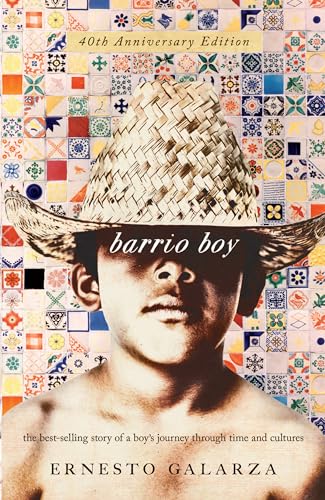
The 40th anniversary edition of this best-selling book includes a new text design and cover, as well an introduction by Ilan Stavans, the distinguished cultural critic and editor of the Norton Anthology of Latino Literature, which places Barrio Boy and Ernesto Galarza in historical context.
"synopsis" may belong to another edition of this title.
About the Authors
Born in Jalcocotán, Nayarit, Mexico, Ernesto Galarza (1905–1984) was a civil rights and labor activist, a scholar, and a pioneer during the decades when Mexican Americans had few public advocates. When he was eight, he migrated to Sacramento, California, where he worked as a farm laborer. One of Stanford's first Chicano alumni, Galarza received an M.A. in 1929, and a Ph.D. in history from Columbia University in 1944. He returned to California where, during the 1950s, he joined the effort to create the first multiracial farm worker union, which set the foundation for the emergence of the United Farm Workers Union of the 1960s. His books most notably include the 1964 Merchants of Labor, on the exploitation of Mexican contract workers, and the 1971 Barrio Boy. In 1979, Dr. Galarza was nominated for the Nobel Prize in Literature.
Ilan Stavans is an American writer and academic. He writes and speaks on American, Hispanic, and Jewish cultures. He is the author of Quixote (2015) and a contributor to the Norton Anthology of Latino Literature (2010). He was the host of the syndicated PBS show Conversations with Ilan Stavans, which ran from 2001 to 2006.
Excerpt. © Reprinted by permission. All rights reserved.
Barrio Boy began as anecdotes I told my family about Jalcocotán, the mountain village in western Mexico where I was born. Among this limited public (my wife, Mae, and daughters, Karla and Eli Lu) my thumbnail sketches became best sellers. Hearing myself tell them over and over I began to agree with my captive audience that they were not only interesting, but possibly good.
Quite by accident I told one of these vignettes at a meeting of scholars and other boring people. It was recorded on tape, printed in a magazine, and circulated among schools and libraries here and there. I received letters asking for reprints and occasionally a tempting suggestion that I write more of the same, perhaps enough to make a book.
Adding up the three listeners in my family and the three correspondents made a public of six. I didn’t need more persuasion than this to link the anecdotes into a story.
But a book is more than a family affair. To make it a public affair I needed more weighty excuses. I thought of two―one historical, the other psychological.
What brought me and my family to the United States from Mexico also brought hundreds of thousands of others like us. In many ways the experiences of a multitude of boys like myself, migrating from countless villages like Jalcocotán and starting life anew in barrios like the one in Sacramento, must have been similar. So much for the historical.
Now for the psychological. Of those boys, the ones who are still living are grey-haired, slightly cantankerous, and in all probability creaking at the joints, like myself. But the worst thing that has happened to them is that some psychologists, psychiatrists, social anthropologists and other manner of “shrinks” have spread the rumor that these Mexican immigrants and their offspring have lost their “self-image.” By this, of course, they mean that a Mexican doesn’t know what he is; and if by chance he is something, it isn’t any good.
I, for one Mexican, never had any doubts on this score. I can’t remember a time I didn’t know who I was; and I have heard much testimony from my friends and other more detached persons to the effect that I thought too highly of what I thought I was.
It seemed to me unlikely that out of six or seven million Mexicans in the United States I was the only one who felt this way. In any event, those I knew and remember and tell about had an abundance of self-image and never doubted that it was a good one.
That is all there is to the plot of Barrio Boy: our home “In the Mountain Village”; the “Peregrinations” of a family uprooted by a revolution; their escape as refugees, “North from Mexico”; their new “Life in the Lower Part of Town” in a city in California; and their joys and tribulations “On the Edge of the Barrio.”
This, then, is a true story of the acculturation of Little Ernie.
"About this title" may belong to another edition of this title.
Search results for Barrio Boy (University of Notre Dame Press)

Stock Image
Barrio Boy: 40th Anniversary Edition
Published by
University of Notre Dame Press, 2011
ISBN 10: 0268029792
ISBN 13: 9780268029791
Used
Paperback
Seller: World of Books (was SecondSale), Montgomery, IL, U.S.A.
Seller rating 5 out of 5 stars

Paperback. Condition: Good. In his gripping autobiography, Galarza tells the story of his journey from a tiny village during the Mexican revolution to the barrio's of Sacramento, offering invaluable insight to the plight of immigrants in America. Seller Inventory # 00101599300
Stock Image
Barrio Boy (University of Notre Dame Press)
Seller: NW Book Rescue, Hubbard, OR, U.S.A.
Seller rating 2 out of 5 stars

paperback. Condition: Fair. Acceptable copy. Shows signs of wear. Any images shown are stock photographs and product may differ from what is shown. Seller Inventory # TLF-20260504-0150-1.1M-A20462
Stock Image
Holt McDougal Library: Barrio Boy
Published by
University of Notre Dame Press, 2011
ISBN 10: 0268029792
ISBN 13: 9780268029791
Used
Softcover
Seller: More Than Words, Waltham, MA, U.S.A.
Seller rating 5 out of 5 stars
Condition: Good. A sound copy with only light wear. Overall a solid copy at a great price! Seller Inventory # BOS-H-01g-02330
Stock Image
Barrio Boy: 40th Anniversary Edition
Published by
University of Notre Dame Press, 2011
ISBN 10: 0268029792
ISBN 13: 9780268029791
Used
Paperback
Seller: World of Books Inc, Montgomery, IL, U.S.A.
Seller rating 4 out of 5 stars

Paperback. Condition: Good. In his gripping autobiography, Galarza tells the story of his journey from a tiny village during the Mexican revolution to the barrio's of Sacramento, offering invaluable insight to the plight of immigrants in America. Seller Inventory # CIN0268029792G
Stock Image
Barrio Boy: 40th Anniversary Edition
Published by
University of Notre Dame Press, 2011
ISBN 10: 0268029792
ISBN 13: 9780268029791
Used
Paperback
Seller: ThriftBooks-Reno, Reno, NV, U.S.A.
Seller rating 5 out of 5 stars
Paperback. Condition: Good. No Jacket. Pages can have notes/highlighting. Spine may show signs of wear. ~ ThriftBooks: Read More, Spend Less. Seller Inventory # G0268029792I3N00
Stock Image
Barrio Boy: 40th Anniversary Edition
Published by
University of Notre Dame Press, 2011
ISBN 10: 0268029792
ISBN 13: 9780268029791
Used
Paperback
Seller: ThriftBooks-Dallas, Dallas, TX, U.S.A.
Seller rating 5 out of 5 stars
Paperback. Condition: Fair. No Jacket. Former library book; Readable copy. Pages may have considerable notes/highlighting. ~ ThriftBooks: Read More, Spend Less. Seller Inventory # G0268029792I5N10
Stock Image
Barrio Boy: 40th Anniversary Edition
Published by
University of Notre Dame Press, 2011
ISBN 10: 0268029792
ISBN 13: 9780268029791
Used
Paperback
Seller: ThriftBooks-Atlanta, AUSTELL, GA, U.S.A.
Seller rating 5 out of 5 stars
Paperback. Condition: Good. No Jacket. Pages can have notes/highlighting. Spine may show signs of wear. ~ ThriftBooks: Read More, Spend Less. Seller Inventory # G0268029792I3N00
Stock Image
Barrio Boy: 40th Anniversary Edition
Published by
University of Notre Dame Press, 2011
ISBN 10: 0268029792
ISBN 13: 9780268029791
Used
Paperback
Seller: ThriftBooks-Phoenix, Phoenix, AZ, U.S.A.
Seller rating 5 out of 5 stars
Paperback. Condition: Good. No Jacket. Pages can have notes/highlighting. Spine may show signs of wear. ~ ThriftBooks: Read More, Spend Less. Seller Inventory # G0268029792I3N00
Stock Image
Barrio Boy: 40th Anniversary Edition
Published by
University of Notre Dame Press, 2011
ISBN 10: 0268029792
ISBN 13: 9780268029791
Used
Paperback
Seller: ThriftBooks-Dallas, Dallas, TX, U.S.A.
Seller rating 5 out of 5 stars
Paperback. Condition: Good. No Jacket. Pages can have notes/highlighting. Spine may show signs of wear. ~ ThriftBooks: Read More, Spend Less. Seller Inventory # G0268029792I3N00
Stock Image
Holt McDougal Library: Barrio Boy
Seller: HPB-Emerald, Dallas, TX, U.S.A.
Seller rating 5 out of 5 stars
Paperback. Condition: Very Good. Connecting readers with great books since 1972! Used books may not include companion materials, and may have some shelf wear or limited writing. We ship orders daily and Customer Service is our top priority! Seller Inventory # S_470629477