
End in Tears: A Wexford Novel (Chief Inspector Wexford Mysteries) - Hardcover
Book 20 of 24: Inspector Wexford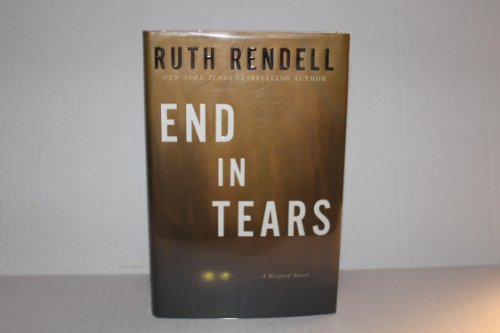
Synopsis
At first there was no reason to link the killings. The first one, months earlier, seemed totally random: a lump of concrete pushed off an overpass onto a passing car. By contrast, the gruesome bludgeoning death of Amber Marshalson, returning home late from a night out clubbing with friends, was obviously calculated. The killer had been seen waiting for the girl in a nearby wood. But when Chief Inspector Wexford discovers that Amber had been the driver right behind the crushed car—and that she’d been driving a silver Honda, while the car in front of her was a gray Honda—he knows that someone wanted the teenager dead badly enough to kill twice to get the job done. And as it turns out, this murderer’s plans are only just getting underway. Can Wexford unravel the complex knots that connect these murders in time to save future victims? Or is he, as he begins to fear, losing his touch and fast becoming a relic of another time?
Long beloved by readers for her deft weaving of wonderfully meticulous characterization, dark humor, and trenchant social commentary into gripping and fast-paced plots, Ruth Rendell is in top form with End in Tears. Taking off from the first page with back-to-back murders and ending with one of Wexford’s own officers in mortal danger, End in Tears touches on issues of class, race, parenthood, aging, and gender roles as it brings the traditional British whodunit into the twenty-first century.
Also available as a Random House AudioBook, Large Print edition, and eBook
"synopsis" may belong to another edition of this title.
About the Author
Ruth Rendell is the author of many novels, most recently the New York Times bestseller Thirteen Steps Down. She has won numerous awards, including three Edgars, the highest accolade from Mystery Writers of America, and three Gold Daggers, one Silver Dagger, and a Diamond Dagger for outstanding contribution to the genre from England’s prestigious Crime Writer’s Association. Ruth Rendell lives in London.
Reviews
Ruth Rendell's quality work is both a blessing and a curse. With over 20 Wexford novels—and an even greater number outside the series and under her pseudonym Barbara Vine—reviewers have had ample opportunity to relish her characterizations and get wise to her narrative proclivities. Here they identify a case of the strengths of Rendell's writing (characterization and the use of metaphor) playing second fiddle to the contrivances of a thriller. Plot twists abound for those into neck-snapping plots, but most critics agree that Rendell is at her best when she foregoes narrative theatrics and focuses on the metaphoric parallels between plot and theme. End in Tears is not bad, but isn't great either—and for a writer of Rendell's status, just good doesn't seem to be good enough.
Copyright © 2004 Phillips & Nelson Media, Inc.
Bestseller Rendell's riveting new novel in her Chief Inspector Wexford series (The Babes in the Wood, etc.) links two disparate worlds—a child-surrogacy ring and the construction trade. A teenage mother, Amber Marshalson, is found dead in the grass outside her home in Kingsmarkham, her skull crushed by a piece of brick. A short time later, Amber's pregnant friend, Megan Bartlow, turns up murdered in a seedy, about-to-be-rehabbed Victorian row house. Suspicions center on a tall man wearing a hooded fleece jacket. Against this sinister backdrop stands Wexford, who's in lion-in-winter mode. He's irked and perplexed by modern life, by the casual way young girls conceive babies, by the sprawl devouring the once-lush Sussex countryside, even by his own fractious family. But he never loses the anger and dedication that propel him to solve crimes and understand evil. While Rendell fans may find this not quite up to the level of her most recent non-Wexford, Thirteen Steps Down (2005), they should be well satisfied. (July)
Copyright © Reed Business Information, a division of Reed Elsevier Inc. All rights reserved.
A rich cast of characters makes up for the mechanical plot in Rendell's twentieth Chief Inspector Wexford mystery, starring the shrewd, grandfatherly detective and his handsome, considerably younger sidekick, Burden. As the novel opens, teenage mother Amber Marshalson has been found bludgeoned to death by the side of a rural English road (the killer, as it turns out, twice tried to end her life, first dropping a lump of concrete onto a silver car he had mistaken for hers). Soon after, a young, pregnant acquaintance of Amber is murdered. The suspects are numerous: a pair of peculiar twins; a heavily pierced and tattooed boyfriend; a thin, hooded figure seen lurking in the nearby woods. Meanwhile, Inspector Wexford has problems of his own; his daughter, Sylvia, has agreed to be the surrogate mother for her ex-husband's new wife. Prolific three-time Edgar winner Rendell (who also writes under the pseudonym Barbara Vine) proves a master at rendering the joys and sorrows of human relationships, from amicable marriages to the cruel practice of preying on sterile women desperate to have children. Allison Block
Copyright © American Library Association. All rights reserved
Excerpt. © Reprinted by permission. All rights reserved.
Chapter 1
When he lifted it off the seat the backpack felt heavier than when he had first put it into the car. He lowered it on to the soft ferny ground. Then he got back into the driving seat to move the car deep into a cave made by hawthorn bushes and brambles, and the hop vines which climbed over everything in this wood. It was late June and the vegetation very dense and luxuriant.
Getting out again and standing back to take a good look, he could barely see the car. Probably he only saw it because he knew it was there. No one else would notice it. He squatted down, hoisted the backpack up on to his shoulders and slowly stood up to his full height. The movement reminded him of something and it was a moment before he realised what it was: lifting up his little son to sit on his shoulders. A hundred years ago, it seemed. The backpack was lighter than the boy but felt heavier to him.
He was afraid that if he stood upright the pack would jerk him backwards and break his spine. Of course it wouldn’t. It just felt that way. All the same, he wouldn’t stand upright, wouldn’t even try it. Instead, he stooped, bending almost double. It wasn’t far. He could walk like this the two hundred yards to the bridge. Anyone seeing him from a distance in this half-light would have thought him a humpbacked man.
There was no one to see. The twisty country lane wound round Yorstone Wood and over the bridge. He could have brought the car right up to the bridge but that way it would have been seen, so he had driven off the lane along a ride and then through a clearing to find the hop-grown cave. In the distance he thought he heard a car, then something heavier with a diesel engine. They would be on the road below, Brimhurst Lane that ran from Myfleet to Brimhurst Prideaux, passing under Yorstone Bridge ahead of him. It wasn’t far now but it seemed like miles. If his legs gave way he wouldn’t be able to get up again. Would it be easier to drag the backpack? What, then, if he met someone? Dragging something looks much more suspicious than carrying it. He pressed his shoulders back a little and, surprisingly, that was better. There was no one to meet. He could see the lane through the trees and the little stone bridge no one had reinforced with steel or replaced with a brightly painted wooden structure.
Its parapets were low, too low for safety, according to the local paper. The paper was always on about this bridge, and the dangers of the lane and the low parapets. He walked out on to the bridge, squatted down and let the backpack slip off his shoulders to the ground. He undid the flaps and then the zip. Inside, now revealed, was a lump of concrete, very roughly spherical, a bit bigger than a soccer ball. A pair of gloves was also inside the pack. To be on the safe side, he put them on. Though it would never come to anyone examining his hands, it would be stupid to scrape or bruise them.
What light remained was fading fast and with the coming of the dark it grew cooler. His watch told him that it was nine fifteen. Not long now. He lifted up the lump of concrete in his gloved hands, thought of balancing it on the parapet in readiness, then thought again. It wasn’t beyond the bounds of possibility that someone would come along the path he had used and cross the bridge. Wait for the call, he thought. It won’t be long now.
No traffic had passed along the road below since he had come on to the bridge but a car came now, going towards Brimhurst Prideaux, most probably all the way to Kingsmarkham. He closed his hand over the mobile in his pocket, worried because it hadn’t rung. Then it rang.
‘Yes?’
‘She’s left. You want the number again?’
‘I’ve got it. A silver Honda.’
‘Right.’
‘A silver Honda. Should be along in four minutes.’
He heard the line close. It was dark now. A car passed under the bridge, heading towards Brimhurst St Mary and Myfleet. The road dipped where the bridge passed over it and then twisted to the left, almost a right-angled bend. There were tall trees on the corner with thick ancient trunks and a black and white arrow sign opposite, pointing traffic to the left. A minute had passed.
He moved across to the other side of the bridge, dragging the backpack behind him, and there he bent down, heaved up the lump of concrete, his arms straining, and set it on the parapet. Just as well it wasn’t far to lift it. Another minute gone. A white van with headlights on at full beam came from the Myfleet direction, a car following it, to pass, just behind him, a motorbike coming from Kingsmarkham. He was momentarily blinded by the headlights, held in them, which made him curse. No one should see him. The silver Honda with the number he had memorised would be along soon, very soon. The third minute passed. A fourth.
He hated anticlimaxes. The silver Honda could have taken another route. It was all very well to say it never did but you could never say that, not when it came to the way people behaved. He was facing the way it would come, towards Myfleet. It would pass under the bridge but before it reached the left-hand bend . . . He could see lights in the distance. The lights appeared and disappeared as a hedge or a tree trunk cut them from his view, and appeared again. Two sets of lights, not one car but two, both of them silver, quite close together. One was the Honda but he couldn’t tell which, not from here, not in the dark, but he could read the number or the last three digits.
As soon as he had given a great push to the lump on the parapet and felt it drop, he knew he had aimed at the wrong car. The crash was huge, like a bomb. The first car, the one he had hit, ploughed into a tree trunk, its bonnet burst open, its windscreen gone, half its roof caved in. It seemed to have split and exploded. The car behind, undamaged until this point, crashed into its rear and its boot lid sprang open. That was the silver Honda which had been his quarry. As its driver got out of it, screaming, her hands up in the air, he knew he had failed.
He waited no longer but picked up the backpack and moved, looking back once to see the leading car burst into flames. In the brilliant light which illuminated everything he saw for the first time the woman he had tried to kill.
"About this title" may belong to another edition of this title.
Other Popular Editions of the Same Title

Search results for End in Tears: A Wexford Novel (Chief Inspector Wexford...

Stock Image
End in Tears: A Wexford Novel (Chief Inspector Wexford Mysteries)
Seller: World of Books (was SecondSale), Montgomery, IL, U.S.A.
Seller rating 5 out of 5 stars

Condition: Good. Item in good condition. Textbooks may not include supplemental items i.e. CDs, access codes etc. Seller Inventory # 00070668747
Stock Image
End in Tears: A Wexford Novel (Chief Inspector Wexford Mysteries)
Seller: World of Books (was SecondSale), Montgomery, IL, U.S.A.
Seller rating 5 out of 5 stars
Condition: Acceptable. Item in acceptable condition! Textbooks may not include supplemental items i.e. CDs, access codes etc. Seller Inventory # 00097224891
Stock Image
End in Tears: A Wexford Novel (Chief Inspector Wexford Mysteries)
Published by
Crown (edition First Edition), 2006
ISBN 10: 0307339769
ISBN 13: 9780307339768
Used
Hardcover
First Edition
Seller: BooksRun, Philadelphia, PA, U.S.A.
Seller rating 5 out of 5 stars
Hardcover. Condition: Very Good. First Edition. With dust jacket. It's a well-cared-for item that has seen limited use. The item may show minor signs of wear. All the text is legible, with all pages included. It may have slight markings and/or highlighting. Seller Inventory # 0307339769-11-1-29
Stock Image
End in Tears: A Wexford Novel (Chief Inspector Wexford Mysteries)
Seller: ThriftBooks-Dallas, Dallas, TX, U.S.A.
Seller rating 5 out of 5 stars
Hardcover. Condition: As New. No Jacket. Pages are clean and are not marred by notes or folds of any kind. ~ ThriftBooks: Read More, Spend Less. Seller Inventory # G0307339769I2N00
Stock Image
End in Tears: A Wexford Novel (Chief Inspector Wexford Mysteries)
Seller: ThriftBooks-Atlanta, AUSTELL, GA, U.S.A.
Seller rating 5 out of 5 stars
Hardcover. Condition: As New. No Jacket. Pages are clean and are not marred by notes or folds of any kind. ~ ThriftBooks: Read More, Spend Less. Seller Inventory # G0307339769I2N00
Stock Image
End in Tears: A Wexford Novel (Chief Inspector Wexford Mysteries)
Seller: Redux Books, Grand Rapids, MI, U.S.A.
Seller rating 5 out of 5 stars
Hardcover. Condition: Very Good. Hardcover with dust jacket. Pages are clean and unmarked. Covers show very minor shelving wear. Binding is tight, hinges strong. Dust jacket shows light edge wear.; 100% Satisfaction Guaranteed! Ships same or next business day! Seller Inventory # 132511280002
Stock Image
End in Tears
Published by
Crown Publishing Group, The, 2006
ISBN 10: 0307339769
ISBN 13: 9780307339768
Used
Hardcover
Seller: Better World Books, Mishawaka, IN, U.S.A.
Seller rating 5 out of 5 stars
Condition: Good. Pages intact with minimal writing/highlighting. The binding may be loose and creased. Dust jackets/supplements are not included. Stock photo provided. Product includes identifying sticker. Better World Books: Buy Books. Do Good. Seller Inventory # GRP73090720
Stock Image
End in Tears
Published by
Crown Publishing Group, The, 2006
ISBN 10: 0307339769
ISBN 13: 9780307339768
Used
Hardcover
Seller: Better World Books, Mishawaka, IN, U.S.A.
Seller rating 5 out of 5 stars
Condition: Good. Former library copy. Pages intact with minimal writing/highlighting. The binding may be loose and creased. Dust jackets/supplements are not included. Includes library markings. Stock photo provided. Product includes identifying sticker. Better World Books: Buy Books. Do Good. Seller Inventory # GRP102443443
Stock Image
End in Tears: A Wexford Novel (Chief Inspector Wexford Mysteries)
Seller: Wonder Book, Frederick, MD, U.S.A.
Seller rating 5 out of 5 stars
Condition: Very Good. Very Good condition. Good dust jacket. A copy that may have a few cosmetic defects. May also contain light spine creasing or a few markings such as an owner's name, short gifter's inscription or light stamp. Seller Inventory # I13A-02987
Stock Image
End in Tears: A Wexford Novel (Chief Inspector Wexford Mysteries)
Seller: Wonder Book, Frederick, MD, U.S.A.
Seller rating 5 out of 5 stars
Condition: Good. Good condition. Good dust jacket. A copy that has been read but remains intact. May contain markings such as bookplates, stamps, limited notes and highlighting, or a few light stains. Bundled media such as CDs, DVDs, floppy disks or access codes may not be included. Seller Inventory # P16P-00969