
Items related to 36 Arguments for the Existence of God: A Work of Fiction
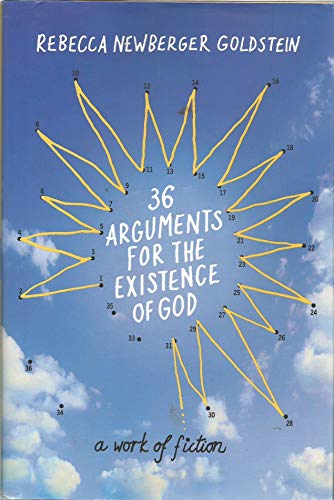
Synopsis
After Cass Seltzer’s book becomes a surprise best seller, he’s dubbed “the atheist with a soul” and becomes a celebrity. He wins over the stunning Lucinda Mandelbaum, “the goddess of game theory,” and loses himself in a spiritually expansive infatuation. A former girlfriend appears: an anthropologist who invites him to join in her quest for immortality through biochemistry. And he is haunted by reminders of the two people who ignited his passion to understand religion: his mentor and professor—a renowned literary scholar with a suspicious obsession with messianism—and an angelic six-year-old mathematical genius who is heir to the leadership of a Hasidic sect. Each encounter reinforces Cass’s theory that the religious impulse spills over into life at large.
36 Arguments for the Existence of God plunges into the great debate of our day: the clash between faith and reason. World events are being shaped by fervent believers at home and abroad, while a new atheism is asserting itself in the public sphere. On purely intellectual grounds the skeptics would seem to have everything on their side. Yet people refuse to accept their seemingly irrefutable arguments and continue to embrace faith in God as their source of meaning, purpose, and comfort.
Through the enchantment of fiction, award-winning novelist and MacArthur Fellow Rebecca Newberger Goldstein shows that the tension between religion and doubt cannot be understood through rational argument alone. It also must be explored from the point of view of individual people caught in the raptures and torments of religious experience in all their variety.
Using her gifts in fiction and philosophy, Goldstein has produced a true crossover novel, complete with a nail-biting debate (“Resolved: God Exists”) and a stand-alone appendix with the thirty-six arguments (and responses) that propelled Seltzer to stardom.
"synopsis" may belong to another edition of this title.
About the Author
Rebecca Newberger Goldstein received her doctorate in philosophy from Princeton University. Her award-winning books include the novels The Mind-Body Problem, Properties of Light, and Mazel, and nonfiction studies of Kurt Gödel and Baruch Spinoza. She has received a MacArthur Foundation Fellowship and Guggenheim and Radcliffe fellowships, and she was elected to the American Academy of Arts and Sciences in 2005. She lives in Massachusetts.
Reviews
Starred Review. An atheist with a soul is in for a lot of soul-searching in MacArthur genius Goldstein's rollicking latest (Mazel). Cass Seltzer, a university professor specializing in the psychology of religion, hits the big time with a bestselling book and an offer to teach at Harvard—quite a step up from his current position at Frankfurter University. While waiting for his girlfriend to return from a conference, Cass receives an unexpected visit from Roz Margolis, whom he dated 20 years earlier and who looks as good now as she ever did. Her secret: dedicating her substantial smarts to unlocking the secrets of immortality. Cass's recent success and Roz's sudden appearance send him into contemplation of the tumultuous events of his past, involving his former mentor, his failed first marriage and a young mathematical prodigy whose talent may go unrealized, culminating in a standing-room-only debate with a formidable opponent where Cass must reconcile his new, unfamiliar life with his experience of himself. Irreverent and witty, Goldstein seamlessly weaves philosophy into this lively and colorful chronicle of intellectual and emotional struggles. (Jan.)
Copyright © Reed Business Information, a division of Reed Elsevier Inc. All rights reserved.
*Starred Review* MacArthur fellow Goldstein, philosopher and writer, continues her many-faceted inquiry into the nature of genius and the intersection between religion and science, returning to fiction (Properties of Light, 2000) and ramping up her gifts for radiant humor and the transmutation of metaphysics, mathematics, and Jewish mysticism into narrative gold. Cass Seltzer, whose field is the psychology of religion, and who is madly in love with Lucinda Mandelbaum, the “Goddess of Game Theory,” has written the surprise best-seller The Variety of Religious Illusion, achieving fame as “the atheist with a soul.” But when his old flame, the fearless and irreverent anthropologist Roz, reappears, he is hurtled back to the past, launching a scintillating romp of academic ambition and spiritual conundrums with a cast of whirling brainiacs. There’s Cass’ edgy ex-wife, the French poet Pascale; Cass’ idol, the ludicrous Jonas Elijah Klapper; and a mathematical prodigy, the son of the rebbe in the Hudson Valley Hasidic settlement where Cass’ mother was raised. Goldstein is entrancing and unfailingly affectionate toward her brilliant yet bumbling seekers in this elegant yet uproarious novel about the darkness of isolation and the light of learning, the beauty of numbers and the chaos of emotions, the “longing for spiritual purity” and love in all its wildness. --Donna Seaman
Excerpt. © Reprinted by permission. All rights reserved.
The Argument from the Improbable Self
Something shifted, something so immense you could call it the world.
Call it the world.
The world shifted, catching lots of smart people off guard, churning up issues you had thought had settled forever beneath the earth’s crust. The more sophisticated you are, the more annotated your mental life, the more taken aback you’re likely to feel, seeing what the world’s lurch has brought to light, thrusting up beliefs and desires you had assumed belonged to an earlier stage of human development.
What is this stuff, you ask one another, and how can it still be kicking around, given how much we already know? It looks like the kind of relics that archeologists dig up and dust off, speculating about the beliefs that once had animated them, to the best that they can be reconstructed, gone as they are now, those thrashings of proto-rationality and mythico-magical hypothesizing, and nearly forgotten.
Now it’s all gone unforgotten, and minds that have better things to think about have to divert precious neuronal resources to figuring out how to knock some sense back into the species. It’s a tiresome proposition, having to take up the work of the Enlightenment all over again, but it’s happened on your watch. You ought to have sent up a balloon now and then to get a read on the prevailing cognitive conditions, the Thinks watching out for the Think-Nots. Now you’ve gone and let the stockpiling of fallacies reach dangerous levels, and the massed weapons of illogic are threatening the survivability of the globe.
None of this is particularly good for the world, but it has been good for Cass Seltzer. That’s what he’s thinking at this moment, gazing down at the frozen river and regarding the improbable swerve his life has lately taken. He’s thinking his life has gotten better because the world has gone bonkers. He’s thinking zealots proliferate and Seltzer prospers.
It’s 4 a.m., and Cass Seltzer is standing on Weeks Bridge, the graceful arc that spans the Charles River near Harvard University, staring down at the river below, which is in the rigor mortis of late February in New England. The whole vista is deserted beyond vacancy, deserted in the way of being inhospitable to human life. There’s not a car passing on Memorial Drive, and the elegant river dorms are darkened to silent hulks, the most hyperkinetic of undergraduates sedated to purring girls and boys.
It’s not like Cass Seltzer to be out in the middle of an icy night, lost in thought while losing sensation in his extremities. Excitement had gotten the better of him. He had lain in his bed for hours, mind racing, until he gave up and crawled out from under the luxe comforter that his girlfriend, Lucinda Mandelbaum, had brought with her when she moved in with him at the end of June. This comforter has pockets for the hands and feet and a softness that’s the result of impregnation with aloe vera. As a man, Cass had been skeptical, but he’s become a begrudging believer in Lucinda’s comforter, and in her Tempur-Pedic pillow, too, suffused with the fragrance of her coconut shampoo, making it all the more remarkable that he’d forsake his bed for this no-man’s stretch of frigid night.
Rummaging in the front closet for some extra protection, he had pulled out, with a smile he couldn’t have interpreted for himself, a long-forgotten item, the tricolor scarf that his ex-wife, Pascale, had learned to knit for him during the four months when she was recovering from aphasia, four months that had produced, among other shockers, an excessively long French flag of a wool scarf, which he wound seven and a half times around his neck before heading out into the dark to deal with the rush in his head.
Lucinda’s away tonight, away for the entire bleak week to come. Cass is missing Lucinda in his bones, missing her in the marrow that’s presently crystallizing into ice. She’s in warmer climes, at a conference in Santa Barbara on “Non-Nash Equilibria in Zero-Sum Games.” Among these equilibria is one that’s called the Mandelbaum Equilibrium, and it’s Cass’s ambition to have the Mandelbaum Equilibrium mastered by the time he picks her up from the airport Friday night.
Technically, Lucinda’s a psychologist, like Cass, only not like Cass at all. Her work is so mathematical that almost no one would suspect it has anything to do with mental life. Cass, on the other hand, is about as far away on the continuum as you can get and still be in the same field. He’s so far away that he is knee-deep in the swampy humanities. Until recently, Cass had felt almost apologetic explaining that his interest is in the whole wide range of religious experience—a bloated category on anyone’s account, but especially on Cass’s, who sees religious frames of mind lurking everywhere, masking themselves in the most secular of settings, in politics and scholarship and art and even in personal relationships.
For close to two decades, Cass Seltzer has all but owned the psychology of religion, but only because nobody else wanted it, not anyone with the smarts to do academic research in psychology and the ambition to follow through. It had been impossible to get grants, and the prestigious journals would return his manuscripts without sending them out for peer review. The undergraduates crowded his courses, but that counted, if anything, as a strike against him in his department. The graduate students stayed away in droves. The sexy psychological research was all in neural-network modeling and cognitive neuroscience. The mind is a neural computer, and the folks with the algorithms ruled.
But now things had happened—fundamental and fundamentalist things—and religion as a phenomenon is on everybody’s mind. And among all the changes that religion’s new towering profile has wrought in the world, which are mostly alarming if not downright terrifying, is the transformation in the life of one Cass Seltzer.
First had come the book, which he had entitled The Varieties of Religious Illusion, a nod to both William James’s The Varieties of Religious Experience and to Sigmund Freud’s The Future of an Illusion. The book had brought Cass an indecent amount of attention. Time magazine, in a cover story on the so-called new atheists, had singled him out as the only one among them who seems to have any idea of what it feels like to be a believer—“to write of religious illusions from the standpoint of the regretfully disillusioned”—and had ended by dubbing him “the atheist with a soul.” When the magazine came out, Cass’s literary agent, Sy Auerbach, called to congratulate him. “Now that you’re famous, even I might have to take you seriously.”
Next had come the girl, although that designation hardly does justice to the situation, not when the situation stands for the likes of Lucinda Mandelbaum, known in her world as “the Goddess of Game Theory.” Lucinda is, pure and simple, a wondrous creature, with adoration her due and Cass’s avocation.
And now, only today, as if his cup weren’t already gushing over, had come a letter from Harvard, laying out its intention of luring him away from Frankfurter University, located in nearby Weedham, Massachusetts, about twelve miles downriver from where Cass is standing right now. Cass has spent the last two decades at Frankfurter, having first arrived to study under the legendary Jonas Elijah Klapper, the larger-than-life figure who had been Cass’s mentor and Cass’s tormentor.
After all that has happened to Cass over the course of this past year, he’s surprised at the degree of awed elation he feels at the letter bearing the insignia of Veritas. But he’s an academic, his sense of success and failure ultimately determined by the academy’s utilities (to use the language of Lucinda’s science), and Harvard counts as the maximum utility. Cass has the letter on him right now, zippered into an inside pocket of his parka, insulating him against the cold.
It will be a treat to tell Lucinda about Harvard’s offer. He can see the celebratory clinking of flutes, her head thrown back in that way she has, exposing the tender vulnerability of her throat, and that’s why he’s decided to wait out the week until she comes home to tell her. There’s no one in all the world in a better position than she to appreciate what this offer means to Cass, and no one who will exult more for him. Lucinda herself has known such dazzling success, from the very beginning of her career, and she has taught him never to make apologies for ambition. Ambition doesn’t have to be small and self-regarding. It can be a way of glorying in existence, of sharing oneself with the world and its offerings, of stretching oneself just as wide to the full spread of its possibilities as one can go. That’s how Lucinda goes about her life.
It’s 1 a.m. now for Lucinda. She’s taken the little amber bottle of Ambien with her—he’d checked their medicine cabinet round about 2 a.m.—so she’s down for seven and a half hours. She’ll be sleeping in T-shirt and shorts, her muscled legs—Lucinda competes in triathlons—probably already having fought their way clear of the bedclothes. Lucinda begins each night neatly tucked within her comforter, carefully placing her cold feet in the pockets, but no sooner is she asleep then the long struggle for freedom begins, and her legs are nightly manumitted.
For thirty-five weeks now, Cass has had the privilege of acquiring this intimacy of information regarding Lucinda Mandelbaum: her rituals of brushing and flossing and exfoliating and lotioning; the facts that she gets hiccoughs if she eats hard-boiled eggs too quickly and that her cold hands and feet are t...
"About this title" may belong to another edition of this title.
Search results for 36 Arguments for the Existence of God: A Work of Fiction

Stock Image
36 Arguments for the Existence of God: A Work of Fiction
Seller: More Than Words, Waltham, MA, U.S.A.
Seller rating 5 out of 5 stars

Condition: Very Good. . . Before placing your order for please contact us for confirmation on the book's binding. Check out our other listings to add to your order for discounted shipping. All orders guaranteed and ship within 24 hours. Seller Inventory # BOS-O-09f-01666
Stock Image
36 Arguments for the Existence of God: A Work of Fiction
Seller: More Than Words, Waltham, MA, U.S.A.
Seller rating 5 out of 5 stars
Condition: Good. A sound copy with only light wear. Overall a solid copy at a great price! Seller Inventory # WAL-Q-4e-01458
Stock Image
36 Arguments for the Existence of God: A Work of Fiction
Seller: World of Books (was SecondSale), Montgomery, IL, U.S.A.
Seller rating 5 out of 5 stars
Hardback. Condition: Very Good. After Cass Seltzers book becomes a surprise best seller, he's dubbed the atheist with a soul and becomes a celebrity. He wins over the stunning Lucinda Mandelbaum, the goddess of game theory, and loses himself in a spiritually expansive infatuation.Then a former girlfriend appears: an anthropologist who invites him to join in her quest for immortality through biochemistry. And he is haunted by reminders of the two people who ignited his passion to understand religion: his mentor and professor--a renowned literary scholar with a suspicious obsession with messianism--and an angelic six-year-old mathematical genius who is heir to the leadership of a Hasidic sect. Each encounter reinforces Cass's theory that the religious impulse spills over into life at large.36 Arguments for the Existence of God plunges into the great debate of our day: the clash between faith and reason. World events are being shaped by fervent believers at home and abroad, while a new atheism is asserting itself in the public sphere. On purely intellectual grounds the skeptics would seem to have everything on their side. Yet people refuse to accept their seemingly irrefutable arguments and continue to embrace faith in God as their source of meaning, purpose, and comfort.Through the enchantment of fiction, award-winning novelist and MacArthur Fellow Rebecca Newberger Goldstein shows that the tension between religion and doubt cannot be understood through rational argument alone. It also must be explored from the point of view of individual people caught in the raptures and torments of religious experience in all their variety.Using her gifts in fiction and philosophy, Goldstein has produced a true crossover novel, complete with a nail-biting debate (Resolved: God Exists) and a stand-alone appendix with the 36 arguments (and responses) that propelled Seltzer to stardom. Seller Inventory # 00101282422
Stock Image
36 Arguments for the Existence of God: A Work of Fiction
Seller: World of Books (was SecondSale), Montgomery, IL, U.S.A.
Seller rating 5 out of 5 stars
Hardback. Condition: Good. After Cass Seltzers book becomes a surprise best seller, he's dubbed the atheist with a soul and becomes a celebrity. He wins over the stunning Lucinda Mandelbaum, the goddess of game theory, and loses himself in a spiritually expansive infatuation.Then a former girlfriend appears: an anthropologist who invites him to join in her quest for immortality through biochemistry. And he is haunted by reminders of the two people who ignited his passion to understand religion: his mentor and professor--a renowned literary scholar with a suspicious obsession with messianism--and an angelic six-year-old mathematical genius who is heir to the leadership of a Hasidic sect. Each encounter reinforces Cass's theory that the religious impulse spills over into life at large.36 Arguments for the Existence of God plunges into the great debate of our day: the clash between faith and reason. World events are being shaped by fervent believers at home and abroad, while a new atheism is asserting itself in the public sphere. On purely intellectual grounds the skeptics would seem to have everything on their side. Yet people refuse to accept their seemingly irrefutable arguments and continue to embrace faith in God as their source of meaning, purpose, and comfort.Through the enchantment of fiction, award-winning novelist and MacArthur Fellow Rebecca Newberger Goldstein shows that the tension between religion and doubt cannot be understood through rational argument alone. It also must be explored from the point of view of individual people caught in the raptures and torments of religious experience in all their variety.Using her gifts in fiction and philosophy, Goldstein has produced a true crossover novel, complete with a nail-biting debate (Resolved: God Exists) and a stand-alone appendix with the 36 arguments (and responses) that propelled Seltzer to stardom. Seller Inventory # 00100598809
Seller Image
36 Arguments for the Existence of God: A Work of Fiction
Seller: Greenworld Books, Arlington, TX, U.S.A.
Seller rating 5 out of 5 stars
Condition: very_good. Fast Free Shipping â" Very Good condition book with a firm cover and clean pages. Shows normal use and some light wear or limited notes markings. A solid, nice copy to enjoy. Seller Inventory # GWV.0307378187.VG
Stock Image
36 Arguments for the Existence of God: A Work of Fiction
Seller: Idaho Youth Ranch Books, Boise, ID, U.S.A.
Seller rating 5 out of 5 stars
Condition: Acceptable. A readable copy. All pages are intact, and the cover is intact (However the dust cover may be missing). Pages can include considerable notes--in pen or highlighter--but the notes cannot obscure the text. Book may be a price cutter or have a remainder mark. EX-LIBRARY COPY. Seller Inventory # DU-01-08-07-0360
Seller Image
36 Arguments for the Existence of God: A Work of Fiction
Seller: MERS Goodwill-Kansas City, Blue Springs, MO, U.S.A.
Seller rating 5 out of 5 stars
Condition: good. The book has been read but is in good condition. It has very minimal damage to the cover, including scuff marks, but no holes or tears. The dust jacket for hard covers may not be included. The binding has minimal wear. The majority of pages are undamaged with minimal creasing or tearing, minimal pencil underlining of text, no highlighting of text, and no writing in the margins. There are no missing pages. See the seller's listing for full details and a description of any imperfections. Seller Inventory # WMEKV.0307378187.G
Stock Image
36 Arguments for the Existence of God: A Work of Fiction
Seller: BooksRun, Philadelphia, PA, U.S.A.
Seller rating 5 out of 5 stars
Hardcover. Condition: Very Good. 1. With dust jacket. It's a well-cared-for item that has seen limited use. The item may show minor signs of wear. All the text is legible, with all pages included. It may have slight markings and/or highlighting. Seller Inventory # 0307378187-11-6-29
Stock Image
36 Arguments for the Existence of God: A Work of Fiction
Seller: HPB-Emerald, Dallas, TX, U.S.A.
Seller rating 5 out of 5 stars
hardcover. Condition: Very Good. Connecting readers with great books since 1972! Used books may not include companion materials, and may have some shelf wear or limited writing. We ship orders daily and Customer Service is our top priority! Seller Inventory # S_395597487
Stock Image
36 Arguments for the Existence of God: A Work of Fiction
Seller: SustainableBooks.com, Amherst, NY, U.S.A.
Seller rating 5 out of 5 stars
Condition: Poor. Book is Poor condition. Good for reading, not pretty to look at! The pages and cover are soiled and/or yellowed, worn throughout. Seller Inventory # 0307378187-2-6