
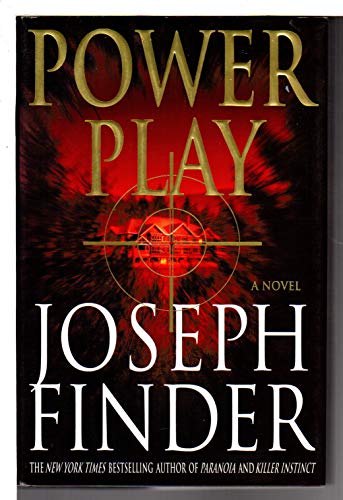
Synopsis
It was the perfect retreat for a troubled company. No cell phones. No BlackBerrys. No cars. Just a luxurious, remote lodge surrounded by thousands of miles of wilderness.
All the top officers of the Hammond Aerospace Corporation are there. And one last-minute substitute -- a junior executive named Jake Landry. He's a steady, modest, and taciturn guy with a gift for keeping his head down and a turbulent past he's trying to put behind him.
Jake's uncomfortable with all the power players he's been thrown in with, with all the swaggering and the posturing. The only person there he knows is the female CEO's assistant--his ex-girlfriend, Ali.
When a band of backwoods hunters crash the opening-night dinner, the executives suddenly find themselves held hostage by armed men who will do anything, to anyone, to get their hands on the largest ransom in history. Now, terrified and desperate and cut off from the rest of the world, the captives are at the mercy of hard men with guns who may not be what they seem.
The corporate big shots hadn't wanted Jake there. But now he's the only one who can save them.
Power Play is a non-stop, pulse-pounding, high-stakes thriller that will hold the reader riveted until the very last page.
All the top officers of the Hammond Aerospace Corporation are there. And one last-minute substitute -- a junior executive named Jake Landry. He's a steady, modest, and taciturn guy with a gift for keeping his head down and a turbulent past he's trying to put behind him.
Jake's uncomfortable with all the power players he's been thrown in with, with all the swaggering and the posturing. The only person there he knows is the female CEO's assistant--his ex-girlfriend, Ali.
When a band of backwoods hunters crash the opening-night dinner, the executives suddenly find themselves held hostage by armed men who will do anything, to anyone, to get their hands on the largest ransom in history. Now, terrified and desperate and cut off from the rest of the world, the captives are at the mercy of hard men with guns who may not be what they seem.
The corporate big shots hadn't wanted Jake there. But now he's the only one who can save them.
Power Play is a non-stop, pulse-pounding, high-stakes thriller that will hold the reader riveted until the very last page.
"synopsis" may belong to another edition of this title.
About the Author
JOSEPH FINDER is the author of several previous thrillers, most recently the New York Times bestsellers Paranoia, Company Man and Killer Instinct. He lives in Boston, Massachusetts
Reviews
Fans agree that Joseph Finder (Company Man, 2005; Killer Instinct, ***1/2 Sept/Oct 2006) has perfected the corporate thriller, favoring the rocket engine of plot over the quiet architecture of character. His eighth novel, Power Play, races along by omitting the texture and depth that might slow the pace; only the protagonist, Jake Landry, is fleshed out. Critics acknowledge this flaw but forgive the author as they're dragged along by the fast-paced action. The New York Times suggests that Finder's novels "could appeal to a broader audience than the one for which they aim." Members of that broader audience might notice the flat characters and occasional clichŽs, but the suspense and tension will keep them turning the pages.
Copyright © 2004 Phillips & Nelson Media, Inc.
If Jake Landry, a tough guy with an understanding of airplane engineering and an innate grasp of corporate politics, is too good to be true, he's still fun to watch in this sleek thriller from bestseller Finder (Killer Instinct). A junior executive at California's Hammond Aerospace, Landry possesses a remarkably flexible intelligence, which lands him on a high-end corporate weekend at a lodge called Rivers Inlet, where the new CEO, Cheryl Tobin, discreetly asks Landry to help her identify corrupt executives. Almost immediately, the lodge is assailed by five men who at first appear to be hunters turned vicious at the sight of the weekend participants' enormous wealth. As they interrogate the executives, however, it becomes clear that they know quite a bit about Hammond and its workings. Landry's job, then, is to figure out their purpose as well as rescue the entire crew. Tight, fluid writing more than compensates for the occasional plot implausibility. 200,000 first printing; author tour. (Aug.)
Copyright © Reed Business Information, a division of Reed Elsevier Inc. All rights reserved.
The best-selling author known for his business thrillers (Paranoia, 2004; Company Man, 2005)here focuses on the aviation industry, as the management team of Hammond Aerospace gathers in a lodge off the coast of British Columbia. The hard-charging businessmen are in full preening mode, showing off their high-end gear and slamming the company's female CEO. Jake Landry, who has been asked to step in for his boss and does not have quite as privileged a background, has brought the wrong clothes and the wrong attitude. When the lodge is overrun by a group of hunters, Jake suspects there's more to the scenario than a robbery, especially since the thieves are toting military-issue weapons. Finder's not much on dialogue and characterization (it's hard to keep all the egotistical businessmen straight), and he throws in just enough tech talk to give his story a realistic veneer. What he does do is hook his readers big time with an irresistible premise: watching the swaggering businessmen cower as a smart-mouthed former juvenile delinquent picks off the bad guys, one by one. Joanne Wilkinson
Copyright © American Library Association. All rights reserved
Excerpt. © Reprinted by permission. All rights reserved.
Chapter One
“We got trouble.”
I recognized Zoë’s voice, but I didn’t turn around from my computer. I was too absorbed in a news report on the website AviationNow.com. A competitor’s new plane had crashed a couple of days ago, at the Paris Air Show. I wasn’t there, but my boss was, and so were all the other honchos at my company, so I’d heard all about it. At least no one was killed.
And at least it wasn’t one of ours.
I picked up my big black coffee mug—the hammond skycruiser: the future of flight—and took a sip. The coffee was cold and bitter.
“You hear me, Landry? This is serious.”
I swiveled slowly around in my chair. Zoë Robichaux was my boss’s admin. She had dyed copper hair and a ghostly pallor. She was in her mid-twenties and lived in El Segundo not too far from me, but she did a lot of club-hopping in L.A. at night. If the dress code at Hammond allowed, I suspected she’d have worn studded black leather every day, black fingernail polish, probably gotten everything pierced. Even parts of the body you don’t want to think about getting pierced. Then again, maybe she already did. I didn’t want to know.
“Does this mean you didn’t get me a bagel?” I said.
“I was on my way down there when Mike called. From Mumbai.”
“What’s he doing in India? He told me he’d be back in the office today for a couple of hours before he leaves for the offsite.”
“Yeah, well, Eurospatiale’s losing orders all over the place since their plane crashed.”
“So Mike’s lined up meetings at Air India instead of coming back here,” I said. “Nice of him to tell me.”
Mike Zorn was an executive vice president and the program manager in charge of building our brand-new wide-bodied passenger jet, the H-880, which we called the SkyCruiser. Four VPs and hundreds of people reported to him—engineers and designers and stress analysts and marketing and finance people. But Mike was always selling the hell out of the 880, which meant he was out of the office far more than he was in.
So he’d hired a chief assistant—me—to make sure everything ran smoothly. Crack the whip if necessary. His jack-of-all-trades and U.N. translator, since I have enough of an engineering background to talk to the engineers in their own geeky language, talk finance with the money people, talk to the shop floor guys in the assembly plant who distrust the lardasses who sit in the office and keep revising and revising the damned drawings.
Zoë looked uneasy. “Sorry, he wanted me to tell you, but I kind of forgot. Anyway, the point is, he wants you to get over to Fab.”
“When?”
“Like an hour ago.”
The fabrication plant was the enormous factory where we were building part of the SkyCruiser. “Why?” I said. “What’s going on?”
“I didn’t quite get it, but the head QA guy found something wrong with the vertical tail? And he just like shut down the whole production line? Like, pulled the switch?”
I groaned. “That’s got to be Marty Kluza. Marty the one-man party.” The lead Quality Assurance inspector at the assembly plant was a famous pain in the ass. But he’d been at Hammond for fifteen years, and he was awfully good at his job, and if he wouldn’t let a part leave the factory, there was usually a good reason for it.
“I don’t know. Anyway, like everyone at headquarters is totally freaking, and Mike wants you to deal with it. Now.”
“Shit.”
“You still want that bagel?” Zoë said.
Chapter Two
I raced over in my Jeep. The fabrication plant was only a five-minute walk from the office building, but it was so immense—a quarter of a mile long—you could spend twenty minutes walking around to the right entrance.
Whenever I walked across the factory floor—I came here maybe every couple of weeks—I was awestruck by the sheer scale. It was an enormous hangar big enough to contain ten football fields. The vaulted ceiling was a hundred feet high. There were miles of catwalks and crane rails.
The whole place was like the set of some futuristic sci-fi movie where robots run the world. There were more machines than people. The robotic Automated Guided Vehicle forklift zoomed around silently, carrying huge pallets of equipment and parts in its jaws. The autoclave, basically a pressure cooker, was thirty feet in diameter and a hundred feet long, as big as some traffic tunnels. The automated tape layers were as tall as two men, with spidery legs like the extraterrestrial creature in Alien, extruding yards of shiny black tape.
Visitors were always surprised by how quiet it was here. That’s because we rarely used metal anymore—no more clanging and riveting. The SkyCruiser, you see, was 80 percent plastic. Well, not plastic, really. We used composites—layers of carbon-fiber tape soaked in epoxy glue, then baked at high temperature and pressure. Like Boeing and Airbus and Eurospatiale, we used as much composite as we could get away with because it’s a lot lighter than metal, and the lighter a plane is, the less fuel it’s going to use. Everyone likes to save money on fuel.
Unfortunately, the whole process of making planes out of this stuff is sort of a black art. We basically experiment, see what works and what doesn’t.
This doesn’t sound too reassuring, I know. If you’re a nervous flyer, this is already probably more than you want to know.
Also like Boeing and Airbus and the others, we don’t really build our own planes anymore. We mostly assemble them, screw and glue them together from parts built all over the world.
But here in Fab, we made exactly one part of the SkyCruiser: an incredibly important part called the vertical stabilizer—what you’d call the tail. It was five stories high.
One of them was suspended from a gantry crane and surrounded by scaffolding. And underneath it I found Martin Kluza, moving a handheld device slowly along the black skin. He looked up with an expression of annoyance.
“What’s this, I get the kid? Where’s Mike?”
“Out of town, so you get me. Your lucky day.”
“Oh, great.” He liked to give me a hard time.
Kluza was heavyset, around fifty, with a pink face and a small white goatee on his double chin. He had safety glasses on, like me, but instead of a yellow safety helmet, he was wearing an L.A. Dodgers cap. No one dared tell him what to do, not even the director of the plant.
“Hey, didn’t you once tell me I was the smartest guy in the SkyCruiser Program?”
“Correction: excluding myself,” Marty said.
“I stand corrected. So I hear we’ve got a problem.”
“I believe the word is ‘catastrophe.’ Check this out.” He led me over to a video display terminal on a rolling cart, tapped quickly at the keys. A green blob danced across the screen, then a jagged red line slashed through it.
“See that red line?” he said. “That’s the bond line between the skin and the spars, okay? About a quarter of an inch in.”
“Cool,” I said. “This is better than Xbox 360. Looks like you got a disbond, huh?”
“That’s not a disbond,” he said. “It’s a kissing bond.”
“Kissing bond,” I said. “Gotta love that phrase.” That referred to when two pieces of composite were right next to each other, no space between, but weren’t stuck together. In my line of work, we say they’re in “intimate contact” but haven’t “bonded.” Is that a metaphor or what?
“The C-scan didn’t pick up any disbonds or delaminations, but for some crazy reason I decided to put one of them through a shake-table vibe test to check out the flutter and the flex/rigid dynamics, and that’s when I discovered a discrepancy in the frequency signature.”
“If you’re trying to snow me with all this technical gobbledygook, it’s not going to work.”
He looked at me sternly for a few seconds, then realized I was giving him shit right back. “Fortunately, this new laser-shot peening diagnostic found the glitch. We’re going to have to scrap every single one.”
“You can’t do that, Marty.”
“You want these vertical stabilizers flying apart at thirty-five thousand feet with three hundred people aboard? I don’t think so.”
“There’s no fix?”
“If I could figure out where the defect is, yeah. But I can’t.”
“Maybe they were overbaked? Or underbaked?”
“Landry.”
“Contaminants?”
“Landry, you could eat off the floor here.”
“Remember when some numbskull used that Loctite silicone spray inside the clean room and ruined a whole day’s production?”
“That guy hasn’t worked here in two years, Landry.”
“Maybe you got a bad lot of Hexocyte.” That was the epoxy adhesive film they used to bond the composite skin to the understructure.
“The supplier’s got a perfect record on that.”
“So maybe someone left the backing paper on.”
“On every single piece of adhesive? No one’s that brain-dead. Not even in this place.”
“Will you scan this bar code? I want to check the inventory log.”
I handed him a tag I’d taken from a roll of Hexocyte adhesive film. He brought it over to another console, scanned it. The screen filled up with a series of dates and temperatures.
I walked over to the screen and studied it for a minute or so.
“Marty,” I said. “I’ll be back in a few. I’m going to take a walk down to Shipping and Receiving.”
“You’re wasting your time,” he said.
Copyright © 2007 by Joseph Finder. All rights reserved.
"About this title" may belong to another edition of this title.
Other Popular Editions of the Same Title

Search results for Power Play

Stock Image
Power Play
Seller: World of Books (was SecondSale), Montgomery, IL, U.S.A.
Seller rating 5 out of 5 stars

Condition: Acceptable. Item in good condition. Textbooks may not include supplemental items i.e. CDs, access codes etc. Seller Inventory # 00064988701
Stock Image
Power Play
Seller: World of Books (was SecondSale), Montgomery, IL, U.S.A.
Seller rating 5 out of 5 stars
Condition: Very Good. Item in very good condition! Textbooks may not include supplemental items i.e. CDs, access codes etc. Seller Inventory # 00094610704
Stock Image
Power Play
Seller: World of Books (was SecondSale), Montgomery, IL, U.S.A.
Seller rating 5 out of 5 stars
Condition: Good. Item in good condition. Textbooks may not include supplemental items i.e. CDs, access codes etc. Seller Inventory # 00086258652
Stock Image
Power Play
Seller: Orion Tech, Kingwood, TX, U.S.A.
Seller rating 5 out of 5 stars
Hardcover. Condition: Good. Seller Inventory # 0312347480-3-22232346
Stock Image
Power Play
Seller: Gulf Coast Books, Cypress, TX, U.S.A.
Seller rating 5 out of 5 stars
Hardcover. Condition: Good. Seller Inventory # 0312347480-3-25183936
Seller Image
Power Play
Seller: 3Brothers Bookstore, Egg harbor township, NJ, U.S.A.
Seller rating 5 out of 5 stars
Condition: very_good. Cover may have light wear, pages in very good condition and binding is sturdy; may have other light shelf wear or creases. May have notes or highlighting. Seller Inventory # EVV.0312347480.VG
Stock Image
Power Play
Seller: SustainableBooks.com, Amherst, NY, U.S.A.
Seller rating 5 out of 5 stars
Condition: Poor. Book is Poor condition. Good for reading, not pretty to look at! The pages and cover are soiled and/or yellowed, worn throughout. Seller Inventory # 0312347480-2-6
Seller Image
Power Play
Seller: Used Book Company, Egg Harbor Township, NJ, U.S.A.
Seller rating 3 out of 5 stars

Condition: very_good. Shows minimal signs of wear and previous use. Can include notes highlighting. A portion of your purchase benefits nonprofits! - Note: Edition & format may differ from what is shown in stock photo & item details. May not include supplementary material such as toys, access code, dvds, etc. Seller Inventory # 584ZSU000P2G_ns
Stock Image
Power Play
Published by
St. Martin's Press (edition First Edition), 2007
ISBN 10: 0312347480
ISBN 13: 9780312347482
Used
Hardcover
First Edition
Seller: BooksRun, Philadelphia, PA, U.S.A.
Seller rating 5 out of 5 stars
Hardcover. Condition: Very Good. First Edition. It's a well-cared-for item that has seen limited use. The item may show minor signs of wear. All the text is legible, with all pages included. It may have slight markings and/or highlighting. Seller Inventory # 0312347480-11-1
Stock Image
Power Play
Seller: Evergreen Goodwill, Seattle, WA, U.S.A.
Seller rating 5 out of 5 stars
hardcover. Condition: Acceptable. Seller Inventory # mon0000638394