
Items related to Little Scarlet: An Easy Rawlins Mystery
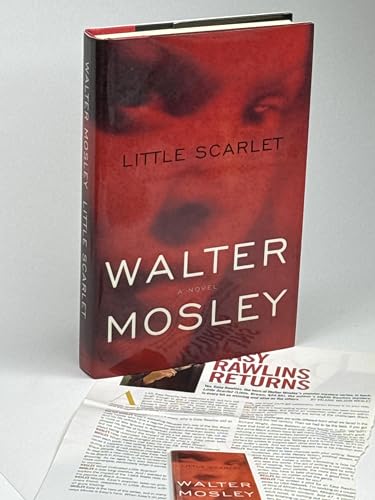
Synopsis
For the huge audience that has always thought they should read Walter Mosley, he delivers at last the novel they've been waiting for-one so unstoppably dramatic that it will rank among the classic mysteries of our time. At the height of the devastating 1965 Watts riots, a white man is pulled from his car by a mob and escapes into a nearby apartment building. Soon afterward, a red-headed woman known as Little Scarlet is found dead in that building-and the man who fled is the suspect. The police investigate, and what Easy finds is a killer whose rage, like that which burned in the city, is intrinsically woven around race and passion.Rawlins's hunt for the killer will reveal a new city emerging from the ashes - and a new life for Easy and his friends. Mosley captures the heat and the rhythm of Los Angeles's heart, where danger is the common currency of everyday life.LITTLE SCARLET is further proof that Mosley is 'a master of mystery' (New York Times Book Review).
"synopsis" may belong to another edition of this title.
Reviews
It is a matter of legend that Walter Mosley's career took off one fine day in 1992 when Bill Clinton named him as one of his favorite novelists. Mosley fits squarely within the tradition of African American authors writing about race and blackness and has been compared to Ralph Ellison (Invisible Man). In an interview with the New York Times recently, Mosley said: "I have never met an African American who was surprised by the attack on the World Trade Center. Blacks do not see America as the great liberator of the world. Blacks understand how the rest of the world sees us, because we have also been the victims of American imperialism."
Given all that, one would expect a Mosley novel based in the Los Angeles suburb of Watts at the height of the devastating race riots of 1965 to amount to more than a simple murder investigation, and Little Scarlet does not disappoint. Although the story is narrated in the first person by Easy Rawlins, who is the hero of a series of Mosley novels, the true protagonist of the book is collectively the riots and their aftermath. Mosley is considerably more interested in the ambiguous state of mind of the black citizenry, the disorientation of the cops and the looted, shambolic condition of Watts itself than he is in the adventures of his hero. Watts, in truth, is a world turned upside down, and Mosley simply points his hero at it and rolls the camera.
The vehicle Mosley has chosen by way of plot is neatly ironic and perfectly mirrors the social inversion of the times: A black woman, Nola Payne (the Little Scarlet of the title -- she has red hair), has been brutally murdered. Fingers are pointed, inevitably, at a white man who was seen with her in Watts during her last hours. But in the high fever of boiling racial tension, the last thing the white cops need is a white perpetrator. On the other hand, failure to investigate would also be seen as highly provocative by the black community. Escalation must be avoided at all costs. Only a child of the streets, a black man with no direct affiliation to white authority, a humble 45-year-old with enough civic responsibility and integrity to be interested in keeping the uneasy peace that followed the riots -- a big, comfortable, family man blessed with quiet charm who can take care of himself in a punch-up and talk back to white cops who do not appreciate his mission and have a lot to hide when it comes to the identity of the true killer -- only Easy, in other words, can possibly save this day that rests on a knife edge. But our hero, with the help of the young and voluptuous Juanda, quickly establishes that the white man didn't do it. The more he digs, the more the evidence points to a quite different kind of villain. So where in L.A. is the culprit? How many black women has he killed already? Why did he kill them? Why haven't the cops investigated him in the past and -- above all -- what color is he? In the end, naturally, the perpetrator is identified thanks to Easy, who almost single-handedly defuses this social time bomb.
To flesh out his hero, Mosley endows him with imposing height, great physical strength, enormous skill in street pugilism and an occasional associate, the killer Raymond "Mouse" Alexander. ("Telling him no was was as dangerous a task as moving nitroglycerine in a truck with no shock absorbers." ) In evoking the atmosphere of Watts after the riots, Mosley is nothing less than masterly: "All he had left was the burnt and broken worktable surrounded by a couple hundred pairs of scorched shoes. Why would somebody want to burn shoes?"
Mosley is also fearless in exploring the underlying ambiguity of race: Negro National Guardsmen bully blacks in perfect imitation of their white colleagues; it is an out-of-town white cop, Detective Melvin Suggs, who bends the rules in order to send Easy off on his mission; some African Americans are so brainwashed by white elitism they will go to insane lengths to present themselves as Caucasian; poor whites without a racist bone in their bodies are left financially ruined by the riots.
The only quibble I have with Little Scarlet, which I enjoyed immensely, concerns the character of the hero. It is commonplace that the lone male who, in the guise of detective or other secret agent, goes about righting wrongs and fighting for the virtue and dignity of women, is a direct descendant of the Arthurian knight, and Easy is a product of this noble line. He never refuses a joust, he gets embroiled with at least one adversary so big, mean, muscular and bad that he can fairly be called a monster, his anger is always of the righteous kind within his chivalric code and he manages to resist the lascivious temptation presented by Juanda.
So far so good, but it is in the nature of narrative that great heroes must have great weaknesses if they are to avoid the genre of fairy tale. Philip Marlowe knew himself to be compromised by the Los Angeles of the '40s, drank heavily and lost as many fights as he won; Holmes loved cocaine; Bond was a relentless womanizer; Lancelot was a passionate adulterer and traitor to his king -- and Quixote was mad. Rawlins, by contrast, is pretty much flawless. Perhaps Mosley wants to show us that a black knight is even better than a white knight, which would explain why dear old Easy hardly misses an opportunity to spell out his virtues ("That's why she liked me, I stood up for myself but still didn't lord it over other people when I had the upper hand") and can come across as somewhat anachronistic in his political correctness.
Personally, I found myself wishing that our hero possessed more in the way of breadth and depth. As I understand it, Watts was part of a mighty revolution that changed America and perhaps the world. I would have liked Rawlins to experience more directly for us the sheer psychological rawness of that time, which Mosley prefers to elicit from third parties: the catharsis following the sudden release of centuries of pent-up rage, the thrill and fear of anarchy, the gnawing terror of the rough beast now unleashed, the squalor and shame of the looting of blacks by blacks, the pride of the African American community that was finally fighting back. Certainly, Easy has plenty of very reasonable, even anodyne, opinions about race and riots; not a lot of convincing gut reaction, however. He is just a tad too good to be true. That aside, Little Scarlet is a terrific yarn from a tormented moment in recent American history.
Copyright 2004, The Washington Post Co. All Rights Reserved.
Mosely introduced Easy Rawlins in 1990’s Devil in a Blue Dress, and the unofficial PI has only become angrier, more intense, and definitely more complex since then. Here, he’s embroiled in L.A.’s racial politics, investigating a murder while asking himself some tough questions. Critics agree that Little Scarlet is the best in the series. Mosely not only offers a dense portrait of bloody black-white relations, but also raises important questions about the “gray” areas that Easy must face. Characters—some new, some old—are introspective and richly drawn. Overall, Little Scarlet is a masterpiece portrait of South Central L.A., “his most searing and unforgettable account of America to date” (Los Angeles Times).
Copyright © 2004 Phillips & Nelson Media, Inc.
Set during the Watts riots of 1965, this eighth entry in Mosley's acclaimed Easy Rawlins series (Bad Boy Brawly Brown, etc.) demonstrates the reach and power of the genre, combining a deeply involving mystery with vigorous characterizations and probing commentary about race relations in America. Easy Rawlins, 45, is—like the rest of black L.A.—angry: "the angry voice in my heart that urged me to go out and fight after all the hangings I had seen, after all of the times I had been called nigger and all of the doors that had been slammed in my face." But Easy stays out of the fiery streets until a white cop and his bosses recruit him to identify the murderer of a young black woman, Nola Payne; the cops suspect an unidentified white man whom Nola sheltered during the riots, and are worried that if they pursue the case, word will leak and the riots will escalate. Easy, an unlicensed PI who also works as a school custodian, agrees to investigate, drawing into his quest several series regulars, including the stone killer Mouse, the magical healer Mama Jo and his own family. There's also a sexy young woman whose allure, like that of the violent streets, threatens to smash the life of integrity he has so carefully built. In time, Easy focuses on a homeless black man as the killer, not only of Nola but of perhaps 20 other black women, all of whom had hooked up with white men. This is Mosley's best novel to date: the plot is streamlined and the language simple yet strong, allowing the serpentine story line to support Easy's amazingly complex character and hypnotic narration as Mosley plunges us into his world and, by extension, the world of all blacks in white-run America. Fierce, provocative, expertly entertaining, this is genre writing at its finest.
Copyright © Reed Business Information, a division of Reed Elsevier Inc. All rights reserved.
*Starred Review* Mosley returns to top form in this ninth installment of his celebrated Easy Rawlins series. In the early volumes, the calendar moved ahead almost one decade per book, but Mosley has been lingering through the 1960s--rightfully so, given the far-reaching impact of that turbulent era on African American life. Here it's the last days of the Watts riots in 1966, and a black woman, nicknamed Little Scarlet, has been found murdered in her apartment, the same building that an unidentified white man appeared to enter after escaping a mob of rioters. Did the white man commit the murder? The LAPD wants answers quickly, which is why Rawlins is asked to investigate. As has been the case throughout this series, the mystery at hand serves as a window opening on a historical moment. As Easy investigates, he finds himself forced to make sense of his own contrary feelings about the riots--his sadness at the loss of life and property in his community set against his recognition of inevitability, of the fact that the riots were expressing out in the open the anger every black man and woman had been forced to hide: "Now it's said and nothing will ever be the same. That's good for us, no matter what we lost. And it could be good for white people, too." Mosley remains a master at showing his readers slices of history from the inside, from a perspective that is all those things history usually isn't: intimate, individual, and passionate. Bill Ott
Copyright © American Library Association. All rights reserved
Excerpt. © Reprinted by permission. All rights reserved.
Little Scarlet
By Walter MosleyLittle, Brown
Copyright © 2004 Walter MosleyAll right reserved.
ISBN: 0-316-07303-2
Chapter One
The morning air still smelled of smoke. Wood ash mainly but therewas also the acrid stench of burnt plastic and paint. And eventhough I knew it couldn't be true, I thought I caught a whiff ofputrid flesh from under the rubble across the street. The hardwarestore and Bernard's Stationery Store were both completely gutted.The Gonzalez Market had been looted but only a part of its roof hadbeen scorched. The corner building, however, Lucky Dime Liquors, hadbeen burned to the ground. Manny Massman was down in the rubble withhis two sons, kicking the metal fixtures. At one point themiddle-aged store owner lowered his head and cried. His sons puttheir hands on his shoulders.I understood how he felt. He had everything in that liquor store.His whole life. And now, after a five-day eruption of rage that hadbeen simmering for centuries, he was penniless and destitute.
In his mind he hadn't done a thing wrong to anyone down in Watts. Hehad never even thought about calling someone a nigger or boy. Butthe men and women down around Central and Eighty-sixth Place tookeverything of Manny's that they could carry, then smashed and burnedthe rest.
Four young black men passed in front of the liquor lot. One of themshouted something at the white men.
Manny barked back.
The youths stopped.
The Massman sons stepped forward with their chests out and theirmouths full of angry sounds.
It's starting all over again, I thought. Maybe we'll be rioting awhole year. Maybe it won't ever end.
The black men crossed the threshold of the Lucky Dime's propertyline.
Stephen Massman bent down to pick up a piece of metal that had oncebeen attached to their counter.
One of the angry youths shoved Martin.
I held my breath.
"Halt!" a man shouted through a megaphone.
A dozen or more soldiers appeared out of nowhere. A black soldierwearing a helmet and camouflage khakis talked to the black men whilefour white soldiers stood in an arc in front of the store owners.The rest of the troop stood across the property line cutting off theravaged lot from the street.
Most of the National Guardsmen brandished rifles. A crowd wasgathering. My hands clenched into fists so tight that my rightforearm went into a spasm.
While I massaged out the knot of pain, the black soldier, asergeant, calmed the four youths. I could hear his voice but myfourth-story window was too far away for me to make out the words.
I turned away from the scene and fell into the plush blue chair thatsat at my desk. For the next hour I just sat there, hearing thesounds of people in the street but not daring to look down.
It had been like that for the past five days: me holding myself incheck while South Los Angeles went up in the flames of a race riot;while stores were looted and snipers fired and while men, women, andchildren cried "Burn, baby, burn!" and "Get whitey!" on every cornerfamiliar to me.
I stayed shut up in my home, in peaceful West L.A., not drinking andnot going out with a trunk full of Molotov cocktails.
WHEN I FINALLY roused myself the street down below was full of blackpeople, some venturing out of their homes for the first time sincethe first night of rioting. Most of them looked stunned.
I went to my office door and out into the hall.
There was the smell of smoke in the building too, but not much.Steinman's Shoe Repair was the only store that had been torched.That was on the first night, when the fire trucks still braved thehails of sniper bullets. The flames were put out before they couldspread.
I went to the far stairwell from my office and down the threeflights to Steinman's side entrance. There was a burnt timberblocking the way. I would have turned around if it weren't for thevoices.
"What the hell you mean you don't have my shoes, white man?"
"Everything is burned up," a frail voice replied in a mild Germanaccent.
"That's not my fault, man," the angry voice said. "I give you myshoes, I expect to get them back."
"They are all burned."
"And do you think if this was my store that I could tell you Ididn't have nuthin' for ya?" the customer said. "Do you think ablack man could just say his store done burned down so he don't haveto make good on his responsibilities?"
"I don't have your shoes."
I shoved the timber out of the way, smudging the palms of my handswith sooty charcoal. When I came into the burned-out room, bothoccupants turned to look at me.
Theodore was a short, powerfully built white man with little hairand big hands. The irate customer was much larger, with a wide chestand a big face that would have been beautiful on a woman.
"Hey, Theodore," I said.
"Wait your turn, man," the Negro customer warned. "I got business totake care of first."
He swiveled his head back to the cobbler and said, "Those shoescosted me thirty-six dollars and if you can't give 'em up right nowI want to see some money across this here hand."
I took a quick breath and then another. There was an electric tingleover my right cheekbone and for a moment the room was tinged in red.
"Brother," I said. "You got to go."
"Are you talkin' to me, niggah?"
"You heard me," I said in a tone that you can't make up. "I been inthe house for some time now, trying not to break out and start doin'wrong. I've been patient and treadin' softly. But if you say onemore word to my friend here I will break you like a matchstick andthrow you out in the street."
"I want my shoes," the big beautiful man said with tears in hisvoice. "He owe it to me. It don't matter what they did."
I heard his cracked tone. I knew that he was just as crazy as I wasat that moment. We were both black men filled with a passionate ragethat was too big to be held in. I didn't want to fight but I knewthat once I started, the only thing that would stop me would be hislifeless throat crushed by my hand.
"Here you are, sir," Theodore said.
He was handing over a ten-dollar bill.
"Your shoes were old, you know," the shoemaker said. "And they bothneeded soles. It was a good make and I would have bought them forseven dollars. So here's ten."
The burly man stared at the note a moment. Then he looked up at me.
"Forget it," he said.
He turned around so quickly that he lost his balance for a momentand had to reach out for a broken, charred timber for support.
"Ow!" he shouted, probably because of a splinter, but I can't sayfor sure because he blundered out, tearing the front door off of itslast hinge as he went.
There was a sleek antique riding saddle on the floor, under ashattered wooden chair. I moved away the kindling and picked up thesaddle. Theodore had received it from his uncle who was a ridingmaster in Munich before World War I. I'd always admired theleatherwork.
Setting the riding gear on a fairly stable part of his ruinedworktable, I said, "You didn't have to pay him, Mr. Steinman."
"He was hurting," the small man replied. "He wanted justice."
"That's not your job."
"It is all of our job," he said, staring at me with blue eyes. "Youcannot forget that."
"Ezekiel Rawlins?"
It was a question asked in a voice filled with authority. It was awhite man's voice. Putting those bits of information together, Iknew that I was being addressed by the police.
(Continues...)
Excerpted from Little Scarletby Walter Mosley Copyright ©2004 by Walter Mosley. Excerpted by permission.
All rights reserved. No part of this excerpt may be reproduced or reprinted without permission in writing from the publisher.
Excerpts are provided by Dial-A-Book Inc. solely for the personal use of visitors to this web site.
"About this title" may belong to another edition of this title.
Search results for Little Scarlet: An Easy Rawlins Mystery

Stock Image
Little Scarlet
Published by
Little, Brown and Company, 2004
ISBN 10: 0316073032
ISBN 13: 9780316073035
Used
Hardcover
Seller: World of Books (was SecondSale), Montgomery, IL, U.S.A.
Seller rating 5 out of 5 stars

Condition: Acceptable. Item in acceptable condition! Textbooks may not include supplemental items i.e. CDs, access codes etc. Seller Inventory # 00101295001
Stock Image
Little Scarlet
Published by
Little, Brown and Company, 2004
ISBN 10: 0316073032
ISBN 13: 9780316073035
Used
Hardcover
Seller: World of Books (was SecondSale), Montgomery, IL, U.S.A.
Seller rating 5 out of 5 stars
Condition: Good. Item in good condition. Textbooks may not include supplemental items i.e. CDs, access codes etc. Seller Inventory # 00096052646
Stock Image
Little Scarlet: An Easy Rawlins Mystery
Published by
Little, Brown and Company, 2004
ISBN 10: 0316073032
ISBN 13: 9780316073035
Used
Hardcover
Seller: Gulf Coast Books, Cypress, TX, U.S.A.
Seller rating 5 out of 5 stars
Hardcover. Condition: Good. Seller Inventory # 0316073032-3-22170552
Stock Image
Little Scarlet: An Easy Rawlins Mystery
Published by
Little, Brown and Company, 2004
ISBN 10: 0316073032
ISBN 13: 9780316073035
Used
Hardcover
Seller: Your Online Bookstore, Houston, TX, U.S.A.
Seller rating 5 out of 5 stars
hardcover. Condition: Fair. Seller Inventory # 0316073032-4-30404001
Seller Image
Little Scarlet: An Easy Rawlins Mystery
Published by
Little, Brown and Company, 2004
ISBN 10: 0316073032
ISBN 13: 9780316073035
Used
Hardcover
Seller: Zoom Books Company, Lynden, WA, U.S.A.
Seller rating 5 out of 5 stars
Condition: very_good. Book is in very good condition and may include minimal underlining highlighting. The book can also include "From the library of" labels. May not contain miscellaneous items toys, dvds, etc. . We offer 100% money back guarantee and 24 7 customer service. Seller Inventory # ZBV.0316073032.VG
Seller Image
Little Scarlet: An Easy Rawlins Mystery
Published by
Little, Brown and Company, 2004
ISBN 10: 0316073032
ISBN 13: 9780316073035
Used
Hardcover
Seller: ZBK Books, Carlstadt, NJ, U.S.A.
Seller rating 5 out of 5 stars
Condition: very_good. Fast & Free Shipping â" Very Good condition book with a firm cover and clean pages. Shows normal use and some light wear or limited notes markings. A solid, nice copy to enjoy. Seller Inventory # ZWV.0316073032.VG
Stock Image
Little Scarlet: An Easy Rawlins Mystery
Published by
Little, Brown and Company (edition ), 2004
ISBN 10: 0316073032
ISBN 13: 9780316073035
Used
Hardcover
Seller: BooksRun, Philadelphia, PA, U.S.A.
Seller rating 5 out of 5 stars
Hardcover. Condition: Very Good. It's a well-cared-for item that has seen limited use. The item may show minor signs of wear. All the text is legible, with all pages included. It may have slight markings and/or highlighting. Seller Inventory # 0316073032-11-1
Stock Image
Little Scarlet: An Easy Rawlins Mystery
Seller: World of Books Inc, Montgomery, IL, U.S.A.
Seller rating 4 out of 5 stars

Hardback. Condition: Fair. When a man who fled the 1965 Watts riots is suspected of killing a woman in a nearby apartment building, Easy Rawlins begins a murder investigation and learns that the case has sobering racial origins. Seller Inventory # CIN0316073032A
Stock Image
Little Scarlet: An Easy Rawlins Mystery
Seller: World of Books Inc, Montgomery, IL, U.S.A.
Seller rating 4 out of 5 stars
Hardback. Condition: Good. When a man who fled the 1965 Watts riots is suspected of killing a woman in a nearby apartment building, Easy Rawlins begins a murder investigation and learns that the case has sobering racial origins. Seller Inventory # CIN0316073032G
Stock Image
Little Scarlet: An Easy Rawlins Mystery
Published by
Little, Brown and Company (edition ), 2004
ISBN 10: 0316073032
ISBN 13: 9780316073035
Used
Hardcover
Seller: BooksRun, Philadelphia, PA, U.S.A.
Seller rating 5 out of 5 stars
Hardcover. Condition: Fair. With dust jacket. The item might be beaten up but readable. May contain markings or highlighting, as well as stains, bent corners, or any other major defect, but the text is not obscured in any way. Seller Inventory # 0316073032-7-18-29