
Items related to Walk In Hell
Synopsis
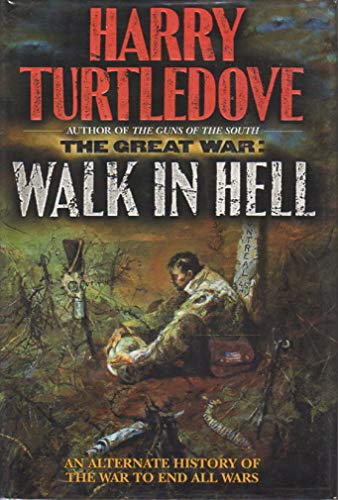
A stunning epic of humanity at war with itself, Harry Turtledove's Great War saga plunges us deeper into the war that began in Europe, then exploded with a vengeance onto American soil.
The world is convulsing. Germany has smashed its enemies: Austria, Denmark, and France, while the United States and the Confederate States of America charge headlong into the global conflict--as bitter enemies once again.
The year is 1915, and the time of darkness has come. Though the Confederacy has defeated its northern enemy twice in fifty years, this time the United States has allied with Prussia. In the South, the freed slaves, fueled by Marxist rhetoric and the bitterness of a racist nation, take up the weapons of the Bolshevik rebellion. Despite these advantages, the United States remains pinned between Canada and the C.S.A., so the bloody conflict continues and grows. Both presidents--Theodore Roosevelt of the Union and staunch Confederate Woodrow Wilson--are stubbornly determined to lead their nations to victory, at any cost.
While land and sea battles are fought around the globe, new killing tools--poison gas, submarines, attack planes, and tanks--are pressed into service. Heroism and fear run hand in hand as ordinary men and women--families, friends, and lovers--choose desperate measures just to survive.
From the trenches that line the Canadian border to occupied Salt Lake City, The Great War: Walk in Hell takes us to the American front, then into prisoner-of-war camps, strategy meetings, and cities roiling with unrest. Once again, Harry Turtledove--"the leading author of alternate history" (USA Today)--has created a gripping, visionary portrait of how, if history had but taken another path, our world would have launched into a much bloodier War to End All Wars.
"synopsis" may belong to another edition of this title.
About the Author
Harry Turtledove was born in Los Angeles in 1949. After flunking out of Caltech, he earned a Ph.D. in Byzantine history from UCLA. He has taught ancient and medieval history at UCLA, Cal State Fullerton, and Cal State L.A., and he has published a translation of a ninth-century Byzantine chronicle, as well as several scholarly articles. He is also a Hugo Award-winning and critically acclaimed full-time writer of science fiction and fantasy. His alternate history works have included several short stories and the novels A World of Difference, The Guns of the South, How Few Remain--winner of the Sidewise Award for Best Novel--and the Worldwar tetralogy that began in 1994 with Worldwar: In the Balance and continues with Colonization: Second Contact. Following on the heels of The Great War: American Front, Walk in Hell is the second volume of Turtledove's epic alternate history tetralogy of World War I.
He is married to fellow novelist Laura Frankos. They have three daughters: Alison, Rachel, and Rebecca.
From the Back Cover
"Turtledove has proved he can divert his readers to astonishing places. He's developed a cult following over the years; and if you already been there, done that with real-history novelists Patrick O'Brian, Dorothy Dunnett, or George MacDonald Fraser, for your Next Big Enthusiasm you might want to try Turtledove. I know I'd follow his imagination almost anywhere."
--San Jose Mercury News
From the Inside Flap
A stunning epic of humanity at war with itself, Harry Turtledove's Great War saga plunges us deeper into the war that began in Europe, then exploded with a vengeance onto American soil.
The world is convulsing. Germany has smashed its enemies: Austria, Denmark, and France, while the United States and the Confederate States of America charge headlong into the global conflict--as bitter enemies once again.
The year is 1915, and the time of darkness has come. Though the Confederacy has defeated its northern enemy twice in fifty years, this time the United States has allied with Prussia. In the South, the freed slaves, fueled by Marxist rhetoric and the bitterness of a racist nation, take up the weapons of the Bolshevik rebellion. Despite these advantages, the United States remains pinned between Canada and the C.S.A., so the bloody conflict continues and grows. Both presidents--Theodore Roosevelt of the Union and staunch Confederate Woodrow Wilson--are stubbornly determined to lead their nations to victory, at any cost.
While land and sea battles are fought around the globe, new killing tools--poison gas, submarines, attack planes, and tanks--are pressed into service. Heroism and fear run hand in hand as ordinary men and women--families, friends, and lovers--choose desperate measures just to survive.
From the trenches that line the Canadian border to occupied Salt Lake City, The Great War: Walk in Hell takes us to the American front, then into prisoner-of-war camps, strategy meetings, and cities roiling with unrest. Once again, Harry Turtledove--"the leading author of alternate history" (USA Today)--has created a gripping, visionary portrait of how, if history had but taken another path, our world would have launched into a much bloodier War to End All Wars.
Reviews
The Hugo Award-winning master of alternate world histories presents the second volume in the WWI series he began last year with The Great War: American Front. In Turtledove's version of the War to End All Wars, conflict rages on the American continent between the USA (with 34 states) and the Confederate States of America, which won secession during the Civil War. Allied with Germany and France, the USA in 1915 hopes to take advantage of a weakened CSA, which is plagued by a socialist revolution engineered by its former slaves. Setting his tale on a suitably large canvas, Turtledove introduces a variety of characters who exemplify the diverse political and economic circumstances of the period: Anne Colleton, a former Confederate landowner, must learn to cooperate with her activist fieldhands; Flora Hamburger, a New York intellectual, fights against class injustice and runs for a seat as a socialist congresswoman; Confederate sub commander Roger Kimball plans a risky attack on New York Harbor. Turtledove judiciously blends famous historical characters into the plot, so readers learn of General Custer's frustration at being unable to conquer Tennessee and see Woodrow Wilson as a Confederate president. Although there are numerous battle scenes, the gore is restrained. Instead, the author emphasizes character, and his thorough knowledge of the period's history will, as usual, captivate his readers, Foreign rights sold in the U.K. (Aug.)
Copyright 1999 Reed Business Information, Inc.
Sequel to The Great War: American Front (1998), an alternate world yarn where WWI has developed into a struggle on American soil. The United States, led by Teddy Roosevelt, have allied themselves with Kaiser Wilhelm's Germany. Woodrow Wilson's Confederate States, though backed by Britain and France, face internal troubles in the shape of a Marxist-inspired rebellion of the South's oppressed blacks. Contortions aside, then, what we end up with is Turtledove's restaging of the American Civil War within a 20th-century milieu. For readers less than totally committed, the question is: when does maybe topple over into no way? -- Copyright ©1999, Kirkus Associates, LP. All rights reserved.
World War I enters its second year, and on the American continent the opposed forces of the United States and the Confederacy (CSA) continue to battle each other, determined once and for all to settle the conflict that has divided them since the Civil War. Continuing the epic saga begun in The Great War: The American Front, Turtledove chronicles the growing turmoil as second-class blacks lead a Communist uprising in the CSA while U.S. Socialists protest American involvement in the war and Canadian civilians rise up against American occupation forces. The author's consummate knowledge of military history lends immediacy to his battle scenes while his understanding of human nature brings a personal touch to the harsh and unforgiving reality of war. A good choice for most libraries. [Science Fiction Book Club main selection.]
Copyright 1999 Reed Business Information, Inc.
The second volume of Turtledove's Great War tetralogy is as enthralling as The American Front. It covers about a year, beginning in 1915, that includes the Negro rebellion in the Confederacy, the continued U.S. advance into Canada, the introduction of tanks (here called barrels) on both sides, and the relentless horrors of trench warfare. The focus remains on North America, although it is implied that the Germans are doing better in this version of the war than they did in the real one, and most of the surviving characters, real and imaginary, return. The Negro Cassius finds new opportunities as a truck driver with an unbigoted white boss; in the Confederacy, Scipio survives the rebellion and sees the government respond to the manpower shortage by enlisting black troops! Socialist Flora Hamburger runs for Congress and wins. George Armstrong Custer continues to lead Union armies (to the great advantage of the Confederacy), despite his wife Libbie's best efforts. The shifts in viewpoint definitely require attentive reading but are essential to the panoramic view of a vast nightmare that Turtledove strives to present. This is not alternate history intended to give readers the warm fuzzies; it is a remorseless working out of the consequences of greater follies producing even worse results than the ones we may read about in actual history. It makes one grateful to live in history as we know it rather than in Turtledove's vivid imaginary version. Roland Green
Excerpt. © Reprinted by permission. All rights reserved.
George Enos looked across the Mississippi toward Illinois. The river was wide, but not wide enough to let him forget it was only a river. Here in St. Louis, he was, beyond any possible doubt, in the middle of the continent.
That felt very strange to him. He'd lived his whole life, all twenty-nine years of it, in Boston, and gone out fishing on the Atlantic ever since he was old enough to run a razor over his cheeks. He'd kept right on going out to fish, even after the USA went to war with the Confederate States and Canada: all part of the worldwide war with Germany and Austria battling England, France, and Russia while pro-British Argentina fought U.S. allies Chile and Paraguay in South America and every ocean turned into a battle zone.
If a Confederate commerce raider hadn't intercepted the steam trawler Ripple and sunk it, George knew he'd still be a fisherman today. But he and the rest of the crew had been captured, and, being civilian detainees rather than prisoners of war, eventually exchanged for similar Confederates in U.S. hands. He had joined the Navy then, partly in hopes of revenge, partly to keep from being conscripted into the Army and sent off to fight in the trenches.
They'd even let him operate out of Boston for a while, on a trawler that had gone hunting for enemy vessels with a submarine pulled on a long tow. He'd helped sink a Confederate submersible, too, but the publicity that came from success made any future success unlikely. And so, instead of his being able to see his wife and children when he wasn't at sea and to work like a fisherman when he was, they'd put him on a train and sent him to St. Louis.
He called up to the deck officer aboard the river monitor USS Punishment: "Permission to come aboard, sir?"
"Granted," Lieutenant Michael Kelly said, and Enos hurried up the gangplank and onto his ship. He saluted the thirty-four-star flag rippling in the breeze at the stern of the Punishment. Kelly waited till he had performed the ritual, then said, "Take your station, Enos. We're going to steam south as soon as we have the full crew aboard."
"Aye aye, sir," Enos said. Because he was still new to the Navy and its ways, he hadn't lost the habit of asking questions of his superiors: "What's going on, sir? Seems like everybody's getting pulled on board at once."
From some officers, a query like that might have drawn a sharp reprimand. Kelly, though, understood that the expanded Navy of 1915 was not the tight-knit, professional force it had been before the war began. The formal mask of duty on his face cracked to reveal an exuberant grin that suddenly made him look much younger: like Enos, he was tanned and lined and chapped from endless exposure to sun and wind. He said, "What's up? I'll tell you what's up, sailor. The niggers down in the CSA have risen up against the government there, that's what. If the Rebs don't put 'em down, they're sunk. But while they're busy doing that, how much attention can they pay to us? You see what I'm saying?"
"Yes, sir, I sure do," Enos answered.
"Mind you," Kelly said, "I haven't got any great use for niggers myself—what white man does? And if the scuttlebutt is the straight goods, a lot of these niggers are Reds, too. And you know what? I don't care. They foul up the Rebels so we can lick 'em, they can fly all the red flags they want."
"Yes, sir," George said again. After the commerce raider snagged him, he'd been interned in North Carolina for several months. He'd seen the kind of treatment Negroes got in the CSA. Technically, they were free. They'd been free for more than thirty years. But— "If I was one of those Negroes, sir, and I saw a chance to take a shot at a Confederate—a white Confederate, I mean—I'd grab it in a second."
"So would I," Kelly said. "So would anybody with any balls. Who would have thought niggers had balls, though?" He turned away from Enos as a couple of other sailors reported back aboard the Punishment.
The river monitor was, in the immortal words that had described the first of her kind, a cheesebox on a raft. She carried a pair of six-inch guns in an armored turret mounted on a low, wide ironclad hull. She also had several machine guns mounted on deck for land targets not worth the fury of guns that could have gone to sea aboard a light cruiser.
Enos had been a fisherman, which meant he was adept at dealing with lines and nets and steam engines, even if the one the Ripple had carried was a toy beside the Punishment's power plant. Having made use in his first assignment of the things he knew, the Navy plainly figured it had done its duty and could now return to its normal mode of operation: his station on the Punishment was at one of those deck machine guns.
He minded it less than he'd thought he would. Any New England fisherman worthy of the name was a born tinker and tinkerer. He'd learned to strip and clean and reassemble the machine gun till he could do it with his eyes closed. It was an elegantly simple means of killing large numbers of men in a hurry, assuming that was what you wanted to do.At Kelly's shouted orders, sailors unfastened the ropes binding the Punishment to the pier. Black coal smoke pouring from her twin stacks, the monitor edged out into the Mississippi. The first hundred miles or so of the journey down the river, as far as Cairo, Illinois, were a shakedown through country that had always belonged to the USA.
Nobody got to relax, though, shakedown or no. Kelly shouted, "Keep your eyes peeled, dammit! They say Rebs sneak up from Arkansas and dump mines in the river every so often. Usually they're full of malarkey when they say something, but we don't want to find out the hard way, now do we?"
Along with everyone else, George Enos peered out at the muddy water. He was used to the idea of mines; Boston harbor had been surrounded by ring upon ring of minefields, to make sure no Canucks or Rebs or limeys paid an unexpected and unwelcome visit. He didn't see any mines now, but he hadn't seen any then, either.
A little north of Cairo, they took a pilot on board. The Spray, the steam trawler that had acted as a decoy for Entente warships, had done the same thing coming back into Boston after a mission. Here as there, the pilot guided the vessel through a U.S. minefield. The Confederacy had gunboats of its own on the Mississippi (though it didn't call them monitors), which had to be kept from steaming upstream and bombarding U.S. positions and supply lines.
When sunset came, the Punishment anchored on the river, the Missouri Ozarks on one side, Kentucky on the other. Kentucky was a Confederate state, but most of it, including that part lying along the Mississippi, lay in U.S. hands.
Over fried catfish and beans belowdecks, Enos said, "When I got transferred here, I thought we'd be going down the river looking for Rebel ships heading up, and we'd have a hell of a fight. That's what you read about in the newspapers back in Boston, anyway."
"It happens," said Wayne Pitchess, the closest friend he'd made on the Punishment: a former fisherman from Connecticut, though he'd joined the Navy back in peacetime. Pitchess scratched at his mustache before going on. Like George, he wore it Kaiser Bill-style, with waxed points jutting upward, but his was blond rather than dark. "It does happen," he repeated. "It just doesn't happen very often."
"Good thing it doesn't happen very often, too," added Sherwood McKenna, who was the third man in the tier of bunks with George and Pitchess. "Monitors can sink each other in a godawful hurry."
George Enos took a swig of coffee. It was vile stuff, but that wasn't the cook's fault. The Empire of Brazil, which produced more coffee than the rest of the world put together, had remained neutral. That meant both the Entente and the Quadruple Alliance went after its shipping with great enthusiasm. Most of the other coffee-growing countries were in the Entente camp. Not even the finest cook in the world could have done much with the beans that had gone into this pot.
"Well, if we don't fight other monitors much," George said, setting down his mug, "what do we do?"
"Bombard enemy land positions, mostly," Pitchess answered. "Moving six-inch guns down a river is easy. Hauling them cross-country is anything but. And we're a harder target to hit back at than guns on land, too, because we can move around easier."
"And because we're armored," Enos added.
"That doesn't hurt," Sherwood McKenna agreed. "Another monitor can smash us up, but we just laugh at those little fast-firing three-inch field guns the Rebs use. Lots of difference between a three-inch shrapnel shell and a six- or eight-incher with an armor-piercing tip."
Lifting the coffee mug again, this time as if to make a toast with it, George said, "Here's hoping we never find out what the difference is." Both his bunkmates drank to that.
Sleeping belowdecks was stifling, especially in the top bunk, which Enos, as a newcomer aboard the Punishment, had inherited. Sometime in the middle of the night, though, a couple of the deck machine guns began to hammer, waking up everyone who was asleep. George didn't stay awake long. As soon as he figured out the shooting wasn't aimed directly at him, he rolled over—carefully, so as not to fall out of the narrow bunk—and started sawing wood again.
Next morning, he found out somebody on the Kentucky shore had fired a machine gun at the Punishment, hoping to pick off someone on deck or in the cabin. Wayne Pitchess took that in stride. "He didn't hurt us, and we probably didn't hurt him," he said around a mouthful of sausage. "That's the kind of war I like to fight."
Cautiously, the Punishment pushed farther down th...
"About this title" may belong to another edition of this title.
Search results for Walk In Hell

Seller Image
Walk In Hell
Seller: Greenworld Books, Arlington, TX, U.S.A.
Seller rating 5 out of 5 stars

Condition: very_good. Fast Free Shipping â" Very Good condition book with a firm cover and clean pages. Shows normal use and some light wear or limited notes markings. A solid, nice copy to enjoy. Seller Inventory # GWV.0345405617.VG
Stock Image
Walk In Hell
Seller: Evergreen Goodwill, Seattle, WA, U.S.A.
Seller rating 5 out of 5 stars
hardcover. Condition: Acceptable. This is a former library/ rental copy with stickers, inserts, and markings. Seller Inventory # mon0000748527
Stock Image
Walk In Hell
Seller: ThriftBooks-Dallas, Dallas, TX, U.S.A.
Seller rating 5 out of 5 stars
Hardcover. Condition: Good. No Jacket. Missing dust jacket; Pages can have notes/highlighting. Spine may show signs of wear. ~ ThriftBooks: Read More, Spend Less. Seller Inventory # G0345405617I3N01
Stock Image
Walk In Hell
Seller: ThriftBooks-Atlanta, AUSTELL, GA, U.S.A.
Seller rating 5 out of 5 stars
Hardcover. Condition: Very Good. No Jacket. May have limited writing in cover pages. Pages are unmarked. ~ ThriftBooks: Read More, Spend Less. Seller Inventory # G0345405617I4N00
Stock Image
Walk In Hell
Seller: ThriftBooks-Phoenix, Phoenix, AZ, U.S.A.
Seller rating 5 out of 5 stars
Hardcover. Condition: Very Good. No Jacket. May have limited writing in cover pages. Pages are unmarked. ~ ThriftBooks: Read More, Spend Less. Seller Inventory # G0345405617I4N00
Stock Image
Walk in Hell
Seller: World of Books (was SecondSale), Montgomery, IL, U.S.A.
Seller rating 5 out of 5 stars
Hardback. Condition: Good. The year is 1915, and the world is convulsing. Though the Confederacy has defeated its northern enemy twice, this time the United States has allied with the Kaiser. In the South, the freed slaves, fueled by Marxist rhetoric and the bitterness of a racist nation, take up the weapons of the Red rebellion. Despite these advantages, the United States remains pinned between Canada and the Confederate States of America, so the bloody conflict continues and grows. Both presidents--Theodore Roosevelt of the Union and staunch Confederate Woodrow Wilson--are stubbornly determined to lead their nations to victory, at any cost. . . Seller Inventory # 00106184649
Stock Image
Walk in Hell
Seller: World of Books (was SecondSale), Montgomery, IL, U.S.A.
Seller rating 5 out of 5 stars
Hardback. Condition: Fair. The year is 1915, and the world is convulsing. Though the Confederacy has defeated its northern enemy twice, this time the United States has allied with the Kaiser. In the South, the freed slaves, fueled by Marxist rhetoric and the bitterness of a racist nation, take up the weapons of the Red rebellion. Despite these advantages, the United States remains pinned between Canada and the Confederate States of America, so the bloody conflict continues and grows. Both presidents--Theodore Roosevelt of the Union and staunch Confederate Woodrow Wilson--are stubbornly determined to lead their nations to victory, at any cost. . . Seller Inventory # 00109993808
Stock Image
Walk In Hell (The Great War, Book 2)
Published by
Del Rey (edition First Edition), 1999
ISBN 10: 0345405617
ISBN 13: 9780345405616
Used
Hardcover
First Edition
Seller: BooksRun, Philadelphia, PA, U.S.A.
Seller rating 5 out of 5 stars
Hardcover. Condition: Fair. First Edition. The item might be beaten up but readable. May contain markings or highlighting, as well as stains, bent corners, or any other major defect, but the text is not obscured in any way. Seller Inventory # 0345405617-7-1-13
Stock Image
Walk In Hell (The Great War, Book 2)
Seller: Hawking Books, Edgewood, TX, U.S.A.
Seller rating 4 out of 5 stars

Condition: Very Good. Very Good Condition. Five star seller - Buy with confidence! Seller Inventory # X0345405617X2
Stock Image
Walk In Hell (The Great War, Book 2)
Seller: Wonder Book, Frederick, MD, U.S.A.
Seller rating 5 out of 5 stars
Condition: Very Good. Very Good condition. Good dust jacket. A copy that may have a few cosmetic defects. May also contain light spine creasing or a few markings such as an owner's name, short gifter's inscription or light stamp. Seller Inventory # M10A-02859