
Synopsis
Camphor for asthma . . . Guajava for skin care . . . Eucalyptus for bronchitis . . . Dragon's Blood for wounds . . . Cat's Claw for arthritis. . . .
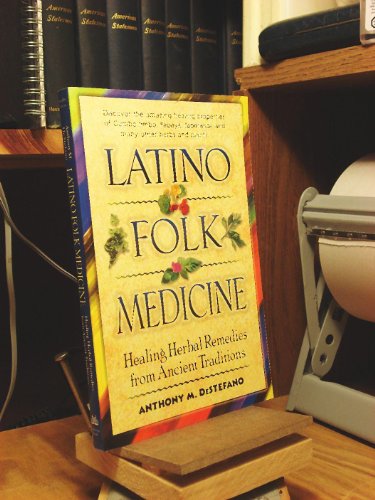
The Latino folk pharmacopoeia is one of the largest and richest on earth. Drawing on a centuries-old culture of healing tradition, informed by a deep reverence for history, this marvelous resource gives a vivid, balanced look at Latino folk medicine as practiced across America. Inside you will meet the lay healers, curanderes, who prescribe for the sick, visit the botanicas that sell hundreds of medicinal plant products, and learn all about the folk remedy tradition, including how
¸ GINGER can soothe an upset stomach
¸ ANISE keeps colic under control
¸ KALALLO BUSH treats the common cold
¸ EMBAUBA works as an astringent on dry skin
Each botanical profile lists the scientific and common name, where the plant is grown and its physical characteristics, traditional uses, availability and dosage, and contraindications and special precautions. It is important to note that herbs should only be taken with the consultation of your physician.
Welcome to the world of the yerba buena ("good herb"), where scientists are finding new hope for chronic disease and ordinary folk are discovering new possibilities for better health and well-being!
"synopsis" may belong to another edition of this title.
From the Inside Flap
asthma . . . Guajava for skin care . . . Eucalyptus for bronchitis . . . Dragon's Blood for wounds . . . Cat's Claw for arthritis. . . .
The Latino folk pharmacopoeia is one of the largest and richest on earth. Drawing on a centuries-old culture of healing tradition, informed by a deep reverence for history, this marvelous resource gives a vivid, balanced look at Latino folk medicine as practiced across America. Inside you will meet the lay healers, curanderes, who prescribe for the sick, visit the botanicas that sell hundreds of medicinal plant products, and learn all about the folk remedy tradition, including how
¸ GINGER can soothe an upset stomach
¸ ANISE keeps colic under control
¸ KALALLO BUSH treats the common cold
¸ EMBAUBA works as an astringent on dry skin
Each botanical profile lists the scientific and common name, where the plant is grown and its physical characteris
Reviews
Pulitzer Prize-winning reporter DeStefano (New York Newsday) offers information on approximately 60 of the most widely used medicinal plants in Mexico and Central and South America and among North American Hispanic populations. The author provides a brief historical background and cultural/spiritual context but focuses on descriptions of the plants, including uses, dosages, precautions, and research findings. Many of these plants are native to Latin America, but others, such as anise, eucalyptus, peppermint, and ginger, were introduced to the Americas. Much of the information seems drawn from publications widely in use, such as Mark Blumenthal's The Complete German Commission E Monographs (American Botanical Council, 1998). Although DeStefano interviewed curanderas and other healers, as well as physicians, it is disappointing that the book was not co-written with a specialist. Complementing the many resources describing traditional Asian herbal remedies, this book fills a niche and is guardedly recommended here, but one should also consider Abel Delgado's Los Mejores Remedios Caseros ("The Best Home Remedies," Rodale Pr., 1998).DAndy Wickens, King Cty. Lib. Syst., Seattle
Copyright 2001 Reed Business Information, Inc.
Excerpt. © Reprinted by permission. All rights reserved.
CHAPTER ONE
The Spirit and the Medicine
Under the gaze of the ceramic saints on the shelves and the smiling Buddha
by the door, a dark-haired, heavyset Dominican woman paced back and forth
in the store. Looking out onto Broadway in upper Manhattan, she was
clearly anxious; her animated eyes betrayed her inner turmoil.
The woman, named Lisa, spoke softly in Spanish to no one in particular as
the store's proprietor, a quiet, bespectacled man named Antonio Mora,
chatted with a visitor. Mora's establishment is known in Spanish as a
botanica, a place where people can buy a variety of medicinal herbs,
perfumed waters and oils, incense, and other items endowed with religious
significance. Customers can also, for a small fee, talk with Lisa in a
private consulta, a heart-to-heart talk that delves into the magical and
the spiritual. An errant child, a marriage problem, depression,
anxiety--Lisa is able to talk about all of it with visitors to the shop.
But on this particular day she was preoccupied with something more
immediate. A man had appeared earlier outside the Botanica Santa Barbara
and uttered some words to a large statue of Saint Barbara, the store's
namesake, which was the centerpiece of the window display. No one heard
what the man said, but Lisa figured it had to be nothing good. For he was
reputed to be a santero, a practitioner of a Cuban-African religion that
has many followers in New York City's Hispanic community, and when he had
last been in the store he had not left on very good terms, at least
according to Mora.
"He stopped outside and talked to Santa Barbara," Mora said, gesturing
toward the large porcelain religious statue in his store's window. "She
saw him," Mora went on, referring to Lisa. "The spirits told her
something."
The spirits had apparently told Lisa something about the negative forces
the man had tried to use, and she knew she had to act fast. She gathered
up a glass bowl and some items from behind the counter and disappeared
into the back room of the store, the place where she plies her own trade.
Mora, a soft-spoken man who had emigrated from Cuba three decades earlier,
seemed to have a slightly bemused smile as he watched Lisa go through her
paces. When she went to the back of the store, Mora turned to talk with a
visitor by a display counter stocked with piles of herbs and plants.
Mora's botanica is well known in New York City. Located near the George
Washington Bridge, it is right in the heart of New York's thriving
Dominican community. Fed by a steady stream of immigration, the area now
has the largest concentration of Dominicans outside their homeland. The
rush to open businesses catering to this immigrant culture has been so
steady that there is hardly a vacant storefront along Broadway and the
side streets. The neighborhood resembles other Latino ethnic enclaves in
East Harlem, Los Angeles, and Miami. Stores that once catered to an older
German community around World War II have been replaced by restaurants,
boutiques, butcher shops, electronics stores, and Chinese restaurants, all
sporting signs in Spanish. Remittance and telephone stores cater to a
steady clientele who wire money back to the Dominican Republic, the
economy of which is partly sustained by the flow of cash sent from
immigrants living in New York.
Botanica Santa Barbara's niche is a special one for the city's Hispanic
community and is symbolic of both the widespread use of medicinal plants
and, as Lisa's presence reminds us, the reliance on spiritual elements and
religion for health care among Latinos. No one knows for certain how many
botanicas exist in New York, but where Hispanic populations settle, the
botanica will soon follow. If none exists to serve the community,
enterprising men and women will start selling medicinal plants and
religious items from their apartments. If business improves, they may
expand their operations to storefronts.
Each botanica is unique, but most stock the same things: magical perfumed
air sprays, oils, votive candles, and religious figurines that relate to
Roman Catholicism, Santeria, and even Buddhism. There are commonplace
medicines, such as Vicks, and more specialized ones known only to
Hispanics, such as siete jarabes, or seven syrups, a blend of extracts
from seven plants, including wild cherry and castor (used in Latin
cultures as an expectorant for the treatment of asthma). Medicinal plants
are also in abundance, perfuming the air with the smell of mint,
chamomile, and many other types of vegetation.
Mora stores his medicinal herbs and plants in a refrigerated display case,
which he believes keeps the products fresh. In other shops the herbs are
kept out in the open, often in a helter-skelter array of boxes and crates.
There is
a steady turnover, said Mora. For no matter what other health care
Hispanics may use, experts estimate that about half rely on folk
medicines, a figure that remains constant even when education or
employment status is taken into account.
It is not just Hispanics, Mora insisted, who come to the botanica. There
is a substantial flow of traffic from other ethnic groups such as
African-Americans and Asians.
"A lot of white people, a lot of people who spend money, come in here," he
said, adding that he even attracts customers who work at the nearby
Columbia-Presbyterian Medical Center, the largest hospital in the
metropolitan area.
Having emigrated from Cuba shortly after Fidel Castro came to power, Mora
landed in New York after a brief stay in Miami and began his career as a
waiter, working in some of the big hotels. A couple of days a week Mora
attends to the affairs of Botanica Santa Barbara, in which he took a part
ownership after some friends approached him with the business proposition.
Mora does not pretend to know the science behind the medicinal plants. But
he does know what sells and why people continue to buy. Waving his hand in
front of the display case, Mora pointed out insulina, a plant that, as the
name suggests, is used because it is believed to control diabetes, a
disease that is particularly prevalent among Hispanics, according to
federal government health studies. Ruda, known by the English name rue, is
also a big seller and has been used in Latin America as everything from an
abortifacient to a treatment for cancer and headaches, even though some
experts say it can cause severe stomach pain, vomiting, and even death if
taken internally. Also evident are herbs such as roma sarquey, used in
Santeria to clean up evil, Mora said.
As Mora was talking about the plants, Lisa emerged from the back room of
the botanica holding a glass bowl of water colored blue with a dye that
came in a small paper-wrapped cube. Floating in the liquid were clumps of
camphor, a substance distilled from the wood of a tree and normally used
as a liniment. But camphor is also known to be a disinfectant; combined
with some ammonia Lisa had added,
the water had an unusual potency against germs and, she hoped, against the
evil that threatened the shop.
Walking to the front of the store, Lisa stopped by the door and with a
paper cup began splashing the blue water onto the floor and throw rug that
lay in front of the medicinal plants. Going behind the glass-topped
counter, she splashed some more, making sure to cover the spots hidden
near Mora's desk. When she was done, Lisa cleaned up the floor with a
cloth mop, using long, languid strokes. She said nothing and returned to
the rear of the botanica. Any prayers she may have spoken were internal
ones, known only to her and the powers she addressed.
Lisa soon came back out again, carrying a coconut in a silver chalice.
Asking Mora for a jar of palm oil, she then smeared some of the oil
lengthwise along the coconut. Lighting a black candle and sticking it atop
the oil-streaked coconut, Lisa walked the concoction over to the door and
placed it on the floor next to a gilded porcelain statue of a smiling
Buddha. She then went to the back of the shop again.
"It is to protect this place," Mora said about the ritual Lisa was
performing.
Many botanicas have people like Lisa affiliated with them, emblematic of
the inseparable link that traditional medicine in the Hispanic community
has with spiritual and religious components. Sickness is very often
perceived to be not solely a question of microbes and biochemical causes
but inextricably intertwined with the spiritual elements of a person's
life and those who take on the job of performing the healing. This is
particularly true in the Puerto Rican community, which has deep historical
ties to espiritismo. According to one survey of Puerto Rican households in
New York, 53 percent of the families had at least one person who believed
in espiritismo.
"Spiritism is the more traditional healing practice among Puerto Ricans,"
says Vivian Garrison, who did a medical anthropological study in the South
Bronx in the late 1960s. "[But] in its present form and its literate
tradition it dates back only to the last half of the nineteenth century
and the writings of Alan Kardec."
An engineer and hypnotist, Kardec, known also by the pseudonym Hippolyte
de Rivail, wrote about and gave form to the belief in spirits that was
popular in Europe during the late nineteenth century. Some of the
adherents to spiritism and Kardec's teachings were Victor Hugo, Mark
Twain,
and Napoleon III. In his Book of the Spirits, Kardec expounded upon a
detailed system of relationships among spirits and the living beings,
known as seres. It is a complex system of good, imperfect, and pure
spirits, with various levels within levels. But the essential elements,
accordin...
"About this title" may belong to another edition of this title.
Other Popular Editions of the Same Title

Search results for Latino Folk Medicine: Healing Herbal Remedies from...

Stock Image
Latino Folk Medicine: Healing Herbal Remedies from Ancient Traditions
Published by
Ballantine Books January 2001, 2001
ISBN 10: 0345438361
ISBN 13: 9780345438362
Used
Paper Back
Seller: Isle of Books, Bozeman, MT, U.S.A.
Seller rating 4 out of 5 stars

Paper Back. Condition: Good. Seller Inventory # 614676
Seller Image
Latino Folk Medicine: Healing Herbal Remedies from Ancient Traditions
Published by
Ballantine Books, 2001
ISBN 10: 0345438361
ISBN 13: 9780345438362
Used
Paperback
First Edition
Seller: Southampton Books, Sag Harbor, NY, U.S.A.
Seller rating 5 out of 5 stars

Paperback. Condition: Like New. First Edition. First Edition, First Printing. Not price-clipped. Published by Ballentine Books, 2001. Octavo. Paperback. Book is like new. 100% positive feedback. 30 day money back guarantee. NEXT DAY SHIPPING! Excellent customer service. Please email with any questions. All books packed carefully and ship with free delivery confirmation/tracking. All books come with free bookmarks. Ships from Sag Harbor, New York. Seller Inventory # 304423
Stock Image
Latino Fok Medicine -
Seller: "Pursuit of Happiness" Books, Oakland, CA, U.S.A.
Seller rating 4 out of 5 stars
Soft cover. Condition: Good. Gd. condition - An exploration into the healing herbal remedies from ancient traditions . (AE5). Book. Seller Inventory # 5016ml
Stock Image
Latino Folk Medicine: Healing Herbal Remedies from Ancient Traditions
Published by
Ballantine Books, 2001
ISBN 10: 0345438361
ISBN 13: 9780345438362
New
Soft cover
First Edition
Seller: BOOKWEST, Phoenix, AZ, U.S.A.
Seller rating 4 out of 5 stars
Soft cover. Condition: New. 1st Edition. SHIPS FROM USA. Seller Inventory # 104D1-0345438361-PB-7-Oz-Ylw
Stock Image
Latino Folk Medicine: Healing Herbal Remedies from Ancient Traditions
Seller: BennettBooksLtd, Los Angeles, CA, U.S.A.
Seller rating 5 out of 5 stars
paperback. Condition: New. In shrink wrap. Looks like an interesting title! Seller Inventory # Q-0345438361