
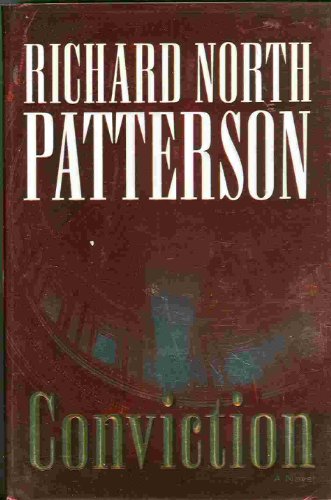
Synopsis
In his acclaimed career as a perennial bestselling author, Richard North Patterson has established himself as one of our most important voices in fiction and a keeper of the American conscience. He consistently writes novels that are intensely dramatic and deeply thought provoking. Now, in Conviction, Patterson tackles one of the most emotional and complex of all legal debates: When, if ever, does the state have the right to exact the ultimate punishment–and is the death penalty a crime unto itself?
Fifty-nine days. That’s how long Rennell Price has to live–after spending fifteen years on death row for the horrifying sexual assault and murder of a girl whose body was found floating in San Francisco Bay. But attorney Terri Paget, who has fought her own way out of hopelessness and abuse, has dedicated her life to fighting for people like Rennell Price. This time, Terri has a client she believes may actually be innocent, which means that an unpunished killer may still be free.
“I didn’t do that little girl” is all Rennell Price has ever said in his own defense. In a trial, Rennell, along with his older brother, Payton, was found guilty of the heinous crime, and the conviction has been upheld through one appeal after another. But as Terri spends time with Rennell and re-creates the events that put him on death row–beginning with the first minutes of the police investigation–she starts to understand the forces that shaped Rennell and the reason he has never been able to defend himself adequately.
As Terri prepares for a last appeal, she gets a new weapon for her battle–fresh evidence suggesting that another man, not Rennell, helped Payton commit the atrocity. But the grim machinery of capital punishment is already in motion, involving precedent and politics reaching from California to the highest court in the nation. As more people are drawn into Terri’s last-ditch battle, and as agendas and personalities clash while time is running out for Rennell Price, this much is clear: The serious doubts about Rennell’s guilt may not be enough to save him.
Conviction raises issues of ethics, political expediency, and personal trauma that will shake readers to their core. For here, in a novel of vivid characters on both sides of the law and profound tension on every page, Patterson illuminates the mysterious precincts between justice and truth–where the fate of one man involves not only his own life and the lives he has affected but the moral life of a nation.
"synopsis" may belong to another edition of this title.
About the Author
RICHARD NORTH PATTERSON’s thirteen novels include eight consecutive international bestsellers, all greeted by critical acclaim–for example, comparing his Protect and Defend to such novels as Allen Drury’s Advise and Consent and Gore Vidal’s Lincoln. Formerly a trial lawyer, Patterson served as the SEC’s liaison to the Watergate special prosecutor and is now on the boards of several Washington-based advocacy groups dealing with gun violence, political reform, and reproductive rights. He lives on Martha’s Vineyard.
Reviews
Richard North Patterson is a pop novelist who wants to change the world. In 12 previous novels, Patterson has taken on date rape (he's opposed), Watergate-style corruption (also opposed), child abuse (ditto), gun control (he's in favor), late-term abortion (see Protect and Defend for his stance on that) and an evil that Washington knows intimately -- the publicly financed sports stadium. One can hardly blame him for trying to slay society's dragons. One can, however, fault him for trying too hard.
In Conviction, Patterson, a former trial lawyer, makes a case against the death penalty; more specifically, against the labyrinthine and counterintuitive laws governing it. The central thrust of Conviction -- that an innocent man can be put to death because today's legal system provides no mechanism to spare him -- faces bipartisan political hostility. As governors campaigning for the presidency, neither Bill Clinton nor George W. Bush did anything to stop the executions of mentally retarded prisoners. In 1992, in an Arkansas prison, Ricky Ray Rector set aside a slice of pecan pie from his last meal, to eat after he returned from his lethal injection. In 2000, Oliver David Cruz died in the Texas death chamber even after lawyers cited his IQ of 63 and his three attempts at completing the seventh grade as evidence that he was useless in his own defense.
The cause celebre of Conviction is Rennell Price, a hulking, sad-eyed, slow-witted product of the San Francisco ghetto who, along with his Svengali brother, Payton, has been sentenced to die for the rape and murder of a 9-year-old girl. Swooping in 15 years after Rennell's conviction is a Justice League familiar to Patterson's readers: crusading attorney Teresa Peralta Paget, along with her law partner and husband, the famous Christopher Paget, and Chris's son, Carlo, now a lawyer, too.
Terri and the gang have two months to derail what increasingly seems like the inevitable execution of Rennell, who they claim is retarded. Rennell's account of the crime is limited to the crude refrain "I didn't do that little girl!" A key witness has died, and the physical evidence is too degraded to test for DNA, but Terri has determined that Rennell's lawyer at the original trial was a lazy cocaine addict, and in an 11th-hour confession, Payton proclaims Rennell's innocence and fingers another suspect in his place. Terri argues that that's enough for the courts to re-examine the conviction, but the game is stacked. Terri's appeals climb the judicial ladder, eventually involving another of Patterson's recurring characters, U.S. Supreme Court Chief Justice Caroline Masters. Masters gets to duke it out with a not-so-veiled Antonin Scalia clone, a capital punishment zealot aptly named Justice Anthony Fini. Adding drama to the mix is Terri's teenage daughter, Elena, whose abuse Patterson fans will remember from Eyes of a Child. She's outraged that her mother would defend a convicted child molester.
It's high stakes and low drama played out in a middlebrow arena -- blue-state values served up red-meat style, hold the purple prose. Deliciously, Patterson spends the first third of Conviction piling on proof that Rennell is a sick predator worthy of being put to death. A less confident plotmeister might shrink from the task Patterson then hands himself -- to rehabilitate Rennell in the story's middle section, rendering him sympathetic enough to care about. The last third of Conviction offers a revelatory tour of the dark side of the American justice system.
But buzz-sawing through a thriller requires different reading muscles from parsing the limits of habeas corpus and the Antiterrorism and Effective Death Penalty Acts. A reader's eyes can be forgiven for skipping over a few didactic paragraphs before Patterson gets back to the action. His argument is clear. The law, he says, is bloodthirsty. The best chance to save the wrongly condemned rests with our governors, and you can see for yourself how often those guys stroll down Mercy Street. The defendant is an afterthought.
Patterson is a terrific novelist whose only bar to greatness is, as with many other popular authors, a slavish devotion to plot. His characters aren't quite stereotypes, but they often seem to be conceived less as individuals than as narrative conveniences. Same with the dialogue. Regardless, Conviction, though not Patterson's best, has its rewards. That it tilts more toward educating than entertaining can be blamed on his decision to push an agenda. But give him credit for backing an underdog. The pen may be mightier than the sword, but at this point in the evolution of our great republic, it isn't mightier than 50cc of potassium chloride.
Reviewed by Bob Ivry
Copyright 2005, The Washington Post Co. All Rights Reserved.
After focusing on gun control and tort reform (in Balance of Power) and late-term abortion and Supreme Court nomination (in Protect and Defend), Patterson takes on the death penalty, exploring its uncertainties and injustices from the perspective of San Francisco lawyer Christopher Paget—hero of the author's first book, The Lasko Tangent—and Paget's lawyer wife, Terri. The horrific crime on which the novel hinges is the killing of nine-year-old Thuy Sen, whose body is found in San Francisco Bay. The medical examiner quickly ascertains that the little girl did not drown but choked to death on semen. After Thuy Sen's picture is broadcast on television, an elderly eyewitness identifies her dope-dealer neighbors Payton and Rennell Price as the killers. This story is told in flashback after Terri Paget, who specializes in representing death row inmates, takes on the 15-year-old case, representing Rennell, who has 59 days before he is to die by lethal injection. Rennell is a hulking retarded black man whose sullen passivity inspires little sympathy in anyone. Over the next several months, Teresa comes to believe in Rennell as she fights not only to stop his execution but to prove him innocent. It's a compelling story, but Patterson's true interest is in the legal details. He mostly succeeds at explaining the often Orwellian legal complexities of the death penalty, but the price he pays as a novelist is high. Many readers will skip over vast sections of the book, but those who stick with it will find the ending moving and come away with a greater understanding of a controversial issue.
Copyright © Reed Business Information, a division of Reed Elsevier Inc. All rights reserved.
Former trial lawyer Patterson, who has tackled such weighty issues as abortion (Protect and Defend, 2000) and the Second Amendment (Balance of Power, 2003), now turns his keen eye to the issue of the death penalty. Terri Peralta Paget has just taken the case of Rennell Price, who is on death row for the murder of a nine-year-old girl. Rennell and his older brother, Payton, were convicted 15 years ago of sexually abusing the girl and killing her in the process. But as Terri goes over the case and talks to the detective in charge of the initial investigation and the lawyer who handled Rennell's subsequent appeals, she starts to have doubts about Rennell's mental capacity and his guilt. Physical evidence placed the victim at the scene, and the prosecution's star witness, Eddie Fleet, named the brothers as her killer, but the same lawyer, an incompetent cokehead who mishandled their defense, represented both Rennell and Payton. As with his previous novels, Patterson examines a complex issue through the lens of a compelling, gripping story. Readers familiar with his characters (many of whom have appeared in his previous novels) and those looking for a powerful courtroom drama will not be disappointed. Kristine Huntley
Copyright © American Library Association. All rights reserved
Excerpt. © Reprinted by permission. All rights reserved.
CONVICTION
Chapter One
In fifty-nine days, if the State of California had its way, the man inside the Plexiglas booth would die by lethal injection.
Teresa Peralta Paget paused to study him, the guard quiet at her side. Her new client stood with his back to them. He was bulky, the blue prison shirt covering his broad back like an oversize bolt of cloth. A picture of enthrallment, he gazed through the high window of the exterior wall at the San Francisco Bay, its water glistening in the afternoon sun. She was reluctant to distract him; the man’s sole glimpses of the world outside, Terri knew, occurred when his lawyers came to see him.
The others were out of it now; the last set of lawyers had withdrawn after their latest defeat. The final desperate efforts to keep Rennell Price alive—what she thought of as the ritual death spasms ordained by the legal system—had fallen to Teresa Paget. This was their first meeting: but for his solitude, she could not have picked her client out from the other men huddled with their lawyers in the two rows of Plexiglas cubicles. It resembled, Terri thought, an exhibit of the damned—sooner or later, in months, or more likely years, the impersonal, inexorable grinding of the machinery of death would consume each one in turn.
But perhaps not, Terri promised herself, this one. At least not until she had burnt herself down to the nerve ends, sleep-deprived from the effort to save him.
To her new client, she supposed, Terri might appear a mere morsel for the machine, insufficient even to slow its gears. She was small—barely five feet four—and slight, with olive skin and a sculpted face, which her husband stubbornly insisted was beautiful: high cheekbones; a delicate chin; a ridged nose too pronounced for her liking; straight black hair, which, in Terri’s mind, she shared with several million other Latinas far more striking than she. There was little about her to suggest the steeliness an inmate might hope for in his lawyer except, perhaps, the green-flecked brown eyes, which even when she smiled never quite lost their keenness, or their watchfulness.
This wariness was Terri’s birthright, the reflex of a child schooled by the volatile chemistry which transformed her father’s drinking to bru- tality, and reinforced by the miserable first marriage which Terri, who had no better model, had chosen as the solution to her pregnancy with Elena. Her personal life was different now. As if to compensate for this good fortune, she had turned her career down a path more arduous than most lawyers could endure: at thirty-nine, she had spent the last seven years representing death row inmates, a specialty which virtually guaranteed the opposition and, quite frequently, the outright hostility of judges, prosecutors, witnesses, cops, governors, most relatives of the victim, and by design, the legal system itself—not to mention, often, her own clients. Now that stress and anxiety no longer waited for her at home, Terri sometimes thought, she had sought them out.
What would be most stressful about this client was not the crime of which he stood convicted, though it was far more odious than most— especially, given certain facts, to Terri herself. Nor was it whatever version of humanity this man turned out to be: her death row clients had run the gamut from peaceable through schizophrenic to barking mad. But this client represented the rarest and most draining kind of all: for fifteen years, through a trial court conviction in 1987, then a chain of defeats in the California Supreme Court, the Federal District Court, the Federal Court of Appeals, and the United States Supreme Court, Rennell Price had claimed his innocence of the crime for which the state meant to kill him.
No court had considered this claim worthy of belief or even, in the last five of these proceedings, a hearing. As far as the State was concerned, its sole remaining task should be to dispatch three psychiatrists to advise the Governor’s office, within twenty days of the appointed date of execution, whether her client was sane enough to die: one of the niceties of capital punishment, Terri thought sardonically, was the State’s insistence that the condemned fully appreciate that lethal injection would, in fact, be lethal.
She nodded to the guard.
He rapped sharply on the Plexiglas. With a twitch of his shoulders, as though startled, the black man inside the cage turned to face them.
His eyes were expressionless; for him, Terri thought, the highlight of her visit—a view of the bay—was already over. With a resignation born of fifteen years of meeting lawyers in these booths, he backed toward the door and, hands held behind his back, thrust them through an open slot.
The guard clapped on his handcuffs, closing them with a metallic click. Then Rennell Price, shackled, stepped away from the door.
The guard opened it, admitting Terri.
The door shut, and Rennell stood over her. As he backed to the slot again, waiting for the guard to uncuff his outthrust hands, Terri had an involuntary spurt of fear, the reflex of a small woman confined with a hulking stranger who had, in the estimate of twelve jurors, done a terrible thing to someone much smaller than she.
She held out her hand. “I’m Terri Paget,” she told him. “Your new lawyer.”
His expression was somewhere between sullen and indifferent—she might as well have pronounced herself an emissary from Pluto. But after a moment, he looked up at her and said in a monotone, “My name Rennell.”
She searched his eyes for hope or, at least, some instinct to trust. She saw none.
“Why don’t we sit,” Terri said. “Get acquainted a little.”
With a fractional shrug, her client turned, slid out the orange plastic chair on the far side of a laminated wood table, and sat, staring past Terri. Settling across from him, Terri saw the inmates in the next two cages huddled with their lawyers, lips moving without sound.
Rennell’s face, Terri decided, was more than inexpressive—it had no lines, as if no emotion had ever crossed it. She reminded herself that he had been only eighteen when convicted, now was barely thirty-three, and that the fifteen years in between had been, were this man lucky, mostly solitary, and unrelentingly the same. But not even Terri’s presence—a novelty, at least—caused the line of his full mouth to soften, or his wide brown eyes to acknowledge her.
Terri tried to wait him out. Yet the broad plane of his face remained so impassive that he seemed not so much to look through her as to deny her presence. It was hard to know the reasons. But one of the hallmarks of an adult abused as a child, Terri reflected, was an emotional numbing to the point of dissociation—a willful process of going blank, of withdrawing mentally from this earth. Jurors often thought such men indifferent to the crimes their prosecutors described so vividly; in the case of this crime, that could hardly have helped Rennell Price.
“I’ve taken over your case,” Terri explained. “Your lawyers at Kenyon and Walker thought you deserved a fresh pair of eyes.”
This drew no reaction. Mentally, Terri cursed her predecessors for their absence, the ultimate act of cowardice and desertion—leaving her to build a relationship with a sullen stranger, the better to save his life, or prepare him to die. Then, to her surprise, he asked, “You know Payton?”
“Your brother? No, I don’t.” Terri tried to animate her voice with curiosity. “How’s he doing?”
“Fixing to die. They’re going to kill him. Before me.”
Oddly, Terri thought, this last detail about Payton seemed to carry more dread than his own fate. “How do you know?” she inquired.
He slumped forward on the table, not answering. “I can’t be there,” he said dully. “Warden told me that.”
Struck by the answer, Terri chose to ignore its unresponsiveness. “What else did she tell you?”
“That I can pick five people. When my time come.”
Five witnesses, Terri thought, granted the condemned by the grace of the State of California. But from what Terri knew, it would be hard to find five people, outside the victim’s family, who gave enough of a damn to watch. Rennell Price’s death, if it came, would be a very private affair.
“You don’t have to worry about that yet.” Pausing, Terri looked hard into his eyes. “We’ll have a lot of help—my husband, Chris, who’s a terrific lawyer, and a team of investigators to look into your case. You’ll meet them all soon. We’ll be doing everything we can to save your life.”
For almost half that life, he had heard this—Terri could see that much in his face. And each time, she already suspected, whoever said it had been lying.
Slowly, his eyelids dropped.
“I didn’t do that little girl,” he said. “Payton didn’t do her.”
The denial sounded rote, yet etched with fatigue. “How do you know about Payton?” Terri asked.
“He told me.”
What to make of that, she wondered. As either a reason to believe his brother or a statement of truth, it was implausible to the point of pitiful, and she could not divine if this man knew it. “Who do you think ‘did’ her, Rennell?”
He gave a silent shrug of the shoulders, suggesting an absence of knowledge or, perhaps, a massive indifference.
“The day she died,” Terri persisted, “can you remember where you were?”
“I don’t remember nothing.”
As an answer, it was at least as credible as the alibi the defense had offered at the brothers’ t...
"About this title" may belong to another edition of this title.
Other Popular Editions of the Same Title

Search results for Conviction

Stock Image
Conviction
Seller: World of Books (was SecondSale), Montgomery, IL, U.S.A.
Seller rating 5 out of 5 stars

Condition: Acceptable. Item in acceptable condition! Textbooks may not include supplemental items i.e. CDs, access codes etc. Seller Inventory # 00084205390
Stock Image
Conviction
Seller: World of Books (was SecondSale), Montgomery, IL, U.S.A.
Seller rating 5 out of 5 stars
Condition: Good. Item in good condition. Textbooks may not include supplemental items i.e. CDs, access codes etc. Seller Inventory # 00083388435
Stock Image
Conviction
Seller: Orion Tech, Kingwood, TX, U.S.A.
Seller rating 5 out of 5 stars
Hardcover. Condition: Good. Seller Inventory # 0345450191-3-18899934
Stock Image
Conviction
Seller: Your Online Bookstore, Houston, TX, U.S.A.
Seller rating 5 out of 5 stars
Hardcover. Condition: Good. Seller Inventory # 0345450191-3-26067991
Stock Image
Conviction
Seller: SustainableBooks.com, Amherst, NY, U.S.A.
Seller rating 5 out of 5 stars
Condition: Fair. Book is in Used-Acceptable condition. Used items may not include supplementary materials such as CDs or access codes. Pages and cover may have wear, tears, and stickers. Pages are may contain notes and highlighting. Seller Inventory # 0345450191-2-5
Stock Image
Conviction
Seller: Once Upon A Time Books, Siloam Springs, AR, U.S.A.
Seller rating 4 out of 5 stars

Hardcover. Condition: Acceptable. This is a used book. It may contain highlighting/underlining and/or the book may show heavier signs of wear . It may also be ex-library or without dustjacket. This is a used book. It may contain highlighting/underlining and/or the book may show heavier signs of wear . It may also be ex-library or without dustjacket. Seller Inventory # mon0000574674
Stock Image
Conviction
Seller: Once Upon A Time Books, Siloam Springs, AR, U.S.A.
Seller rating 4 out of 5 stars
Hardcover. Condition: Good. This is a used book in good condition and may show some signs of use or wear . This is a used book in good condition and may show some signs of use or wear . Seller Inventory # mon0000595349
Seller Image
Conviction
Seller: MERS Goodwill-Kansas City, Blue Springs, MO, U.S.A.
Seller rating 5 out of 5 stars
Condition: good. The book has been read but is in good condition. It has very minimal damage to the cover, including scuff marks, but no holes or tears. The dust jacket for hard covers may not be included. The binding has minimal wear. The majority of pages are undamaged with minimal creasing or tearing, minimal pencil underlining of text, no highlighting of text, and no writing in the margins. There are no missing pages. See the seller's listing for full details and a description of any imperfections. Seller Inventory # WMEKV.0345450191.G
Seller Image
Conviction
Seller: Used Book Company, Egg Harbor Township, NJ, U.S.A.
Seller rating 3 out of 5 stars

Condition: like_new. Shows very minimal signs of wear and previous use. Can include notes highlighting. A portion of your purchase benefits nonprofits! - Note: Edition & format may differ from what is shown in stock photo & item details. May not include supplementary material such as toys, access code, dvds, etc. Seller Inventory # 584ZSU000IXR_ns
Stock Image
Conviction
Seller: BookHolders, Towson, MD, U.S.A.
Seller rating 5 out of 5 stars
Condition: Good. [ No Hassle 30 Day Returns ][ Ships Daily ] [ Underlining/Highlighting: NONE ] [ Writing: NONE ] [ Edition: First ] Publisher: Random House Pub Date: 1/25/2005 Binding: Hardcover Pages: 463 First edition. Seller Inventory # 6449858