
Items related to Sunstorm (A Time Odyssey, Book 2)
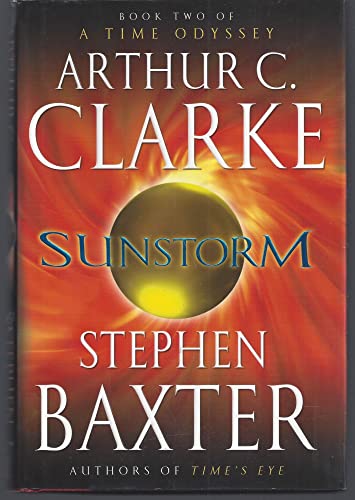
Synopsis
When Sir Arthur C. Clarke, the greatest science fiction writer ever, teams up with award-winning author Stephen Baxter, who shares Clarke’s bold vision of a future where technology and humanism advance hand in hand, the result is bound to be a book of stellar ambition and accomplishment. Such was the case with Time’s Eye. Now, in the highly anticipated sequel, Clarke and Baxter draw their epic to a triumphant conclusion that is as mind-blowing as anything in Clarke’s famous Space Odyssey series.
SUNSTORM
Returned to the Earth of 2037 by the Firstborn, mysterious beings of almost limitless technological prowess, Bisesa Dutt is haunted by the memories of her five years spent on the strange alternate Earth called Mir, a jigsaw-puzzle world made up of lands and people cut out of different eras of Earth’s history. Why did the Firstborn create Mir? Why was Bisesa taken there and then brought back on the day after her original disappearance?
Bisesa’s questions receive a chilling answer when scientists discover an anomaly in the sun’s core–an anomaly that has no natural cause is evidence of alien intervention over two thousand years before. Now plans set in motion millennia ago by inscrutable watchers light-years away are coming to fruition in a sunstorm designed to scour the Earth of all life in a bombardment of deadly radiation.
Thus commences a furious race against a ticking solar time bomb. But even now, as apocalypse looms, cooperation is not easy for the peoples and nations of the Earth. Religious and political differences threaten to undermine every effort.
And all the while, the Firstborn are watching...
"synopsis" may belong to another edition of this title.
About the Author
ARTHUR C. CLARKE is considered the greatest science fiction writer of all time and is an international treasure in many other ways, including the fact that a 1945 article by him in 1945 led to the invention of satellite technology. Books by Clarke–both fiction and nonfiction–have sold more than one hundred million copies worldwide. He lives in Sri Lanka.
STEPHEN BAXTER is a trained engineer with degrees from Cambridge and Southampton universities. Baxter is the acclaimed author of the Manifold novels and Evolution. He is the winner of the British Science Fiction Award, the Locus Award, the John W. Campbell Award, and the Philip K. Dick Award, as well as being a nominee for an Arthur C. Clarke Award.
Reviews
Two giants—Clarke, one of the greatest SF writers, and award-winning Evolution (2003) author Baxter—have collaborated on an insidious vision of the future that’s sure to thrill fans of 2001: A Space Odyssey and other SF classics. It may help to first read Time’s Eye, which provides the back story to the aliens’ cruel experiments and desire to wipe out Earth, but each book stands alone. Convincing characters, including a British astronomer and doomsday physicist, lead the collective countdown to destruction. The authors’ scientific details (why the Earth’s shield must be made of glass manufactured on the moon, for instance) complement the plot. But it’s the climax, although flawed, that’s sure to blow your mind.
Copyright © 2004 Phillips & Nelson Media, Inc.
Set in the same universe as Clarke's 2001 and its sequels, Clarke and Baxter's second and final Time Odyssey book (after 2004's Time's Eye) will especially appeal to fans of hard SF who appreciate well-grounded science and humans with a can-do attitude to problem solving. In 2037, the same day the enigmatic alien Firstborn return Bisea Dutt, the heroine of Time's Eye, to her home in London, the city grinds to a halt as a sun storm sends a massive surge of energy to Earth, temporarily destroying the world's electronic infrastructure. This surge presages another, much larger sun storm, due to hit in 2042, which will utterly annihilate life across the globe. Against all odds, the nations of Earth come together to construct a huge space umbrella that will shield the planet from the worst of the barrage. The answer to why the sun's activity is being manipulated to wipe out life on Earth must wait, given the day-to-day difficulties and politics of the construction project. The five-year sweep of events, the plethora of characters and the cuts from Mars to Earth to the moon during the climactic sun storm give the story a movie montage feel, but the focus on the enormously challenging task at hand will keep readers turning the pages. Agent, Scovil, Chichak, Galen. (Mar. 1)
Copyright © Reed Business Information, a division of Reed Elsevier Inc. All rights reserved.
In this splendid sequel to Time's Eye [BKL O 15 03], Bisesa Dutt returns from Mir, the scrambled world of kidnapped human samples, just when Earth is stricken by a massive solar flare. Astronomer Royal Siobhan McGorran learns from scientists on the moon that the flare is only a precursor to one that will destroy all life on Earth, and Bisesa's travels offer clues that the flares are constituents in a lengthy plot on the part of the alien Firstborn to destroy the human race. A superbly drawn battle for the survival of Earth takes up the rest of the book. The details of humanity's survival device (an Earth-sized sun shield) and the fraying of society, and the characters of the astronauts, engineers, lunar settlers, and artificial intelligences (each with its distinctive personality) are filled out with skill and total conviction, and without at any point slowing the pace. Most of the novel and its predecessor are based on concepts that Clarke absolutely masters (e.g., that of watchful elder races, though the Firstborn have entirely different plans for humanity than the Overlords had in Clarke's classic Childhood's End, 1953). Since Baxter is gaining similar mastery, Sunstorm is his and Clarke's most seamless collaboration to date. Roland Green
Copyright © American Library Association. All rights reserved
Excerpt. © Reprinted by permission. All rights reserved.
Return
Bisesa Dutt gasped, and staggered.
She was standing. She didn’t know where she was.
Music was playing.
She stared at a wall, which showed the magnified image of an impossibly beautiful young man crooning into an old-fashioned microphone. Impossible, yes; he was a synth-star, a distillation of the inchoate longings of subteen girls. “My God, he looks like Alexander the Great.”
Bisesa could barely take her eyes off the wall’s moving colors, its brightness. She had forgotten how drab and dun-colored Mir had been. But then, Mir had been another world altogether.
Aristotle said, “Good morning, Bisesa. This is your regular alarm call. Breakfast is waiting downstairs. The news headlines today are—”
“Shut up.” Her voice was a dusty desert croak.
“Of course.” The synthetic boy sang on softly.
She glanced around. This was her bedroom, in her London apartment. It seemed small, cluttered. The bed was big, soft, not slept in.
She walked to the window. Her military-issue boots were heavy on the carpet and left footprints of crimson dust. The sky was gray, on the cusp of sunrise, and the skyline of London was emerging from the flatness of silhouette.
“Aristotle.”
“Bisesa?”
“What’s the date?”
“Tuesday.”
“The date.”
“Ah. The ninth of June, 2037.”
“I should be in Afghanistan.”
Aristotle coughed. “I’ve grown used to your sudden changes of plans, Bisesa. I remember once—”
“Mum?”
The voice was small, sleepy. Bisesa turned.
Myra was barefoot, her tummy stuck out, fist rubbing at one eye, hair tousled, a barely awake eight-year-old. She was wearing her favorite pajamas, the ones across which cartoon characters gamboled, even though they were now about two sizes too small for her. “You didn’t say you were coming home.”
Something broke inside Bisesa. She reached out. “Oh, Myra—”
Her daughter recoiled. “You smell funny.”
Shocked, Bisesa glanced down at herself. In her jumpsuit, scuffed and torn and coated with sweat-soaked sand, she was as out of place in this twenty-first-century London flat as if she had been wearing a spacesuit.
She forced a smile. “I guess I need a shower. Then we’ll have breakfast, and I’ll tell you all about it . . .”
The light changed, subtly. She turned to the window.
There was an Eye over the city, a silver sphere, floating like a barrage balloon. She couldn’t tell how far away it was, or how big. But she knew it was an instrument of the Firstborn, who had transported her to Mir, another world, and brought her home.
And over the rooftops of London, a baleful sun was rising.
The Peak of Eternal Light
Mikhail Martynov had devoted his life to the study of Earth’s star. And from the first moment he saw the sun, at the beginning of that fateful day, he knew, deep in his bones, that something was wrong.
“Good morning, Mikhail. The time on the Moon is two o’clock in the morning. Good morning, Mikhail. The time is two o’clock and fifteen seconds. Good morning . . .”
“Thank you, Thales.” But he was already up and moving. As always he had woken to within a minute of his personal schedule, without need of Thales’s softly spoken electronic wake-up call, a schedule he kept independently of the Houston time to which the rest of the Moon was enslaved.
Mikhail was a man of routine. And he would begin the day, as he began every day of his long solitary watches in this Space Weather Service Station, with a walk into the sunlight.
He took a quick breakfast of fruit concentrate and water. He always drank the water pure, never polluted with coffee granules or tea leaves, for it was water from the Moon, the result of billions of years of slow cometary accretion and now mined and processed for his benefit by million-dollar robots; he believed it deserved to be savored.
He clambered briskly into his EVA suit. Comfortable and easy to use, the suit was the result of six decades’ development from the clumsy armor worn by the Apollo astronauts. And it was smart, too; some said so smart it could go out Moonwalking by itself.
But smart suit or not, Mikhail worked cautiously through a series of manual checks of the suit’s vital systems. He lived alone here at the Moon’s South Pole, save for the electronic omnipresence of Thales, and everybody knew that low gravity made you dumb—the “space stupids,” they called it. Mikhail was well aware of the importance of concentrating on the chores necessary to keep himself alive.
Still, it was only minutes before he was locked tight into the warm enclosure of the suit. Through the slight distortion of his wedge-shaped visor he peered out at his small living quarters. He was a man equipped for interplanetary space, standing incongruously in a clutter of laundry and unwashed dishes.
Then, with a grace born of long practice, he pushed his way out through the airlock, and then the small dustlock beyond, and emerged onto the surface of the Moon.
Standing on the slope of a crater rim mountain, Mikhail was in shadow broken only by sparse artificial lighting. Above him stars crowded a silent sky. When he looked up—he had to lean back in his stiff suit—he could make out dazzling splashes of light high on the crater wall, places the low polar sunlight could reach. Solar-cell arrays and an antenna farm had been placed up there in the light, as well as the sun sensors that were the Station’s main purpose.
This Space Weather Service Station, dug into the wall of a crater called Shackleton, was one of the Moon’s smaller habitats, just a few inflatable domes linked by low tunnels and heaped over by a layer of charcoal-gray Moon dust.
Unprepossessing the hab itself may have been, but it was situated in one of the Moon’s more remarkable locations. Unlike the Earth, the Moon’s axis has no significant tilt; there are no lunar sea- sons. And at the Moon’s South Pole the sun never rises high in the sky. There the shadows are always long—and, in some places, permanent. Thus the pool of darkness in which Mikhail stood had been unbroken for billions of years, save by humans.
Mikhail looked down the slope, beyond the low bulges of the Station domes. On Shackleton’s floor floodlights revealed a complex tangle of quarries and lumbering machines. Down there robots toiled over the real treasure of this place: water.
When the Apollo astronauts had brought home their first dusty Moon rocks, the geologists had been dumbfounded that the samples contained not a trace of water, not even bound chemically into the mineral structures. It took some decades to unravel the truth. The Moon was no sister world of Earth but a daughter, created in the early days of the solar system when a collision with another infant world had smashed apart a proto-Earth. The debris that had eventually coalesced into the Moon had been superheated until it glowed blue-white, in the process driving off every trace of water. Later, comets had splashed on the Moon’s surface. Out of the billions of tonnes of water delivered by these lesser impacts, most had been lost immediately. But a trace, just a trace, had found its way to the permanently shadowed floors of the polar craters, a gift of water to the Moon as if in recompense for the circumstances of its birth.
By Earth’s standards the Moon’s water was little enough—not much more than a respectably sized lake—but for human colonists it was a treasure beyond price, literally worth far more than its weight in gold. It was invaluable for the scientists too, as it bore a record of eons of cometary formation, and offered indirect clues to the formation of Earth’s oceans, which had also been bequeathed by cometary impacts.
Mikhail’s interest in this place was not lunar ice, however, but solar fire.
He turned away from the shadows and began to toil up the steepening slope of the rim mountain toward the light. The path was just a trail, beaten flat by human footprints. It was marked by streetlights, as everybody called them, small globe lamps hung from poles, so he could see what he was doing.
The slope was steep, each step an effort even in the Moon’s gentle one-sixth gravity. His suit helped, with a subtle hum from exoskeletal servos and a high-pitched whir of the fans and pumps that labored to keep his faceplate clear of condensed sweat. He was soon breathing hard, and his muscles ached pleasantly: this walk was his daily constitutional.
At last he reached the summit of the mountain and emerged into flat sunlight. A small collection of robot sensors huddled here, peering with unending electronic patience at the sun. But the light was too brilliant for Mikhail’s eyes, and his visor quickly opaqued.
The view around him was still more dramatic, and complex. He was standing on the rim of Shackleton, itself a comparatively minor crater, but here at its western rim Shackleton intersected the circles of two other craters. The landscape was jumbled on a superhuman scale: even the craters’ far rims were hidden by the Moon’s horizon. But with long practice Mikhail had trained himself to make out the chains of mountains, slowly curving, that marked the perimeters of these overlapping scars. And all this was thrown into stark relief by the low light of the sun as it rolled endlessly around the horizon, the long shadows it cast turning like clock hands.
The South Pole, shaped when the Moon was young by an immense impact that had bequeathed it the deepest crater in all the solar system, was the most contorted landscape on the Moon. A gre...
"About this title" may belong to another edition of this title.
Other Popular Editions of the Same Title

Search results for Sunstorm (A Time Odyssey, Book 2)

Stock Image
Sunstorm (A Time Odyssey, Book 2)
Seller: Gulf Coast Books, Cypress, TX, U.S.A.
Seller rating 5 out of 5 stars

hardcover. Condition: Fair. Seller Inventory # 034545250X-4-23865011
Stock Image
Sunstorm (A Time Odyssey, Book 2)
Seller: World of Books (was SecondSale), Montgomery, IL, U.S.A.
Seller rating 5 out of 5 stars
Condition: Acceptable. Item in acceptable condition! Textbooks may not include supplemental items i.e. CDs, access codes etc. Seller Inventory # 00104033413
Stock Image
Sunstorm (A Time Odyssey, Book 2)
Seller: World of Books (was SecondSale), Montgomery, IL, U.S.A.
Seller rating 5 out of 5 stars
Condition: Good. Good condition ex-library book with usual library markings and stickers. Seller Inventory # 00103980896
Stock Image
Sunstorm (A Time Odyssey, Book 2)
Seller: World of Books (was SecondSale), Montgomery, IL, U.S.A.
Seller rating 5 out of 5 stars
Condition: Good. Item in good condition. Textbooks may not include supplemental items i.e. CDs, access codes etc. Seller Inventory # 00107992472
Seller Image
Sunstorm (A Time Odyssey, Book 2)
Seller: Zoom Books Company, Lynden, WA, U.S.A.
Seller rating 5 out of 5 stars
Condition: very_good. Book is in very good condition and may include minimal underlining highlighting. The book can also include "From the library of" labels. May not contain miscellaneous items toys, dvds, etc. . We offer 100% money back guarantee and 24 7 customer service. Seller Inventory # ZBV.034545250X.VG
Seller Image
Sunstorm (A Time Odyssey, Book 2)
Seller: Greenworld Books, Arlington, TX, U.S.A.
Seller rating 5 out of 5 stars
Condition: good. Fast Free Shipping â" Good condition. It may show normal signs of use, such as light writing, highlighting, or library markings, but all pages are intact and the book is fully readable. A solid, complete copy that's ready to enjoy. Seller Inventory # GWV.034545250X.G
Seller Image
Sunstorm (A Time Odyssey, Book 2)
Seller: Greenworld Books, Arlington, TX, U.S.A.
Seller rating 5 out of 5 stars
Condition: like_new. Fast Free Shipping â" Excellent condition book with clean cover and pages. Barely handled, with minimal wear. An outstanding copy, close to enjoy! Seller Inventory # GWV.034545250X.LN
Stock Image
Sunstorm (A Time Odyssey, Book 2)
Seller: Evergreen Goodwill, Seattle, WA, U.S.A.
Seller rating 5 out of 5 stars
hardcover. Condition: Good. Seller Inventory # mon0000748591
Stock Image
Sunstorm (A Time Odyssey, Book 2)
Published by
Ballantine books (edition First Edition), 2005
ISBN 10: 034545250X
ISBN 13: 9780345452504
Used
Hardcover
First Edition
Seller: BooksRun, Philadelphia, PA, U.S.A.
Seller rating 5 out of 5 stars
Hardcover. Condition: Very Good. First Edition. With dust jacket. It's a well-cared-for item that has seen limited use. The item may show minor signs of wear. All the text is legible, with all pages included. It may have slight markings and/or highlighting. Seller Inventory # 034545250X-11-1-29
Seller Image
Sunstorm (A Time Odyssey, Book 2)
Seller: -OnTimeBooks-, Phoenix, AZ, U.S.A.
Seller rating 5 out of 5 stars
Condition: very_good. Gently read. May have name of previous ownership, or ex-library edition. Binding tight; spine straight and smooth, with no creasing; covers clean and crisp. Minimal signs of handling or shelving. 100% GUARANTEE! Shipped with delivery confirmation, if you're not satisfied with purchase please return item! Ships USPS Media Mail. Seller Inventory # OTV.034545250X.VG