
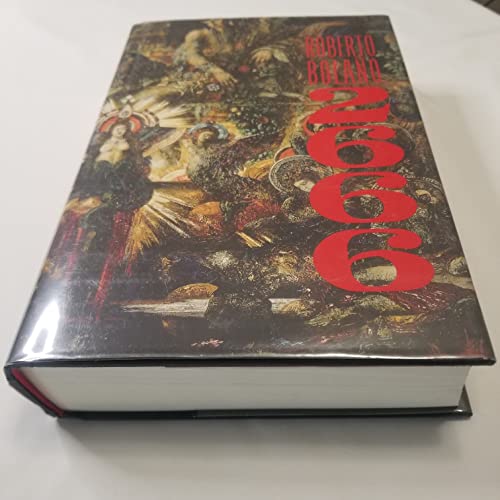
Synopsis
THE POSTHUMOUS MASTERWORK FROM “ONE OF THE GREATEST AND MOST INFLUENTIAL MODERN WRITERS” (JAMES WOOD, THE NEW YORK TIMES BOOK REVIEW)
Composed in the last years of Roberto Bolaño’s life, 2666 was greeted across Europe and Latin America as his highest achievement, surpassing even his previous work in its strangeness, beauty, and scope. Its throng of unforgettable characters includes academics and convicts, an American sportswriter, an elusive German novelist, and a teenage student and her widowed, mentally unstable father. Their lives intersect in the urban sprawl of SantaTeresa—a fictional Juárez—on the U.S.-Mexico border, where hundreds of young factory workers, in the novel as in life, have disappeared.
"synopsis" may belong to another edition of this title.
About the Author
ROBERTO BOLAÑO was born in Santiago, Chile, in 1953. He grew up in Chile and Mexico City, where he was a founder of the infrarealist poetry movement. His first full-length novel, The Savage Detectives, received the Herralde Prize and the Romulo Gallegos Prize when it appeared in 1998. Bolaño died in Blanes, Spain, at the age of fifty. NATASHA WIMMER ’s translation of The Savage Detectives was chosen as one of the ten best books of 2007 by The Washington Post and The New York Times.
Reviews
From The Washington Post's Book World/washingtonpost.com Reviewed by Steven Moore The Chilean writer Roberto Bolaño died in 2003 at the relatively young age of 50, but since then a steady stream of English translations has introduced American readers to the Gabriel García Márquez of our time: politically engaged, formally daring and wildly imaginative. The Savage Detectives, a huge novel published last year to wide acclaim, looked like his masterpiece, but now comes a monstrous novel twice as long and daring, and one that should cement his reputation as a world-class novelist. Knowing that his liver ailment would probably kill him, Bolaño pulled out all the stops for his last novel and threw out the rulebook for conventional fiction. A catch-all for many of his concerns, 2666 is at heart a fascinating meditation on violence and literature, on how writers "turned pain, which is natural, enduring, and eternally triumphant, into personal memory, which is human, brief, and eternally elusive." At its simplest level, 2666 leisurely follows a handful of characters who are drawn, like vultures to a rotting carcass, to the northern Mexican city of Santa Teresa in the 1990s. For "Santa Teresa" read Ciudad Juárez, the killing fields since 1993 for over 400 girls and women -- most of them raped, mutilated, then dumped into the nearby desert -- with justice for none due to official corruption, incompetence and macho indifference to women. (The Daughters of Juárez, by Teresa Rodriguez, provides an informative overview of this tragedy.) While the murders of Santa Teresa occupy the center of the novel, the perimeters make for the most satisfying reading. In the first of the novel's five semi-independent parts, we're told how three European literary critics became obsessed with the work of a mysterious writer named Benno von Archimboldi -- think B. Traven or Thomas Pynchon. They travel to Santa Teresa after hearing the elusive writer may be there researching his next novel. Part 2 concerns an Archimboldi expert currently living in Santa Teresa and watching over his daughter, who seems destined to be another victim in the femicide epidemic. In part 3, a black American reporter travels to Santa Teresa to cover a prizefight and becomes embroiled in the ongoing murders. Part 4, the longest of the novel's five parts, is a numbing chronological account of individual murders from 1993 to 1997, narrated in police-report fashion, along with digressions on various officials, policemen, lawyers and reporters involved in the cases. And finally, part 5 is a mesmerizing account of how a strange Prussian boy became the enigmatic Archimboldi, an author neglected at first but considered Nobel-worthy after he's rediscovered by the scholar-detectives of part 1. We also learn his real reason for going to Santa Teresa. Archimboldi never meets his critics, the reporters never solve the crimes, and nothing is resolved at the novel's end. (Even the title is left unexplained, though an editor's note offers a clue.) This is not because Bolaño didn't finish it but because he was more interested in conveying the culture of violence and how writers respond to it than in telling a tidy story. In one of many self-reflexive comments on his work, he has a character sneer at a reader who prefers short, well-made works of literature, "afraid to take on the great, imperfect, torrential works, books that blaze paths into the unknown." 2666 is just such a work, with a historical reach extending back to the bloody rituals of the Aztecs, to the horrors of the Eastern front during World War II, to the Black Panthers of the '60s. Countless fascinating subplots blaze paths into unknown corners of 20th-century culture, and there are enough references to Greek mythology to give the whole work a timeless quality. Uniting the sprawling work are moments and metaphors where sex and violence collide. This is a delightfully bookish novel, filled with writers, critics, publishers, copy editors, reporters -- all illustrating how reading and writing help make sense of the world. Archimboldi is a grim, humorless character, but we're told "he derived pleasure from writing, a pleasure similar to that of the detective on the heels of the killer"; Bolaño likewise exults in his indefatigable storytelling skills and his mastery of an arsenal of styles, from factual to frivolous, from plain to purple. In this he is expertly partnered by Natasha Wimmer, whose translation is fluid and faithful. The novel is probably longer than it needs to be, but there isn't a boring page in it, and I suspect further study would justify everything here. With 2666 Bolaño joins the ambitious overachievers of the 20th-century novel, those like Proust, Musil, Joyce, Gaddis, Pynchon, Fuentes and Vollmann, who push the novel far past its conventional size and scope to encompass an entire era, deploying encyclopedic knowledge and stylistic verve to offer a grand, if sometimes idiosyncratic summation of their culture and the novelist's place in it. Bolaño has joined the immortals.
Copyright 2008, The Washington Post. All Rights Reserved.
To say that 2666 is a novel is like calling a Beethoven symphony a collection of songs. If we must, though, this novel in five parts is without doubt Roberto Bola√±o's masterwork, epic in scope, labyrinthine, frustrating, disjointed, maybe a bit pretentious, always somewhat aloof—and brilliant. The novel's parts are interrelated only to the extent that the author wants them to be, and his intention isn't always clear (witness the title, which has little, if any, connection to the text itself). Reading 2666 is a daunting task, though once accepted, the result might be something akin to what readers felt in 1922 when, faced for the first time with the disquieting modern vision of James Joyce, they picked up Ulysses and were changed by the experience. Perhaps we'll know in 657 years.
Copyright 2008 Bookmarks Publishing LLC
Starred Review. Last year's The Savage Detectives by the late Chilean-Mexican novelist Bolaño (1953–2003) garnered extraordinary sales and critical plaudits for a complex novel in translation, and quickly became the object of a literary cult. This brilliant behemoth is grander in scope, ambition and sheer page count, and translator Wimmer has again done a masterful job. The novel is divided into five parts (Bolaño originally imagined it being published as five books) and begins with the adventures and love affairs of a small group of scholars dedicated to the work of Benno von Archimboldi, a reclusive German novelist. They trace the writer to the Mexican border town of Santa Teresa (read: Juarez), but there the trail runs dry, and it isn't until the final section that readers learn about Benno and why he went to Santa Teresa. The heart of the novel comes in the three middle parts: in The Part About Amalfitano, a professor from Spain moves to Santa Teresa with his beautiful daughter, Rosa, and begins to hear voices. The Part About Fate, the novel's weakest section, concerns Quincy Fate Williams, a black American reporter who is sent to Santa Teresa to cover a prizefight and ends up rescuing Rosa from her gun-toting ex-boyfriend. The Part About the Crimes, the longest and most haunting section, operates on a number of levels: it is a tormented catalogue of women murdered and raped in Santa Teresa; a panorama of the power system that is either covering up for the real criminals with its implausible story that the crimes were all connected to a German national, or too incompetent to find them (or maybe both); and it is a collection of the stories of journalists, cops, murderers, vengeful husbands, prisoners and tourists, among others, presided over by an old woman seer. It is safe to predict that no novel this year will have as powerful an effect on the reader as this one. (Nov.)
Copyright © Reed Business Information, a division of Reed Elsevier Inc. All rights reserved.
More vast and more lurid than his previous novels that have been translated into English, 2666 is not Roberto Bolaño's masterpiece but almost a compendium, in individual scenes, of the qualities that made him a great writer. His themes are violence, dislocation, and the sexiness of literature, and here these strands are recombined endlessly, in Europe, Detroit, and Mexico, through multiple narrators and prose styles. The action converges on the Sonoran desert, where Bolaño anatomizes, in brutal and eerie detail, the true-life murders of hundreds of women, most of which remain unsolved. By the end, after close to nine hundred pages, the reader will be impressed by the range and power on display but might wish that the novel cohered, rather than merely concluding.
Copyright ©2008 Click here to subscribe to The New Yorker
Excerpt. © Reprinted by permission. All rights reserved.
2666
A NovelBy Roberto BolaoFarrar, Straus and Giroux, LLC
Copyright © 2008 Roberto BolaoAll right reserved.
ISBN: 978-0-374-10014-8
Chapter One
The first time that Jean-Claude Pelletier read Benno von Archimboldi was Christmas 1980, in Paris, when he was nineteen years old and studying German literature. The book in question was D'Arsonval. The young Pelletier didn't realize at the time that the novel was part of a trilogy (made up of the English themed The Garden and the Polish-themed The Leather Mask, together with the clearly French-themed D'Arsonval), but this ignorance or lapse of bibliographical lacuna, attributable only to his extreme youth, did nothing to diminish the wonder and admiration that the novel stirred in him.From that day on (or from the early morning hours when he concluded his maiden reading) he became an enthusiastic Archimboldian and set out on a quest to find more works by the author. This was no easy task. Getting hold of books by Benno von Archimboldi in the 1980s, even in Paris, was an effort not lacking in all kinds of difficulties. Almost no reference to Archimboldi could be found in the university's German department. Pelletier's professors had never heard of him. One said he thought he recognized the name. Ten minutes later, to Pelletier's outrage (and horror), he realized that the person his professor had in mind was the Italian painter, regarding whom he soon revealed himself to be equally ignorant.
Pelletier wrote to the Hamburg publishing house that had published D'Arsonval and received no response. He also scoured the few German bookstores he could find in Paris. The name Archimboldi appeared in a dictionary of German literature and in a Belgian magazine devoted-whether as a joke or seriously, he never knew-to the literature of Prussia. In 1981, he made a trip to Bavaria with three friends from the German department, and there, in a little bookstore in Munich, on Voralmstrasse, he found two other books: the slim volume titled Mitzi's Treasure, less than one hundred pages long, and the aforementioned English novel, The Garden.
Reading these two novels only reinforced the opinion he'd already formed of Archimboldi. In 1983, at the age of twenty-two, he undertook the task of translating D'Arsonval. No one asked him to do it. At the time, there was no French publishing house interested in publishing the German author with the funny name. Essentially Pelletier set out to translate the book because he liked it, and because he enjoyed the work, although it also occurred to him that he could submit the translation, prefaced with a study of the Archimboldian oeuvre, as his thesis, and-why not?-as the foundation of his future dissertation.
He completed the final draft of the translation in 1984, and a Paris publishing house, after some inconclusive and contradictory readings, accepted it and published Archimboldi. Though the novel seemed destined from the start not to sell more than a thousand copies, the first printing of three thousand was exhausted after a coupld of contradictory, positive, even effusive reviews, opening the door for the second, third, and fourth printings.
(Continues...)
Excerpted from 2666 by Roberto Bolao Copyright © 2008 by Roberto Bolao. Excerpted by permission.
All rights reserved. No part of this excerpt may be reproduced or reprinted without permission in writing from the publisher.
Excerpts are provided by Dial-A-Book Inc. solely for the personal use of visitors to this web site.
"About this title" may belong to another edition of this title.
Other Popular Editions of the Same Title

Search results for 2666: A Novel

Seller Image
2666: A Novel
Published by
Farrar, Straus and Giroux, 2008
ISBN 10: 0374100144
ISBN 13: 9780374100148
Used
Hardcover
Seller: Goodwill Northern Illinois, Rockford, IL, U.S.A.
Seller rating 5 out of 5 stars

Condition: acceptable. This item is a previous library, school edition or rental copy. It has stickers on the cover, inside front pages and may also have stamping writing on the page edges. Seller Inventory # NIV.0374100144.A
Seller Image
2666: A Novel
Published by
Farrar, Straus and Giroux, 2008
ISBN 10: 0374100144
ISBN 13: 9780374100148
Used
Hardcover
Seller: Goodwill of Central and Coastal Virginia, Richmond, VA, U.S.A.
Seller rating 4 out of 5 stars

Condition: acceptable. Seller Inventory # CCVV.0374100144.A
Stock Image
2666: A Novel
Published by
Farrar, Straus and Giroux, 2008
ISBN 10: 0374100144
ISBN 13: 9780374100148
Used
Hardcover
Seller: World of Books (was SecondSale), Montgomery, IL, U.S.A.
Seller rating 5 out of 5 stars
Condition: Very Good. Item in very good condition! Textbooks may not include supplemental items i.e. CDs, access codes etc. Seller Inventory # 00104983715
Stock Image
2666 A Novel
Published by
Farrar, Straus and Giroux, 2008
ISBN 10: 0374100144
ISBN 13: 9780374100148
Used
Hardcover
Seller: Tacoma Book Center, Tacoma, WA, U.S.A.
Seller rating 4 out of 5 stars
Hardcover. Condition: Very Good. Dust Jacket Condition: Very Good. Later Printing. Hardcover. Later printing. Very slight wear to corners and edges; very slight dustsoiling to edges; otherwise tight, sound and unmarked in Very Good condition. Dustjacket with slight wear to corners and edges; $30.00 original price on front flap; Very Good condition. ; 898 pages. Seller Inventory # 4224464
Seller Image
2666
Published by
Farrar, Straus and Giroux, New York, 2008
ISBN 10: 0374100144
ISBN 13: 9780374100148
Used
Hardcover
First Edition
Seller: Capitol Hill Books, ABAA, Washington, DC, U.S.A.
Seller rating 5 out of 5 stars
Condition: Very Good. Dust Jacket Condition: Very Good. First Edition. New York: Farrar, Straus and Giroux, 2008. First American Edition with full number line. Thick octavo (23.5cm); publisher's boards, illustrated endpapers, in unclipped pictorial dust jacket; [12],898pp. Moderate shelf wear to jacket and board margins, jacket spine sunned and rear flap creased. Spine a bit cocked. Light dust-soil to textblock edges. Overall About Very Good and sound. The late Chilean author's posthumously published masterpiece, a three-part fragmentary novel revolving around the murder and disappearance of women in the fictitious city of Santa Teresa, inspired by Ciudad Juarez. Seller Inventory # 47901
Seller Image
2666: A Novel
Published by
Farrar, Straus and Giroux, 2008
ISBN 10: 0374100144
ISBN 13: 9780374100148
Used
Hardcover
First Edition
Seller: Snowden's Books, Santa Fe, NM, U.S.A.
Seller rating 5 out of 5 stars
Hardcover. Condition: Very Good. Dust Jacket Condition: Very Good. 1st Edition. Original hardcover in jacket, full number line on copyright page, this is the first printing. Book is solid and square; it was read with some creasing along the spine; scrape to the top spine at board's edge. Just light reference wear to the pages. Jacket is bright and clean and attractive in protective mylar sleeve; original price of $30 still present on jacket flap. Very good. e7. Seller Inventory # ABE-1779164877950
Stock Image
2666
Published by
FSG, New York, 2008
ISBN 10: 0374100144
ISBN 13: 9780374100148
Used
Hardcover
First Edition
Seller: Desert General, Twentynine Palms, CA, U.S.A.
Seller rating 5 out of 5 stars
Hardcover. Condition: Fine. 1st Edition. Seller Inventory # S106
Stock Image
2666 A Novel
Published by
Farrar, Straus and Giroux, New York, 2008
ISBN 10: 0374100144
ISBN 13: 9780374100148
Used
Hardcover
Seller: Time Traveler Books, Pittsburgh, PA, U.S.A.
Seller rating 5 out of 5 stars
Hardcover. Condition: Fine. Dust Jacket Condition: Fine. Second Printing. 6.37 X 1.8 X 9.29 inches; 898 pages. Seller Inventory # 46991
Stock Image
2666: A Novel
Published by
Farrar, Straus and Giroux, New York, 2008
ISBN 10: 0374100144
ISBN 13: 9780374100148
Used
Hardcover
First Edition
Seller: FITZ BOOKS AND WAFFLES, Buffalo, NY, U.S.A.
Seller rating 5 out of 5 stars
Hardcover. Condition: Near Fine. 1st Edition. Advance Reader's Copy. This is a clean, unmarked copy with light use wear. Seller Inventory # ABE-1766088324152
Stock Image
2666: A Novel
Published by
Farrar, Straus and Giroux, 2008
ISBN 10: 0374100144
ISBN 13: 9780374100148
Used
Hardcover
First Edition
Seller: FITZ BOOKS AND WAFFLES, Buffalo, NY, U.S.A.
Seller rating 5 out of 5 stars
Hardcover. Condition: Fine. Dust Jacket Condition: Fine. 1st Edition. This is a clean, unmarked, undamaged copy. Seller Inventory # ABE-1766095127709