
Synopsis
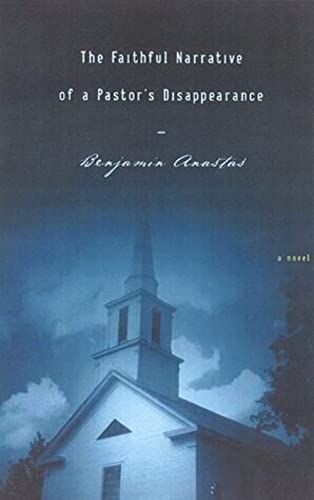
When young, black Reverend Thomas Mosher vanishes, his congregation grapples with the crisis and the theories about his disappearance, from his rumored affair to the white liberal parishioners who might have driven him away.
"synopsis" may belong to another edition of this title.
About the Author
Benjamin Anastas is the author of An Underachiever's Diary. He lives in Brooklyn and is an editor at Grand Street.
Reviews
Writing with the same panache he brought to his clever first novel, An Underachiever's Diary, Anastas again proves himself a smart literary voice. Punctuated by breathless, run-on sentences that impart a hectic feel to the narrative, this is a subversive and funny satire of American materialism and spirituality. Just after Easter Sunday, Rev. Thomas Mosher goes missing from his Congregational church in a Boston suburb. The circumstances were unusual before he disappeared: Thomas is black and ministers to a white congregation that has no idea of the loneliness and self-doubt that plagues their pastor. One faction of the church council, led by hard-driving realtor Martha Howard, thinks that Thomas's abrupt departure may be traced to an affair with married Bethany Caruso. Then again, Martha is a bitter woman, disappointed in her feckless husband and drug-dealing college dropout son. After finding a randy letter tucked inside the parsonage's back door, Martha feels vindicated and takes action. Most of the narrative, however, belongs to Bethany. Highly nervous, Zoloft-dependent, spiritually bereft, yet a loving mother to her two young children, she is an oddly compelling heroine. Returning to the church, she hopes, will satisfy her vague longings what she doesn't guess is that she will be called upon to succor Thomas. In depicting Thomas's inner thoughts a murky m‚lange of sexual longing, cynicism, jealousy and ugly self-justification Anastas bluntly conveys the poignancy of unfulfilled lives. His unsparing take on the emptiness and desperation of a materialist society sparkles with dry wit and a generous understanding of human complexities. (May)Forecast: The cult following that Grand Street editor Anastas established with his first book should increase with this adroit and urbane novel. If he is as articulate as his fiction suggests, he will have a good run on talk shows.
Copyright 2001 Cahners Business Information, Inc.
This rueful second novel by Anastas (An Underachiever's Diary) opens with a mystery: the Rev. Thomas Mosher of the Pilgrims' Congregational Church in suburban Massachusetts has disappeared. Was the young black man driven out by his pseudo-liberal white congregants, or was he fleeing the private sorrow he seemed to carry around with him? Or was the rumored affair between him and gorgeous-but-married Bethany Caruso too much for his conscience? The congregants soon grow uneasy, especially Bethany, whom, we learn quickly, really was carrying on a torrid affair with her spiritual adviser. The novel gently mixes wry observations on Mosher's mostly sanctimonious flock the unbearable Margarent Howard is particularly well drawn with a darker story of wrecked hopes and irreconcilable desires. In the end, the story is more Bethany's than Thomas's as she learns to accept his loss and her responsibilities. It's frustrating, though, that we never really learn what went wrong for Thomas; his disappearance starts to feel like a device, and some of the targets Anastos hits religious smugness, frustrated spouses seem a little too easy. Still, this is a thoughtful enough read; for larger collections.
- Barbara Hoffert, "Library Journal"
Copyright 2001 Reed Business Information, Inc.
Rich, white liberals in suburban Boston call a young, intellectual, African American man to be the pastor of their historic Puritan church. After two years, the pastor disappears without a trace. The investigation that ensues, however, is not only a search for the pastor but also a look into the lives of the congregants--lives that are not nearly as pretty or sophisticated on the inside as they are on the surface. The uncomfortable tensions of this small New England village are looked at scrupulously. Why did the pastor disappear? Did he commit suicide? What hints could be gathered from his sermons? And what about the suspected adulterous affair with a married woman of the community? Hawthorne's Scarlet Letter meets a John Waters film in this extraordinary look at suburban ennui and New England small-mindedness. Anastas succeeds in creating a vivid portrayal of suspicion, doubt, and understanding, written in a crisp and honest voice. Michael Spinella
Copyright © American Library Association. All rights reserved
Excerpt. © Reprinted by permission. All rights reserved.
The founding member of the Monday Reflection Group noticed first, arriving at the church to find the pastor's driveway empty and the curtains in the parsonage still drawn, but she knew nothing of his sudden and astonishing disappearance, not yet, only that the Reverend Thomas Mosher, well-liked minister of the Pilgrims' Congregational Church ("An Historic Church with a Modern Message" they included below their name in all the literature) in W-----, Massachusetts, spiritual mentor to his well-heeled but undeniably eccentric congregants, author of competent -- if sometimes esoteric -- Sunday sermons heavy on the Book of Psalms, culminating in his very last one, "The Shapes of Love," which had veered away from the usual Easter Cycle to explore the possibility that God is an "infinite sphere," an idea that had bored some members of the church dumb and had seemed to others inappropriate for a Trinitarian; eligible bachelor rumored to have carried on an affair with a married woman in the church, Bethany Caruso (née Coleman), the mother of a preteen son and pious daughter widely considered angelic, if, at times, unusually frank when speaking to adults, and prone to disruptive behavior during Sunday school, the product, many believed, of Bethany's frequent separations from her husband (not a regular churchgoer), making her, already envied for her smoldering good looks and close relationship with the pastor, the object of persistent disapproval, despite the fact that an adulterous tryst between the two had never been confirmed, and the Reverend Mosher, according to the local women who openly pursued him -- Sadie Maxwell, flashy owner of the town's leather boutique; twice-divorced Alessandra Palacios y Rio, self-styled socialite and beneficiary of a Hollywood divorce settlement -- showed no interest in matters of the flesh, possessing, as he did, an awkward bearing in the world of men and women, little sense for the subtleties of flirtation and its deeper second step, seduction; truth be told, the Reverend Mosher seemed comfortable only at the pulpit, draped in his black Geneva gown and elevated slightly above his audience, able to communicate with an ease that usually escaped him, projecting authority with his lovely voice (they all agreed that, with their eyes closed during the morning prayers, his intonation could often be transporting), while in life he was acutely absentminded, a chronic mumbler, famous for calling members of the church by the wrong name, as well as accident-prone (how many times had he driven his car, the unfortunately named Ford Probe, off the road? The product of relentless dreaming), known for his inept pitching in church league softball, and sloppy housekeeping, according to the Thursday Housekeepers, who grew so tired of scrubbing down the parsonage they pooled their resources and hired a cleaning woman; no, the Reverend Mosher was not like the dull and energetic middle managers who had lately moved to town for a short commute and joined the congregation out of some imagined duty, who talked too loud among themselves and, but for a few opening minutes, paid little attention to his painstakingly prepared sermons, although there were notable exceptions, troubled men who had no choice but to display their depth, like high-strung Carlo Wagner, a physicist with a wide repertoire of nervous tics (clearing his throat, touching his glasses, pinching the end of his nose, scratching his ear with an index finger, and twitching, all in no particular order), or Ed Brooks, a school administrator who was obviously manic depressive, but refused his wife's attempts to have him seek counseling and -- this was her ardent hope, expressed in weekly talks with the Reverend Mosher -- a prescription for antidepressants, no longer a stigma in the community, or even a topic of gossip and/or debate, quite the opposite: Paxil and Zoloft had long since entered the local vocabulary, and stood, now, for happiness and hope, as if a tablet could ever contain these illusory states of being, reinventing the founding principles of W-----, Massachusetts, as well as of every other place in the New World chosen by displaced men and women for settlement: a belief in the value of work, the importance of family, the dominion of God over all things personal and political . . . The pastor was a complicated man and seemed to live across some subtle divide from life, certainly from happiness, and often from the members of his congregation, still he was an admired figure on the pulpit (already mentioned) and in the church office, the scene of so many helpful -- if halting -- conversations, and, as the black leader of a traditionally white church (although this, too, was changing), the object of some pride, as if his position were irrefutable evidence of their forward-thinking politics and enlightened Christianity; but no one in the church -- not one worshipper out of a scant few hundred souls -- could have predicted the events that began to unfold on the fine spring morning in question, when the Monday Reflection Group, such as it was, convened at the appointed time, and the Reverend Thomas Mosher was missing.
Copyright © 2001 Benjamin Anastas
"About this title" may belong to another edition of this title.
Other Popular Editions of the Same Title

Search results for The Faithful Narrative of a Pastor's Disappearance

Stock Image
The Faithful Narrative of a Pastor's Disappearance
Published by
Farrar, Straus & Giroux, 2001
ISBN 10: 0374152144
ISBN 13: 9780374152147
Used
Hardcover
First Edition
Seller: Better World Books, Mishawaka, IN, U.S.A.
Seller rating 5 out of 5 stars

Condition: Good. 1st. Former library copy. Pages intact with minimal writing/highlighting. The binding may be loose and creased. Dust jackets/supplements are not included. Includes library markings. Stock photo provided. Product includes identifying sticker. Better World Books: Buy Books. Do Good. Seller Inventory # 2292969-6
Stock Image
The Faithful Narrative of a Pastor's Disappearance
Seller: ThriftBooks-Atlanta, AUSTELL, GA, U.S.A.
Seller rating 5 out of 5 stars
Hardcover. Condition: Very Good. No Jacket. Former library book; May have limited writing in cover pages. Pages are unmarked. ~ ThriftBooks: Read More, Spend Less. Seller Inventory # G0374152144I4N10
Seller Image
The Faithful Narrative of a Pastor's Disappearance
Published by
Farrar, Straus & Giroux, New York, 2001
ISBN 10: 0374152144
ISBN 13: 9780374152147
Used
Hardcover
First Edition
Seller: The Book Collector, Inc. ABAA, ILAB, Fort Worth, TX, U.S.A.
Seller rating 4 out of 5 stars

Hardcover. Condition: Fine. Dust Jacket Condition: Fine. 1st Edition. 277 pages. Octavo (8 1/2" 6 1/4") bound in original publisher's blue boards with gilt lettering to spine in original pictorial jacket. Review copy with review request laid in. First edition. A young, charismatic African-American pastor disappears from his local parish of W, a comfortable bedroomcommunity in suburban New England. In the backlash and impending investigation, no satirical stone is left unturned, especially those within the Caruso household, an ordinary American family hollowed out by their world of convenience and easy moral remedies. Condition: A Fine copy in like jacket. Seller Inventory # L0588
Stock Image
The Faithful Narrative of a Pastor's Disappearance
Seller: Wonder Book, Frederick, MD, U.S.A.
Seller rating 5 out of 5 stars
Condition: Very Good. Very Good condition. Very Good dust jacket. With remainder mark. A copy that may have a few cosmetic defects. May also contain light spine creasing or a few markings such as an owner's name, short gifter's inscription or light stamp. Seller Inventory # L03I-01076
Stock Image
The Faithful Narrative of a Pastor's Disappearance
Seller: HPB-Diamond, Dallas, TX, U.S.A.
Seller rating 5 out of 5 stars
hardcover. Condition: Very Good. Connecting readers with great books since 1972! Used books may not include companion materials, and may have some shelf wear or limited writing. We ship orders daily and Customer Service is our top priority! Seller Inventory # S_465699507
Stock Image
The Faithful Narrative of a Pastor's Disappearance
Seller: Harmonium Books, Philadelphia, PA, U.S.A.
Seller rating 4 out of 5 stars
Hardcover. Condition: Very Good. Hardback; ex-library; text is unmarked; usual library stamps; w/ protective mylar cover. Seller Inventory # 0825W381371
Stock Image
The Faithful Narrative of a Pastor's Disappearance
Seller: Roundabout Books, Greenfield, MA, U.S.A.
Seller rating 4 out of 5 stars
hardcover. Condition: Very Good. Clean, unmarked copy with some edge wear. Good binding. Dust jacket included if issued with one. We ship in recyclable American-made mailers. 100% money-back guarantee on all orders. Seller Inventory # 1670312
Stock Image
The Faithful Narrative of a Pastor's Disappearance
Published by
Farrar Straus & Giroux, 2001
ISBN 10: 0374152144
ISBN 13: 9780374152147
Used
Hardcover
First Edition
Seller: Bookplate, Chestertown, MD, U.S.A.
Seller rating 4 out of 5 stars
Hardcover. Condition: Good. Dust Jacket Condition: Good. 1st Edition. Pages are clean and crisp. Blue cloth binding is tight and shows little to no signs of wear. DJ is clean with minor bumping/wrinkling by spine, and has been preserved in mylar to prevent further damage. TM. Seller Inventory # ABE-1573534957884
Stock Image
The Faithful Narrative of a Pastor's Disappearance
Published by
Farrar Straus & Giroux, 2001
ISBN 10: 0374152144
ISBN 13: 9780374152147
Used
Hardcover
First Edition
Seller: Jen's Books, Douglas, WY, U.S.A.
Seller rating 4 out of 5 stars
Hardcover. Condition: Very Good. Dust Jacket Condition: Very Good. 1st Edition. 1St Edition. Very Clean, Square And Tight, No Markings. In An Unclipped Dust Jacket With Little Shelf Wear. Seller Inventory # 047102
Seller Image
The Faithful Narrative of A Pastor's Disappearance (Review Copy)
Published by
Farrar, Straus and Giroux, New York, 2001
ISBN 10: 0374152144
ISBN 13: 9780374152147
Used
Hardcover
First Edition
Seller: Jeff Hirsch Books, ABAA, Wadsworth, IL, U.S.A.
Seller rating 5 out of 5 stars
Dust Jacket Condition: dj. First Edition. First edition. A review copy with review material laid in. His second book. A fine copy in fine dust jacket. Seller Inventory # 103376