
Synopsis
In the years between World War II and the emergence of television as a mass medium, American popular culture as we know it was first created--in the pulpy, boldly illustrated pages of comic books. No sooner had this new culture emerged than it was beaten down by church groups, community bluestockings, and a McCarthyish Congress--only to resurface with a crooked smile on its face in Mad magazine.
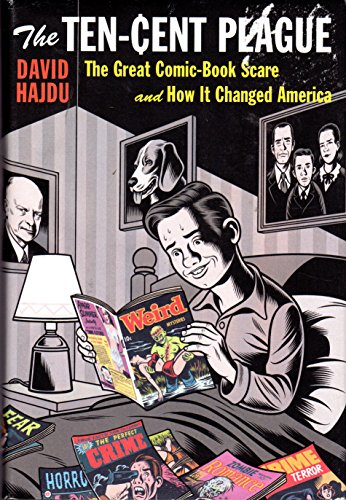
The story of the rise and fall of those comic books has never been fully told--until The Ten-Cent Plague. David Hajdu's remarkable new book vividly opens up the lost world of comic books, its creativity, irreverence, and suspicion of authority.
When we picture the 1950s, we hear the sound of early rock and roll. The Ten-Cent Plague shows how--years before music--comics brought on a clash between children and their parents, between prewar and postwar standards. Created by outsiders from the tenements, garish, shameless, and often shocking, comics spoke to young people and provided the guardians of mainstream culture with a big target. Parents, teachers, and complicit kids burned comics in public bonfires. Cities passed laws to outlaw comics. Congress took action with televised hearings that nearly destroyed the careers of hundreds of artists and writers.
The story of the rise and fall of those comic books has never been fully told--until The Ten-Cent Plague. David Hajdu's remarkable new book vividly opens up the lost world of comic books, its creativity, irreverence, and suspicion of authority.
When we picture the 1950s, we hear the sound of early rock and roll. The Ten-Cent Plague shows how--years before music--comics brought on a clash between children and their parents, between prewar and postwar standards. Created by outsiders from the tenements, garish, shameless, and often shocking, comics spoke to young people and provided the guardians of mainstream culture with a big target. Parents, teachers, and complicit kids burned comics in public bonfires. Cities passed laws to outlaw comics. Congress took action with televised hearings that nearly destroyed the careers of hundreds of artists and writers.
The Ten-Cent Plague radically revises common notions of popular culture, the generation gap, and the divide between "high" and "low" art. As he did with the lives of Billy Strayhorn and Duke Ellington (in Lush Life) and Bob Dylan and his circle (in Positively 4th Street), Hajdu brings a place, a time, and a milieu unforgettably back to life.
"synopsis" may belong to another edition of this title.
About the Author
David Hajdu is the author of Lush Life: A Biography of Billy Strayhorn and Positively 4th Street: The Lives and Times of Joan Baez, Bob Dylan, Mimi Baez Farina and Richard Farina. He is the music critic for The New Republic, and he teaches at the Columbia Graduate School of Journalism.
Reviews
Starred Review. After writing about the folk scene of the early 1960s in Positively 4th Street, Hajdu goes back a decade to examine the censorship debate over comic books, casting the controversy as a prelude to the cultural battle over rock music. Fredric Wertham's Seduction of the Innocent, the centerpiece of the movement, has been reduced in public memory to a joke—particularly the attack on Batman for its homoeroticism—but Hajdu brings a more nuanced telling of Wertham's background and shows how his arguments were preceded by others. Yet he comes down hard on the unsound research techniques and sweeping generalizations that led Wertham to conclude that nearly all comic books would inspire antisocial behavior in young readers. There are no real heroes here, only villains and victims; Hajdu turns to the writers and artists whose careers were ruined when censorship and other legal restrictions gutted the comics industry, and young kids who were coerced into participating in book burnings by overzealous parents and teachers. With such a meticulous setup, the history builds slowly but the main attraction—EC Comics publisher Bill Gaines's attempt to explain in a Senate committee hearing how an illustration of a man holding a severed head could be in good taste—holds all the dramatic power it has acquired as it's been told among fans over the past half-century. (Mar.)
Copyright © Reed Business Information, a division of Reed Elsevier Inc. All rights reserved.
The movies and rock ’n’ roll have had brushes with censorship, but the comic-book industry was nearly wiped out in the 1950s by do-gooders concerned about their hypothesized detrimental effects on young readers. As Hajdu shows, comics were controversial right from their turn-of-the-century origins in newspapers, but the post–World War II development of lurid crime comic books depicting the exploits of violent gangsters aroused virulent opposition that intensified with the medium’s next step—gruesome horror titles. The latter became the target of newspaper crusades, the psychiatric establishment (led by Frederic Wertham, whose 1954 screed Seduction of the Innocent became a bestseller), congressional hearings, and censorship boards in more than 50 cities. The industry, a refuge for ethnic minorities and other outsiders who reveled in the freedoms gained by working under the radar of adult audiences, survived only through self-regulation in the form of a Comics Code that stripped comics of much vitality. As a telling coda, Hajdu appends a list of nearly 900 creators who, after the crackdown, never worked in comics again. --Gordon Flagg
Excerpt. © Reprinted by permission. All rights reserved.
Prologue
Sawgrass Village, a tidy development about twenty-five miles east of Jacksonville, Florida, is named for the wild marsh greenery that its turf lawns displaced. It has 1,327 houses, each of them pale gray on the outside. On the inside, the one at 133 Lake Julia Drive is a dream shrine—a temple not to the past, like many other homes of retirees, but to a life imagined and denied. All the walls in its eight rooms, as well as the halls, are covered with framed paintings by Janice Valleau Winkleman, who moved there from Pittsburgh with her husband, Ed, in 1982, when he ended his four-decade career in sales (first, chemicals, then steel products). She had been painting almost every day for nearly thirty years. Having shown artistic talent at an early age, she had taken some formal training in fine art and illustration, and, at age nineteen, she began working professionally, drawing for Quality Comics in Manhattan. Then, one evening eleven years later, she came home from work and never went back.
For more than fifty years after that, Winkleman made no mention of the fact that she had had artwork prominently published as Janice Valleau. Her daughter Ellen grew up reading comic books without knowing that her mother had once helped create them.
In 2004, the Winklemans’ living room held seventy-four paintings—vigorous watercolor seascapes with violent waves, rendered in heavy blues and blacks; an acrylic of two seagulls suspended in flight, positioned upright in a golden-brown sky and surrounded by other gulls darting about them in every direction; watercolor after watercolor of old sailing ships, moldering in dry dock; a few abstracts of angular shapes and patterns done in pastel; portraits of exotic, alluring young women, one of them topless, with her face either unfinished or painted over. The images—at once lovely and tortured, all skillfully done but madly varied—could occupy a graduate art student or a psychoanalyst for some time.
At age eighty-one, Winkleman was a fragile woman, weakened by age and illness, though she still painted when she felt up to it, usually one or two days each week. “I like art—it’s important to me,” she said in a small but firm voice. Her eyes were bright behind grand, squarish glasses that covered most of her face. She sat straight-backed in a thin-cushioned metal chair that went with the desk in a half-room that also had her easel and taboret, a few boxes of art supplies, and a tea set. Her hands formed a teepee on her lap. She wore a pressed linen house dress and well-used tennis shoes, and she kept her legs crossed tightly with her calves angled back under the chair, as if to hide the shoes. Hanging in a frame on the wall to her right was the original pen-and-ink art to the first page of a Blackhawk comic-book story drawn by one of her old studio mates, Reed Crandall. In the days when they were working together, Winkleman had sneaked the page home in her portfolio, because she admired Crandall’s dynamic compositions and sure line.
“I wanted to be a magazine illustrator, but I loved comics, too,” she said, pointing her teepee toward the Blackhawk page. “I would have been happy being in any kind of art at all.”
Why, then, had she stopped working professionally half a century earlier? The paintings all over her house show that Winkleman had the skill and the versatility to have done commercial illustration. She had the experience in comics and the affection for the medium to have continued in that field. With the imagination she applied to some of her canvases, she might even have pursued fine art professionally. Why not?
“My God,” she said. She separated her hands and slapped them on her lap, then slowly brought them back together. “I couldn’t go back out there—I was scared to death. Don’t you know what they did to us?”
In the mid-1940s, when Janice Valleau was thriving as an artist for Quality Comics, the comic book was the most popular form of entertainment in America. Comics were selling between eighty million and a hundred million copies every week, with a typical issue passed along or traded to six to ten readers, thereby reaching more people than movies, television, radio, or magazines for adults. By 1952, more than twenty publishers were producing nearly 650 comics titles per month, employing well over a thousand artists, writers, editors, letterers, and others—among them women such as Valleau, as well as untold members of racial, ethnic, and social minorities who turned to comics because they thought of themselves or their ideas as unwelcome in more reputable spheres of publishing and entertainment.
Created by outsiders of various sorts, comics gave voice to their makers’ fantasies and discontent in the brash vernacular of cartoon drawings and word balloons, and they spoke with special cogency to young people who felt like outsiders in a world geared for and run by adults. In the forties, after all, the idea of youth culture as it would later be known—as a vast socioeconomic system comprising modes of behavior and styles of dress, music, and literature intended primarily to express independence from the status quo—had not yet formed; childhood and young adulthood were generally considered states of subadulthood, phases of training to enter the orthodoxy. Comic books were radical among the books of their day for being written, drawn, priced, and marketed primarily for and directly to kids, as well as for asserting a sensibility anathema to grown-ups.
Most adults never paid much mind until the comics—and the kids reading them—began to change.
During the early postwar years, comic books shifted in tone and content. Fed by the same streams as pulp fiction and film noir, many of the titles most prominent in the late forties and early fifties told lurid stories of crime, vice, lust, and horror, rather than noble tales of costumed heroes and heroines such as Superman, Captain Marvel, and Wonder Woman, whose exploits had initially established the comics genre in the late thirties and early forties. These unprecedented dark comics sprouted from cracks in the back corners of the cultural terrain and grew wild. Unlike the movies and the broadcast media, comic books had no effective monitoring or regulatory mechanism—no powerful self-censoring body like the film industry’s Hays Office, no government authority like the FCC imposing content standards. Uninhibited, shameless, frequently garish and crude, often shocking, and sometimes excessive, these crime, horror, and romance comics provided young people of the early postwar years with a means of defying and escaping the mainstream culture of the time, while providing the guardians of that culture an enormous, taunting, close-range target. The world of comics became a battleground in a war between two generations, delineating two eras in American pop-culture history.
“Comic books are definitely harmful to impressionable people, and most young people are impressionable,” said the psychiatrist Fredric Wertham, author of an incendiary tract, Seduction of the Innocent, which indicted comics as a leading cause of juvenile delinquency. “I think Hitler was a beginner compared to the comic-book industry.
“The time has come to legislate these books off the newsstands and out of the candy stores.”
Churches and community groups raged and organized campaigns against comic books. Young people acted out mock trials of comics characters. Schools held public burnings of comics, and students threw thousands of the books into the bonfires; at more than one conflagration, children marched around the flames reciting incantations denouncing comics. Headlines in newspapers and magazines around the country warned readers: “Depravity for Children—Ten Cents a Copy!” “Horror in the Nursery,” “The Curse of the Comic Books.” The offices of one of the most adventurous and scandalous publishers, EC Comics, were raided by the New York City police. More than a hundred acts of legislation were introduced on the state and municipal levels to ban or limit the sale of comics: Scores of titles were outlawed in New York, Connecticut, Maryland, and other states, and ordinances to regulate comics were passed in dozens of cities. Soon, Congress took action with a set of sensational, televised hearings that nearly destroyed the comic-book business. Like Janice Valleau, the majority of working comics artists, writers, and editors—more than eight hundred people—lost their jobs. A great many of them would never be published again.
Through the near death of comic books and the end of many of their makers’ creative lives, postwar popular culture was born.
Page-one news as it occurred, the story of the comics controversy is a largely forgotten chapter in the history of the culture wars and one that defies now-common notions about the evolution of twentieth-century popular culture, including the conception of the postwar sensibility—a raucous and cynical one, inured to violence and absorbed with sex, skeptical of authority, and frozen in young adulthood—as something spawned by rock and roll. The truth is more complex. Elvis Presley and Chuck Berry added the soundtrack to a scene created in comic books.
It is clear now that the hysteria over comic books was always about many things other than cartoons: about class and money and taste; about traditions and religions and biases rooted in time and place; about presidential politics; about the influence of a new medium called television; and about how art forms, as well as people, grow up. The comic-book war was one of the first and hardest-fought conflicts between youn...
"About this title" may belong to another edition of this title.
Other Popular Editions of the Same Title

Search results for The Ten-Cent Plague: The Great Comic-Book Scare and...

Stock Image
The Ten-Cent Plague: The Great Comic-Book Scare and How It Changed America
Published by
Farrar, Straus and Giroux, 2008
ISBN 10: 0374187673
ISBN 13: 9780374187675
Used
Hardcover
Seller: World of Books (was SecondSale), Montgomery, IL, U.S.A.
Seller rating 5 out of 5 stars

Condition: Good. Good condition ex-library book with usual library markings and stickers. Seller Inventory # 00103171476
Stock Image
The Ten-Cent Plague : The Great Comic-Book Scare and How It Changed America
Published by
Farrar, Straus & Giroux, 2008
ISBN 10: 0374187673
ISBN 13: 9780374187675
Used
Hardcover
First Edition
Seller: Better World Books, Mishawaka, IN, U.S.A.
Seller rating 5 out of 5 stars
Condition: Very Good. First Edition. Former library copy. Pages intact with possible writing/highlighting. Binding strong with minor wear. Dust jackets/supplements may not be included. Includes library markings. Stock photo provided. Product includes identifying sticker. Better World Books: Buy Books. Do Good. Seller Inventory # 4330136-6
Stock Image
The Ten-Cent Plague : The Great Comic-Book Scare and How It Changed America
Published by
Farrar, Straus & Giroux, 2008
ISBN 10: 0374187673
ISBN 13: 9780374187675
Used
Hardcover
First Edition
Seller: Better World Books: West, Reno, NV, U.S.A.
Seller rating 5 out of 5 stars
Condition: Good. First Edition. Former library copy. Pages intact with minimal writing/highlighting. The binding may be loose and creased. Dust jackets/supplements are not included. Includes library markings. Stock photo provided. Product includes identifying sticker. Better World Books: Buy Books. Do Good. Seller Inventory # 3221107-6
Stock Image
The Ten-Cent Plague : The Great Comic-Book Scare and How It Changed America
Published by
Farrar, Straus & Giroux, 2008
ISBN 10: 0374187673
ISBN 13: 9780374187675
Used
Hardcover
First Edition
Seller: Better World Books, Mishawaka, IN, U.S.A.
Seller rating 5 out of 5 stars
Condition: Very Good. First Edition. Pages intact with possible writing/highlighting. Binding strong with minor wear. Dust jackets/supplements may not be included. Stock photo provided. Product includes identifying sticker. Better World Books: Buy Books. Do Good. Seller Inventory # 4897801-6
Stock Image
The Ten-Cent Plague : The Great Comic-Book Scare and How It Changed America
Published by
Farrar, Straus & Giroux, 2008
ISBN 10: 0374187673
ISBN 13: 9780374187675
Used
Hardcover
First Edition
Seller: Better World Books, Mishawaka, IN, U.S.A.
Seller rating 5 out of 5 stars
Condition: Good. First Edition. Former library copy. Pages intact with minimal writing/highlighting. The binding may be loose and creased. Dust jackets/supplements are not included. Includes library markings. Stock photo provided. Product includes identifying sticker. Better World Books: Buy Books. Do Good. Seller Inventory # 3221107-6
Stock Image
The Ten-Cent Plague: The Great Comic-Book Scare and How It Changed America
Published by
Farrar, Straus and Giroux, 2008
ISBN 10: 0374187673
ISBN 13: 9780374187675
Used
Hardcover
Seller: ThriftBooks-Dallas, Dallas, TX, U.S.A.
Seller rating 5 out of 5 stars
Hardcover. Condition: Very Good. No Jacket. May have limited writing in cover pages. Pages are unmarked. ~ ThriftBooks: Read More, Spend Less. Seller Inventory # G0374187673I4N00
Stock Image
The Ten-Cent Plague: The Great Comic-Book Scare and How It Changed America
Published by
Farrar, Straus and Giroux, 2008
ISBN 10: 0374187673
ISBN 13: 9780374187675
Used
Hardcover
Seller: ThriftBooks-Dallas, Dallas, TX, U.S.A.
Seller rating 5 out of 5 stars
Hardcover. Condition: As New. No Jacket. Pages are clean and are not marred by notes or folds of any kind. ~ ThriftBooks: Read More, Spend Less. Seller Inventory # G0374187673I2N00
Stock Image
The Ten-Cent Plague: The Great Comic-Book Scare and How It Changed America
Published by
Farrar, Straus and Giroux, 2008
ISBN 10: 0374187673
ISBN 13: 9780374187675
Used
Hardcover
Seller: Half Price Books Inc., Dallas, TX, U.S.A.
Seller rating 5 out of 5 stars
Hardcover. Condition: Very Good. Connecting readers with great books since 1972! Used books may not include companion materials, and may have some shelf wear or limited writing. We ship orders daily and Customer Service is our top priority! Seller Inventory # S_461666001
Stock Image
The Ten-Cent Plague: The Great Comic-Book Scare and How It Changed America
Published by
Farrar, Straus and Giroux, 2008
ISBN 10: 0374187673
ISBN 13: 9780374187675
Used
Hardcover
Seller: HPB Inc., Dallas, TX, U.S.A.
Seller rating 5 out of 5 stars
Hardcover. Condition: Very Good. Connecting readers with great books since 1972! Used books may not include companion materials, and may have some shelf wear or limited writing. We ship orders daily and Customer Service is our top priority! Seller Inventory # S_427041014
Stock Image
The Ten-Cent Plague: The Great Comic-Book Scare and How It Changed America
Published by
Farrar, Straus and Giroux, 2008
ISBN 10: 0374187673
ISBN 13: 9780374187675
Used
Hardcover
Seller: HPB-Diamond, Dallas, TX, U.S.A.
Seller rating 5 out of 5 stars
Hardcover. Condition: Very Good. Connecting readers with great books since 1972! Used books may not include companion materials, and may have some shelf wear or limited writing. We ship orders daily and Customer Service is our top priority! Seller Inventory # S_461203560