
Items related to Landed
Synopsis
“Choi's lovely, somber, full-page watercolors and Lee's quiet narrative. . .put a human face on the great abstraction of immigration.” ―Washington Post Book World
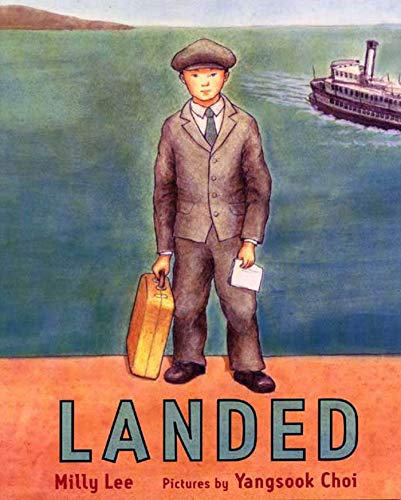
Sun is ready to leave his village in China for America, the place known as Gum Saan, Gold Mountain. His father warns him, though, that passage will not be easy. Because of the 1882 Chinese Exclusion Act, new immigrants like Sun are detained at Angel Island until they are called to take a difficult oral exam before they can "land" – leave Angel Island and go ashore. On the boat, Sun had studied maps of his village and memorized facts about his ancestors. But as the weeks pass in detainment, the map's compass points swirl in his memory, and
Sun worries that he will lose his direction and be turned away.
The oil paintings are rich with historical details in this vivid recounting, based on the author's father-in-law's experiences, of a disturbing chapter in Chinese American history.
"synopsis" may belong to another edition of this title.
About the Authors
Milly Lee grew up in San Francisco’s Chinatown as Mildred Chan in a household where grandparents, parents, siblings, aunts, uncles, and cousins all lived under one roof. She attended Chinese school after the regular school day and spoke Cantonese at home and in the neighborhood. Up until the end of World War II, Chinatown was a small, close-knit community whose members were under pressure to conform to the ideals of Chinese culture.
When she was a child, Milly found few books about children like herself. There were some Asian stories, but they were set in an exotic land of long, long ago. Milly felt strongly that stories of bicultural children and their experiences needed to be voiced, so that they would see their own likeness in books. A retired school librarian who had been very active in the American Library Association, among other professional associations and organizations, she knew exactly what she wanted her first book to be.
Nim and the War Effort is an autobiographical story, but it speaks directly to the experiences of all bicultural children in their struggles to find out who they are. In it, a young Chinese American girl, trying to prove her patriotism during World War II, risks her family’s disapproval by leaving Chinatown to collect newspapers for the war effort.
Milly revisits Chinatown in Earthquake. Basing her story on her mother’s experiences in the 1906 San Francisco catastrophe, she tells of the family’s escape across the burning, crumbling city to safety. With an endnote explaining the details of the quake, and including newly discovered information, Earthquake gives readers a fascinating picture of a city coping with an emergency; it is also a moving tribute to the hundreds of Chinese Americans who lost their homes, and in some cases their lives, in that disaster.
Landed, Milly’s most recent book, is also based on a true story, that of her father-in-law and his experiences as a boy immigrating to the United States from China in the early twentieth century. Because of the 1882 Chinese Exclusion Act, he and other new immigrants were detained at Angel Island, California, where, whether or not they were legitimate sons, they had to pass a difficult interrogation before being allowed into the country. Milly found that the people who had been incarcerated there didn’t speak about their experiences because they feared their legal status would be challenged.
Milly was asked recently what her books are about, which set her to thinking that her books have a more common thread than she had realized: “I have thought of them as stories based on my own and my family’s experiences. I believe they provide some insight into how we lived within our own culture and how we lived segregated from the larger community. The stories are from the perspective of people outside the mainstream who have been left out of the stories of the times, in our case, of World War II and the San Francisco earthquake and fire. Chinese Americans were part of those events; their experiences were just a bit different from other American stories of the period. I wanted to let readers know that ‘we were there, too’ . . . When I talk with school groups, minority students such as the Hispanic school population are often surprised that other people faced these issues as well. I feel it’s important for them to know that and to know that they are not singled out, that their immigration problems are similar to those of other groups who have wanted to come to America. Teachers have told me that my books have helped to open discussions on racism with their students.”
Since she retired in 1991, Milly, besides writing, travels with her husband, Kearn, to many of the places they read about but never dared to dream of going when they were growing up in San Francisco’s Chinatown. Milly Lee, the mother of three and grandmother of six, lives in San Francisco, California.
Yangsook Choi is the author and/or illustrator of many celebrated picture books, including The Name Jar and A Letter to My Best Friend, and Janet Wong’s This Next New Year. Born and raised in Korea, she now divides her time between New York and Seoul.
Reviews
Grade 3-6–Entering America from China will be difficult for 12-year-old Sun because of the 1882 Chinese Exclusion Act, even though he will be traveling with his father. He studies hard so that he can answer all of the questions the American officials will ask upon his arrival; he will be alone because his father, a returning merchant, will not have to be interrogated. When he arrives on Angel Island, where Asian immigrants are held for sometimes up to a year, he waits four weeks to be called. The only questions that he cant answer are about directions, and it seems that he might fail the test and be sent back to China. Finally, with the help of a compass, he passes the test. Based on the experiences of the authors father-in-law, the book recounts a story from a neglected and shameful era in United States history. An authors note gives readers more information about the history of Chinese immigration and suggests resources for further research. Chois soft illustrations, reminiscent of those in Allen Says Grandfathers Journey (Houghton, 1993), capture the spirit of the time with beautiful visual detail. This is a significant book; from it, students will learn much about this chapter in U.S. history.–Lee Bock, Glenbrook Elementary School, Pulaski, WI
Copyright © Reed Business Information, a division of Reed Elsevier Inc. All rights reserved.
*Starred Review* Gr. 3-5. Like Katrina Saltonstall Currier's Kai's Journey to Gold Mountain (2005), this poignant picture book is about a Chinese immigrant boy trying to join his father^B in America. But this story is much more detailed, with a lengthy text that describes leaving the old country as well as the difficulties of getting into the new one. Drawing on her father-in-law's experience, Lee tells of Sun, 12, whose family employs a tutor to help prepare him for American officials' questions. Sun must memorize minute details about his home in China to prove that he is his father's true son. Indeed, Sun is detained on Angel Island, where he is interrogated for a month, and where he makes friends with two "paper sons," who have made up identities to get into the country. The story is told with quiet restraint; there are no emotional partings from Sun's mother in China, no tearful reunions with older brothers already in California. But the tension is always there, and Choi's beautiful, full-page oil paintings, in sepia tones and shades of green, are quiet and packed with feeling--especially evident when the boy, stripped to the waist, endures the humiliating medical exam and when, dressed in suit and tie, he faces his interrogators, trying to remember his story. Pair this with Lawrence Yep's Tongues of Jade (1991) and other stories of immigrants detained on Ellis Island, terrified of being sent back. Hazel Rochman
Copyright © American Library Association. All rights reserved
"About this title" may belong to another edition of this title.
Search results for Landed

Stock Image
Landed
Published by
Farrar, Straus and Giroux (Byr), 2006
ISBN 10: 0374343144
ISBN 13: 9780374343149
Used
Hardcover
Seller: World of Books (was SecondSale), Montgomery, IL, U.S.A.
Seller rating 5 out of 5 stars

Hardback. Condition: Good. Choi, Yangsook (illustrator). "Choi's lovely, somber, full-page watercolors and Lee's quiet narrative. . .put a human face on the great abstraction of immigration." --Washington Post Book World Sun is ready to leave his village in China for America, the place known as Gum Saan, Gold Mountain. His father warns him, though, that passage will not be easy. Because of the 1882 Chinese Exclusion Act, new immigrants like Sun are detained at Angel Island until they are called to take a difficult oral exam before they can "land" - leave Angel Island and go ashore. On the boat, Sun had studied maps of his village and memorized facts about his ancestors. But as the weeks pass in detainment, the map's compass points swirl in his memory, and Sun worries that he will lose his direction and be turned away. The oil paintings are rich with historical details in this vivid recounting, based on the author's father-in-law's experiences, of a disturbing chapter in Chinese American history. Seller Inventory # 00098746627
Stock Image
Landed
Published by
Farrar, Straus and Giroux (BYR), 2006
ISBN 10: 0374343144
ISBN 13: 9780374343149
Used
Hardcover
Seller: More Than Words, Waltham, MA, U.S.A.
Seller rating 5 out of 5 stars
Condition: Good. Choi, Yangsook (illustrator). . Former Library book. All orders guaranteed and ship within 24 hours. Before placing your order for please contact us for confirmation on the book's binding. Check out our other listings to add to your order for discounted shipping. Seller Inventory # WAL-A-6a-002470
Stock Image
Landed
Published by
Farrar, Straus and Giroux (BYR), 2006
ISBN 10: 0374343144
ISBN 13: 9780374343149
Used
Hardcover
Seller: Evergreen Goodwill, Seattle, WA, U.S.A.
Seller rating 5 out of 5 stars
hardcover. Condition: Good. Choi, Yangsook (illustrator). Seller Inventory # mon0000778315
Seller Image
Landed
Published by
Farrar, Straus and Giroux (BYR), 2006
ISBN 10: 0374343144
ISBN 13: 9780374343149
Used
Hardcover
Seller: Dream Books Co., Denver, CO, U.S.A.
Seller rating 5 out of 5 stars
Condition: good. Choi, Yangsook (illustrator). Gently used with minimal wear on the corners and cover. A few pages may contain light highlighting or writing, but the text remains fully legible. Dust jacket may be missing, and supplemental materials like CDs or codes may not be included. May be ex-library with library markings. Ships promptly! Seller Inventory # DBV.0374343144.G
Stock Image
Landed
Published by
Farrar, Straus and Giroux (BYR) (edition First Edition), 2006
ISBN 10: 0374343144
ISBN 13: 9780374343149
Used
Hardcover
First Edition
Seller: BooksRun, Philadelphia, PA, U.S.A.
Seller rating 5 out of 5 stars
Hardcover. Condition: Very Good. Choi, Yangsook (illustrator). First Edition. It's a well-cared-for item that has seen limited use. The item may show minor signs of wear. All the text is legible, with all pages included. It may have slight markings and/or highlighting. Seller Inventory # 0374343144-8-1
Stock Image
Landed
Published by
Farrar, Straus & Giroux, 2006
ISBN 10: 0374343144
ISBN 13: 9780374343149
Used
Hardcover
First Edition
Seller: Better World Books: West, Reno, NV, U.S.A.
Seller rating 5 out of 5 stars
Condition: Good. Choi, Yangsook (illustrator). 1st Edition. Pages intact with minimal writing/highlighting. The binding may be loose and creased. Dust jackets/supplements are not included. Stock photo provided. Product includes identifying sticker. Better World Books: Buy Books. Do Good. Seller Inventory # 5394646-6
Stock Image
Landed
Published by
Farrar, Straus & Giroux, 2006
ISBN 10: 0374343144
ISBN 13: 9780374343149
Used
Hardcover
First Edition
Seller: Better World Books, Mishawaka, IN, U.S.A.
Seller rating 5 out of 5 stars
Condition: Good. Choi, Yangsook (illustrator). 1st Edition. Former library copy. Pages intact with minimal writing/highlighting. The binding may be loose and creased. Dust jackets/supplements are not included. Includes library markings. Stock photo provided. Product includes identifying sticker. Better World Books: Buy Books. Do Good. Seller Inventory # GRP17032200
Stock Image
Landed
Published by
Farrar, Straus & Giroux, 2006
ISBN 10: 0374343144
ISBN 13: 9780374343149
Used
Hardcover
First Edition
Seller: Better World Books, Mishawaka, IN, U.S.A.
Seller rating 5 out of 5 stars
Condition: Good. Choi, Yangsook (illustrator). 1st Edition. Pages intact with minimal writing/highlighting. The binding may be loose and creased. Dust jackets/supplements are not included. Stock photo provided. Product includes identifying sticker. Better World Books: Buy Books. Do Good. Seller Inventory # 5394646-6
Stock Image
Landed
Published by
Farrar, Straus and Giroux (BYR), 2006
ISBN 10: 0374343144
ISBN 13: 9780374343149
Used
Hardcover
Seller: Wonder Book, Frederick, MD, U.S.A.
Seller rating 5 out of 5 stars
Condition: Good. Choi, Yangsook (illustrator). Good condition. Good dust jacket. In protective mylar cover. A copy that has been read but remains intact. May contain markings such as bookplates, stamps, limited notes and highlighting, or a few light stains. Seller Inventory # G02F-02022
Stock Image
Landed
Published by
Farrar, Straus and Giroux (Byr), 2006
ISBN 10: 0374343144
ISBN 13: 9780374343149
Used
Hardcover
Seller: World of Books Inc, Montgomery, IL, U.S.A.
Seller rating 4 out of 5 stars

Hardback. Condition: Good. Choi, Yangsook (illustrator). "Choi's lovely, somber, full-page watercolors and Lee's quiet narrative. . .put a human face on the great abstraction of immigration." --Washington Post Book World Sun is ready to leave his village in China for America, the place known as Gum Saan, Gold Mountain. His father warns him, though, that passage will not be easy. Because of the 1882 Chinese Exclusion Act, new immigrants like Sun are detained at Angel Island until they are called to take a difficult oral exam before they can "land" - leave Angel Island and go ashore. On the boat, Sun had studied maps of his village and memorized facts about his ancestors. But as the weeks pass in detainment, the map's compass points swirl in his memory, and Sun worries that he will lose his direction and be turned away. The oil paintings are rich with historical details in this vivid recounting, based on the author's father-in-law's experiences, of a disturbing chapter in Chinese American history. Seller Inventory # CIN0374343144G