
Items related to Papa's Mechanical Fish
Synopsis
Candace Fleming and illustrator Boris Kulikov pair up to tell a fun story about a real submarine inventor in Papa's Mechanical Fish
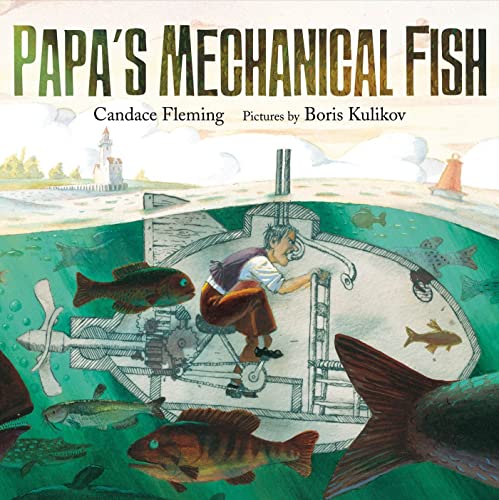
Clink! Clankety-bang! Thump-whirr! That's the sound of Papa at work. Although he is an inventor, he has never made anything that works perfectly, and that's because he hasn't yet found a truly fantastic idea. But when he takes his family fishing on Lake Michigan, his daughter Virena asks, "Have you ever wondered what it's like to be a fish?"―and Papa is off to his workshop. With a lot of persistence and a little bit of help, Papa―who is based on the real-life inventor Lodner Phillips―creates a submarine that can take his family for a trip to the bottom of Lake Michigan.
"synopsis" may belong to another edition of this title.
About the Authors
Candace Fleming is the author of Giant Squid, an ALA Notable Book and Charlotte Zolotow Honor Book, and numerous other books for children. She lives in Oak Park, Illinois.
From the Author:
I have always been a storyteller. Even before I could write my name, I could tell a good tale. And I told them all the time. As a preschooler, I told my neighbors all about my three-legged cat named Spot. In kindergarten, I told my classmates about the ghost that lived in my attic. And in first grade, I told my teacher, Miss Harbart, all about my family’s trip to Paris, France.
I told such a good story that people always thought I was telling the truth. But I wasn’t. I didn’t have a three-legged cat or a ghost in my attic, and I’d certainly never been to Paris, France. I simply enjoyed telling a good story . . . and seeing my listener’s reaction.
Sure, some people might have said I was a seven-year-old fibber. But not my parents. Instead of calling my stories "fibs" they called them "imaginative." They encouraged me to put my stories down on paper. I did. And amazingly, once I began writing, I couldn’t stop. I filled notebook after notebook with stories, poems, plays. I still have many of those notebooks. They’re precious to me because they are a record of my writing life from elementary school on.
In second grade, I discovered a passion for language. I can still remember the day my teacher, Ms. Johnson, held up a horn-shaped basket filled with papier-mâché pumpkins and asked the class to repeat the word "cornucopia." I said it again and again. I tasted the word on my lips. I tested it on my ears. That afternoon, I skipped all the way home from school chanting "Cornucopia! Cornucopia!" From then on, I really began listening to words -- to the sounds they made, and the way they were used, and how they made me feel. I longed to put them together in ways that were beautiful and yet told a story.
As I grew, I continued to write stories. But I never really thought of becoming an author. Instead, I went to college, where I discovered yet another passion -- history. I didn’t realize it then, but studying history was really just an extension of my love of stories. After all, some of the best stories are true ones -- tales of heroism and villainy made more incredible by the fact they really happened.
After graduation, I got married and had children. I read to them a lot, and that’s when I discovered the joy and music of children’s books. I simply couldn’t get enough of them. With my two sons in tow, I made endless trips to the library. I read stacks of books. I found myself begging, "Just one more, pleeeease!" while my boys begged for lights-out and sleep. Then it struck me. Why not write children’s books? It seemed the perfect way to combine all the things I loved -- stories, musical language, history, and reading. I couldn’t wait to get started.
But writing children’s books is harder than it sounds. For three years, I wrote story after story. I sent them to publisher after publisher. And I received rejection letter after rejection letter. Still, I didn’t give up. I kept trying until finally one of my stories was pulled from the slush pile and turned into a book. My career as a children’s author had begun.
Boris Kulikov is the critically acclaimed illustrator of many children's books. His work includes Papa's Mechanical Fish by Candace Fleming; W is for Webster by Tracey Fern; and the Max's Math series, written by Kate Banks.He lives in Brooklyn, New York.
Reviews
Gr 2-4-This picture book is a fictional account based on events in the life of eccentric inventor Lodner Phillips as told from the perspective of his daughter, Virena. Papa theorizes and tinkers but never succeeds. Finally, while the family is dropping lines from a pier into Lake Michigan, his daughter asks, "have you ever wondered what it's like to be a fish?" Immediately the man dashes back to his workshop and soon produces one of the world's earliest submarines, the Whitefish. Children will delight in the way Virena is the catalyst for her father's successive improvements to his primitive vessel as she continues to ask questions: about how fish move through water, stay dry, and know where they are going. Kulikov's luminous, playful, detailed illustrations on full-bleed spreads incorporate a variety of perspectives, including close-up views of fish and of Papa underwater and cutaway diagrams of his creations. An afterword is included. The exuberant and inquisitive tone of this book is sure to entertain curious children.-Anne Barreca, New York Public Libraryα(c) Copyright 2013. Library Journals LLC, a wholly owned subsidiary of Media Source, Inc. No redistribution permitted.
There’s a rich history of batty inventor/tinkerer dads in children’s books, and the girl narrator’s father in this book could hang with the best of them. That he’s based on a real mid-nineteenth-century person makes it all the better. Whether Papa’s spectacular failures have been great ideas (steam-powered roller skates) or not-so-great (edible socks), “not once has Papa invented anything that works perfectly.” But inspiration flashes when the family is out fishing in the lake—a mechanical fish. Iteration after iteration of his rudimentary submarine ends in lighthearted disaster, each time the object growing more complex and preposterous until he’s finally come up with a vessel just crazy enough to work. Fleming festoons her glib narrative with read-aloud treats of “Clacketa-claketa-clacketa!” and “Clink! Clankety-bang! Thump-whirr!” Meanwhile, Kulikov dishes out some tall-tale-worthy artwork and cut-out designs somewhere between Leonardo da Vinci and Rube Goldberg. A closing note talks about Fleming’s inspiration, the inventor Lodner Phillips, who really did take his family for an underwater spin in Lake Michigan in 1851. Grades K-2. --Ian Chipman
"About this title" may belong to another edition of this title.
Search results for Papa's Mechanical Fish

Stock Image
Papa's Mechanical Fish
Published by
Farrar, Straus and Giroux (Byr), 2013
ISBN 10: 0374399085
ISBN 13: 9780374399085
Used
Hardcover
Seller: World of Books (was SecondSale), Montgomery, IL, U.S.A.
Seller rating 5 out of 5 stars

Hardback. Condition: Fair. Kulikov, Boris (illustrator). Candace Fleming and illustrator Boris Kulikov pair up to tell a fun story about a real submarine inventor in Papa's Mechanical Fish Clink! Clankety-bang! Thump-whirr! That's the sound of Papa at work. Although he is an inventor, he has never made anything that works perfectly, and that's because he hasn't yet found a truly fantastic idea. But when he takes his family fishing on Lake Michigan, his daughter Virena asks, "Have you ever wondered what it's like to be a fish?"--and Papa is off to his workshop. With a lot of persistence and a little bit of help, Papa--who is based on the real-life inventor Lodner Phillips--creates a submarine that can take his family for a trip to the bottom of Lake Michigan. Seller Inventory # CIN0374399085A
Stock Image
Papa's Mechanical Fish
Published by
Farrar, Straus and Giroux (Byr), 2013
ISBN 10: 0374399085
ISBN 13: 9780374399085
Used
Hardcover
Seller: World of Books (was SecondSale), Montgomery, IL, U.S.A.
Seller rating 5 out of 5 stars
Hardback. Condition: Very Good. Kulikov, Boris (illustrator). Candace Fleming and illustrator Boris Kulikov pair up to tell a fun story about a real submarine inventor in Papa's Mechanical Fish Clink! Clankety-bang! Thump-whirr! That's the sound of Papa at work. Although he is an inventor, he has never made anything that works perfectly, and that's because he hasn't yet found a truly fantastic idea. But when he takes his family fishing on Lake Michigan, his daughter Virena asks, "Have you ever wondered what it's like to be a fish?"--and Papa is off to his workshop. With a lot of persistence and a little bit of help, Papa--who is based on the real-life inventor Lodner Phillips--creates a submarine that can take his family for a trip to the bottom of Lake Michigan. Seller Inventory # 00110971379
Stock Image
Papa's Mechanical Fish
Published by
Farrar, Straus and Giroux (Byr), 2013
ISBN 10: 0374399085
ISBN 13: 9780374399085
Used
Hardcover
Seller: World of Books (was SecondSale), Montgomery, IL, U.S.A.
Seller rating 5 out of 5 stars
Hardback. Condition: Good. Kulikov, Boris (illustrator). Candace Fleming and illustrator Boris Kulikov pair up to tell a fun story about a real submarine inventor in Papa's Mechanical Fish Clink! Clankety-bang! Thump-whirr! That's the sound of Papa at work. Although he is an inventor, he has never made anything that works perfectly, and that's because he hasn't yet found a truly fantastic idea. But when he takes his family fishing on Lake Michigan, his daughter Virena asks, "Have you ever wondered what it's like to be a fish?"--and Papa is off to his workshop. With a lot of persistence and a little bit of help, Papa--who is based on the real-life inventor Lodner Phillips--creates a submarine that can take his family for a trip to the bottom of Lake Michigan. Seller Inventory # 00101873385
Stock Image
Papa's Mechanical Fish
Published by
Farrar, Straus and Giroux (BYR) (edition First Edition), 2013
ISBN 10: 0374399085
ISBN 13: 9780374399085
Used
Hardcover
First Edition
Seller: BooksRun, Philadelphia, PA, U.S.A.
Seller rating 5 out of 5 stars
Hardcover. Condition: Very Good. Kulikov, Boris (illustrator). First Edition. With dust jacket. It's a well-cared-for item that has seen limited use. The item may show minor signs of wear. All the text is legible, with all pages included. It may have slight markings and/or highlighting. Seller Inventory # 0374399085-11-1-29
Seller Image
Papa's Mechanical Fish
Published by
Farrar, Straus and Giroux (BYR), 2013
ISBN 10: 0374399085
ISBN 13: 9780374399085
Used
Hardcover
Seller: Dream Books Co., Denver, CO, U.S.A.
Seller rating 5 out of 5 stars
Condition: acceptable. Kulikov, Boris (illustrator). This copy has clearly been enjoyedâ"expect noticeable shelf wear and some minor creases to the cover. Binding is strong, and all pages are legible. May contain previous library markings or stamps. Seller Inventory # DBV.0374399085.A
Seller Image
Papa's Mechanical Fish
Published by
Farrar, Straus and Giroux (BYR), 2013
ISBN 10: 0374399085
ISBN 13: 9780374399085
Used
Hardcover
Seller: Greenworld Books, Arlington, TX, U.S.A.
Seller rating 5 out of 5 stars
Condition: good. Kulikov, Boris (illustrator). Fast Free Shipping â" Good condition. It may show normal signs of use, such as light writing, highlighting, or library markings, but all pages are intact and the book is fully readable. A solid, complete copy that's ready to enjoy. Seller Inventory # GWV.0374399085.G
Stock Image
Papa's Mechanical Fish
Published by
Farrar, Straus and Giroux (BYR), 2013
ISBN 10: 0374399085
ISBN 13: 9780374399085
Used
Hardcover
Seller: HPB-Ruby, Dallas, TX, U.S.A.
Seller rating 5 out of 5 stars
Hardcover. Condition: Very Good. Kulikov, Boris (illustrator). Connecting readers with great books since 1972! Used books may not include companion materials, and may have some shelf wear or limited writing. We ship orders daily and Customer Service is our top priority! Seller Inventory # S_439595101
Stock Image
Papa's Mechanical Fish
Published by
Farrar, Straus and Giroux (BYR), 2013
ISBN 10: 0374399085
ISBN 13: 9780374399085
Used
Hardcover
Seller: HPB-Movies, Dallas, TX, U.S.A.
Seller rating 4 out of 5 stars

Hardcover. Condition: Very Good. Kulikov, Boris (illustrator). Connecting readers with great books since 1972! Used books may not include companion materials, and may have some shelf wear or limited writing. We ship orders daily and Customer Service is our top priority! Seller Inventory # S_432739707
Stock Image
Papa's Mechanical Fish
Published by
Farrar, Straus and Giroux (BYR), 2013
ISBN 10: 0374399085
ISBN 13: 9780374399085
Used
Hardcover
Seller: HPB-Emerald, Dallas, TX, U.S.A.
Seller rating 5 out of 5 stars
Hardcover. Condition: Very Good. Kulikov, Boris (illustrator). Connecting readers with great books since 1972! Used books may not include companion materials, and may have some shelf wear or limited writing. We ship orders daily and Customer Service is our top priority! Seller Inventory # S_475011807
Seller Image
Papa's Mechanical Fish
Published by
Farrar, Straus and Giroux (BYR), 2013
ISBN 10: 0374399085
ISBN 13: 9780374399085
Used
Hardcover
Seller: Austin Goodwill 1101, Austin, TX, U.S.A.
Seller rating 5 out of 5 stars
Condition: good. Kulikov, Boris (illustrator). Book shows general signs of use and handling. May have light wear on the cover or edges and minimal writing or highlighting. Binding remains tight, and pages are clean and readable. Seller Inventory # CTXV.0374399085.G