
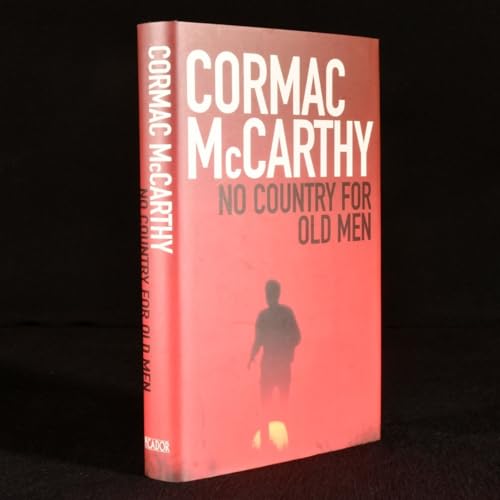
Synopsis
Set in our own time along the bloody frontier between Texas and Mexico, this is Cormac McCarthy’s first novel since Cities of the Plain completed his acclaimed, best-selling Border Trilogy.
Llewelyn Moss, hunting antelope near the Rio Grande, instead finds men shot dead, a load of heroin, and more than $2 million in cash. Packing the money out, he knows, will change everything. But only after two more men are murdered does a victim’s burning car lead Sheriff Bell to the carnage out in the desert, and he soon realizes how desperately Moss and his young wife need protection. One party in the failed transaction hires an ex–Special Forces officer to defend his interests against a mesmerizing freelancer, while on either side are men accustomed to spectacular violence and mayhem. The pursuit stretches up and down and across the border, each participant seemingly determined to answer what one asks another: how does a man decide in what order to abandon his life?
A harrowing story of a war that society is waging on itself, and an enduring meditation on the ties of love and blood and duty that inform lives and shape destinies, No Country for Old Men is a novel of extraordinary resonance and power.
"synopsis" may belong to another edition of this title.
About the Author
Cormac McCarthy is the author of eight previous novels, and among his honors are the National Book Award and the National Book Critics Circle Award.
Reviews
For 40 years, since The Orchard Keeper, Cormac McCarthy has brought forth literature as important as it is rare. Beyond that, critics and readers tend to diverge wildly with each novel, which to my eye is further proof of the writer's power. No Country for Old Men will have the same effect. This is a profoundly disturbing and gorgeously rendered novel that will certainly be quibbled with. Not the least of the objections will almost surely be what makes the novel so attractive. No Country for Old Men is the most accessible of all McCarthy's works. This is not necessarily a good thing.
The plot is simple. One fine morning in west Texas, a young Vietnam vet is antelope hunting when he comes upon the carnage of a drug deal gone bad. Both heroin and a suitcase of cash remain at the site, along with a number of bodies. The cash is enough to entice the otherwise upright Llewelyn Moss to steal it, although conveniently it's not so much that it can't be carried, not even after Moss receives the first in a long line of wounds. Moss has a moral clarity reminiscent of John Grady Cole from All the Pretty Horses (1992); he knows he's making the worst mistake of his life but can't resist the temptation or the chance to test himself. He knows he'll be hunted (and hunted he is) but believes he can outsmart the hunters.
The other two main characters enter as polarities: a psychopathic killer, Anton Chigurh, whose only apparent moral code is to leave no witnesses to his existence; and Sheriff Bell, a World War II veteran who's a bit smarter than most other law enforcement officers and does his best to find and protect Moss while offering thoughts on existence and the unhinged modern world. The sheriff has his own dark secret which, unfortunately, is somewhat at odds with his character.
Finally, other than a handful of minor characters, there are three women -- or two and a half, depending how you count. The wives of Moss and Bell are tough, tender women, rock-solid square behind their men. The third has the same potential but like most everyone in the novel winds up dead first.
McCarthy's language is stripped lean and mean here. In places, dialogue carries large sections of the story. His ear for speech, dialect and wordplay remains noteworthy in American letters. His descriptive passages are lucid and visual -- this novel needs no film adaptation. He writes in painstaking and painful detail about self-treatment of gunshot wounds, exhibiting a near-morbid fascination that's beyond the call of the narrative. Even what in previous novels were long digressions are now minimal injections of first-person rumination and reflection by Bell. In short, No Country for Old Men is a page-turner. Readers who have been unwilling to wade through McCarthy's more complicated fables will be swept along for the ride. Many long-term readers will do the same.
So what's not to like? Plenty. The symbolism is achingly awkward, starting with the names; Moss, Bell, Chigurh (rhymes with "sugar" but reminded this reader of chigger, the small boring insect that gets under the skin and causes a rash, pain and possibly blood infection). Narcotics are the broken hinge of the world or, as the sheriff, who offers homely and homespun thoughts at a numbing rate, has it, "If you were Satan and you were settin around tryin to think up somethin that would just bring the human race to its knees what you would probably come up with is narcotics." Modern society's abandonment of Christ is frequently mentioned, which, while fitting the near-stereotypical rural nature of these characters, is handled simplistically. Even moments that on first reading appear insightful lose their sheen a second time through:
"Every moment in your life is a turning and every one a choosing. Somewhere you made a choice. All followed to this. The accounting is scrupulous. The shape is drawn. No line can be erased. I had no belief in your ability to move a coin to your bidding. How could you? A person's path through the world seldom changes and even more seldom will it change abruptly. And the shape of your path was visible from the beginning."
Bell's wife, Loretta, is quickly sketched but has a vibrancy lacking in more fully realized women from previous works. Still, it's hard to picture ex-prisoners bringing their new wives to meet her and breaking into tears because she fed them well when they were incarcerated. Cornpone, pure and simple.
That said, this is an entertaining novel from one of our best writers. Often seen as a fabulist and an engineer of dark morality tales, McCarthy is first a storyteller. But No Country for Old Men is a minor addition to his work. Rumor has it that this novel came to the publisher at around 600 pages. If that is the case, one can't help but wonder if a truly magnificent work was lost at the cost of pruning with an eye toward the marketplace.
Reviewed by Jeffrey Lent
Copyright 2005, The Washington Post Co. All Rights Reserved.
McCarthy’s Border Trilogy, distinguished by the award-winning All the Pretty Horses (1992), contains dark Westerns set against beautiful, bleak landscapes. His newest novel updates his character-driven plots and themes of violence and moral ambiguity. Perhaps the true sign of a master is one whose work raises debate—and this is what No Country has done. Most critics praised McCarthy’s clean, simple prose, though a few thought it too spare for such a graceful stylist. ("The man looked at Chigurh’s eyes for the first time. Blue as lapis. At once glistening and opaque. Like wet stones.") Compelling characters (even women) abound, but Sheriff Bell came off as either smart or too long winded. Finally, the violence seemed gratuitous to some. Even if No Country may be a more minor McCarthy novel, it’s still a terrifying page-turner in the vein of the Trilogy.
Copyright © 2004 Phillips & Nelson Media, Inc.
Starred Review. Seven years after Cities of the Plain brought his acclaimed Border Trilogy to a close, McCarthy returns with a mesmerizing modern-day western. In 1980 southwest Texas, Llewelyn Moss, hunting antelope near the Rio Grande, stumbles across several dead men, a bunch of heroin and $2.4 million in cash. The bulk of the novel is a gripping man-on-the-run sequence relayed in terse, masterful prose as Moss, who's taken the money, tries to evade Wells, an ex–Special Forces agent employed by a powerful cartel, and Chigurh, an icy psychopathic murderer armed with a cattle gun and a dangerous philosophy of justice. Also concerned about Moss's whereabouts is Sheriff Bell, an aging lawman struggling with his sense that there's a new breed of man (embodied in Chigurh) whose destructive power he simply cannot match. In a series of thoughtful first-person passages interspersed throughout, Sheriff Bell laments the changing world, wrestles with an uncomfortable memory from his service in WWII and—a soft ray of light in a book so steeped in bloodshed—rejoices in the great good fortune of his marriage. While the action of the novel thrills, it's the sensitivity and wisdom of Sheriff Bell that makes the book a profound meditation on the battle between good and evil and the roles choice and chance play in the shaping of a life.
Copyright © Reed Business Information, a division of Reed Elsevier Inc. All rights reserved.
*Starred Review* Dark themes suffuse McCarthy's first offering since his completion of The Border Trilogy, wose opening installment, All the Pretty Horses earned him both the National Book Award and National Book Critics Circle Award in 1992. Texas welder Llewelyn Moss makes a dubious discovery while out hunting antelope near the banks of the Rio Grande: a dead man, a stash of heroin, and more than $2 million in cash. Moss packs out the money, knowing his actions will imperil him for the rest of his life. He's soon on the run, left to his own devices against vengeful drug dealers, a former Special Forces agent, and a psychopathic freelance killer with ice blue eyes. Shades of Dostoyevsky, Hemingway, and Faulkner resonate in McCarthy's blend of lyrical narrative, staccato dialogue, and action-packed scenes splattered with bullets and blood. McCarthy fans will revel in the author's renderings of the raw landscapes of Mexico and the Southwest and the precarious souls scattered along the border that separates the two. Many are the men here who maim in the name of drugs. "If you killed 'em all," says the local sheriff, "they'd have to build an annex onto hell." Allison Block
Copyright © American Library Association. All rights reserved
Excerpt. © Reprinted by permission. All rights reserved.
I
I sent one boy to the gaschamber at Huntsville. One and only one. My arrest and my testimony. I went up there and visited with him two or three times. Three times. The last time was the day of his execution. I didnt have to go but I did. I sure didnt want to. He’d killed a fourteen year old girl and I can tell you right now I never did have no great desire to visit with him let alone go to his execution but I done it. The papers said it was a crime of passion and he told me there wasnt no passion to it. He’d been datin this girl, young as she was. He was nineteen. And he told me that he had been plannin to kill somebody for about as long as he could remember. Said that if they turned him out he’d do it again. Said he knew he was goin to hell. Told it to me out of his own mouth. I dont know what to make of that. I surely dont. I thought I’d never seen a person like that and it got me to wonderin if maybe he was some new kind. I watched them strap him into the seat and shut the door. He might of looked a bit nervous about it but that was about all. I really believe that he knew he was goin to be in hell in fifteen minutes. I believe that. And I’ve thought about that a lot. He was not hard to talk to. Called me Sheriff. But I didnt know what to say to him. What do you say to a man that by his own admission has no soul? Why would you say anything? I’ve thought about it a good deal. But he wasnt nothin compared to what was comin down the pike.
They say the eyes are the windows to the soul. I dont know what them eyes was the windows to and I guess I’d as soon not know. But there is another view of the world out there and other eyes to see it and that’s where this is goin. It has done brought me to a place in my life I would not of thought I’d of come to. Somewhere out there is a true and living prophet of destruction and I dont want to confront him. I know he’s real. I have seen his work. I walked in front of those eyes once. I wont do it again. I wont push my chips forward and stand up and go out to meet him. It aint just bein older. I wish that it was. I cant say that it’s even what you are willin to do. Because I always knew that you had to be willin to die to even do this job. That was always true. Not to sound glorious about it or nothin but you do. If you aint they’ll know it. They’ll see it in a heartbeat. I think it is more like what you are willin to become. And I think a man would have to put his soul at hazard. And I wont do that. I think now that maybe I never would.
The deputy left Chigurh standing in the corner of the office with his hands cuffed behind him while he sat in the swivelchair and took off his hat and put his feet up and called Lamar on the mobile.
Just walked in the door. Sheriff he had some sort of thing on him like one of them oxygen tanks for emphysema or whatever. Then he had a hose that run down the inside of his sleeve and went to one of them stunguns like they use at the slaughterhouse. Yessir. Well that’s what it looks like. You can see it when you get in. Yessir. I got it covered. Yessir.
When he stood up out of the chair he swung the keys off his belt and opened the locked desk drawer to get the keys to the jail. He was slightly bent over when Chigurh squatted and scooted his manacled hands beneath him to the back of his knees. In the same motion he sat and rocked backward and passed the chain under his feet and then stood instantly and effortlessly. If it looked like a thing he’d practiced many times it was. He dropped his cuffed hands over the deputy’s head and leaped into the air and slammed both knees against the back of the deputy’s neck and hauled back on the chain.
They went to the floor. The deputy was trying to get his hands inside the chain but he could not. Chigurh lay there pulling back on the bracelets with his knees between his arms and his face averted. The deputy was flailing wildly and he’d begun to walk sideways over the floor in a circle, kicking over the wastebasket, kicking the chair across the room. He kicked shut the door and he wrapped the throwrug in a wad about them. He was gurgling and bleeding from the mouth. He was strangling on his own blood. Chigurh only hauled the harder. The nickelplated cuffs bit to the bone. The deputy’s right carotid artery burst and a jet of blood shot across the room and hit the wall and ran down it. The deputy’s legs slowed and then stopped. He lay jerking. Then he stopped moving altogether. Chigurh lay breathing quietly, holding him. When he got up he took the keys from the deputy’s belt and released himself and put the deputy’s revolver in the waistband of his trousers and went into the bathroom.
He ran cold water over his wrists until they stopped bleeding and he tore strips from a handtowel with his teeth and wrapped his wrists and went back into the office. He sat on the desk and fastened the toweling with tape from a dispenser, studying the dead man gaping up from the floor. When he was done he got the deputy’s wallet out of his pocket and took the money and put it in the pocket of his shirt and dropped the wallet to the floor. Then he picked up his airtank and the stungun and walked out the door and got into the deputy’s car and started the engine and backed around and pulled out and headed up the road.
On the interstate he picked out a late model Ford sedan with a single driver and turned on the lights and hit the siren briefly. The car pulled onto the shoulder. Chigurh pulled in behind him and shut off the engine and slung the tank across his shoulder and stepped out. The man was watching him in the rearview mirror as he walked up.
What’s the problem, officer? he said.
Sir would you mind stepping out of the vehicle?
The man opened the door and stepped out. What’s this about? he said.
Would you step away from the vehicle please.
The man stepped away from the vehicle. Chigurh could see the doubt come into his eyes at this bloodstained figure before him but it came too late. He placed his hand on the man’s head like a faith healer. The pneumatic hiss and click of the plunger sounded like a door closing. The man slid soundlessly to the ground, a round hole in his forehead from which the blood bubbled and ran down into his eyes carrying with it his slowly uncoupling world visible to see. Chigurh wiped his hand with his handkerchief. I just didnt want you to get blood on the car, he said.
Moss sat with the heels of his boots dug into the volcanic gravel of the ridge and glassed the desert below him with a pair of twelve power german binoculars. His hat pushed back on his head. Elbows propped on his knees. The rifle strapped over his shoulder with a harnessleather sling was a heavybarreled .270 on a ’98 Mauser action with a laminated stock of maple and walnut. It carried a Unertl telescopic sight of the same power as the binoculars. The antelope were a little under a mile away. The sun was up less than an hour and the shadow of the ridge and the datilla and the rocks fell far out across the floodplain below him. Somewhere out there was the shadow of Moss himself. He lowered the binoculars and sat studying the land. Far to the south the raw mountains of Mexico. The breaks of the river. To the west the baked terracotta terrain of the run- ning borderlands. He spat dryly and wiped his mouth on the shoulder of his cotton workshirt.
The rifle would shoot half minute of angle groups. Five inch groups at one thousand yards. The spot he’d picked to shoot from lay just below a long talus of lava scree and it would put him well within that distance. Except that it would take the better part of an hour to get there and the antelope were grazing away from him. The best he could say about any of it was that there was no wind.
When he got to the foot of the talus he raised himself slowly and looked for the antelope. They’d not moved far from where he last saw them but the shot was still a good seven hundred yards. He studied the animals through the binoculars. In the compressed air motes and heat distortion. A low haze of shimmering dust and pollen. There was no other cover and there wasnt going to be any other shot.
He wallowed down in the scree and pulled off one boot and laid it over the rocks and lowered the forearm of the rifle down into the leather and pushed off the safety with his thumb and sighted through the scope.
They stood with their heads up, all of them, looking at him.
Damn, he whispered. The sun was behind him so they couldnt very well have seen light reflect off the glass of the scope. They had just flat seen him.
The rifle had a Canjar trigger set to nine ounces and he pulled the rifle and the boot toward him with great care and sighted again and jacked the crosshairs slightly up the back of the animal standing most broadly to him. He knew the exact drop of the bullet in hundred yard increments. It was the distance that was uncertain. He laid his finger in the curve of the trigger. The boar’s tooth he wore on a gold chain spooled onto the rocks inside his elbow.
"About this title" may belong to another edition of this title.
Other Popular Editions of the Same Title

Search results for No Country for Old Men

Stock Image
No Country for Old Men
Seller: Craig Hokenson Bookseller, Dallas, TX, U.S.A.
Seller rating 5 out of 5 stars

Hardcover. Condition: Near Fine. Dust Jacket Condition: Near Fine+. Later Printing. Later printing, a fourth. Slight spine lean. Close to new otherwise. Seller Inventory # 047321
Stock Image
No Country for Old Men
Seller: Friends of Pima County Public Library, Tucson, AZ, U.S.A.
Seller rating 5 out of 5 stars
hardcover. Condition: Acceptable. Ex-Library with usual markings, stamps and / or stickers. Mylar cover on dust jacket taped to book. Cover has edge/corner wear. Pages are clean and free of markings. Binding is cocked. Proceeds benefit the Pima County Public Library system, which serves Tucson and southern Arizona. Seller Inventory # mon0000013144
Stock Image
No Country for Old Men
Seller: Friends of Pima County Public Library, Tucson, AZ, U.S.A.
Seller rating 5 out of 5 stars
hardcover. Condition: Very Good. Dust Jacket Condition: Very Good. Dust jacket is clean with some edgewear. Cover is clean and unmarred. Pages are clean and free of markings. Proceeds benefit the Pima County Public Library system, which serves Tucson and southern Arizona. Seller Inventory # mon0000012591
Stock Image
No Country For Old Men
Published by
Alfred a Knopf Inc, 2005
ISBN 10: 0375406778
ISBN 13: 9780375406775
Used
Hardcover
First Edition
Seller: Chapter Two Bookstore, Lompoc, CA, U.S.A.
Seller rating 5 out of 5 stars
Hardcover. Condition: Very Good. Dust Jacket Condition: Very Good. 1st Edition. Dust jacket shows minor shelf wear along the top edge front and back. The spine of the book is creased and the book slumps forward slightly. Book and pages are clean as a whistle. Binding is tight. Stated First Edition. Seller Inventory # 056492
Stock Image
No Country for Old Men
Seller: Bookplate, Chestertown, MD, U.S.A.
Seller rating 4 out of 5 stars

First edition. Minor bumping/shelf wear to DJ, other Near Fine copy with tight binding, clean pages. BP/Fiction. Seller Inventory # ABE-1778869802946
Stock Image
No Country For Old Men
Published by
Alfred a Knopf Inc, 2005
ISBN 10: 0375406778
ISBN 13: 9780375406775
Used
Hardcover
First Edition
Seller: Black Cat Books, Shelter Island, NY, U.S.A.
Seller rating 5 out of 5 stars
Hardcover. Condition: Very Good. Dust Jacket Condition: Very Good. 1st Edition. 1st edition. Hardbound in dust jacket. Seller Inventory # 94046
Stock Image
No Country for Old Men
Seller: GoldBooks, Denver, CO, U.S.A.
Seller rating 5 out of 5 stars
Hardcover. Condition: new. New Copy. Customer Service Guaranteed. Seller Inventory # 34H75_98_0375406778
Stock Image
No Country for Old Men
Published by
Knopf 19-Jul-05, 2005
ISBN 10: 0375406778
ISBN 13: 9780375406775
Used
Hardcover
First Edition
Seller: arc{hive}, Warren, RI, U.S.A.
Seller rating 5 out of 5 stars
Hardcover. Condition: Fine. Dust Jacket Condition: Fine. First Edition. Hardcover. Condition: Fine. Dust Jacket Condition: Fine. A First Edition, First Printing. Fine and appears unread in a fine unclipped dust jacket. Seller Inventory # 9780375406775
Stock Image
No Country For Old Men
Published by
Alfred A. Knopf, New York, 2005
ISBN 10: 0375406778
ISBN 13: 9780375406775
Used
Hardcover
First Edition
Seller: Twinwillow Books, Los Alamitos, CA, U.S.A.
Seller rating 5 out of 5 stars
Hardcover. Condition: Near Fine. Dust Jacket Condition: Very Good. 1st Edition. First edition stated. 5 3/4 x 8 1/2 Book; binding tight, subtle bump to bottom front corner else boards straight and clean; modest soiling to top and bottom edges else text free of marks, appears barely read. Dust jacket ($24.95) has mild bumping to mostly top edges with 1/4" closed tear to top spine. Color bright and sharp. Under archival quality mylar cover. Photos upon request. Packed well and shipped in a sturdy box. Seller Inventory # 061423SP2
Stock Image
No Country for Old Men
Seller: Griffin Books, Stamford, CT, U.S.A.
Seller rating 5 out of 5 stars
Paperback. Condition: Like New. As new softcover Advance Reader's Edition in brand new condition, looks unread. Paperback. Please email for photos. Larger books or sets may require additional shipping charges. Books sent via US Postal. Seller Inventory # 128735