
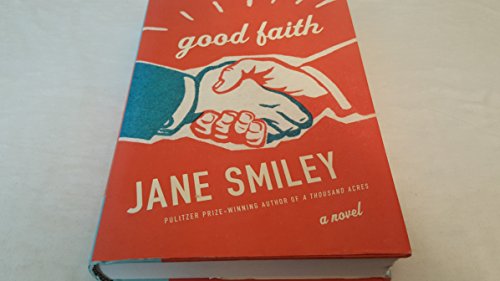
Synopsis
Jane Smiley brings her extraordinary gifts—comic timing, empathy, emotional wisdom, an ability to deliver slyly on big themes and capture the American spirit—to the seductive, wishful, wistful world of real estate, in which the sport of choice is the mind game. Her funny and moving new novel is about what happens when the American Dream morphs into a seven-figure American Fantasy.
Joe Stratford is someone you like at once. He makes an honest living helping nice people buy and sell nice houses. His not-very-amicable divorce is finally settled, and he’s ready to begin again. It’s 1982. He is pretty happy, pretty satisfied. But a different era has dawned; Joe’s new friend, Marcus Burns from New York, seems to be suggesting that the old rules are ready to be repealed, that now is the time you can get rich quick. Really rich. And Marcus not only knows that everyone is going to get rich, he knows how. Because Marcus just quit a job with the IRS.
But is Joe ready for the kind of success Marcus promises he can deliver? And what’s the real scoop on Salt Key Farm? Is this really the development opportunity of a lifetime?
And then there’s Felicity Ornquist, the lovely, feisty, winning (and married) daughter of Joe’s mentor and business partner. She has finally owned up to her feelings for Joe: she’s just been waiting for him to be available.
The question Joe asks himself, over and over, is, Does he have the gumption? Does he have the smarts and the imagination and the staying power to pay attention—to Marcus and to Felicity—and reap the rewards?
Good Faith captures the seductions and illusions that can seize America during our periodic golden ages (every Main Street an El Dorado). To follow Joe as he does deals and is dealt with in this newly liberated world of anything goes is a roller-coaster ride through the fun park of the 1980s. It is Jane Smiley in top form.
4/2003
"synopsis" may belong to another edition of this title.
About the Author
Jane smiley is the author of many novels, including A Thousand Acres, which won the Pulitzer Prize, and Horse Heaven. She lives in Northern California. In 2001, she was inducted into the American Academy of Arts and Letters.
From the Back Cover
brings her extraordinary gifts—comic timing, empathy, emotional wisdom, an ability to deliver slyly on big themes and capture the American spirit—to the seductive, wishful, wistful world of real estate, in which the sport of choice is the mind game. Her funny and moving new novel is about what happens when the American Dream morphs into a seven-figure American Fantasy.
Joe Stratford is someone you like at once. He makes an honest living helping nice people buy and sell nice houses. His not-very-amicable divorce is finally settled, and he’s ready to begin again. It’s 1982. He is pretty happy, pretty satisfied. But a different era has dawned; Joe’s new friend, Marcus Burns from New York, seems to be suggesting that the old rules are ready to be repealed, that now is the time you can get rich quick. Really rich. And Marcus not only knows that everyone is going to get rich, he knows how. Because Marcus just quit a job with the IRS.
But is Joe ready f
From the Inside Flap
brings her extraordinary gifts comic timing, empathy, emotional wisdom, an ability to deliver slyly on big themes and capture the American spirit to the seductive, wishful, wistful world of real estate, in which the sport of choice is the mind game. Her funny and moving new novel is about what happens when the American Dream morphs into a seven-figure American Fantasy.
Joe Stratford is someone you like at once. He makes an honest living helping nice people buy and sell nice houses. His not-very-amicable divorce is finally settled, and he s ready to begin again. It s 1982. He is pretty happy, pretty satisfied. But a different era has dawned; Joe s new friend, Marcus Burns from New York, seems to be suggesting that the old rules are ready to be repealed, that now is the time you can get rich quick. Really rich. And Marcus not only knows that everyone is going to get rich, he knows how. Because Marcus just quit a job with the IRS.
But is Joe ready f
Reviews
Smiley's range as a writer is always surprising. Eschewing both the tragic dimension of A Thousand Acres and the satiric glee of Moo, her 12th book is a clever and entertaining cautionary tale about America's greedy decade of the 1980s. Narrator Joe Stratford is a genial, well-liked realtor in a small New England town who's respected for his honesty; even his divorce was friendly. When smooth-talking Marcus Burns comes to town, fresh from a decade working at the IRS, where he's learned how to manipulate the law to avoid paying taxes, he convinces Joe and other decent but na‹ve people that it's never been easier to get rich quick. Marcus envisions a multi-use golf club and housing development. With the help of the conniving president of the local S&L, he easily finds money to purchase Salt Key Farm, a beautiful estate on 580 acres. The reader knows that the bubble will burst, but not how or when; frissons of suspense keep building as Smiley describes the fine points of land assessment, soil evaluation, loan applications and permit hearings in surprisingly riveting detail. Joe's personal life, too, is a tightrope walk. He's having an affair with a married woman, Felicity Baldwin, the daughter of his mentor, Gordon. When that cools, he takes up with another woman who seems perfect, but who turns out to be as devious as Marcus. What makes the story beguiling is Smiley's appreciation of the varieties and frailties of human nature. Every character here is fresh and fully dimensional, and anybody who lived through the '80s will recognize them-and maybe themselves.
Copyright 2003 Reed Business Information, Inc.
Everyone trusts Joe Stratford, the affable Pennsylvania real-estate agent who narrates Smiley's ninth novel—his clients, his bankers, his boss, his boss's sexy married daughter, and even the irascible contractor who builds the most beautiful houses in the county. But when Marcus Burns, a charismatic I.R.S. agent turned developer, comes to town, Joe feels that no one else understands his potential the way Marcus does. With Joe as his partner, Marcus soon seduces half the county into investing in a development venture that he says will make everyone rich. It is hard to imagine a novelist better suited to taking on the S. & L. scandals of the nineteen-eighties than Smiley, who has proved herself capable of writing about corruption in wildly different stylistic and moral registers ("A Thousand Acres," "Moo"). Yet Joe's sense of who he has become is oddly muffled, a quality that infects the novel as a whole—as if the author were unable to decide what, finally, her characters are guilty of, or how hard they deserve to fall.
Copyright © 2005 The New Yorker
*Starred Review* Smiley has never been more seductive than in this acutely entertaining novel of big-time greed coming to a small East Coast town in the high-rolling 1980s. In her last novel, Horse Heaven (2000), Smiley, brilliant and versatile, constructed a complex collage of characters and story lines. Here she concentrates on the significantly limited perspective of Joe Stratford, a handsome and seemingly imperturbable realtor. The only child of pious parents, Joe found a more simpatico family in the expansive Baldwins. He enjoys working for the wheeler-dealer patriarch, Gordon, and is in love with his free-spirited yet married daughter, Felicity. Gordon and Joe were just starting to plan some modest housing developments for the farmland they recently acquired when a nattily attired, voluble, and ambitious former IRS agent shows up looking for a fancy house and a new line of work. Joe is initially skeptical of the aggressive newcomer's insistent prediction of a looming real estate boom and extravagant vision of luxury homes, golf courses, and boutiques blossoming all over the placid countryside. But Marcus is bewitchingly charming and convincing, and soon Joe is ensnared in the web of a wildly speculative and highly questionable venture. Smiley is fascinated by obsession, and all the jargon and arcane knowledge associated with risky pursuits, and she expertly reanimates the mad and venal, not to mention illegal and disastrous, financial finagling that drove the money-mad, coked-up eighties, providing a thrilling rear-view mirror look at that notoriously covetous time. But this expertly crafted and subtly suspenseful tale is also notable for its exuberant eroticism: Smiley's sex scenes, and there are many, are truly ravishing. Donna Seaman
Copyright © American Library Association. All rights reserved
In this indictment of the gilded 1980s, Joe reluctantly joins pal Marcus in a get-rich-quick real estate scheme that just seems too easy. With an impressive 12-city author tour.
Copyright 2002 Reed Business Information, Inc.
Excerpt. © Reprinted by permission. All rights reserved.
Chapter 1
THIS WOULD BE '82. I was out at the Viceroy with Bobby Baldwin. Bobby Baldwin was my one employee, which made us not quite friends, but we went out to the Viceroy almost every night. My marriage was finished and his hadn't started, so we spent a lot of time together that most everyone else we knew was spending with their families. I didn't mind. My business card had the Viceroy's number in the corner, under "may also be reached at." Buyers called me there. It was a good sign if they wanted to see a house again in what you might call the middle of the night. That meant they couldn't wait till morning. And if they wanted to see it again in the middle of the night--well, I did my best to show it to them. That was the difference between Bobby and me. He always said, "Their motivation needs to be tested, that's what I think. Let 'em wait a little bit."
Bobby was not my brother, but he might as well have been. Sally, his sister, had been my girlfriend in high school for about a year and a half. She was the first person I ever knew who had a phone of her own. She used to call me up and tell me what to do. "Now, Joey," she would say, "tomorrow wear those tan pants you've got, and the blue socks with the clocks on them, and your white shirt, and that green sweater I gave you, and I am going to wear my blue circle skirt with the matching cashmere sweater, and I'll meet you on the steps. We'll look great. Have you done your algebra problems? When you get to number four, the variable is seven, and x equals half of y. If you remember that, then you won't have a problem with it. Did you wash your face yet? Don't forget to use that stuff I bought you. Rub it in clockwise, just a little tiny dab, about the size of the tip of your pencil eraser. Okay?"
I had been short, and now I was tall. I had been skinny and quiet and religious, and now I was good-looking and muscular. It was Sally Baldwin who brought me along, told me what to wear and do and think and say. She was never wrong; she never lost her patience. She created me, and when she was done we broke up in a formal sense, but she kept calling me. She was smart and went off to Smith College, and I was sure she would get everything organized there once and for all. I went to Penn State. In April of my freshman year, Sally was killed in a car accident outside of Boston. I had talked to her two days before. "Now, Joey," she had said, "it's okay to see a woman who is almost thirty, but you don't say that you are dating her, you say that you are seeing her. Seeing is much more sophisticated than dating, and it doesn't lead to marriage."
I went home for the funeral. It was as if the Baldwins had been eviscerated. All they had left were Felicity, Norton, Leslie, and Bobby. That didn't seem like much without Sally to move them along. Betty, their mom, couldn't act of her own free will. The funeral director, Pat Mahoney, had to seat her here and stand her there and remove her from this spot and place her in that spot. Gordon seemed better, almost vigilant in a way, though my mother said he would never recover and maybe he never did. Bobby was ten then, nine years younger than I was. Gordon came up to me afterward and asked me how I was doing. He was concerned, the way you always get at funerals, and I couldn't help telling him that I wasn't doing at all well--I hated college and was terribly homesick anyway, and now there was this stunning thing that was the end of Sally--and the next thing I knew he was offering me a job and I was taking it, and I went back to pick up my stuff at Penn State two days after the funeral, and I started working for Gordon the following Monday, which I certainly would not have been invited to do if Sally were alive and my girlfriend or fiancee because Gordon didn't like to be bankrolling everyone in the whole family, especially not sons-in-law.
My dad used to wonder what the Baldwins' real name was. They weren't like any Baldwins he had ever known. Gordon was loud and affectionate. Hey, honey, he always said, no matter who he was talking to. He ate out every night. He had three or four restaurants he took everyone to, owned by his poker buddies, I think. He played poker twice a week, high stakes. These games had been going for generations. For a living, he bought and sold things. For a while, it was antiques; for a while, jewelry; for a while, cars; for a while, expensive fixtures out of houses and restaurants and hotels that were being torn down. Once in a while he would hear about some hotel in the city that was going under, and he would come home with a truckload of dishes or silver that carried a hotel monogram. One year, his barn was full of pink silk chairs and settees from the lobby of a hotel in Montreal. Another year he got a thousand commodes. That was the year he persuaded everyone who bought a house from us that "you got to have one more bathroom than the number of bedrooms. It's the wave of the future." Always land and houses and dairy-cattle breeding stock. One thing leads to another; that is, houses lead to commodes, and then commodes lead to houses, which lead to land, which leads to dairy cattle, which lead to cheese, which leads to pizza pies, which lead to manicotti and veal Parmesan, which lead to wine, which leads to love, which leads to babies, houses, and commodes. That was Gordon Baldwin in a nutshell.
My father, who didn't like anything to lead to anything else, because of sin, couldn't decide whether the Baldwins had originally been "Obolenskis" or "Balduccis" or "Baldagyis." He took solace in the fact that we were Stratfords, always had been Stratfords; there was no misspelling of the Stratford name since the Middle Ages. The Baldwins had come to town after the war. That was all anyone knew; and for all that Gordon had gotten rich and locally famous, and he, Bobby, and everyone else in the family talked and talked, where the Baldwins had come from was something they never talked about.
Anyway, I could hardly keep my eyes open, though it was only midnight, early for a Baldwin, and Bobby was wide awake. He was drinking and playing craps for pennies with a builder we knew. The bar was about half full. It was a Wednesday. I said, "See you at ten."
Bobby said, "See that, a five and a three. That's eight."
"Bobby," I said. "Ten! I have to show a house at ten-fifteen and I want to be sure you're there before I go."
"Ten," said Bobby.
"Ten in the morning."
"In the morning."
"Morning is when the sun is in the sky and you don't have to turn on your headlights."
"Got you. Roll 'em." He looked at me and smiled. He looked just like Betty. I shook my head. As I passed next to the table right behind where we had been sitting, I saw a guy look up, look at me. I went out into the parking lot.
The parking lot of the Viceroy backed up on the river, the Nut. My condo was in a development in a smaller town upriver, Nut Hollow. Instead of getting right into my car, I walked down to the river and had a look at the moon, which was shining round and bright. The river was black and glassy around the circle of the moon for just a single long moment; then the wind came up and ruffled the image. I saw there was a woman squatting at the base of a tree, about ten yards from the river. When she turned at my footsteps, I realized it was Fern Minette, Bobby's fiancee. She stood up with a big smile, wiping her hands on her jeans. Fern was about twenty-seven or so. She and Bobby had been engaged for four and a half years. I said, "Well, it's Fern! What are you doing, Fernie?"
"Cat entrapment."
"You're trapping cats?"
"Well, my cat. He got out of the car when I took him to the grocery store Friday." She pointed to a cat carrier with its door open, just barely visible, in a cleft up the bank from the river. "I put things in there. Liver. His toys. Last night he went in, but when I moved away from the tree, he ran out again." She sighed.
I said, "Bobby's in the Viceroy. Maybe he would help you. He's not doing anything productive."
"You can't help with a cat. A cat can't be herded, a cat has to be attracted. I just can't figure out the thing that would do it, and as the nights go by it gets harder. You should go away, anyway."
"Do you stay out here all night?"
"Till two. Then I come back at six. Go away! He might be watching me and making up his mind!"
I got in my car and shut the door. When I turned on my headlights, Fern waved, then hunkered down beside the tree. The strangest thing about Bobby and Fern was that they had actually discussed marriage. Neither one was the sort of person you could image having any life plan that would lead to regular hours, a house, and then children who accepted them as parents.
Bobby was still on my mind when I got up to go to the office in the morning, probably because I was annoyed in advance that he would be late and I would have to rush to my appointment. It was a sharp but clear spring morning, not quite to the daffodil stage. The sky was a cold blue-gray, but the grass had greened up on the hillsides, and it seemed like you could see each blade shining with chlorophyll. It was the sort of day where houses look great, especially brick houses, and I had a brick house to show, one with a big front lawn and a newly blacktopped driveway.
The surprise was that Bobby was at the office, in a jacket and a tie, and he had the Multiple Listing book out of his desk, wide open to the listings in the high one-hundreds. In those days, that was the back of the book and there were some nice houses there, houses up in Rollins Hills with five and six bedrooms and Sub-Zero refrigerators. I remember I showed a house up there with its own little sauna/steam room. The buyers and I stood in our shoes in the bathroom, turning the...
"About this title" may belong to another edition of this title.
Other Popular Editions of the Same Title

Search results for Good Faith

Stock Image
Good Faith
Seller: World of Books (was SecondSale), Montgomery, IL, U.S.A.
Seller rating 5 out of 5 stars

Condition: Very Good. Item in very good condition! Textbooks may not include supplemental items i.e. CDs, access codes etc. Seller Inventory # 00073937044
Stock Image
Good Faith
Seller: World of Books (was SecondSale), Montgomery, IL, U.S.A.
Seller rating 5 out of 5 stars
Condition: Good. Item in good condition. Textbooks may not include supplemental items i.e. CDs, access codes etc. Seller Inventory # 00096713795
Stock Image
Good Faith
Seller: Once Upon A Time Books, Siloam Springs, AR, U.S.A.
Seller rating 4 out of 5 stars

Hardcover. Condition: Acceptable. This is a used book. It may contain highlighting/underlining and/or the book may show heavier signs of wear . It may also be ex-library or without dustjacket. Seller Inventory # mon0001178806
Stock Image
Good Faith
Seller: HPB-Movies, Dallas, TX, U.S.A.
Seller rating 4 out of 5 stars
hardcover. Condition: Very Good. Connecting readers with great books since 1972! Used books may not include companion materials, and may have some shelf wear or limited writing. We ship orders daily and Customer Service is our top priority! Seller Inventory # S_362872269
Stock Image
Good Faith
Seller: HPB-Diamond, Dallas, TX, U.S.A.
Seller rating 5 out of 5 stars
hardcover. Condition: Very Good. Connecting readers with great books since 1972! Used books may not include companion materials, and may have some shelf wear or limited writing. We ship orders daily and Customer Service is our top priority! Seller Inventory # S_457937597
Stock Image
Good Faith
Published by
Knopf (edition First Edition), 2003
ISBN 10: 0375412174
ISBN 13: 9780375412172
Used
Hardcover
First Edition
Seller: BooksRun, Philadelphia, PA, U.S.A.
Seller rating 5 out of 5 stars
Hardcover. Condition: Very Good. First Edition. With dust jacket. It's a well-cared-for item that has seen limited use. The item may show minor signs of wear. All the text is legible, with all pages included. It may have slight markings and/or highlighting. Seller Inventory # 0375412174-11-1-29
Stock Image
Good Faith
Published by
Knopf (edition First Edition), 2003
ISBN 10: 0375412174
ISBN 13: 9780375412172
Used
Hardcover
First Edition
Seller: BooksRun, Philadelphia, PA, U.S.A.
Seller rating 5 out of 5 stars
Hardcover. Condition: Very Good. First Edition. With dust jacket. It's a well-cared-for item that has seen limited use. The item may show minor signs of wear. All the text is legible, with all pages included. It may have slight markings and/or highlighting. Seller Inventory # 0375412174-8-18-29
Stock Image
Good Faith
Seller: Half Price Books Inc., Dallas, TX, U.S.A.
Seller rating 5 out of 5 stars
Hardcover. Condition: Very Good. Connecting readers with great books since 1972! Used books may not include companion materials, and may have some shelf wear or limited writing. We ship orders daily and Customer Service is our top priority! Seller Inventory # S_390323600
Seller Image
Good Faith
Seller: Blue Vase Books, Interlochen, MI, U.S.A.
Seller rating 5 out of 5 stars
Condition: good. The item shows wear from consistent use, but it remains in good condition and works perfectly. All pages and cover are intact including the dust cover, if applicable . Spine may show signs of wear. Pages may include limited notes and highlighting. May NOT include discs, access code or other supplemental materials. Seller Inventory # 31UI5600DL7A_ns
Stock Image
Good Faith
Seller: Wonder Book, Frederick, MD, U.S.A.
Seller rating 5 out of 5 stars
Condition: As New. Like New condition. Like New dust jacket. A near perfect copy that may have very minor cosmetic defects. Seller Inventory # K04A-03401