
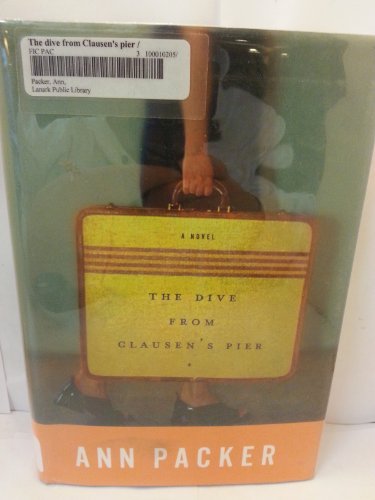
Synopsis
"The Dive from Clausen's Pier is one of those small miracles that reinforce our faith in fiction. It does what the best novels so often do, making the largest things visible by its perfect rendering of life on the smaller scale. It is witty, tragic and touching, and beguiling from the first page." --Scott Turow
A riveting novel about loyalty and self-knowledge, and the conflict between who we want to be to others and who we must be for ourselves.
Carrie Bell has lived in Wisconsin all her life. She’s had the same best friend, the same good relationship with her mother, the same boyfriend, Mike, now her fiancé, for as long as anyone can remember. It’s with real surprise she finds that, at age twenty-three, her life has begun to feel suffocating. She longs for a change, an upheaval, for a chance to begin again.
That chance is granted to her, terribly, when Mike is injured in an accident. Now Carrie has to question everything she thought she knew about herself and the meaning of home. She must ask: How much do we owe the people we love? Is it a sign of strength or of weakness to walk away from someone in need?
The Dive from Clausen’s Pier reminds us how precarious our lives are and how quickly they can be divided into before and after, whether by random accident or by the force of our own desires. It begins with a disaster that could happen, out of the blue, in anybody’s life, and it forces us to ask how we would bear up in the face of tragedy and what we know, or think we know, about our deepest allegiances. Elegantly written and ferociously paced, emotionally nuanced and morally complex, The Dive from Clausen’s Pier marks the emergence of a prodigiously gifted new novelist.
"synopsis" may belong to another edition of this title.
About the Author
Ann Packer is a past recipient of a James Michener award and a National Endowment for the Arts fellowship. Her work has appeared in The New Yorker, Ploughshares, and other magazines, as well as in Prize Stories 1992: The O. Henry Awards. The author of Mendocino and Other Stories, she lives in northern California with her husband and two children.
From the Back Cover
"The novels it calls most to mind. . . . are Allegra Goodman's 'Kaaterskill Falls' and Sue Miller's 'The Good Mother'. . . .its most admirable trait -- and surely the one that will define Packer's future work -- is its moral authenticity." --Gail Caldwell, Boston Globe
"The Dive from Clausen's Pier is one of those small miracles that reinforce our faith in fiction. It does what the best novels so often do, making the largest things visible by its perfect rendering of life on the smaller scale. It is witty, tragic and touching, and beguiling from the first page." --Scott Turow
"A reflective and probing first novel...there's not a false note in the story's tentative resolution, which thwarts our initial expectations in order to satisfy more complex demands...Very fine fiction indeed." --Kirkus Reviews
"This is the sort of book one reads dying to know what happens to the characters, but loves for its wisdom: it sees the world with more clarity than you do." --Publishers Weekly
"Ann Packer’s first novel has all the weight of reality, tooled with a jeweler’s precision. The Dive from Clausen's Pier is a poignant and painstakingly rendered account of a woman in flight from catastrophe, in search of herself."--Madison Smartt Bell
From the Inside Flap
"The Dive from Clausen's Pier is one of those small miracles that reinforce our faith in fiction. It does what the best novels so often do, making the largest things visible by its perfect rendering of life on the smaller scale. It is witty, tragic and touching, and beguiling from the first page." --Scott Turow
A riveting novel about loyalty and self-knowledge, and the conflict between who we want to be to others and who we must be for ourselves.
Carrie Bell has lived in Wisconsin all her life. She's had the same best friend, the same good relationship with her mother, the same boyfriend, Mike, now her fiancé, for as long as anyone can remember. It's with real surprise she finds that, at age twenty-three, her life has begun to feel suffocating. She longs for a change, an upheaval, for a chance to begin again.
That chance is granted to her, terribly, when Mike is injured in an accident. Now Carrie has to question everything she thought she knew about herself and the meaning of home. She must ask: How much do we owe the people we love? Is it a sign of strength or of weakness to walk away from someone in need?
The Dive from Clausen's Pier reminds us how precarious our lives are and how quickly they can be divided into before and after, whether by random accident or by the force of our own desires. It begins with a disaster that could happen, out of the blue, in anybody's life, and it forces us to ask how we would bear up in the face of tragedy and what we know, or think we know, about our deepest allegiances. Elegantly written and ferociously paced, emotionally nuanced and morally complex, The Dive from Clausen's Pier marks the emergence of a prodigiously gifted new novelist.
Reviews
Adult/High School-Carrie Bell, 23, is engaged to her boyfriend of eight and a half years and will likely live and die in the same town where she grew up and attended college. Lately, the prospect of such a life has left her feeling unsatisfied and yearning for something different. On Memorial Day, a picnic get-together with friends turns into a tragedy when Mike, her fianc , dives off Clausen's Pier. Partially paralyzed in both arms and with total paralysis below the waist, he is changed forever. Carrie is then left to decide whether to stay and become the supportive, loving wife everyone expects her to be or leave to pursue a life separate from him. Throughout the novel, she battles the central question of responsibility, what she owes Mike and what she owes herself. Unfortunately, there is no easy answer. This story places readers in Carrie Bell's shoes, and will leave them pondering "what if" questions in their own lives. Teens are sure to connect with the protagonist's feelings of unrest and general indecision about her future. This fast-paced, character-driven story will keep them hooked through to the last page.
Julie Dasso, Fairfax County Public Library, VA
Copyright 2002 Reed Business Information, Inc.
Packer's engrossing debut novel begins without ostentation. On Memorial Day, Carrie Bell and her fiance, Mike Mayer, drive out to Clausen's Pier for their annual ritual, a picnic with their friends, a trip they make the way a middle-aged couple might, in grudging silence. Before their resentments can be aired, Mike dives into too shallow water, suffering injuries that change their lives. If Mike survives, he will survive as a quadriplegic, and Carrie faces unexpected responsibilities. Ultimately, Carrie does what is both understandable and unthinkable. She leaves her hometown of Madison, Wis., and shows up on the doorstep of a friend in New York City. There she discovers a different world, different friends and a different self. The hovering question--what will Carrie do? Abandon Mike or return to him?--generates genuine suspense. Packer portrays her characters--both New Yorkers and Madisonites--deftly, and her scenes unfold with uncommon clarity. But if Packer has a keen eye, she has an even keener ear. The dialogue is usually witty; more important, it is always surprising, as if the characters were actually thinking--one of the reasons they become as familiar to the reader as childhood friends. The recipient of several awards, Packer is also the author of Mendocino and Other Stories. Clearly, she has honed her skills writing short fiction. What is unexpected is the assurance she brings to a larger canvas. In quiet but beautiful prose, Packer tells a complex and subtly constructed story of friendship, love and the hold the past has on the present. This is the sort of book one reads dying to know what happens to the characters, but loves for its wisdom: it sees the world with more clarity than you do.
Copyright 2002 Cahners Business Information, Inc.
*Starred Review* Packer's first novel is a sensitive exploration of the line between selfishness and self-preservation. Carrie Bell is 23 and has lived in Madison, Wisconsin, all her life. She is engaged to her high-school sweetheart, Mike, and all seems well--to everyone but Carrie, who is falling out of love with Mike, with Madison, with everything. On Memorial Day she numbly watches Mike dive off of Clausen's Pier and break his neck in the too-shallow water, leaving him a quadriplegic. She is stricken with grief, guilt, indecision, and fear--she wants to be supportive and faithful, but she cannot make herself love him again. After a painful summer of hospital vigils, she flees to New York City and tries on a new life, a new relationship. She cannot escape what she's left behind, though, and must eventually face those who feel she has betrayed them. There are no easy answers for Carrie, but her struggle to do what's right and her revelations about the life she wants for herself will keep readers turning page after eloquently written page. Give this to the same young female audience that loved Melissa Bank's The Girls' Guide to Hunting and Fishing (1999). Carrie Bissey
Copyright © American Library Association. All rights reserved
Excerpt. © Reprinted by permission. All rights reserved.
Chapter 1
When something terrible happens to someone else, people often use the word "unbearable." Living through a child's death, a spouse's, enduring some other kind of permanent loss–it's unbearable, it's too awful to be borne, and the person or people to whom it's happened take on a kind of horrible glow in your mind, because they are in fact bearing it, or trying to: doing the thing that it's impossible to do. The glow can be blinding at first–it can be all you see–and although it diminishes as years pass it never goes out entirely, so that late some night when you are wandering the back pathways of your mind you may stop at the sudden sight of someone up ahead, signaling even now with a faint but terrible light.
Mike's accident happened to Mike, not to me, but for a long time afterward I felt some of that glow, felt I was giving it off, so that even doing the most innocuous errand, filling my car with gas or buying toothpaste, I thought everyone around me must see I was in the middle of a crisis.
Yet I didn't cry. The first days at the hospital were full of crying–Mike's parents crying, his brother and sister, and Rooster, maybe Rooster most of all–but I was dry-eyed. My mother and Jamie told me it was because I was numb, and I guess that was part of it, numb and terrified: when I looked at him it was as if years had unwound, and I'd just met him, and I couldn't stand not knowing what was going to happen. But there was something else, too: everyone was treating me so carefully and solicitously that I felt breakable, and yet I wasn't broken. Mike was broken, and I wasn't broken. He was separate from me, and that was shocking.
He was in a coma. Thanks to the combination of drought and a newly banked-up shoreline, the water in Clausen's Reservoir had been three feet lower than usual. If he woke up, it would be to learn that he'd broken his neck.
But he didn't wake up. Days went by, and then it was a week, ten days, and he was still unconscious, lying in Intensive Care in a tiny room crowded with machines, more than I ever would have imagined. He was in traction, his shaven head held by tongs attached to weights, and because he had to be turned onto his stomach every few hours to avoid bedsores, his bed was a two-part contraption that allowed for this: a pair of giant ironing-board-shaped things that could sandwich him and flip him. Visiting hours were three p.m. to eight p.m., ten minutes per hour, two people at a time, but it seemed we'd no sooner get in to see him than the nurses would ask us to leave. It was as if, merely body now, he belonged to them.
Near the nursing station there was a small lounge, and that's where we mostly were, talking or not talking, looking at each other or not looking. There would be five of us, or ten, or twenty: a core group of family and close friends, plus Mike's co-workers stopping by after the bank had closed, the Mayers' neighbors checking in, my mother arriving with bags of sandwiches. There was a rack of ancient magazines by the door, and we offered them to each other now and then, just for something to do. I couldn't read, but whenever the single, warped issue of Vogue came my way I flipped through it, pausing each time at an article about a clothing designer in London. I'm not sure I ever noticed her name, but I can still remember the clothes: a fitted, moss green velvet jacket; a silver dress with long, belled sleeves; a wide, loose sweater in deep purple mohair. I was getting through the evenings by sewing, a pair of cotton shorts or a summer dress every two or three days, and those exotic images from London kept appearing in my mind as I bent over my sewing machine, reminding me at once of the hospital and the world.
The two-week mark came, and when I woke that morning I thought of something one of the doctors had said early on, that each week he was unconscious the prognosis got worse. ("Unresponsive" was the word they used, and whenever I heard it I thought of myself in the car on the way to Clausen's Reservoir, not answering his questions.) Two weeks was only one day more than thirteen days, but I felt we'd turned a corner that shouldn't have been turned, and I couldn't get myself out of bed.
I lay on my side. The bedsheets were gritty and soft with use; I hadn't changed them since the accident. I reached for my quilt, lying in a tangle down past my feet. I'd made it myself one summer during high school, a patchwork of four-inch squares in no particular order, though I'd limited myself to blues and purples and the overall effect was nice. I'd read somewhere that quiltmakers "signed" their work with a little deviation, so in one corner I'd used a square cut from an old shirt of Mike's, white with a black windowpane check. I found that square now and arranged the quilt so it was near my face.
He had to wake up. He had to. I couldn't stand to think of what a bitch I'd been at Clausen's Reservoir–what a bitch all spring. It was like a horrible equation: my bitchiness plus his fear of losing me equaled Mike in a coma. I knew as clearly as I knew anything that I'd driven him to dive, to impress me. I squeezed my eyes shut and tried to remember when everything between us had been fine. February? January? Christmas? Maybe not even Christmas: he'd given me plain pearl earrings that were very pretty and exactly what I would have wanted just a year earlier, but I found them stodgy and obvious, and I felt dead inside–not because of the earrings but because of my disappointment in them. "Do you like them?" he said uneasily. "I love them," I lied.
It was June now. I had the day off work, and at last I got up and made coffee, then started laying out the pattern for an off-white linen jacket I'd been planning to make, first ironing the crumpled tissue and then moving the pieces around on the length of fabric until I was satisfied. I pinned them and cut them out with my Fiskars, then went back and did the notches, snip by snip. I chalked the pattern marks onto the fabric, and by late morning I was sitting at my Bernina winding a bobbin, entranced by the fast whir of it, by the knowledge that for hours now I'd be at the machine, my foot on the pedal.
I'd been sewing for eleven years, since my first home ec class in junior high, when I'd made an A-line skirt and fallen in love. It was the inexorability of it that appealed to me, how a length of fabric became a group of cut-out pieces that gradually took on the shape of a garment. I loved everything about it, even the little snipped threads to be gathered and thrown away, the smell of an overheated iron, the scatter of pins at the end of the day. I loved how I got better and better, closer and closer with each thing I made to achieving just what I'd hoped.
When the phone rang at eight-thirty that evening I'd taken a few breaks for iced cranberry juice, but mostly I'd sat there sewing, and the sound woke me from the work. Surprised by how dark it had gotten, I pushed away from the table and turned on a light, blinking at the jacket parts that lay everywhere, the slips of pattern and the pinked-off edges of seams. I was starving, my back and shoulders knotted and aching.
It was Mrs. Mayer. She asked how I was, told me she'd heard it might rain, and then cleared her throat and said she'd appreciate it if I'd stop by the next day.
The morning sun slanted down the sidewalk, aiming my shadow in the direction of Lake Mendota. My car was already hot to the touch, and I unlocked it and rolled down the windows, then strolled to the end of the block and stood looking across Gorham Street at the water, still almost colorless under the early sky. Mike loved Lake Mendota, the way the city hugged its curves. He liked to pull people into debating the relative merits of it and Lake Monona, Madison's other big lake: he'd reel off a list of ways that Mendota was superior, as if it were a team he supported.
Mendota and Monona. "Sounds like bad names for twins," a girl from New York had said to me once, and I'd never been able to forget it. I laughed, but I was a little offended: she spoke so smugly, flipping her brown hair over her shoulder and raising her chin. I hardly knew her–she was in my freshman American history class at the U–but thinking about her five years later, I remembered this: that she'd owned a jacket I'd coveted, pearl-snapped and collarless like something made of cotton fleece, but fashioned from smooth black napa leather, soft as skin.
Across the street two guys sauntered by. They both wore sunglasses with tiny mirrored lenses–one guy's tinted blue, the other's green. "No fucking way," I heard one of them say.
I went back to my car. It had a baked vinyl smell, and the seat scorched my legs. I always took the same route to the Mayers', an easy six-to eight-minute drive up Gorham to University and then up the hill, but today I headed away from Gorham instead. I crossed the isthmus that divided the lakes, and when I got close to Lake Monona I drove up and down the streets parallel to it, braking occasionally to look at some of my favorite houses: Victorians painted colors you didn't see in other neighborhoods, fuchsia and teal and deep purple. At a little lakeside park I got out and walked down to the water, where a cloud of gnats swarmed over the grassy green edge. Both lakes could lift my spirits–silvery blue when the sun was low, or vast and frosty in winter–but today they seemed flat and ordinary.
Unable to put it off any longer, I returned to my car. At the hospital I'd felt Mrs. Mayer watching me and watching me, waiting for me to break down; when the familiar shape of Mike's house came into view a little later, she was watching again, standing at the living room window with the curtain held aside, as if she'd heard I was on my way but didn't believe it.
I got out of my car. The house was big and white, a perfectly symmetrical colonial with black-shuttered windows...
"About this title" may belong to another edition of this title.
Other Popular Editions of the Same Title

Search results for The Dive From Clausen's Pier

Stock Image
The Dive from Clausen's Pier
Seller: World of Books (was SecondSale), Montgomery, IL, U.S.A.
Seller rating 5 out of 5 stars

Condition: Good. Item in good condition. Textbooks may not include supplemental items i.e. CDs, access codes etc. Seller Inventory # 00099060613
Stock Image
The Dive from Clausen's Pier
Seller: World of Books (was SecondSale), Montgomery, IL, U.S.A.
Seller rating 5 out of 5 stars
Condition: Acceptable. Item in acceptable condition! Textbooks may not include supplemental items i.e. CDs, access codes etc. Seller Inventory # 00102158905
Stock Image
The Dive from Clausen's Pier
Seller: World of Books (was SecondSale), Montgomery, IL, U.S.A.
Seller rating 5 out of 5 stars
Condition: Very Good. Item in very good condition! Textbooks may not include supplemental items i.e. CDs, access codes etc. Seller Inventory # 00102539617
Stock Image
The Dive From Clausen's Pier
Seller: More Than Words, Waltham, MA, U.S.A.
Seller rating 5 out of 5 stars
Condition: Good. A sound copy with only light wear. Overall a solid copy at a great price! Seller Inventory # BOS-E-11d-01995
Stock Image
The Dive From Clausen's Pier
Seller: More Than Words, Waltham, MA, U.S.A.
Seller rating 5 out of 5 stars
Condition: Very Good. A bright, square, and overall a nice copy. Seller Inventory # BOS-B-11b-01716
Stock Image
The Dive From Clausen's Pier
Seller: Once Upon A Time Books, Siloam Springs, AR, U.S.A.
Seller rating 4 out of 5 stars

Hardcover. Condition: Good. This is a used book in good condition and may show some signs of use or wear . This is a used book in good condition and may show some signs of use or wear . Seller Inventory # mon0001130407
Stock Image
The Dive From Clausen's Pier
Seller: Once Upon A Time Books, Siloam Springs, AR, U.S.A.
Seller rating 4 out of 5 stars
Hardcover. Condition: Acceptable. This is a used book. It may contain highlighting/underlining and/or the book may show heavier signs of wear . It may also be ex-library or without dustjacket. This is a used book. It may contain highlighting/underlining and/or the book may show heavier signs of wear . It may also be ex-library or without dustjacket. Seller Inventory # mon0001358255
Stock Image
The Dive From Clausen's Pier
Seller: HPB-Diamond, Dallas, TX, U.S.A.
Seller rating 5 out of 5 stars
Hardcover. Condition: Very Good. Connecting readers with great books since 1972! Used books may not include companion materials, and may have some shelf wear or limited writing. We ship orders daily and Customer Service is our top priority! Seller Inventory # S_421864865
Stock Image
The Dive From Clausen's Pier
Seller: Half Price Books Inc., Dallas, TX, U.S.A.
Seller rating 5 out of 5 stars
Hardcover. Condition: Very Good. Connecting readers with great books since 1972! Used books may not include companion materials, and may have some shelf wear or limited writing. We ship orders daily and Customer Service is our top priority! Seller Inventory # S_380905010
Stock Image
The Dive From Clausen's Pier
Seller: ThriftBooks-Reno, Reno, NV, U.S.A.
Seller rating 5 out of 5 stars
Hardcover. Condition: As New. No Jacket. Pages are clean and are not marred by notes or folds of any kind. ~ ThriftBooks: Read More, Spend Less. Seller Inventory # G0375412824I2N00