
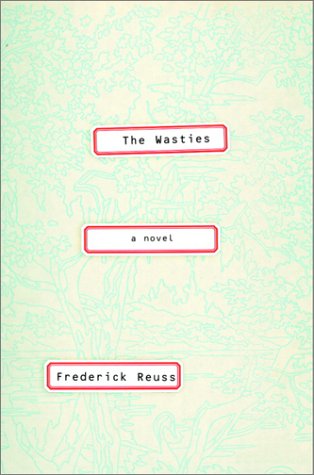
Synopsis
The Wasties is a compassionate, darkly comic novel about a man who is slowly losing his ability to understand the adult world.
In Frederick Reuss’s highly praised novels, Henry of Atlantic City and Horace Afoot, we have the stories of people who find themselves strangely isolated from everyone around them. In The Wasties, Reuss takes us to a new level, giving us the story of Michael “Caruso” Taylor, a man who has lost his ability to speak and is gradually reverting to infancy. All of his most intimate relationships are redefined: His wife, Gina, must assume the role of mother; his day nurse becomes his nanny; and “Caruso” is reduced to drinking tomato juice through sippy straws and observing the world from a radically skewed perspective. Once a professor of literature, Michael’s predicament is compounded by a deteriorating memory of his adult self, and he begins to “see” the famous—and often dead—denizens of his former learning in everyone from a bum in the park to a doctor in the hospital. Walt Whitman, John Muir, Ralph Ellison, and a host of others materialize before him as he tries to comprehend and articulate his plight. He calls his condition “the wasties”—but what kind of malady is it? Physical? Psychological? Or some sort of higher madness?
Humane, funny, and deeply affecting, The Wasties is a satiric work of unique vision and voice about one man whose infantilization plays out a secret fantasy many of us share: to shun the responsibilities of life as an adult.
"synopsis" may belong to another edition of this title.
About the Author
Frederick Reuss is the author of Horace Afoot and Henry of Atlantic City. He lives in Washington, D.C., with his wife and two daughters.
From the Back Cover
The Wasties is a compassionate, darkly comic novel about a man who is slowly losing his ability to understand the adult world.
In Frederick Reuss’s highly praised novels, Henry of Atlantic City and Horace Afoot, we have the stories of people who find themselves strangely isolated from everyone around them. In The Wasties, Reuss takes us to a new level, giving us the story of Michael “Caruso” Taylor, a man who has lost his ability to speak and is gradually reverting to infancy. All of his most intimate relationships are redefined: His wife, Gina, must assume the role of mother; his day nurse becomes his nanny; and “Caruso” is reduced to drinking tomato juice through sippy straws and observing the world from a radically skewed perspective. Once a professor of literature, Michael’s predicament is compounded by a deteriorating memory of his adult self, and he begins to “see” the famous—and often dead—denizens of his former learning in everyone from a bum in the park to a doctor in the hospital. Walt Whitman, John Muir, Ralph Ellison, and a host of others materialize before him as he tries to comprehend and articulate his plight. He calls his condition “the wasties”—but what kind of malady is it? Physical? Psychological? Or some sort of higher madness?
Humane, funny, and deeply affecting, The Wasties is a satiric work of unique vision and voice about one man whose infantilization plays out a secret fantasy many of us share: to shun the responsibilities of life as an adult.
From the Inside Flap
The Wasties is a compassionate, darkly comic novel about a man who is slowly losing his ability to understand the adult world.<br><br>In Frederick Reuss’s highly praised novels, <i>Henry of Atlantic City</i> and <i>Horace Afoot,</i> we have the stories of people who find themselves strangely isolated from everyone around them. In <i>The Wasties</i>, Reuss takes us to a new level, giving us the story of Michael “Caruso” Taylor, a man who has lost his ability to speak and is gradually reverting to infancy. All of his most intimate relationships are redefined: His wife, Gina, must assume the role of mother; his day nurse becomes his nanny; and “Caruso” is reduced to drinking tomato juice through sippy straws and observing the world from a radically skewed perspective. Once a professor of literature, Michael’s predicament is compounded by a deteriorating memory of his adult self, and he begins to “see” the famous―and often dead―denizens of his former learning in everyone from a bum in the park to a doctor in the hospital. Walt Whitman, John Muir, Ralph Ellison, and a host of others materialize before him as he tries to comprehend and articulate his plight. He calls his condition “the wasties”―but what kind of malady is it? Physical? Psychological? Or some sort of higher madness?<br><br>Humane, funny, and deeply affecting, <i>The Wasties</i> is a satiric work of unique vision and voice about one man whose infantilization plays out a secret fantasy many of us share: to shun the responsibilities of life as an adult.
Reviews
Alienation cloaks itself in a new and blackly humorous guise in this third novel by Reuss (Henry of Atlantic City; Horace Afoot). English professor Michael "Caruso" Taylor has lost the ability to speak and embarks on a journey of infantilization that progressively strips him of his autonomy a condition he labels "the wasties." He grows entirely dependent on others: his pregnant wife, Gina; his nurse, Theresa; and a host of health-care professionals who attempt to rein in his childish impulses. Taylor communicates via scribbled messages, IBM ThinkPad and hand gestures. This occasionally makes for humorous episodes, such as Taylor's psychosexual explanation to his therapist of why he bit Theresa's hand. A side effect of the wasties includes seeing famous people, often long deceased (Walt Whitman, Marianne Moore, John Muir), in prosaic disguise (e.g., Ralph Ellison as a male nurse) and occasionally holding conversations with them. Reuss employs this device effectively at first, since such interactions match Taylor's deteriorating condition, yet as they multiply, they grow stale. Another problem is the novel's dependence on Taylor's observations and thoughts, which lose their bite as Taylor sinks into greater dependence. In his previous novels, Reuss proved himself to be a highly original and idiosyncratic thinker. Here he manages flashes of insight into the innate human desire to flee communication and autonomy, but flounders as the novel floats free of solid plot and character development. Still, Reuss's insouciant weirdness Taylor takes to communicating in fragments of Simon and Garfunkel songs and he does the hokey pokey to NPR as part of his physical therapy gives the novel a loopy charm.
Copyright 2002 Cahners Business Information, Inc.
Michael Taylor, a professor of English, has what he calls the "wasties," a mysterious condition that seems based in his fantasies. He can't speak, communicates by typing on a laptop computer, and has problems walking. His wife, Gina, tries her best to mind him, but after he insists that he met Jimmy Carter in the park, she decides to hire a home-care aide named Theresa. Soon, Michael meets Walt Whitman in the drugstore and gets annoyed with Theresa and bites her, causing a scene with the police. After sending him to a therapist, Gina decides to place him in a residential facility. All these events are narrated by Michael, allowing the reader to understand his behavior as he slides further from reality. As in his earlier works, Henry of Atlantic City and Horace Afoot, Reuss takes us into a character's consciousness and explores his growing isolation from the world. But while we feel compassion for Michael, his failure to resist what is happening to him is ultimately exasperating. An optional purchase for literary fiction collections. Joshua Cohen, Mid-Hudson Lib. Syst., Poughkeepsie,
Copyright 2002 Cahners Business Information, Inc.
The author of the well-received Horace Afoot (1997) and Henry of Atlantic City (1999) tells the story of Michael "Caruso" Taylor, who has lost the ability to speak and seems to be slowly sinking into a vegetative state. Declaring that he is suffering from the "wasties, a disease of the soul," the former English professor has been reduced to drinking through a "sippy" straw and being visited by hallucinations of famous people. As he lies on a gurney in a corridor in Bellevue, he's convinced that he is being cared for by African American literary icons. But despite his dire physical condition, his mind continues to operate, often in overdrive, as he attempts to communicate the exact nature of his condition and his relationships with his wife and caregivers. Because the novel is told entirely from Caruso's point of view, it begins to feel a bit claustrophobic, as if you were trapped in one of comedian Dennis Miller's erudite, funny, but seemingly endless rants. This should appeal to sophisticated readers who like darkly humorous, cerebral fiction. Joanne Wilkinson
Copyright © American Library Association. All rights reserved
Excerpt. © Reprinted by permission. All rights reserved.
Chapter 1
I have the wasties.
The wasties is what I call it. There are probably about four thousand different names for it but I don't like to pronounce most of them, much less try to understand what they really mean. The wasties is a disease of the soul and you don't have to have a theistic bone in your body to get it. There are those pedantic types who say it's not a disease, it's a "condition." For God's sake! Why bother making such distinctions? When you've got the wasties everything is perfect and nothing matters, sort of like Buddhism-except for those with the wasties there aren't any doctrinal outs. I call the wasties a disease of the soul because it envelops the whole being of a person and is imposed from within. There's nothing you can do about it. A condition is something imposed on you from without, something you can point to-like capitalism. But I have a disease of the soul. I call it the wasties. You can't see it. All you can do is feel the effects.
Lots of people have the wasties. The doctors say it's serious. All you can say to such people-well, there's not much you can say to such people. They've been too thoroughly trained and they're too seriously taken up with looking at cause and effect and tissue and fluid samples. There's a lot to be learned about the wasties. The doctors know this, but are determined not to say too much about anything that can't be trial-tested and backed up by empirical facts-which is to say they think they can find a cure. I appreciate that. There's a lot to be said about the facts. But getting too caught up in them is as crazy as looking for cures to everything. Sure, you want your Boeing engineer to know the facts. Every nut and bolt. And knowing those sorts of facts is what allows us to fly. But when you have the wasties you get a different impression of the world. You don't say things like "if every nut and bolt on this aircraft isn't just right the system will fail." When you have the wasties you don't even begin thinking like that, because it is accepted a priori that all systems are doomed to failure, and trying to make them perfect is as losing a proposition as the construction business in Babel. I would say, rather, "I wish I could never come down." So, while getting your facts right is nice and creates job opportunities, it doesn't mean that planes won't fall out of the sky. Thinking like this makes me horny. That's another thing about the wasties: you think of sex all the time. It's a little frustrating. One of the consequences of the wasties is you don't get to have sex because most people are repelled by you. It's not fear of contagion. They just don't want to get involved. So let's talk about airplanes because there's sex in them. I mean it. Not just in the machines themselves, but the consequences of unnatural flight. A person with the wasties, if he was in an airplane that was going down, would turn to his neighbor-even if that person was a perfect stranger-and kiss her. Just like that. Because my case is fairly advanced, I would take it one step further. I would stand up and shout, "Okay, everybody! Start fucking!" And even though I know it's impossible to have sex in most passenger airplanes because of the seat belts and the tray tables, the idea is that at the moment of extreme mortal peril, every doomed organism within that cold hollow steel machine could be doing what all living organisms are meant to do above all else, i.e., reproduce themselves, even though there is absolutely no point in it and the extinction of the individual is the one and only certainty in all existence. Well, now you have a better idea of how a person with the wasties thinks of sex. That's the beauty of the wasties. You see the perfect beauty in all the despicable ironies of existence. It's a kind of acedia, an evil sadness that weighs you down. And there are no orgasms. That's the one thing I have to say I do miss from time to time. The feeling of release, the uncoiling of the spring of eternity, the discontinuity of being. It's not purely physical. Not at all. I would like nothing more than to go for days and days with a boner, a big honker of a thing. Of course, it's impossible because going outside would land me in jail. People with the wasties are many things, but they are not predatory perverts. They accept the fate of their nature in private. So, no, it's definitely not physical. It's organizational. It's getting everything all lined up that's the problem.
I don't remember when I got hit. Yes. The wasties hits you. POW! Like the flu or that fashion model named Fablio who was riding a roller coaster-surrounded even in that screaming contraption by adoring women-and POW a bird flew right into his face and splattered. Broke his nose! The picture was in the paper and all I can say is, if Fablio isn't well into the wasties now, he will be when he sees that picture of himself with bloody bird goo all over the shocked look on his face. Anyway, it hits you just like that. One day you're walking around doing everything the way you used to-which is to say blindfolded-and the next thing you know you've lost all power of speech and the familiar becomes suddenly alien and what was known becomes unfathomable and what was previously unfathomable seems strangely knowable. You are frozen in your tracks and prevented from speaking by a metastatic new knowledge that has no name. But never mind all that. I'm not asking to be believed. Just telling you what I have to say.
"You seem to be suffering from symptoms of depression," the doctors said early on.
Depression? That's like saying a dead person is merely suffering the consequences of mortality. The wasties makes depression look like a teenage kiss. It doesn't just involve the individual, the wasties involves all of us-and I'm not just talking about the Judeo-Christian Western world but human consciousness itself. There are no therapies and no excuses. Science is powerless. Religion is powerless. There is nothing that can be done-except nothing, and that's the beauty of it. Having the wasties is like being told not to think of the left eye of a camel.
There you have it.
My wife, Gina, found me. She found me from the beginning and she says she will probably keep discovering me anew day after day after day and that's probably bad because it's too late now. Too late for me, that is. I won't speak for Gina except selfishly, which is to say that I'd love it if she decided to become a nun. Gina and I go way back back back and back again. We go back so far there was nothing but forward for us from the beginning. Now forward means a black hole. "Hold on a minute," Gina would say, "just wait right there." She doesn't put much faith in numbers. If our marriage has anything to do with anything, gravitational collapse is as good a way of putting it as, say, qualified non-dualism. Gina is great. Gina is pure. In the days before we had to pass notes, she was as good a listener as I was a talker and afterwards we'd go to bed and fuck each other to sleep.
But I'm getting way behind myself now. Or maybe ahead. I don't know. I seem to be starting where I wanted to finish, in some impossible someplace outside beginnings and endings when I became too contemptible to deserve as loving a partner as my wife, Gina. I have tried to let Gina in on my gratitude, but everything comes out sounding stranded somewhere between Petrarch and Rimbaud. Rimbaud had a fine case of the wasties. Je finis par trouver sacré le désordre de mon esprit, which translated into English means it was so fine he regarded it as sacred. It's why he quit his poems and went to Africa. Petrarch had the wasties, too; and was the first ever to keep records. He even recorded the day and time he got hit: April 6, 1327, at the first hour. I've tried explaining this again and again and Gina just gets this far-off, misty look in her eyes. She used to stroke my cheek with the back of her index and middle fingers until I began to suspect that she was seeing someone, and I cried and cried and carried on and told her to stop.
I have always loved Gina and will always love her and want nothing more than to continue to love her, except that in truth I no longer deserve her and so I can't. Love is not a prerogative for someone like me. Love, for me, is a recurring nightmare. It's what Goethe meant when he wrote You have shattered the beautiful world with brazen fist. It falls, it is scattered. In the days before the wasties I would have put it a little differently; but that was then and, like I said, something always gets lost in translation. Gina is like a recurring nightmare, too. When I think of her I think of all the bestial things she might be enjoying with men of another nature, men other than me, who are different from me and who, for all I know, are coming and going from her life like a motorcycle gang bang. Jealousy is not the word for it. I know I've lost her. The word for it is quicksand, the disappearance of the ground underneath your feet. And lest anyone think I'm merely feeling sorry for myself, let me say it is a marvelous thing to experience: to be drawn down into the earth. To become and be undone by your becoming.
I wish I could remember the night Gina and I first met. All I have is a vague memory of laughter. I believe we were laughing because what had been so urgently desired was so suddenly and noisily accomplished. Is that why our relationship was cemented so quickly? Not because we tore into each other but because we laughed afterwards. Orgasm is such a monumental anticlimax. You don't get very far if it's all you do together. You have to laugh, too. And cry and lose your patience and forget what brought you together in the first place because sex is too absurdly quaint a basis for growing old together, nothing more than affection passing between two beings plus the vigorous rubbing of body parts.
At around seven o'clock every morning I'd go into the kitchen where Gina was making coffee and we'd listen to National Public Radio. I used to read...
"About this title" may belong to another edition of this title.
Other Popular Editions of the Same Title

Search results for The Wasties: A Novel

Stock Image
The Wasties: A Novel
Published by
Pantheon, 2002
ISBN 10: 0375420711
ISBN 13: 9780375420719
New
Hardcover
First Edition
Signed
Seller: Shadetree Rare Books, Chatham, VA, U.S.A.
Seller rating 5 out of 5 stars

Hardcover. Condition: New. 1st Edition. NEW HARDCOVER WITH DJ. Signed by Author(s). Seller Inventory # L7449
Stock Image
The Wasties: A Novel
Published by
Pantheon Books, 2002
ISBN 10: 0375420711
ISBN 13: 9780375420719
Used
Hardcover
First Edition
Signed
Seller: Garys Books-Log Cabin Books, Apache Junction, AZ, U.S.A.
Seller rating 5 out of 5 stars
Hardcover. Condition: Fine. Dust Jacket Condition: Fine. 1st Edition. First Printing. Author of HORACE AFOOT. Signed by Author(s). Seller Inventory # 008619
Seller Image
The Wasties: A Novel - LRBP
Published by
Pantheon Books, New York, 2002
ISBN 10: 0375420711
ISBN 13: 9780375420719
Used
Hardcover
First Edition
Seller: Little River Book Peddlers, Woodstock, GA, U.S.A.
Seller rating 5 out of 5 stars
Hardcover. Condition: Near Fine. Dust Jacket Condition: Near Fine. 1st Edition. Pantheon Books, New York, 2002. First edition, first impression hardcover book in Near Fine condition; light wear to the heel of the spine; pristine, square, and tight. Dust jacket in Near Fine condition; very light wear along the edges; mild sun toning along the top edges; not price clipped. 21090043, 14 oz, Col-3. Seller Inventory # 001650
Stock Image
The Wasties: A Novel
Seller: Montclair Book Center, Montclair, NJ, U.S.A.
Seller rating 4 out of 5 stars

Hardcover. Condition: USED Good. Seller Inventory # 101551
Seller Image
The Wasties: A Novel
Seller: Jake's Place Books, Clarksville, TN, U.S.A.
Seller rating 5 out of 5 stars
Hardcover. Condition: New. Dust Jacket Condition: New. 1st Edition. New and shiny! 1st Edition. Seller Inventory # ABE-1668278384171
Stock Image
The Wasties: A Novel
Published by
Pantheon Books/ A Divisioin of Random House, Inc., New York, 2002
ISBN 10: 0375420711
ISBN 13: 9780375420719
Used
Hardcover
First Edition
Seller: gearbooks, The Bronx, NY, U.S.A.
Seller rating 5 out of 5 stars
Hardcover. Condition: Like New. Dust Jacket Condition: Like New. Virginia Tan (Book Design); Archie Ferguson (Jacket Design); D.A. Peterson (Author Photo) (illustrator). 1st Edition/ 1st Priniting. 229 pp. Flawless book and dj. Seller Inventory # 4iCd0036
Stock Image
The Wasties: A Novel
Published by
U.S.A.: Pantheon, 2002
ISBN 10: 0375420711
ISBN 13: 9780375420719
Used
Hardcover
First Edition
Seller: Affordably Rare, Westport, CT, U.S.A.
Seller rating 5 out of 5 stars
Hardcover. Condition: As New. Dust Jacket Condition: As New. 1st Edition. Unread-like new; described by the New York Times Book Review as "an inventive and moving parable about a boy who finally learns to have faith in himself.". Seller Inventory # 1174
Stock Image
The Wasties: A Novel
Seller: World of Books (was SecondSale), Montgomery, IL, U.S.A.
Seller rating 5 out of 5 stars
Condition: Good. Item in good condition. Textbooks may not include supplemental items i.e. CDs, access codes etc. Seller Inventory # 00094978952
Stock Image
The Wasties: A Novel
Published by
Pantheon Books, 2002
ISBN 10: 0375420711
ISBN 13: 9780375420719
Used
Hardcover
First Edition
Signed
Seller: Riverby Books, Fredericksburg, VA, U.S.A.
Seller rating 5 out of 5 stars
Hardcover. Condition: Very Good. Dust Jacket Condition: Very Good. 1st Edition. Hardcover with DJ. Half-bound white paper-covered boards and orange paper-covered spine, with gold lettering along spine. Binding is square and tight. White and blue illustrated DJ of trees, with black lettering on front cover and spine. Small penciling of a previous price on front free endpaper. Signed by author, Frederick Reuss, on title page. No date on title page. Copyright page dated 2002. Stated first edition. Interiors are clean and unmarked. A very good copy. Signed by Author(s). Seller Inventory # 19-1228
Stock Image
The Wasties: A Novel
Seller: SatelliteBooks, Burlington, VT, U.S.A.
Seller rating 5 out of 5 stars
hardcover. Condition: Like New. Hardcover. First Edition / First Printing. Near fine / near fine Mylar-protected dust jacket. For any additional information or pictures, please inquire. Seller Inventory # 221231017