
Synopsis
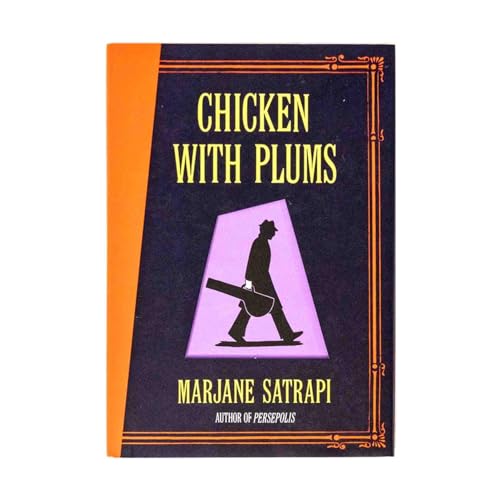
In her acclaimed Persepolis books and in Embroideries, Marjane Satrapi rendered the events of her life and times in a uniquely captivating and powerful voice and vision. Now she turns that same keen eye and ear to the heartrending story of her great-uncle, a celebrated Iranian musician who gave up his life for music and love.
We are in Tehran in 1958, and Nasser Ali Khan, one of Iran’s most revered tar players, discovers that his beloved instrument is irreparably damaged. Though he tries, he cannot find one to replace it, one whose sound speaks to him with the same power and passion with which his music speaks to others. In despair, he takes to his bed, renouncing the world and all its pleasures, closing the door on the demands and love of his wife and his four children. Over the course of the week that follows, his family and close friends attempt to change his mind, but Nasser Ali slips further and further into his own reveries: flashbacks and flash-forwards (with unexpected appearances by the likes of the Angel of Death and Sophia Loren) from his own childhood through his children’s futures. And as the pieces of his story slowly fall into place, we begin to understand the profundity of his decision to give up life.
Marjane Satrapi brings what has become her signature humor, insight, and generosity to this emotional tale of life and death, and the courage and passion both require of us. The poignant story of one man, it is also a story of stunning universality–and an altogether luminous work.
"synopsis" may belong to another edition of this title.
About the Author
Marjane Satrapi was born in 1969 in Rasht, Iran. She now lives in Paris, where she is a regular contributor to magazines and newspapers throughout the world, including The New Yorker and The New York Times. She is also the author of several children’s books, Embroideries, and the internationally best-selling and award-winning comic book autobiography in two parts, Persepolis and Persepolis 2. Persepolis is currently being made into an animated feature film, cowritten and codirected by Satrapi, which will be distributed by Sony Picture Classics in 2007.
Reviews
Starred Review. The question of what makes a life worth living has rarely been posed with as much poignancy and ambition as it is in Satrapi's dazzling new effort. Satrapi's talent for distilling complex personal histories into richly evocative vignettes made Persepolis a bestseller. Here she presents us with the story of her great-uncle Nasser Ali Khan, one of Iran's most revered musicians, who takes to bed after realizing that he'll never be able to find an instrument to replace his beloved, broken tar. Eight days later, he's dead. These final eight days, which we're taken through one by one, make up the bulk of this slim volume. While waiting for death, Nasser Ali is visited by family, memories and hallucinations. Because everything is being filtered through Satrapi's formidable imagination, we are also treated to classical Persian poetry, bits of history, folk stories, as well as an occasional flash forward into lives Nasser Ali will never have a chance to see. Each episode is illustrated with Satrapi's characteristic, almost childlike drawings, which take on the stark expressiveness of block prints. Clear and emotive, they bring surprising force and humor to this stunning tribute to a life whose worth can be measured in the questions it leaves. (Oct.)
Copyright © Reed Business Information, a division of Reed Elsevier Inc. All rights reserved.
The writer and illustrator who chronicled her childhood in the best-selling graphic memoir "Persepolis" now turns to the life of her great-uncle Nasser Ali Khan. A revered musician, he takes to his bed and refuses sustenance after his frustrated wife breaks his tar - an Iranian lute - over her knee. It takes him eight days to die, and in that time Satrapi reveals the futures of his children and unearths his past. She shows her great-uncle not merely as a wayward romantic but as a conflicted man whose story embodies several aspects of Iranian cultural identity during the late nineteen-fifties. Satrapi's deceptively simple, remarkably powerful drawings match the precise but flexible prose she employs in adapting to her multiple roles as educator, folklorist, and grand-niece.
Copyright © 2006 Click here to subscribe to The New Yorker
Iranian born writer-artist Satrapi has been steadily building a reputation with children's books and simple but distinctive New Yorker cartoons. Her acclaimed autobiographical graphic novels, Persepolis (2003) and Persepolis 2 (2004), on her childhood exile from and eventual return to Iran, have been translated into 12 languages. The poignant last days of her granduncle, Nassar Ali Khan, a famous musician in 1950s Iran, provides the foundation of her latest illustrated tale. After his wife spitefully fractures his favorite tar (an instrument akin to the Indian sitar), Nassar goes on a wayward mission to find a suitable replacement. When the search fails, he renounces the world, vowing to end his life in bed. Scenes from his final week alternate with episodes from his courtship and musical training, along with glimpses into the destinies of his offspring after his death. Fans of fine artwork may regard Satrapi's boxy black-and-white drawings as primitive and unschooled, but her characters' faces and sad fates will haunt readers long after the last pages are turned. Carl Hays
Copyright © American Library Association. All rights reserved
"About this title" may belong to another edition of this title.
Other Popular Editions of the Same Title

Search results for Chicken with Plums

Stock Image
Chicken with Plums
Seller: World of Books (was SecondSale), Montgomery, IL, U.S.A.
Seller rating 5 out of 5 stars

Condition: Good. Item in good condition. Textbooks may not include supplemental items i.e. CDs, access codes etc. Seller Inventory # 00103186024
Stock Image
Chicken with Plums
Seller: ThriftBooks-Atlanta, AUSTELL, GA, U.S.A.
Seller rating 5 out of 5 stars
Hardcover. Condition: Very Good. No Jacket. Former library book; May have limited writing in cover pages. Pages are unmarked. ~ ThriftBooks: Read More, Spend Less. Seller Inventory # G0375424156I4N10
Stock Image
Chicken with Plums
Seller: ThriftBooks-Atlanta, AUSTELL, GA, U.S.A.
Seller rating 5 out of 5 stars
Hardcover. Condition: Very Good. No Jacket. May have limited writing in cover pages. Pages are unmarked. ~ ThriftBooks: Read More, Spend Less. Seller Inventory # G0375424156I4N00
Stock Image
Chicken with Plums
Seller: ThriftBooks-Dallas, Dallas, TX, U.S.A.
Seller rating 5 out of 5 stars
Hardcover. Condition: Good. No Jacket. Former library book; Pages can have notes/highlighting. Spine may show signs of wear. ~ ThriftBooks: Read More, Spend Less. Seller Inventory # G0375424156I3N10
Stock Image
Chicken with Plums
Seller: ThriftBooks-Dallas, Dallas, TX, U.S.A.
Seller rating 5 out of 5 stars
Hardcover. Condition: Very Good. No Jacket. May have limited writing in cover pages. Pages are unmarked. ~ ThriftBooks: Read More, Spend Less. Seller Inventory # G0375424156I4N00
Stock Image
Chicken with Plums
Published by
Knopf Doubleday Publishing Group, 2006
ISBN 10: 0375424156
ISBN 13: 9780375424151
Used
Hardcover
Seller: Better World Books: West, Reno, NV, U.S.A.
Seller rating 5 out of 5 stars
Condition: Good. Pages intact with minimal writing/highlighting. The binding may be loose and creased. Dust jackets/supplements are not included. Stock photo provided. Product includes identifying sticker. Better World Books: Buy Books. Do Good. Seller Inventory # 5740645-6
Stock Image
Chicken with Plums
Published by
Knopf Doubleday Publishing Group, 2006
ISBN 10: 0375424156
ISBN 13: 9780375424151
Used
Hardcover
Seller: Better World Books, Mishawaka, IN, U.S.A.
Seller rating 5 out of 5 stars
Condition: Good. Former library copy. Pages intact with minimal writing/highlighting. The binding may be loose and creased. Dust jackets/supplements are not included. Includes library markings. Stock photo provided. Product includes identifying sticker. Better World Books: Buy Books. Do Good. Seller Inventory # 3223648-6
Stock Image
Chicken with Plums
Published by
Knopf Doubleday Publishing Group, 2006
ISBN 10: 0375424156
ISBN 13: 9780375424151
Used
Hardcover
Seller: Better World Books, Mishawaka, IN, U.S.A.
Seller rating 5 out of 5 stars
Condition: Very Good. Pages intact with possible writing/highlighting. Binding strong with minor wear. Dust jackets/supplements may not be included. Stock photo provided. Product includes identifying sticker. Better World Books: Buy Books. Do Good. Seller Inventory # 5268264-6
Stock Image
Chicken with Plums
Seller: HPB Inc., Dallas, TX, U.S.A.
Seller rating 5 out of 5 stars
Hardcover. Condition: Very Good. Connecting readers with great books since 1972! Used books may not include companion materials, and may have some shelf wear or limited writing. We ship orders daily and Customer Service is our top priority! Seller Inventory # S_453245060
Stock Image
Chicken with Plums
Seller: HPB-Ruby, Dallas, TX, U.S.A.
Seller rating 5 out of 5 stars
Hardcover. Condition: Very Good. Connecting readers with great books since 1972! Used books may not include companion materials, and may have some shelf wear or limited writing. We ship orders daily and Customer Service is our top priority! Seller Inventory # S_450386803