
Items related to Meely LaBauve: A Novel
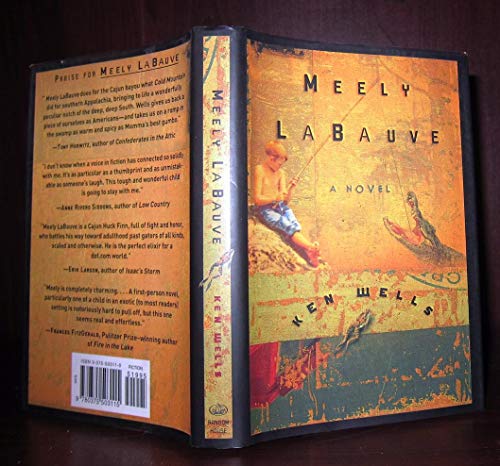
Synopsis
Fifteen-year-old Meely LaBauve is growing up on Catahoula Bayou and living by his wits. His father is an alligator hunter, still unable to cope with the death of his wife eight years earlier. He finds comfort in bottles of hooch and with companionable women and disappears for days at a time. School, for Meely, is a long, dusty walk away in a place where truancy isn't a top priority. "Up at Catahoula School, we've got all the grades. I'm in ninth when I'm in anything," says Meely. But the law has it out for Meely's dad; and Junior Guidry, nephew of a rogue cop and a bully himself, considers badgering Meely his favorite sport. When the LaBauves find themselves in the law's sights, it takes baseball bats, fire ants, flying alligators, an unidentified body, and a lot of fast thinking to set things right.
Not since Huck Finn rafted down the Mississippi has there been a coming-of-age story like this, told in such an utterly authentic, unlettered American voice. From a charming encounter with first love in the Canciennes' corn patch to an adventurous paddle through wild and timeless places little explored, Ken Wells has cooked up a zesty gumbo of a book--rich, poignant, and often hilarious.
"synopsis" may belong to another edition of this title.
About the Author
Ken Wells grew up on the banks of Bayou Black, deep in South Louisiana's Cajun belt. He got his first newspaper job as a nineteen-year-old college dropout, covering car wrecks and gator sightings for The Courier, a Houma, Louisiana, weekly, while still helping out in his family's snake-collecting enterprise. He is now a senior writer and features editor for The Wall Street Journal's Page One staff. He lives with his family on the outskirts of Manhattan. Meely LaBauve is his first novel.
From the Back Cover
Praise for Meely La Bauve
"Meely LaBauve does for the Cajun bayou what Cold Mountain did for southern Appalachia, bringing to life a wonderfully peculiar notch of the deep, deep South. Wells gives us back a piece of ourselves as Americans--and takes us on a romp in the swamp as warm and spicy as Momma's best gumbo."
--Tony Horwitz, author of Confederates in the Attic
"I don't know when a voice in fiction has connected so solidly with me. It's as particular as a thumbprint and as unmistakable as someone's laugh. This tough and wonderful child is going to stay with me."
--Anne Rivers Siddons, author of Low Country
"Meely LaBauve is a Cajun Huck Finn, full of fight and honor, who battles his way toward adulthood past gators of all kinds, scaled and otherwise. He is the perfect elixir for a dot.com world."
--Erik Larson, author of Isaac's Storm
"Meely is completely charming. . . . A first-person novel, particularly one of a child in an exotic (to most readers) setting is notoriously hard to pull off, but this one seems real and effortless."
--Frances FitzGerald, Pulitzer Prize-winning author of Fire in the Lake
From the Inside Flap
-old Meely LaBauve is growing up on Catahoula Bayou and living by his wits. His father is an alligator hunter, still unable to cope with the death of his wife eight years earlier. He finds comfort in bottles of hooch and with companionable women and disappears for days at a time. School, for Meely, is a long, dusty walk away in a place where truancy isn't a top priority. "Up at Catahoula School, we've got all the grades. I'm in ninth when I'm in anything," says Meely. But the law has it out for Meely's dad; and Junior Guidry, nephew of a rogue cop and a bully himself, considers badgering Meely his favorite sport. When the LaBauves find themselves in the law's sights, it takes baseball bats, fire ants, flying alligators, an unidentified body, and a lot of fast thinking to set things right. <br><br>Not since Huck Finn rafted down the Mississippi has there been a coming-of-age story like this, told in such an utterly authentic, unlettered American voice. From a charming encounter with fir
Reviews
YA-"Us LaBauves need to be out under the sky, where the rabbits and the coons and the gators are. We just need to go fishin' sometimes." This has been a basic problem for both 15-year-old Meely and his father. The teen's mother died in childbirth seven years previously and since then his drink-prone father has been even more absent, sometimes hunting gators, sometimes womanizing, and sometimes in jail. Though unreliable by most standards, he has taught his son kindness and tolerance beyond that of most inhabitants of Louisiana bayou country in the early '60s. However, Mr. LaBauve's trust of Meely and the boy's good nature get them into a disastrous predicament involving seeming disregard for the law, a wild truck chase, and a gator. The resolution is satisfying, and Meely and the other characters are fully realized and original. This evocative coming-of-age story is redolent of Cajun culture; from the food, the fishing, the hunting, and the boating to the colorful language. Much like Huck Finn, this picaresque journey through another time and place is warm and funny and thought-provoking as Meely discovers the opposite sex and encounters racism and bullying with a natural aplomb.
Susan H. Woodcock, Chantilly Regional Library, VA
Copyright 2000 Reed Business Information, Inc.
"An endearing debut novel...Wells also offers a terrific gator hunt, adolescent sexual discovery...and a wild and comic car chase."
In his lean, nimble and wise first novel, Wells breathes life into an adolescent boy down on his luck in "the lonesome end of Catahoula Bayou" in Louisiana. The eponymous narrator relates the tale in a restrained, wry voice that is a mixture of Southern vernacular and Cajun phrasing. Meely's father--kindhearted, often drunk and always on the wrong side of the law--hunts gators in the swamp, which is also a great place to hide from the police. He has never recovered from the death of his wife, in childbirth, eight years before. Meely (short for Emile) dreams of his mother and his dead baby sister, but his waking hours are consumed with catching or shooting his own dinner, trying hard to steer clear of a gang of bullies led by Junior Guidry, avoiding school and occasionally hiding from the police in the woods. Wells manages to be graphic, sweet and funny in the scenes where Meely discovers the pleasures of sex with his black friend and neighbor, Cassie. There aren't too many other pleasures for Meely, who is attacked by Junior and his bunch and rescued by Chilly Cox, Cassie's ex-boyfriend. Meanwhile, his father is arrested for driving without a license, and his truck is confiscated by the police. Father and son steal the truck back and set out on a gator hunt, where Meely stumbles upon a grisly scene involving Junior, his racist uncle, a policeman and Chilly. Meely's father arrives and turns the tables, quickly rendering himself persona non grata with the authorities. An action-packed stretch that includes a chase, a spectacular accident and Meely's dad's flight into the swamp, culminates in Meely's arrest and trial for assault and battery and attempted murder. There are echoes here of Huckleberry Finn and Tom Sawyer, in the friendship between a white boy and a black, and in a faked death. But Wells puts his own distinctive spin on this affecting tale, depicting Meely's harsh life without sentimentality, and capturing, as any writer of a coming-of-age story should, the melding of innocence and wisdom. (Feb.) FYI: Wells is a veteran Wall Street Journal reporter who grew up in Bayou Black, La., where he helped with his family's snake-collecting business.
Copyright 1999 Reed Business Information, Inc.
Wells' charming and touching first novel is the story of a young boy growing up in the Louisiana bayou. Fifteen-year-old Meely is pretty much on his own; his mother died in childbirth when he was seven, and his father is off hunting alligators when he isn't drinking and womanizing. When Meely goes to school (which isn't too often), the school bully, Junior Guidry, picks on him. How Meely and his friends (who are more numerous and loyal than Meely first realizes) deal with Junior and his cronies makes for a lively, engaging story that never falters, mainly because it is carried along by Meely's honest and unique voice. Although it is an extremely satisfying read, in which the good guys triumph over the villains, it is never simplistic: Meely's often absent father is portrayed in a very sympathetic light, and Wells makes it clear that he cares deeply for his son. In Meely, Wells has created a distinctive and interesting character who ranks with the best of the bildungsroman heroes. Kristine Huntley
Fifteen-year-old Emile "Meely" LaBauve is something of a 20th-century Huck Finn. He lives in a ramshackle house on Louisiana's Catahoula Bayou with his often-absent alligator-hunter father, fishing and exploring and only attending school when he feels like it (his father has asserted that school never did him any good). The novel revolves around a confrontation between Meely and local bully Junior Guidry on a day when he does attend school, a run-in that eventually escalates to property destruction, an attempted murder charge against Meely's father, and the jailing of Meely himself. With the backing of a respected local teacher, Meely fights to avoid the equally unpalatable options of prison and the orphanage. Wall Street Journal writer Wells has cooked up a zestful gumbo of a first novel, a rich and raucous coming-of-age tale redolent with the flavor of the bayou. Recommended for all public libraries.
-Lawrence Rungren, Merrimack Valley Lib. Consortium, Andover, MA
Copyright 2000 Reed Business Information, Inc.
Excerpt. © Reprinted by permission. All rights reserved.
Daddy's gone off again to hunt gators. He says the police might come lookin' for him 'cause of some problem with his ole truck. He says I can hide or not.
I'm not gonna hide this time. If they come they'll ax me questions. But I won't know where Daddy is any more than they do. I'll say back in the swamp somewhere, which is close as I can come. They'll go lookin' but they won't find him, not unless he wants to be found. Or unless he gits drunk, which is always possible with Daddy, and he comes roarin' into town raisin' hell. He might run right into the police station and bust up a couple of 'em till they throw him in jail.
It sometimes happens that way. That's Daddy for you.
We live way down on the lonesome end of Catahoula Bayou. Our house is ugly and fallin' apart here and there. Daddy won't fix it. He says he's give up on houses and when this one falls down he won't have another. He'll go live in the woods.
He don't say what I'm s'posed to do.
When Momma was alive, she kept it up pretty well. She mopped and swept and got after Daddy to carpenter and paint and mow. He listened most times, as I remember.
But since Momma's gone, Daddy don't listen to nobody. He runs off into the swamps huntin' alligators and just stays. Otherwise, he's pretty much in town, drinkin' in a saloon.
I myself have never tried to tell Daddy anything, though I might one day.
My name is Emile LaBauve, Emile comin' from my Grandpa Toups on Momma's side. I never liked my name and people that know me, 'cept the teachers and Father Giroir, the bayou priest, call me Meely. I'm fifteen, small for my age everybody says. I tend to stay away from school and such. Every so often, the police come lookin' for me instead of Daddy. And I run off, too, and hide in the woods. It's amazin' how poor the police are at findin' people.
I hope I never git lost and need the police to find me for real.
The police come 'cause I live pretty well by myself and I don't go to school unless I want to. Daddy, him, he won't make me. He says I'm pretty near growed and got his hound dog ways and Momma's brains. He says a hound dog is good at scroungin' and will never starve and somebody with brains can always figger out what to do.
He says I don't need much else, and anyway school never did him much good.
I don't mind school sometimes, just like sometimes I don't mind breakfast.
I wouldn't mind it, actually, if Daddy bought groceries now and then.
But I'm doin' okay. I've planted my own garden and there's fish and frogs and crawfish in the bayou and swamps, and I take my twenty-two out and shoot me some birds and rabbits and such.
Blackbirds is good, though people don't think so.
Heck, I roasted a mockin' bird in the oven once.
It cooked up itty-bitty but was all right. Sweet it was.
Junior Guidry says only a moron would shoot a mockin' bird 'cause the law is against such things and they could put you in the jailhouse. I don't say nothin' to Junior Guidry, usually, as I know he's plannin' to bust me up good one day. He's tried a few times already. Sometimes I look at him the way Daddy says I should, with the Evil Eye.
Junior's a big ole s.o.b. and mean as a gut-shot gator. He's been in eighth grade a long time. I keep hopin' he'll just quit school but he won't 'cause his momma makes him go.
Junior don't like the Evil Eye.
I don't know what the Evil Eye is all about. It comes from Daddy's side of the family. His ole Tante Eve knew all about it and put the gris-gris on lots of people and they took it serious. Daddy taught me how to look just like Tante Eve looked but it don't mean nothin' to me. But I guess I look like one scary booger when I do it.
That's what Daddy says.
Don't matter what it means, Meely, just what it looks like.
Junior thinks I'm crazy, which is prob'ly a good thing for Junior to think.
I got one real friend far as I know, Joey Hebert. He lives up the bayou in a big ole house kept nice. It's white and once, Joey says, slaves tended it. The yard's bigger than the grounds at school and the oak trees are so big and old that the slaves tended them, too. Mr. Hebert mows the grass hisself with a big tractor, though the Heberts, Joey says, got all the money in the world. His daddy could hire twenty people to cut the grass but he don't want to, Joey says. He just likes sittin' up on that tractor mowin' away. He don't work much anymore, otherwise.
The Heberts got all that cane land and people tend it and give Mr. Hebert the money. They got two Cadillacs, one black for Mr. Hebert and one white for Miz Hebert, and a pretty new red 1961 Ford pickup truck and a colored maid who dresses like a nurse, and a colored cook who does too.
Mr. Hebert mows the grass and drives his truck up and down the bayou lookin' at his cane land. He drives the Cadillac to church on Sundays.
He don't like me much, though Joey does.
Joey says I'm smart, which I think I am, and he says I'm lucky 'cause I git to do just what I want when I want to do it. He says he would love to skip school 'cept he cain't. He says I'm lucky I don't have a momma 'cause he has a momma and she gits on him every day about this or that. He says Daddy is a character and he wishes his daddy was. He says Daddy's right when he says a boy with hound dog ways and brains is about as good as a boy gits.
I agree with most of that and, anyway, Joey's the only person I know who's ever agreed with anything Daddy's said.
Me and Joey do things sometimes when he can slip away. We go swimmin' down at Poule D'eau Curve and I take him out in the woods and show him things I know about that Daddy's showed me. We catch garter snakes and frogs and we tease cottonmouths with willow switches, which ain't dangerous provided you use a pretty long switch. We track deer. We've never got close enough to shoot one, though we've seen the backsides of a few.
Once we shot a rabbit with my twenty-two. I skinned it and dabbed it with Tabasco sauce, which I carry in my huntin' vest, and we roasted it on a spit out in the woods over a fire I made. It was tender and good. We shot it out of huntin' season and Joey was afraid we'd git caught. But I laughed.
I told him I knew all about the police and game wardens, too. If they come to chase us, I knew just where to run.
Anyway, what do the police care if I eat me a rabbit?
Daddy says the woods and what's in 'em are free to a hungry man.
Joey says he agrees with this, too.
Joey is popular down at the school with the teachers and girls and such. He says he's gotta go to a college called Tulaneóhe cain't git out of it. His momma would have a fit 'cause her own daddy went there. He says he's gotta be a lawyer or else his Daddy will leave him out of his will.
He says there's lots of money in that will, Meely, so you wouldn't wanna be left out of it.
After we ate that rabbit in the woods, he said he was gonna invite me to supper. But he ain't yet.
I'm interested in that big ole house. I think about slaves and ghosts and such.
And supper, sometimes.
"About this title" may belong to another edition of this title.
Search results for Meely LaBauve: A Novel

Stock Image
Meely LaBauve: A Novel
Seller: Wonder Book, Frederick, MD, U.S.A.
Seller rating 5 out of 5 stars

Condition: Very Good. Very Good condition. Very Good dust jacket. A copy that may have a few cosmetic defects. May also contain light spine creasing or a few markings such as an owner's name, short gifter's inscription or light stamp. Seller Inventory # Z11B-02663
Stock Image
Meely LaBauve: A Novel
Seller: HPB-Ruby, Dallas, TX, U.S.A.
Seller rating 5 out of 5 stars
hardcover. Condition: Very Good. Connecting readers with great books since 1972! Used books may not include companion materials, and may have some shelf wear or limited writing. We ship orders daily and Customer Service is our top priority! Seller Inventory # S_474793914
Stock Image
Meely LaBauve
Seller: ThriftBooks-Atlanta, AUSTELL, GA, U.S.A.
Seller rating 5 out of 5 stars
Hardcover. Condition: Very Good. No Jacket. May have limited writing in cover pages. Pages are unmarked. ~ ThriftBooks: Read More, Spend Less. Seller Inventory # G0375503110I4N00
Stock Image
Meely LaBauve
Seller: ThriftBooks-Atlanta, AUSTELL, GA, U.S.A.
Seller rating 5 out of 5 stars
Hardcover. Condition: Fair. No Jacket. Readable copy. Pages may have considerable notes/highlighting. ~ ThriftBooks: Read More, Spend Less. Seller Inventory # G0375503110I5N00
Stock Image
Meely LaBauve
Seller: ThriftBooks-Dallas, Dallas, TX, U.S.A.
Seller rating 5 out of 5 stars
Hardcover. Condition: Very Good. No Jacket. May have limited writing in cover pages. Pages are unmarked. ~ ThriftBooks: Read More, Spend Less. Seller Inventory # G0375503110I4N00
Stock Image
Meely LaBauve
Seller: ThriftBooks-Atlanta, AUSTELL, GA, U.S.A.
Seller rating 5 out of 5 stars
Hardcover. Condition: Very Good. No Jacket. Former library book; May have limited writing in cover pages. Pages are unmarked. ~ ThriftBooks: Read More, Spend Less. Seller Inventory # G0375503110I4N10
Stock Image
Meely LaBauve
Seller: ThriftBooks-Reno, Reno, NV, U.S.A.
Seller rating 5 out of 5 stars
Hardcover. Condition: Very Good. No Jacket. May have limited writing in cover pages. Pages are unmarked. ~ ThriftBooks: Read More, Spend Less. Seller Inventory # G0375503110I4N00
Stock Image
Meely LaBauve: A Novel
Seller: HPB Inc., Dallas, TX, U.S.A.
Seller rating 5 out of 5 stars
hardcover. Condition: Very Good. Connecting readers with great books since 1972! Used books may not include companion materials, and may have some shelf wear or limited writing. We ship orders daily and Customer Service is our top priority! Seller Inventory # S_475382344
Stock Image
Meely LaBauve
Published by
Random House Publishing Group, 2000
ISBN 10: 0375503110
ISBN 13: 9780375503115
Used
Hardcover
Seller: Better World Books, Mishawaka, IN, U.S.A.
Seller rating 5 out of 5 stars
Condition: Good. Pages intact with minimal writing/highlighting. The binding may be loose and creased. Dust jackets/supplements are not included. Stock photo provided. Product includes identifying sticker. Better World Books: Buy Books. Do Good. Seller Inventory # 67536096-6
Stock Image
Meely LaBauve
Published by
Random House Publishing Group, 2000
ISBN 10: 0375503110
ISBN 13: 9780375503115
Used
Hardcover
Seller: Better World Books, Mishawaka, IN, U.S.A.
Seller rating 5 out of 5 stars
Condition: Very Good. Former library copy. Pages intact with possible writing/highlighting. Binding strong with minor wear. Dust jackets/supplements may not be included. Includes library markings. Stock photo provided. Product includes identifying sticker. Better World Books: Buy Books. Do Good. Seller Inventory # 48944207-6