
Synopsis
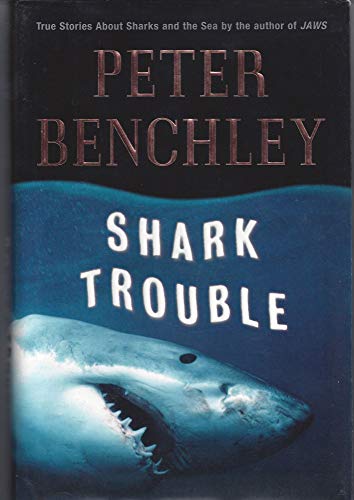
Master storyteller Peter Benchley combines high adventure with practical information in Shark Trouble, a book that is at once a thriller and a valuable guide to being safe in, on, under, and around the sea. The bestselling author of Jaws, The Deep, and other works draws on more than three decades of experience to share information about sharks and other marine animals.
“Shark attacks on human beings generate a tremendous amount of media coverage,” Benchley writes, “partly because they occur so rarely, but mostly, I think, because people are, and always have been, simultaneously intrigued and terrified by sharks. Sharks come from a wing of the dark castle where our nightmares live—deep water beyond our sight and understanding—and so they stimulate our fears and fantasies and imaginations.”
Benchley describes the many types of sharks (including the ones that pose a genuine threat to man), what is and isn’t known about shark behavior, the odds against an attack and how to reduce them even further—all reinforced with the lessons he has learned, the mistakes he has made, and the personal perils he has encountered while producing television documentaries, bestselling novels, and articles about the sea and its inhabitants. He tells how to swim safely in the ocean, how to read the tides and currents, what behavior to avoid, and how to survive when danger suddenly strikes. He discusses how to tell children about sharks and the sea and how to develop, in young and old alike, a healthy respect for the ocean.
As Benchley says, “The ocean is the only alien and potentially hostile environment on the planet into which we tend to venture without thinking about the animals that live there, how they behave, how they support themselves, and how they perceive us. I know of no one who would set off into the jungles of Malaysia armed only with a bathing suit, a tube of suntan cream, and a book, and yet that’s precisely how we approach the oceans.”
No longer. Not after you’ve read Shark Trouble.
"synopsis" may belong to another edition of this title.
About the Author
After graduating from Harvard, Peter Benchley worked as a reporter for The Washington Post, then as an editor at Newsweek and a speechwriter in the White House. His novel Jaws was published in 1974, followed by The Deep, The Island, The Girl of the Sea of Cortez, Q Clearance, Rummies, and Beast, among others. He has written screenplays for three of his novels, and his articles and essays have appeared in such publications as National Geographic and The New York Times. He has written, narrated, and appeared in dozens of television documentaries. He is a member of the national council of Environmental Defense and is a spokesman for its Oceans Program.
From the Back Cover
Praise for Peter Benchley
“Benchley is a master.” —Chicago Tribune
“Benchley’s a fine, smooth writer, taut of technique,
inventive of language.” —The Washington Post, about Beast
“Benchley’s pacing is irresistible. His descriptions of complex action, machinery and marine life are as colorful and vivid as a tropical reef before pollution set in.”
—The New York Times, about White Shark
From the Inside Flap
Master storyteller Peter Benchley combines high adventure with practical information in <b>Shark Trouble</b>, a book that is at once a thriller and a valuable guide to being safe in, on, under, and around the sea. The bestselling author of <b>Jaws, The Deep</b>, and other works draws on more than three decades of experience to share information about sharks and other marine animals.<br><br>“Shark attacks on human beings generate a tremendous amount of media coverage,” Benchley writes, “partly because they occur so rarely, but mostly, I think, because people are, and always have been, simultaneously intrigued and terrified by sharks. Sharks come from a wing of the dark castle where our nightmares live―deep water beyond our sight and understanding―and so they stimulate our fears and fantasies and imaginations.”<br><br>Benchley describes the many types of sharks (including the ones that pose a genuine threat to man), what is and isn’t known about shark behavior, the odds against an attack and how to reduce them even further―all reinforced with the lessons he has learned, the mistakes he has made, and the personal perils he has encountered while producing television documentaries, bestselling novels, and articles about the sea and its inhabitants. He tells how to swim safely in the ocean, how to read the tides and currents, what behavior to avoid, and how to survive when danger suddenly strikes. He discusses how to tell children about sharks and the sea and how to develop, in young and old alike, a healthy respect for the ocean.<br><br>As Benchley says, “The ocean is the only alien and potentially hostile environment on the planet into which we tend to venture without thinking about the animals that live there, how they behave, how they support themselves, and how they perceive us. I know of no one who would set off into the jungles of Malaysia armed only with a bathing suit, a tube of suntan cream, and a book, and yet that’s precisely how we approach the oceans.” <br><br>No longer. Not after you’ve read <b>Shark Trouble</b>.
Reviews
The man who wrote Jaws in 1974 and White Shark 20 yearslater is not merely a wily storyteller playing on our fears ofmonsters from the deep but, rather, a knowledgeable and intrepid diverand a passionate advocate for the preservation of ocean life. Inaddition to writing his best-selling, movie-compatible novels,Benchley has also reported for National Geographic and the NewYork Times and written and hosted television documentaries, and hedraws on both his research and risky but revelatory ocean experiencesto create a suspenseful and resonantly informative overview of thelives of sharks and other amazing creatures who dwell in the nowworrisomely overfished seas. Benchley begins by gently mocking thehysteria of both the media and the public over shark attacks duringthe summer of 2001. Not only was the number of tragic run-ins betweenhumans and sharks normal, Benchley writes, the truth of the matter isthat "for every human being killed by a shark, roughly ten millionsharks are killed by humans." Handy with statistics and quick to cracka joke with himself as the target, Benchley offers riveting accountsof his and his family's up close and personal encounters with sharks,a gigantic manta ray, a friendly killer whale, barracuda, and sundryother wild creatures. These vivid moments inspire clarion tributes tothe wonder of the entire marine ecosystem, and a no-nonsense warningabout the disastrous consequences of continued assaults against "theworld's largest primal wilderness." It's a boon to have a writer withsuch tremendous name recognition speak up for nature. Donna Seaman
Copyright © American Library Association. All rights reserved
Last summer, the media fueled a shark attack scare when in fact the number of incidents was below average. This year seems primed to be the "Summer of the Shark Book," in which authors interested in the predatory fish capitalize on last summer's hype just in time for this summer's beach crowd. Shark is an anthology of excerpts from previously published books and articles, including Peter Benchley's Jaws, Eugenie Clark's Lady with a Spear, Ernest Hemingway's The Old Man and the Sea, and Jean-Michel Cousteau's Cousteau's Great White Shark. The only apparent common thread is that the selections feature people being attacked by sharks or sharks being attacked by people. The fact that this is part of the "Adrenaline Book" series is a good clue as to the nature of this volume. Benchley's Shark Trouble is intended more as an argument against the hype than more fuel for it. The author's introduction emphasizes how much has been learned since he wrote Jaws in 1974 and that sharks, including the most fearsome ones, are in much more danger from humans than humans from sharks. A chapter called "The Summer of Hype" sets the record straight on last year's media hysteria. Other chapters discuss the real dangers of swimming in the ocean (e.g., tides, rips, and other currents) and how to avoid getting caught. Some personal shark anecdotes add excitement as well. Benchley's solid and informative book is recommended for public and school libraries, especially where there is an interest in the ocean and scuba diving. Shark is not recommended; libraries would do better to purchase the publications that it highlights, plus a few other classic shark books, such as Thomas H. Lineaweaver's The Natural History of the Shark. [John A. Musick and Beverly McMillan's The Shark Chronicles: A Scientist Tracks the Consummate Predator is coming in September from Holt. Ed.] Margaret A. Rioux, MBL/WHOI Lib., Woods Hole Oceanographic Inst., M.
- Margaret A. Rioux, MBL/WHOI Lib., Woods Hole Oceanographic Inst., MA
Copyright 2002 Reed Business Information, Inc.
Excerpt. © Reprinted by permission. All rights reserved.
1
South Australia, 1974
Swimming with Nightmares
Let's start with a story about sharks: Dangerous Reef, in the Neptunes Islands, 1974.
Blinded by blood, nauseated by the taste of fish guts, whale oil, and putrid horse flesh, I gripped the aluminum bars of the shark cage to steady myself against the violent, erratic jolts as the cage was tossed by the choppy sea. A couple of feet above, the surface was a prism that scattered rays of gray from the overcast sky; below, the bottom was a dim plain of sand sparsely covered with strands of waving grass.
The water was cold, a spill from the chill Southern Ocean that traversed the bottom of the world, and my core body heat was dropping; it could no longer warm the seepage penetrating my neoprene wetsuit. I shivered, and my teeth chattered against the rubber mouthpiece of my regulator.
Happy now? I thought to myself. Ten thousand miles you flew, for the privilege of freezing to death in a sea of stinking chum.
I envisioned the people on the boat above, warmed by sunlight and cups of steaming tea, cozy in their woolen sweaters: my wife, Wendy; the film crew from ABC-TV's American Sportsman; the boat crew and their leader, Rodney Fox, the world's most celebrated shark-attack survivor.
I thought of the animal I was there to see: the great white shark, largest of all the carnivorous fish in the sea. Rarely had it been seen under water; rarer still were motion pictures of great whites in the wild.
And I thought of why I was bobbing alone in a flimsy cage in the frigid sea: I had written a novel about that shark, and had called it Jaws, and when it had unexpectedly become a popular success, a television producer had challenged me to go diving with the monster of my imagination. How could I say no?
Now, though, I wondered how I could have said yes.
Visibility was poor--ten feet? Twenty? It was impossible to gauge because nothing moved against the walls of blue gloom surrounding me. I turned, slowly, trying to see in all directions at once, peering over, under, beside the clouds of blood that billowed vividly against the blue green water.
I had expected to find silence under water, but my breath roared, like wind in a tunnel, as I inhaled through my regulator, and my exhales gurgled noisily, like bubbles being blown through a straw in a drink. Waves slapped against the loose-fitting top hatch of the cage, the welded joints creaked with every torque and twist, and when the rope that tethered the cage to the boat drew taut, there was a thudding, straining noise and the clank of the steel ring scraping against its anchor plate.
Then I saw movement. Something was moving against the blue. Something dark. It was there and gone and there again, not moving laterally, as I'd thought it would, not circling, but coming straight at me, slowly, deliberately, unhurried, emerging from the mist.
I stopped breathing--not intentionally but reflexively, as if by suspending my breath I could suspend all animation--and I heard my pulse hammering in my ears. I wasn't afraid, exactly; I had been afraid, before, on the boat, but by now I had passed through fear into a realm of excitement and something like shocked disbelief.
There it is! Feel the pressure in the water as the body moves through it. The size of it! My God, the size!
The animal kept coming, and now I could see all of it: the pointed snout, the steel gray upper body in stark contrast with the ghostly white undercarriage, the symmetry of the pectoral fins, the awful knife blade of the dorsal fin, the powerful, deliberate back-and-forth of the scythelike tail fin that propelled the enormous body toward me, steadily, inexorably, as if it had no need for speed, for it knew it could not be stopped.
It did not slow, did not hesitate. Its black eyes registered neither interest nor excitement. As it drew within a few feet of me, it opened its mouth and I saw, first, the lower jaw crowded with jagged, needle-pointed teeth, and then--as the upper jaw detached from the skull and dropped downward--the huge, triangular cutting teeth, each side serrated like a saw blade.
The great white's mouth opened wider and wider, until it seemed it would engulf the entire cage, and me within it. Transfixed, I stared into the huge pink-and-white cavern that narrowed into a black hole, the gullet. I could see rows and rows of spare teeth buried in the gum tissue, each tooth a holstered weapon waiting to be summoned forward to replace a tooth lost in battle. Far back on each side of the massive head, gill flaps fluttered open and shut, admitting flickering rays of light.
A millisecond before the mouth would have collided with the cage, the great white bit down, rammed forward by a sudden thrust of its powerful tail. The upper teeth struck first, four inches from my face, scraping noisily--horribly--against the aluminum bars. Then the lower teeth gnashed quickly, as if seeking something solid in which to sink.
I shrank back, stumbling, as if through molasses, until I could cringe in relative safety in a far corner of the cage.
My brain shouted, You...you of all people, ought to know: HUMAN BEINGS DO NOT BELONG IN THE WATER WITH GREAT WHITE SHARKS!
The shark withdrew, then quickly bit the cage again, and again, and not till the third or fourth bite did I realize that there was something desultory about the attack. It seemed less an assault than an exploration, a testing. A tasting.
Then the shark turned, showing its flank, and by instinct I crept forward and extended my hand between the bars to feel its skin. Hard, it felt, and solid, a torpedo of muscle, sleek and polished like steel. I let my fingers trail along with the movement of the animal. But when I rubbed the other way, against the grain, I felt the legendary sandpaper texture, the harsh abrasiveness of the skin's construction: millions upon millions of minuscule toothlike particles, the dermal denticles.
The shark was moving away, upward; it had found a hunk of quartered horse, probably ten pounds, possibly twenty, dangling in the chum. The shark's mouth opened and--in a split-second mechanical replay of the bite on the cage--it swallowed the chunk of horse whole. Its gullet bulged once as the meat and bone passed through on its way to the gut.
Tantalized now, the shark turned again in search of something more to eat. It bit randomly, gaping and snapping as if hoping that the next bite, or the next, would prove fruitful.
I saw a length of rope drift into its gaping mouth: the lifeline, I realized, the only connection between the cage and the boat.
Drift out again. Don't get caught. Not in the mouth. Please.
The great white's mouth closed and opened, closed and opened; the shark shook its head, trying to rid itself of the rope. But the rope was stuck.
In a fraction of a second, I saw that the rope had snagged between two--perhaps three or four--of the shark's teeth.
At that instant, neurons and synapses in the shark's small, primitive brain must have connected and sent a message of alarm, of entrapment, for suddenly the shark seemed to panic. Instinct commandeered its tremendous strength and great weight--at least a ton, I knew, spread over the animal's fourteen-foot length--and detonated an explosion of frenzied thrashing.
The shark's tail whipped one way and its head the other; its body slammed against the cage, against the boat, between the cage and the boat. I was upside down, then on my side, then bashed against the side of the boat. There was no up and no down for me, only a burst of bubbles amid a cloud of blood and shreds of flesh from the chum and the butchered horse.
What are they doing up there? Don't they see what's going on down here? Why doesn't somebody do something?
For a second I saw the shark's head and the rope that had disappeared into its mouth--and that's the last thing I remember seeing for a long, long time. For when the shark's tail bashed the cage again, the cage slid down four or five feet and swung into the darkness beneath the boat.
I knew what would happen next; I had heard of it happening once before: the shark's teeth would sever the rope. My survival would depend on precisely where the rope was severed. If the shark found itself free of the cage, it would flee, leaving the cage to drift away and, perhaps, sink. Someone from the boat would get a line to me. Eventually.
But if the rope stayed caught in the shark's mouth, the animal might drag the cage to the bottom, fifty feet away, and beat it to pieces. If I were to have a chance of surviving, I would have to find the rope, grab it, and cut it, all while being tumbled about like dice in a cup.
I reached for the knife in the rubber sheath strapped to my leg.
This isn't really happening. It can't be! I'm just a writer! I write fiction!
It was happening, though, and somewhere in the chaos of my beleaguered brain I appreciated the irony.
How many other writers, I wondered, have had the privilege of writing the story that foretells their own grisly demise?
"About this title" may belong to another edition of this title.
Other Popular Editions of the Same Title

Search results for Shark Trouble

Stock Image
Shark Trouble True Stories Abo
Seller: World of Books (was SecondSale), Montgomery, IL, U.S.A.
Seller rating 5 out of 5 stars

Condition: Very Good. Item in very good condition! Textbooks may not include supplemental items i.e. CDs, access codes etc. Seller Inventory # 00094972386
Stock Image
Shark Trouble
Seller: World of Books (was SecondSale), Montgomery, IL, U.S.A.
Seller rating 5 out of 5 stars
Condition: Good. Item in good condition. Textbooks may not include supplemental items i.e. CDs, access codes etc. Seller Inventory # 00090744037
Stock Image
Shark Trouble
Seller: Your Online Bookstore, Houston, TX, U.S.A.
Seller rating 5 out of 5 stars
Hardcover. Condition: Good. Seller Inventory # 0375508244-3-18648810
Stock Image
Shark Trouble
Seller: Gulf Coast Books, Cypress, TX, U.S.A.
Seller rating 5 out of 5 stars
Hardcover. Condition: Good. Seller Inventory # 0375508244-3-18077879
Seller Image
Shark Trouble
Seller: Reliant Bookstore, El Dorado, KS, U.S.A.
Seller rating 5 out of 5 stars
Condition: good. This book is in good condition with very minimal damage. Pages may have minimal notes or highlighting. Cover image on the book may vary from photo. Ships out quickly in a secure plastic mailer. Seller Inventory # RDV.0375508244.G
Seller Image
Shark Trouble
Seller: Greenworld Books, Arlington, TX, U.S.A.
Seller rating 5 out of 5 stars
Condition: very_good. Fast Free Shipping â" Very Good condition book with a firm cover and clean pages. Shows normal use and some light wear or limited notes markings. A solid, nice copy to enjoy. Seller Inventory # GWV.0375508244.VG
Seller Image
Shark Trouble
Seller: Greenworld Books, Arlington, TX, U.S.A.
Seller rating 5 out of 5 stars
Condition: good. Fast Free Shipping â" Good condition. It may show normal signs of use, such as light writing, highlighting, or library markings, but all pages are intact and the book is fully readable. A solid, complete copy that's ready to enjoy. Seller Inventory # GWV.0375508244.G
Seller Image
Shark Trouble
Seller: Used Book Company, Egg Harbor Township, NJ, U.S.A.
Seller rating 4 out of 5 stars

Condition: very_good. Shows minimal signs of wear and previous use. Can include notes highlighting. A portion of your purchase benefits nonprofits! - Note: Edition & format may differ from what is shown in stock photo & item details. May not include supplementary material such as toys, access code, dvds, etc. Seller Inventory # 584R0H000CMD_ns
Seller Image
Shark Trouble
Seller: Used Book Company, Egg Harbor Township, NJ, U.S.A.
Seller rating 4 out of 5 stars
Condition: like_new. Shows very minimal signs of wear and previous use. Can include notes highlighting. A portion of your purchase benefits nonprofits! - Note: Edition & format may differ from what is shown in stock photo & item details. May not include supplementary material such as toys, access code, dvds, etc. Seller Inventory # 584R0H000D5L_ns
Seller Image
Shark Trouble
Seller: Off The Shelf, Antonia, MO, U.S.A.
Seller rating 5 out of 5 stars
Condition: good. The item shows wear from consistent use, but it remains in good condition and works perfectly. All pages and cover are intact including the dust cover, if applicable . Spine may show signs of wear. Pages may include limited notes and highlighting. May NOT include discs, access code or other supplemental materials. Seller Inventory # OSV.0375508244.G