
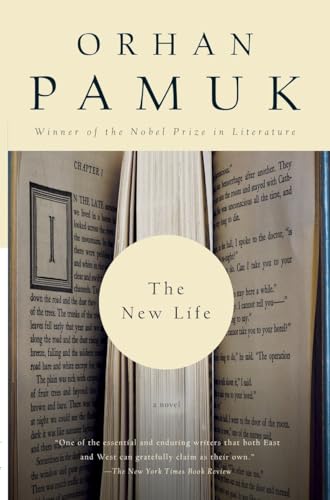
Synopsis
From the Nobel Prize winner and the acclaimed author of My Name is Red comes an engaging intellectual thriller and high romance set in Turkey about a young student whose life and identity is uprooted through the single act of reading a book.
The protagonist of Orhan Pamuk's fiendishly engaging novel is launched into a world of hypnotic texts and (literally) Byzantine conspiracies that whirl across the steppes and forlorn frontier towns of Turkey. And with The New Life, Pamuk himself vaults from the forefront of his country's writers into the arena of world literature. Through the single act of reading a book, a young student is uprooted from his old life and identity. Within days of reading a book, a young student’s old life and identity is uprooted, and he’s fallen in love with the luminous and elusive Janan; witnessed the attempted assassination of a rival suitor; and forsaken his family to travel aimlessly through a nocturnal landscape of traveler's cafes and apocalyptic bus wrecks. As imagined by Pamuk, the result is a wondrous marriage of the intellectual thriller and high romance. Translated from the Turkish by Guneli Gun.
"synopsis" may belong to another edition of this title.
About the Author
Orhan Pamuk is the author of seven novels and the recipient of major Turkish and international literary awards. He is one of Europe's most prominent novelists, and his work has been translated into twenty-six languages. He lives in Istanbul.
From the Back Cover
The protagonist of Orhan Pamuk's fiendishly engaging novel is launched into a world of hypnotic texts and (literally) Byzantine conspiracies that whirl across the steppes and forlorn frontier towns of Turkey. And with The New Life, Pamuk himself vaults from the forefront of his country's writers into the arena of world literature. Through the single act of reading a book, a young student is uprooted from his old life and identity. Within days he has fallen in love with the luminous and elusive Janan; witnessed the attempted assassination of a rival suitor; and forsaken his family to travel aimlessly through a nocturnal landscape of traveler's cafes and apocalyptic bus wrecks. As imagined by Pamuk, the result is a wondrous marriage of the intellectual thriller and high romance. Translated from the Turkish by Guneli Gun.
"[A] weird, hypnotic new novel...It veers from intellectual conundrums in the Borges vein to rapturous lyricism reminiscent of Gabriel Garcia Marquez."--Wall Street Journal
From the Inside Flap
The protagonist of Orhan Pamuk's fiendishly engaging novel is launched into a world of hypnotic texts and (literally) Byzantine conspiracies that whirl across the steppes and forlorn frontier towns of Turkey. And with The New Life, Pamuk himself vaults from the forefront of his country's writers into the arena of world literature. Through the single act of reading a book, a young student is uprooted from his old life and identity. Within days he has fallen in love with the luminous and elusive Janan; witnessed the attempted assassination of a rival suitor; and forsaken his family to travel aimlessly through a nocturnal landscape of traveler's cafes and apocalyptic bus wrecks. As imagined by Pamuk, the result is a wondrous marriage of the intellectual thriller and high romance. Translated from the Turkish by Guneli Gun.
"[A] weird, hypnotic new novel...It veers from intellectual conundrums in the Borges vein to rapturous lyricism reminiscent of Gabriel Garcia Marquez."--Wall Street Journal
Excerpt. © Reprinted by permission. All rights reserved.
The New Life
By Orhan PamukVintage Books USA
Copyright ©1998 Orhan PamukAll right reserved.
ISBN: 9780375701719
Chapter One
The others experienced nothing like it even though they heard the same tales.
--Novalis
1 I read a book one day and my whole life waschanged. Even on the first page I was so affected by thebook's intensity I felt my body sever itself and pull away from thechair where I sat reading the book that lay before me on thetable. But even though I felt my body dissociating, my entirebeing remained so concertedly at the table that the book workedits influence not only on my soul but on every aspect of myidentity. It was such a powerful influence that the light surgingfrom the pages illumined my face; its incandescence dazzled myintellect but also endowed it with brilliant lucidity. This was thekind of light within which I could recast myself; I could lose myway in this light; I already sensed in the light the shadows of anexistence I had yet to know and embrace. I sat at the table,turning the pages, my mind barely aware that I was reading, andmy whole life was changing as I read the new words on eachnew page. I felt so unprepared for everything that was to befallme, and so helpless, that after a while I moved my face awayinstinctively as if to protect myself from the power that surgedfrom the pages. It was with dread that I became aware of thecomplete transformation of the world around me, and I wasovertaken by a feeling of loneliness I had never beforeexperienced--as if I had beenstranded in a country where I knew neither the lay of the landnor the language and the customs.
I fastened onto the book even more intensely in the face of thehelplessness brought on by that feeling of isolation. Nothingbesides the book could reveal to me what was my necessarycourse of action, what it was that I might believe in, or observe,and what path my life was to take in the new country in which Ifound myself. I read on, turning the pages now as if I werereading a guidebook which would lead me through a strange andsavage land. Help me, I felt like saying, help me find the new life,safe and unscathed by any mishap. Yet I knew the new life wasbuilt on words in the guidebook. I read it word for word, trying tofind my path, but at the same time I was also imagining, to myown amazement, wonders upon wonders which would surelylead me astray.
The book lay on my table reflecting its light on my face, yet itseemed similar to the other familiar objects in the room. While Iaccepted with joy and wonder the possibility of a new life in thenew world that lay before me, I was aware that the book whichhad changed my life so intensely was in fact something quiteordinary. My mind gradually opened its doors and windows to thewonders of the new world the words promised me, and yet Iseemed to recall a chance encounter that had led me to the book.But the memory was no more shall a superficial image, one thathadn't completely impressed itself on my consciousness. As Iread on, a certain dread prompted me to reflect on the image: thenew world the book revealed was so alien, so odd andastonishing that, in order to escape being totally immersed in thisuniverse, I was anxious to sense anything related to the present.
What if I raised my eyes from the book and looked around atmy room, my wardrobe, my bed, or glanced out the window, butdid not find the world as I knew it? I was inhabited with this fear.
Minutes and pages followed one another, trains went by in thedistance, I heard my mother leave and shell return; I listened tothe everyday roar of the city, the tinkle of the yogurt vendor'sbell in the street, car engines, all the sounds familiar to me, as if Iwere hearing outlandish sounds. At first I thought there was adownpour outside, but it turned out to he the sound of some girlsjumping rope. I thought it was beginning to clear up, but thenthere was the patter of raindrops on my window. I read thefollowing page, the next one, and the ones after that; I saw lightseeping through the threshold of the other life; I saw what Iknew and what I didn't know; I saw my life, the path I assumedmy own life would take ...
The more I turned the pages, the more a world that I couldhave never imagined, or perceived, pervaded my being and tookhold of my soul. All the things I had known or consideredpreviously had now become trivial details, but things I had not beenaware of before now emerged from their hiding places and sentme signals. Had I been asked to say what these were, it seemedI couldn't have given an answer while I still read on; I knew Iwas slowly making progress on a road that had no return, awarethat my former interest in and curiosity for things were nowclosing behind me, but I was so excited and exhilarated by thenew life that opened before me that all creation seemed worthyof my attention. I was shuddering and swinging my legs with theexcitement of this insight when the wealth, the multiplicity, andthe complexity of possibilities turned into a kind of terror.
In the light that surged from the book into my face, I wasterrified to see shabby rooms, frenetic buses, bedraggled people,faint letters, lost towns, lost lives, phantoms. A journey wasinvolved; it was always about a journey. I beheld a gaze thatfollowed me on the journey, one that seemed to appear in theleast expected places only to disappear, making itself sought allthe more because it was so elusive, a tender gaze that had longbeen free of guilt and blame ... I longed to become that gaze. I longedto exist in a world beheld by that gaze. I wanted it so much that Ialmost believed in my existence in that world. There was nonecessity even to convince myself: I did in fact live there. Giventhat I lived there, the book must, of course, be about me.Someone had already imagined my ideas and put them down.
This led me to understand that the words and their meaningswere, of necessity, dissimilar. From the beginning I had knownthe book had been written expressly for my benefit; it was notbecause these were portentous phrases and brilliant words thatevery word and every figure of speech pervaded my being, itwas because I was under the impression that the book was aboutme. I could not fathom how I became subject to this feeling, butperhaps I did figure it out only to lose it trying to see my waythrough the murders, accidents, death, and missing signs withwhich the book was filled.
So it was that as I read my point of view was transformed bythe book, and the book was transformed by my point of view.My dazzled eyes could no longer distinguish the world thatexisted within the book from the book that existed within theworld. It was as if a singular world, a complete creation with allits colors and objects, were contained in the words that existed inthe book; thus I could read into it with joy and wonder all thepossibilities in my own mind. I began to understand that everything thebook had initially whispered to me, then pounded into me, andeventually forced on me relentlessly had always been present,there, lying deep in my soul. The book had found the lost treasurythat had been lying below the surface for ages and brought it up,and I felt I could appropriate for myself what I read in betweenthe lines and the words. Somewhere in the final pages, I wantedto say I too had come up with the same ideas. It was much later,after I had been totally overtaken by the world the bookdescribed, that I actually saw death appear in the half-lightbefore dawn, radiant as an angel. My own death.
I suddenly understood that my life had been enriched beyondmy ken. Losing sight of the book was the only thing thatfrightened me shell, but I was no longer as afraid of being unableto recognize what the book had told me of in the mundaneobjects around me in my room or in the street. I held the book betweenmy hands and sniffed the smell of paper and ink that rose fromthe pages, just as I would do in my childhood when I'd finishedreading a comic book from cover to cover. The smell was thesame.
I rose from the table and pressed my forehead on the coolwindowpane, as I used to do when I was a child, and I lookeddown into the street. Five hours ago, shortly after midday when Ihad placed the book on the table and begun reading, there hadbeen a truck parked across the street which was now gone;wardrobes with mirrors, heavy tables, stands, boxes, pedestallamps, et cetera, had been unloaded from the vehicle and a newfamily had moved into the vacant fiat across the street. Since thecurtains hadn't yet been put up, in the light of the bare bulb thatlit the scene I could see the middle-aged parents, the son who wasabout my age, and their daughter; they were eating their eveningmeal in front of the TV. The girl's hair was light brown, the TVscreen green.
I watched my new neighbors for a while; I liked watchingthem, perhaps because they were new or perhaps becausewatching them kept me safe. I didn't yet want to face the entiretransformation of a familiar world now changed from top to bottom,but I was well aware that my room was no longer the same oldroom, nor the streets the same streets, my friends the samefriends, my mother the same mother. They all implied a certainhostility, something dreadful and menacing that I could not quitename. I took a few steps away from the window but could notreturn to the book beckoning me back to the table. The objectthat had taken my life off its course was there on the table behind me,waiting. No matter how much I turned my back on it, theinception of everything was there in the pages of the book, and Icould no longer put off embarking on that road.
Being cut off from my former life must have felt so horrifyingfor the moment that I too, like other people whose lives havebeen irretrievably altered by some disaster, wanted to comfortmyself by assuming my life would resume its former course, thatit was not something terrible that had befallen me, some accidentor catastrophe. But the presence of the book standing openbehind me was so palpable to my senses that I could not evenimagine how my life could ever return to its old track.
It was in this state that I left my room when my mother calledme to supper; I sat down like a novice unaccustomed to a newplace, and tried making conversation. The TV was on; before uswere platters with a stew of potato and chopped meat, coldbraised leeks, a green salad, and apples. My mother brought upthe new neighbors who were moving in across the street, myhaving sat down and, bravo, worked all afternoon, her shoppingtrip, the downpour, the evening news on TV, and thenewscaster. I loved my mother; she was a good-looking womanwho was gentle, temperate, and sympathetic; I felt guilty ofhaving read a book that had estranged me from her world.
Had the book been written for everybody, I reasoned, life inthe world could not continue to flow on this slowly and thiscarelessly. On the other hand, it wouldn't do for this rationalstudent of engineering to think the book had been writtenspecifically for him. Yet, if it hadn't been addressed to me, and tome alone, how could the world outside possibly go on being justwhat it was before? I was afraid even to think the book might bea mystery constructed for my sake alone. Later when my motherwashed the dishes, I wanted to help her: her touch might restoreme back to the present from the world into which I had projectedmyself.
"Don't bother, dear," she said, "I'll do them."
I watched TV for a while. Maybe I could get involved in thatworld, or else kick in the screen. But this was our TV set, theone we watched, a lamp of sorts, a kind of household deity. I puton my jacket and my street shoes.
"I'm going out," I said.
"What time will you get back?" my mother said. "Shall I waitup?"
"Don't, or you'll fall asleep in front of the TV again."
"Have you turned off the light in your room?"
So I ventured out into the precincts of my childhood where Ihad lived for twenty-two years, walking in the streets as if Iwere in the danger zone in some strange realm. Damp December airtouched my face like a light breeze, making me think a fewthings had possibly penetrated through from the old world intothis new world that I had entered, things which I should sooncome across in the streets that constituted my life. I felt likerunning.
I walked briskly along unlighted sidewalks, avoiding hulkinggarbage cans and craters of mud, watching a new worldmaterialize with each step I took. The plane and poplar trees that I'd knownsince my childhood still seemed the same planes and poplars, butthey were bereft of their powers of association and memory. Iobserved the haggard trees, the familiar two-story houses, thegrimy apartment buildings I had watched being built from thestage when they were mere mortar pits to the time when theroofs were raised and tiled, and where I played later as newplaymates moved in; yet these images did not seem to beinalienable pieces of my life but photographs that I couldn'tremember being taken: I recognized the shadows, the lightedwindows, the trees in the yard, the lettering at the entrances, butthe objects I recognized exerted no pull on my sensibilities. Myold world was all around me, in the street across from me, here,there, everywhere, in the form of familiar grocery-storewindows, streetlights at the Erenkoy Station Square, bakeryovens still baking corek, fruit cratesthat belonged to the greengrocer, pushcarts, the pastry shopcalled Life, dilapidated trucks, tarpaulins, tired and obscurefaces. Part of my heart, where I carried the book surreptitiouslyas if it were a sin, had frozen itself against all the forms thatwere softly shimmering in the city lights. I wanted to run awayfrom these well-known streets, away from the sadness ofrain-drenched trees, the grocer's and the butcher's brightly litsigns, neon letters reflected on the asphalt and in the rainpuddles. A light wind rose, droplets fell off the trees, and therewas a roaring in my ears that made me decide the book must bea mystery that had been bestowed upon me. I was gripped withfear. I wanted to talk to other people.
At the Station Square, I made for the Youth Cafe, wheresome of my neighborhood friends still met in the evenings,playing cards, watching the soccer game, or just hanging out.Someone I knew from the university who put in time at hisfather's shoe store and another from the neighborhood whoplayed amateur-league soccer were at the table in the back,chatting in the black-and-white light reflected off the TV screen.In front of them were newspapers that had fallen to pieces frombeing read too much, two tea glasses, cigarettes, and a bottle ofbeer bought at the grocery and concealed on the seat of a chair.I needed to have a long conversation, maybe one that went onfor hours and hours, but I soon realized I couldn't talk to thesetwo. I was gripped with a sorrow that brought tears into my eyesfor a moment, but I pulled myself together arrogantly: I couldonly bare my soul to persons chosen from among those whoalready existed in the world implied by the book.
That was how I almost came to believe I had total possessionof my future, but I also knew what possessed me at present wasthe book. Not only had the book permeated my being like asecret or a sin, it had dragged me into the kind of speechlessnessone experiences in dreams. Where were the kindred spirits with whomI could talk? Where was the country in which I'd find the dreamthat spoke to my heart? Where were those who had also readthe book? Where?
I walked across the train tracks, took back streets, trampled onyellow autumn leaves stuck to the pavement. A deep feeling ofoptimism surged up inside me. If only I could always walk likethis, walking fast, without stopping, if only I could go on journeys,it seemed I'd reach the universe in the book. The glow of thenew life I felt inside me existed in a faraway place, even in aland that was unattainable, but I sensed that as long as I was inmotion, I was getting closer. I could at least leave my old lifebehind me.
When I got to the shore, I was astonished that the sea lookedpitch-black. Why hadn't I ever noticed before that the Sea ofMarmara was so dark, so stern, and so cruel at night? It was asif objects spoke a language which I was beginning to hear, evenif just barely, in the temporal silence into which the book hadlured me. For a moment I felt the weight of the gently swayingsea like the flash of my own intractable death that I'd felt insideme while reading the book, but it was not a sensation of "the endhas come" brought on by actual death; it was more the curiosityand excitement of someone beginning a new life that animatedme.
I walked up and down the beach. I used to come here with thekids in the neighborhood to look through the piles of stuff the seadeposited along the shore--the tin cans, plastic balls, bottles,plastic flip-flops, clothes pins, light bulbs, plasticdolls--searching for something, a magic talisman from sometreasury, a shiny new article the use of which we couldn't beginto fathom. For a moment I sensed that if any old object from myold world were to be discovered and scrutinized now, from my newviewpoint enlightened by the book, it could be transformed intothat magical piece children are always looking for. At the sametime I was so besieged by the feeling that the book had isolated mefrom the world, I thought the dark sea would suddenly swell, pull me intoitself, and swallow me. I was beset with anxiety and startedwalking briskly, not for the sake of observing the new worldactualize with every step I took, but to be alone with the book inmy room as soon as possible. I almost ran, already envisioningmyself as someone who was created out of the light thatemanated from the book. This tended to soothe me.
My father had had a good friend about his own age who had alsoworked for the State Railroads for many years and had evenrisen to the rank of inspector; he wrote articles in Rail magazinefor railroad buffs. Besides that, he wrote and illustrated children'scomics which were published in the series called WeeklyAdventures for Children. There were many times when I ranhome to lose myself in one of the comics like Peter and Pertev orKamer Visits America that Uncle Railman Rifki presented to me,but those children's books always came to an end. The last pagesaid "The End" just like in the movies and, reading those sixletters, not only did I come to the exit point of the country whereI'd wanted to remain, I was once again painfully aware that themagic realm was just a place made up by Uncle Railman Rifki.
In contrast, everything in the book I wanted to read again wastrue; and that's why I carried the book inside me and why thewet streets I tore through did not appear real but seemed likepart of a boring homework assignment I'd been given aspunishment. After all, the book revealed, so it seemed to me, themeaning of my existence.
I'd gone across the railroad tracks and was coming around themosque when, just as I was about to step in a mud puddle, I leaptaway, my foot slipped, and I stumbled and fell to one knee on themuddy pavement. I pulled myself up immediately and was aboutto go my way.
"Oh, my, you almost had a bad fall, my boy!" said a beardedold man who'd seen me take the spill. "You hurt?"
"Yes," I said. "My father died yesterday. We buried himtoday. He was a shitty guy; he drank, beat my mother, didn'twant us around. I lived in Viran Bag all those years."
Viran Bag yet! Where in the world did I come up with thistown called Viran Bag? Perhaps the old guy was on to my lies,but momentarily I convinced myself that I was too clever by half.I couldn't tell if it was the lies I made up, or the book, or simplythe old man's stupefied face that prompted me, but I kept tellingmyself: "Never fear, never fear! The world in the book is real!"But I was afraid.
Why?
I had heard of others who had read a book only to have theirlives disintegrate. I'd read the account of someone who had reada book called Fundamental Principles of Philosophy; in totalagreement with the book, which he read in one night, he joinedthe Revolutionary Proletarian Advance Guard the very next day,only to be nabbed three days later robbing a bank and end updoing time for the next ten years. I also knew about those whohad stayed awake the whole night reading books such as Islamand the New Ethos or The Betrayal of Westernization, thenimmediately abandoned the tavern for the mosque, satthemselves on those ice-cold rugs doused with rosewater, andbegan preparing patiently for the next life which was not due foranother fifty years. I had even met some who got carried awayby books with titles like Love Sets You Free or Know Yourself, andalthough these people were the sort who were capable ofbelieving in astrology, they too could say in all sincerity, "Thisbook changed my life overnight!"
Actually, the frightening thing on my mind was not even thebathos of these scenarios: I was afraid of isolation. I was afraidof the sorts of things a fool like me might very well end up doing,such as misunderstanding the book, being shallow or, as the casemay be, not shallow, being different, drowning in love, being privyto the mysteries of the universe but looking ridiculous all my lifeexplaining the mystery to those who are not in the leastinterested, going to jail, being considered a crackpot,comprehending at last that the world is even crueler than I'dimagined, being unable to get pretty girls to love me. If thecontents of the book were true, if life was indeed like what Iread in the book, if such a world was possible, then it wasimpossible to understand why people needed to go to prayer, whythey yakked their lives away at coffeehouses, why they had to sitin front of the TV set in the evening so as not to die of boredom,unwilling to close even their curtains all the way, just in casesomething halfway interesting in the street might also bewatched, like a car speeding by, a horse neighing, or a drunkcutting loose.
I can't figure out how long it was before I realized I wasstanding in front of Uncle Railman Rifki's building and staring upinto his second-floor flat through the half-open curtains. I hadperhaps realized it without realizing it, and I was instinctivelysending him my regards on the eve of my new life. There was anodd wish on my mind. I wanted to take a close look at theobjects I'd seen in his house when my father and I had last paidhim a visit. The canaries in the cage, the barometer on the wall,the meticulously framed pictures of railroad trains, the breakfrontin which cordial sets, miniature railway cars, a silver candy dish,a conductor's punch, the railroad service medals were placed inone half of the showcase and maybe forty or fifty books in theother half, the unused samovar standing on top of it, the playingcards on the table ... Through the half-open curtains, I couldsee the light emanating from the TV but not the set itself.
A surge of determination suddenly hit me out of nowhere,prompting me to get on top of the wall around the front yard andsee not only the TV set Uncle Railman Rifki's widow AuntRatibe was watching but also her head. She was seated in herdead husband's easy chair at a forty-five-degree angle to the TVand had hunched her head between her shoulders, just the waymy mother does when watching TV, but instead of knitting, thisone was smoking up a storm.
Uncle Railman Rifki had died a year ahead of my father, whowent of a heart attack last year, but Uncle Rifki's death was notdue to natural causes. He was on his way to the coffeehouse oneevening, it seems, when he was fired on and killed; the killer wasnever caught; there was some talk of sexual jealousy, which myfather never believed a word of during the last year of his life.The couple had never had any children.
Continues...
Excerpted from The New Lifeby Orhan Pamuk Copyright ©1998 by Orhan Pamuk. Excerpted by permission.
All rights reserved. No part of this excerpt may be reproduced or reprinted without permission in writing from the publisher.
Excerpts are provided by Dial-A-Book Inc. solely for the personal use of visitors to this web site.
"About this title" may belong to another edition of this title.
Other Popular Editions of the Same Title

Search results for The New Life (Vintage International)

Seller Image
The New Life
Published by
Knopf Doubleday Publishing Group, 1998
ISBN 10: 0375701710
ISBN 13: 9780375701719
Used
Softcover
Seller: Greenworld Books, Arlington, TX, U.S.A.
Seller rating 5 out of 5 stars

Condition: good. Fast Free Shipping â" Good condition. It may show normal signs of use, such as light writing, highlighting, or library markings, but all pages are intact and the book is fully readable. A solid, complete copy that's ready to enjoy. Seller Inventory # GWV.0375701710.G
Stock Image
The New Life (Vintage Internat
Seller: World of Books (was SecondSale), Montgomery, IL, U.S.A.
Seller rating 5 out of 5 stars
Condition: Good. Item in good condition and has highlighting/writing on text. Used texts may not contain supplemental items such as CDs, info-trac etc. Seller Inventory # 00101971440
Stock Image
The New Life (Vintage Internat
Seller: World of Books (was SecondSale), Montgomery, IL, U.S.A.
Seller rating 5 out of 5 stars
Condition: Acceptable. Item in acceptable condition! Textbooks may not include supplemental items i.e. CDs, access codes etc. Seller Inventory # 00102296908
Seller Image
The New Life
Published by
Knopf Doubleday Publishing Group, 1998
ISBN 10: 0375701710
ISBN 13: 9780375701719
Used
Softcover
Seller: Blue Vase Books, Interlochen, MI, U.S.A.
Seller rating 5 out of 5 stars
Condition: acceptable. The item is very worn but is perfectly usable. Signs of wear can include aesthetic issues such as scratches, dents, worn and creased covers, folded page corners and minor liquid stains. All pages and the cover are intact, but the dust cover may be missing. Pages may include moderate to heavy amount of notes and highlighting, but the text is not obscured or unreadable. Page edges may have foxing age related spots and browning . May NOT include discs, access code or other supplemental materials. Seller Inventory # BVV.0375701710.A
Seller Image
The New Life
Published by
Knopf Doubleday Publishing Group, 1998
ISBN 10: 0375701710
ISBN 13: 9780375701719
Used
Softcover
Seller: Goodwill, Brooklyn Park, MN, U.S.A.
Seller rating 4 out of 5 stars

Condition: good. Cover does not match photos; some content may vary from version shown. Seller Inventory # MINV.0375701710.G
Stock Image
The New Life
Published by
Knopf Doubleday Publishing Group, 1998
ISBN 10: 0375701710
ISBN 13: 9780375701719
Used
Paperback
Seller: ThriftBooks-Dallas, Dallas, TX, U.S.A.
Seller rating 5 out of 5 stars
Paperback. Condition: Good. No Jacket. Pages can have notes/highlighting. Spine may show signs of wear. ~ ThriftBooks: Read More, Spend Less. Seller Inventory # G0375701710I3N00
Stock Image
The New Life
Published by
Knopf Doubleday Publishing Group, 1998
ISBN 10: 0375701710
ISBN 13: 9780375701719
Used
Paperback
Seller: ThriftBooks-Atlanta, AUSTELL, GA, U.S.A.
Seller rating 5 out of 5 stars
Paperback. Condition: Good. No Jacket. Pages can have notes/highlighting. Spine may show signs of wear. ~ ThriftBooks: Read More, Spend Less. Seller Inventory # G0375701710I3N00
Stock Image
The New Life
Published by
Knopf Doubleday Publishing Group, 1998
ISBN 10: 0375701710
ISBN 13: 9780375701719
Used
Paperback
Seller: ThriftBooks-Atlanta, AUSTELL, GA, U.S.A.
Seller rating 5 out of 5 stars
Paperback. Condition: Good. No Jacket. Former library book; Pages can have notes/highlighting. Spine may show signs of wear. ~ ThriftBooks: Read More, Spend Less. Seller Inventory # G0375701710I3N10
Stock Image
The New Life
Published by
Knopf Doubleday Publishing Group, 1998
ISBN 10: 0375701710
ISBN 13: 9780375701719
Used
Paperback
Seller: ThriftBooks-Atlanta, AUSTELL, GA, U.S.A.
Seller rating 5 out of 5 stars
Paperback. Condition: Fair. No Jacket. Readable copy. Pages may have considerable notes/highlighting. ~ ThriftBooks: Read More, Spend Less. Seller Inventory # G0375701710I5N00
Stock Image
The New Life
Published by
Knopf Doubleday Publishing Group, 1998
ISBN 10: 0375701710
ISBN 13: 9780375701719
Used
Paperback
Seller: ThriftBooks-Dallas, Dallas, TX, U.S.A.
Seller rating 5 out of 5 stars
Paperback. Condition: Very Good. No Jacket. May have limited writing in cover pages. Pages are unmarked. ~ ThriftBooks: Read More, Spend Less. Seller Inventory # G0375701710I4N00