
Synopsis
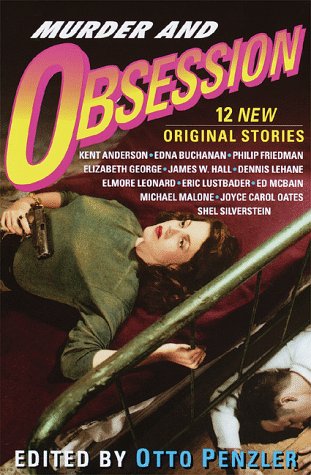
From lethal spikes to fatal kisses, from mad dogs to battle-crazed Englishmen, here indeed is Murder and Obsession, a star-studded collection of previously unpublished short mysteries. In the wickedly entertaining tradition of his acclaimed collections Murder for Love and Murder for Revenge, award-winning editor Otto Penzler has once again gathered the best of the best, fifteen bestselling authors who dare to explore a deliciously chilling subject: obsession at its most insidious.
Her toenails were bloodred, her lips were blue in Edna Buchanan's "The Red Shoes," a riveting tale that takes us into the life of an alcoholic-turned-foot-fetishist who steps into the middle of a murder. What happens when a hard-nosed insurance investigator lights up a joint and sniffs out a case of arson? It's a tale that only Elmore Leonard could tell, in "Sparks." Then there's "Slow Burn," Eric Van Lustbader's gripping story of a beautiful detective torn among obsessions--a past injustice, a consuming passion, and a savage crime that links them both.
Elizabeth George reaches into English history in "I, Richard," as an academic obsessed by a priceless artifact plots a deadly course of seduction--only to discover that fate is the most quixotic mistress of all. But "Barking at Butterflies" is a story straight out of today's headlines: Ed McBain's tale of a man who goes barking mad when a yappy Maltese takes over his life. Can the devil make you do it? Joyce Carol Oates has the answer as she plumbs the darkest recesses of possession in "The Vampire."
A paranoid cop smokes out an unseen perpetrator... a minor annoyance mushrooms into a major crime... an aging voyeur is lured into self-destruction by a teenage temptress seen through a crack in the wall... It's a devil's brew of Murder and Obsession in nine more mesmerizing stories by Kent Anderson, Amanda Cross, James Crumley, Philip Friedman, James W. Hall, Dennis Lehane, Michael Malone, Anne Perry, and Shel Silverstein, America's favorite writers exploring the depths of obsession--for the height of bone-chilling fun.
"synopsis" may belong to another edition of this title.
About the Author
Otto Penzler is the owner of The Mysterious Bookshop in New York City, Los Angeles, and London. The founder of The Mysterious Press and Otto Penzler Books, he is also the editor of the acclaimed collections Murder for Love and Murder for Revenge. He received an Edgar Award for the Encyclopedia of Mystery and Detection, and was honored by the Mystery Writers of America in 1994 with the Ellery Queen Award for his contributions in the publishing field. He lives in New York City.
From the Inside Flap
spikes to fatal kisses, from mad dogs to battle-crazed Englishmen, here indeed is <b>Murder and Obsession</b>, a star-studded collection of previously unpublished short mysteries. In the wickedly entertaining tradition of his acclaimed collections <b>Murder for Love</b> and <b>Murder for Revenge</b>, award-winning editor Otto Penzler has once again gathered the best of the best, fifteen bestselling authors who dare to explore a deliciously chilling subject: obsession at its most insidious.<br><br>Her toenails were bloodred, her lips were blue in Edna Buchanan's "The Red Shoes," a riveting tale that takes us into the life of an alcoholic-turned-foot-fetishist who steps into the middle of a murder. What happens when a hard-nosed insurance investigator lights up a joint and sniffs out a case of arson? It's a tale that only Elmore Leonard could tell, in "Sparks." Then there's "Slow Burn," Eric Van Lustbader's gripping story of a b
Reviews
Like his Murder for Love and Murder for Revenge, Penzler's latest collection features original stories (14, plus one reprint) by an all-star team. Most of the writers score solid hits but, unexpectedly, not Elmore Leonard. In "Sparks," Dutch seems to be going through the motions as a good-looking widow and an insurance claims investigator talk over the recent destruction of her overly insured house; Leonard even resorts to characterization through celebrity-branding: "Linda Fiorentino. That was who Robin looked like... Robin had the same effortless way about her.... " Ed McBain does better in his cute tale ("Barking at Butterflies") of a man whose plans to dispose of the dog he hates and to keep the woman he loves badly misfire. James W. Hall provides surprise in "Crack," when a Fulbright scholar peeping on his nubile neighbor sees more than he expected. In "The Vampire," Joyce Carol Oates waxes gothic, freezing a murder in progress to backtrack through a dying artist's last years with his manipulative mistress. And in the collection's only reprint, "The Mexican Pig Banquet," James Crumley has C.W. Sughrue laying low until a gang of thieves and their accomplice tap his usual weakness: a damsel in distress. Top marks go to Dennis Lehane; his "Running Out of Dog" manages a novel's worth of fine tension and nuanced characters as two childhood friends deal with loving the same woman in a small town after Vietnam. Elizabeth George, Anne Perry and Eric Van Lustbader are among the others contributing to this enjoyable collection. (Mar.) FYI: Penzler is the proprietor of the Mysterious Bookshop in New York City and the Mysterious Bookshop West in Los Angeles.
Copyright 1999 Reed Business Information, Inc.
The third entry in Penzler's themed series of new stories (Murder for Revenge, 1998, etc.) is doubly generous. Though there are only 15 stories, a few are long enough to send the page count through the roof. And the topic itself is so broad that almost any crime story could be shoehorned in (though you'd have to stretch to find much obsession in Elmore Leonard's arson investigation or much murder in Shel Silverstein's droll sex-offender anecdote). No other individual entry measures up to Joyce Carol Oates's ``The Vampire,'' but two kinds of stories are especially rewarding: a handful that focus, well, obsessively on their compulsive subjects (Edna Buchanan's shoe fetishist, James W. Hall's voyeur, Elizabeth George's scheming modern champion of Richard III, Philip Friedman's and Ed McBain's city-dwellers who have diverse problems with dogs), and a pair of surprising, and surprisingly accomplished, wild-cards from regional specialists Dennis Lehane (who leaves Boston to vacation among some memorable southern lowlifes) and Michael Malone (whose path crosses Lehane's as he travels north for a closer look at homicide among New York's Four Hundred). Supporting performances by Kent Anderson, James Crumley, Anne Perry, and Amanda Cross make this an anthology with something for everyone. -- Copyright ©1999, Kirkus Associates, LP. All rights reserved.
As in his previous anthologies, e.g., Murder for Revenge (LJ 12/95), Penzler has commissioned some high-caliber talent (Elmore Leonard, Edna Buchanan). While not all of these 15 new short stories involve murder, the characters in each tale do cross the line of normal and moral behavior. Only one author, James Crumley, uses a series character. Others, like Amanda Cross, James W. Hall, and Eric Lustbader, take a break from their usual environments, as does Anne Perry in the accomplished "Heroes." Shel Silverstein dispenses Solomonic justice, Elizabeth George probes the Ricardian movement, and Philip Friedman, Dennis Lehane, and Ed McBain each explore, among other things, the sinister side of canine-human relations. Rounding out the collection are solid contributions from Kent Anderson, Michael Malone, and Joyce Carol Oates. With individual introductions from Penzler, this anthology has something for every crime reader.ADevon Thomas, Highland Twp. Lib., MI
Copyright 1999 Reed Business Information, Inc.
Excerpt. © Reprinted by permission. All rights reserved.
Running Out of Dog
by Dennis Lehane
This thing with Blue and the dogs and Elgin Bern happened a while back, a few years after some of our boys--like Elgin Bern and Cal Sears--came back from Vietnam, and a lot of others--like Eddie Vorey and Carl Joe Carol, the Stewart cousins--didn't. We don't know how it worked in other towns, but that war put something secret in our boys who returned. Something quiet and untouchable. You sensed they knew things they'd never say, did things on the sly you'd never discover. Great card players, those boys, able to bluff with the best, let no joy show in their face no matter what they were holding.
A small town is a hard place to keep a secret, and a small Southern town with all that heat and all those open windows is an even harder place than most. But those boys who came back from overseas, they seemed to have mastered the trick ofprivacy. And the way it's always been in this town, you get a sizable crop of young, hard men coming up at the same time, they sort of set the tone.
So, not long after the war, we were a quieter town, a less trusting one (or so some of us seemed to think), and that's right when tobacco money and textile money reached a sort of critical mass and created construction money and pretty soon there was talk that our small town should maybe get a little bigger, maybe build something that would bring in more tourist dollars than we'd been getting from fireworks and pecans.
That's when some folks came up with this Eden Falls idea--a big carnival-type park with roller coasters and water slides and such. Why should all those Yankees spend all their money in Florida? South Carolina had sun too. Had golf courses and grapefruit and no end of KOA campgrounds.
So now a little town called Eden was going to have Eden Falls. We were going to be on the map, people said. We were going to be in all the brochures. We were small now, people said, but just you wait. Just you wait.
And that's how things stood back then, the year Perkin and Jewel Lut's marriage hit a few bumps and Elgin Bern took up with Shelley Briggs and no one seemed able to hold on to their dogs.
* * *
The problem with dogs in Eden, South Carolina, was that the owners who bred them bred a lot of them. Or they allowed them to run free where they met up with other dogs of opposite gender and achieved the same result. This wouldn't have been so bad if Eden weren't so close to I-95, and if the dogs weren't in the habit of bolting into traffic and fucking up the bumpers of potential tourists.
The mayor, Big Bobby Vargas, went to a mayoral conference up in Beaufort,where the governor made a surprise appearance to tell everyone how pissed off he was about this dog thing. Lot of money being poured into Eden these days, the governor said, lot of steps being taken to change her image, and he for one would be goddamned if a bunch of misbehaving canines was going to mess all that up.
"Boys," he'd said, looking Big Bobby Vargas dead in the eye, "they're starting to call this state the Devil's Kennel 'cause of all them pooch corpses along the interstate. And I don't know about you all, but I don't think that's a real pretty name."
Big Bobby told Elgin and Blue he'd never heard anyone call it the Devil's Kennel in his life. Heard a lot worse, sure, but never that. Big Bobby said the governor was full of shit. But, being the governor and all, he was sort of entitled.
The dogs in Eden had been a problem going back to the twenties and a part-time breeder named J. Mallon Ellenburg who, if his arms weren't up to their elbows in the guts of the tractors and combines he repaired for a living, was usually lashing out at something--his family when they weren't quick enough, his dogs when the family was. J. Mallon Ellenburg's dogs were mixed breeds and mongrels and they ran in packs, as did their offspring, and several generations later, those packs still moved through the Eden night like wolves, their bodies stripped to muscle and gristle, tense and angry, growling in the dark at J. Mallon Ellenburg's ghost.
Big Bobby went to the trouble of measuring exactly how much of 95 crossed through Eden, and he came up with 2.8 miles. Not much really, but still an average of .74 dog a day or 4.9 dogs a week. Big Bobby wanted the rest of the state funds the governor was going to be doling out at year's end, and if that meant getting rid of five dogs a week, give or take, then that's what was going to get done.
"On the QT," he said to Elgin and Blue, "on the QT, what we going to do, boys, is set up in some trees and shoot every canine who gets within barking distance of that interstate."
Elgin didn't much like this "we" stuff. First place, Big Bobby'd said "we" that time in Double O's four years ago. This was before he'd become mayor, when he was nothing more than a county tax assessor who shot pool at Double O's every other night, same as Elgin and Blue. But one night, after Harlan and Chub Uke had roughed him up over a matter of some pocket change, and knowing that neither Elgin nor Blue was too fond of the Uke family either, Big Bobby'd said, "We going to settle those boys' asses tonight," and started running his mouth the minute the brothers entered the bar.
Time the smoke cleared, Blue had a broken hand, Harlan and Chub were curled up on the floor, and Elgin's lip was busted. Big Bobby, meanwhile, was hiding under the pool table, and Cal Sears was asking who was going to pay for the pool stick Elgin had snapped across the back of Chub's head.
So Elgin heard Mayor Big Bobby saying "we" and remembered the ten dollars it had cost him for that pool stick, and he said, "No, sir, you can count me out this particular enterprise."
Big Bobby looked disappointed. Elgin was a veteran of a foreign war, former Marine, a marksman. "Shit," Big Bobby said, "what good are you, you don't use the skills Uncle Sam spent good money teaching you?"
Elgin shrugged. "Damn, Bobby. I guess not much."
But Blue kept his hand in, as both Big Bobby and Elgin knew he would. All the job required was a guy didn't mind sitting in a tree who liked to shoot things. Hell, Blue was home.
* * *
Elgin didn't have the time to be sitting up in a tree anyway. The past few months, he'd been working like crazy after they'd broke ground at Eden Falls--mixing cement, digging postholes, draining swamp water to shore up the foundation--with the real work still to come. There'd be several more months of drilling and bilging, spreading cement like cake icing, and erecting scaffolding to erect walls to erect facades. There'd be the hump-and-grind of rolling along in the dump trucks and drill trucks, the forklifts and cranes and industrial diggers, until the constant heave and jerk of them drove up his spine or into his kidneys like a corkscrew.
Time to sit up in a tree shooting dogs? Shit. Elgin didn't have time to take a piss some days.
And then on top of all the work, he'd been seeing Drew Briggs's ex-wife, Shelley, lately. Shelley was the receptionist at Perkin Lut's Auto Emporium, and one day Elgin had brought his Impala in for a tire rotation and they'd got to talking. She'd been divorced from Drew over a year, and they waited a couple of months to show respect, but after a while they began showing up at Double O's and down at the IHOP together.
Once they drove clear to Myrtle Beach together for the weekend. People asked them what it was like, and they said, "Just like the postcards." Since the postcards never mentioned the price of a room at the Hilton, Elgin and Shelley didn't mention that all they'd done was drive up and down the beach twice before settling in a motel a bit west in Conway. Nice, though; had a color TV and one of those switches turned the bathroom into a sauna if you let the shower run. They'd started making love in the sauna, finished up on the bed with the steam coiling out from the bathroom and brushing their heels. Afterward, he pushed her hair back off her forehead and looked in her eyes and told her he could get used to this.
She said, "But wouldn't it cost a lot to install a sauna in your trailer?" then waited a full thirty seconds before she smiled.
Elgin liked that about her, the way she let him know he was still just a man after all, always would take himself too seriously, part of his nature. Letting him know she might be around to keep him apprised of that fact every time he did. Keep him from pushing a bullet into the breech of a thirty-aught-six, slamming the bolt home, firing into the flank of some wild dog.
Sometimes, when they'd shut down the site early for the day--if it had rained real heavy and the soil loosened near a foundation, or if supplies were running late--he'd drop by Lut's to see her. She'd smile as if he'd brought her flowers, say, "Caught boozing on the job again?" or some other smartass thing, but it made him feel good, as if something in his chest suddenly realized it was free to breathe.
Before Shelley, Elgin had spent a long time without a woman he could publicly acknowledge as his. He'd gone with Mae Shiller from fifteen to nineteen, but she'd gotten lonely while he was overseas, and he'd returned to find her gone from Eden, married to a boy up in South of the Border, the two of them working a corn-dog concession stand, making a tidy profit, folks said. Elgin dated some, but it took him a while to get over Mae, to get over the loss of something he'd always expected to have, the sound of her laugh and an image of her stepping naked from Cooper's Lake, her pale flesh beaded with water, having been the things that got Elgin through the jungle, through the heat, through the ticking of his own death he'd heard in his ears every night he'd been over there.
About a year after he'd come home, Jewel Lut had come to visit her mother, who still lived in the trailer park where Jewel had ...
"About this title" may belong to another edition of this title.
Other Popular Editions of the Same Title

Search results for Murder and Obsession: 12 New Original Stories

Stock Image
Murder and Obsession: 12 New Original Stories
Seller: World of Books (was SecondSale), Montgomery, IL, U.S.A.
Seller rating 5 out of 5 stars

Condition: Good. Item in good condition. Textbooks may not include supplemental items i.e. CDs, access codes etc. Seller Inventory # 00105181496
Stock Image
Murder and Obsession: 12 New Original Stories
Seller: ThriftBooks-Atlanta, AUSTELL, GA, U.S.A.
Seller rating 5 out of 5 stars
Hardcover. Condition: Fair. No Jacket. Readable copy. Pages may have considerable notes/highlighting. ~ ThriftBooks: Read More, Spend Less. Seller Inventory # G0385318006I5N00
Stock Image
Murder and Obsession: 12 New Original Stories
Seller: ThriftBooks-Dallas, Dallas, TX, U.S.A.
Seller rating 5 out of 5 stars
Hardcover. Condition: Very Good. No Jacket. Former library book; May have limited writing in cover pages. Pages are unmarked. ~ ThriftBooks: Read More, Spend Less. Seller Inventory # G0385318006I4N10
Stock Image
Murder and Obsession: 12 New Original Stories
Seller: ThriftBooks-Reno, Reno, NV, U.S.A.
Seller rating 5 out of 5 stars
Hardcover. Condition: Very Good. No Jacket. Missing dust jacket; May have limited writing in cover pages. Pages are unmarked. ~ ThriftBooks: Read More, Spend Less. Seller Inventory # G0385318006I4N01
Seller Image
Murder and Obsession: 12 New Original Stories
Seller: Goodwill Books, Hillsboro, OR, U.S.A.
Seller rating 5 out of 5 stars
Condition: good. Signs of wear and consistent use. Seller Inventory # GICWV.0385318006.G
Stock Image
Murder and Obsession: 12 New Original Stories
Seller: HPB-Ruby, Dallas, TX, U.S.A.
Seller rating 5 out of 5 stars
hardcover. Condition: Very Good. Connecting readers with great books since 1972! Used books may not include companion materials, and may have some shelf wear or limited writing. We ship orders daily and Customer Service is our top priority! Seller Inventory # S_463813594
Seller Image
Murder and Obsession 15 New Original Stories
Published by
Delacorte Press, 1999
ISBN 10: 0385318006
ISBN 13: 9780385318006
Used
Hardcover
First Edition
Seller: Friendly Used Books, Omaha, NE, U.S.A.
Seller rating 5 out of 5 stars
Hardcover. Condition: Fine. Dust Jacket Condition: Fine. 1st Edition. fine book in a fine dust jaCket. First edition with full number line on copyright page. Seller Inventory # 126019
Stock Image
Murder and Obsession
Published by
Delacorte Press March 1999, 1999
ISBN 10: 0385318006
ISBN 13: 9780385318006
Used
Hardcover
Seller: A Cappella Books, Inc., Atlanta, GA, U.S.A.
Seller rating 5 out of 5 stars
Hardcover. Condition: Very Good. Dust Jacket Condition: Very Good. Seller Inventory # 345516
Stock Image
Murder and Obsession: 15 New Original Stories
Published by
Delacorte Press, New York, NY, 1999
ISBN 10: 0385318006
ISBN 13: 9780385318006
Used
Hardcover
First Edition
Seller: JAC Books, Cortland, NY, U.S.A.
Seller rating 4 out of 5 stars

Cloth. Condition: Fine. Dust Jacket Condition: Fine. Richie Fahey (illustrator). First Edition. Delacorte Press, New York, 1999. Hardcover First Edition/Printing in DJ, 406 pp. Great collection about the high cost of obsessions. 15 original stories by a fascinating group of authors, including Joyce Carol Oates, Elmore Leonard, Edna Buchanan, Ed McBain, and Shel Silverstein. Very mild rubbing to DJ, otherwise a fine, unread copy. Seller Inventory # 000917
Stock Image
Murder and Obsession: 12 New Original Stories
Published by
Delacorte Press, New York, New York, U. S. A., 1999
ISBN 10: 0385318006
ISBN 13: 9780385318006
Used
Hardcover
First Edition
Seller: Granada Bookstore, IOBA, Woodlawn, IL, U.S.A.
Seller rating 5 out of 5 stars
Hardcover. Condition: Very Good. Dust Jacket Condition: Very Good. 1st Edition. First Edition (Number Line With The One Present). The Book Is Bound Within Boards With Burgundy Paper Over One Quarter Dark Gray With Gilt Lettering On The Spine. The Upper Front Corner Is Bumped And The Lower Board Edges Have A Few Tiny Dimples. The Unclipped Jacket Has Moderate Rubbing And A Few Indentions From Sticker Removal On The Front. Seller Inventory # 038970