
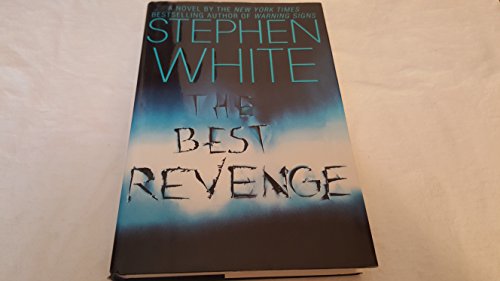
Synopsis
In a riveting new novel of psychological suspense, Stephen White shines a brilliant light on the darkness that hides just beneath the surface of ordinary lives, on the fears that cripple us and the prisons we create --prisons of the body, mind, and spirit. A thriller of runaway tension, taps into our most closely guarded fears, taking us on a harrowing journey into a realm of terror and pain, of love gone wrong and vengeance gone mad.
The Best Revenge
Psychologist Alan Gregory is living through a season of discontent. With a new daughter, a wonderful wife, and a prospering career, he has little to complain about and lots of regrets: past cases that won’t let him go, patients who don’t get better, and a growing unease with keeping secrets. But Gregory has two new patients who will drag him out of his introspection--and dare him to enter a storm of
injustice and revenge.
FBI special agent Kelda James is a hero, a woman who as a rookie agent made a choice, drew her gun, and saved a life, taking another. Now Kelda is hiding from the world a secret pain that is gradually crippling her body--and she has turned to Alan Gregory to help free her from the prison of her pain. Then Kelda refers a patient to Gregory, who is terrifyingly dangerous to them both.
Tom Clone served thirteen years on Colorado’s death row for a crime he claimed he didn’t commit--until an FBI agent dug up evidence that set him free. The agent’s name: Kelda James. With both Kelda and Clone telling him their innermost secrets, Alan Gregory becomes the one person who can piece together an extraordinary puzzle--of two unsolved violent deaths of vulnerable women, of a man who may be innocent or may be very lucky, and of the strange, fatal attraction between two people trapped in a horrific plot to get revenge--at any price.
A thriller that delivers a stunning body-blow of a surprise ending, captures lives colliding at unpredictable angles, probing the dangerous lies people tell to each other and themselves. In this astonishing work by a novelist at the height of his powers, Stephen White brilliantly blends thrilling action and breakneck pacing with unrivaled insight into the human mind, heart, and psyche.
"synopsis" may belong to another edition of this title.
From the Back Cover
g new novel of psychological suspense, Stephen White shines a brilliant light on the darkness that hides just beneath the surface of ordinary lives, on the fears that cripple us and the prisons we create --prisons of the body, mind, and spirit. A thriller of runaway tension, taps into our most closely guarded fears, taking us on a harrowing journey into a realm of terror and pain, of love gone wrong and vengeance gone mad.
The Best Revenge
Psychologist Alan Gregory is living through a season of discontent. With a new daughter, a wonderful wife, and a prospering career, he has little to complain about and lots of regrets: past cases that won’t let him go, patients who don’t get better, and a growing unease with keeping secrets. But Gregory has two new patients who will drag him out of his introspection--and dare him to enter a storm of
injustice and revenge.
FBI special agent Kelda James is a hero, a woman who as a rookie agent ma
From the Inside Flap
g new novel of psychological suspense, Stephen White shines a brilliant light on the darkness that hides just beneath the surface of ordinary lives, on the fears that cripple us and the prisons we create --prisons of the body, mind, and spirit. A thriller of runaway tension, taps into our most closely guarded fears, taking us on a harrowing journey into a realm of terror and pain, of love gone wrong and vengeance gone mad.
The Best Revenge
Psychologist Alan Gregory is living through a season of discontent. With a new daughter, a wonderful wife, and a prospering career, he has little to complain about and lots of regrets: past cases that won t let him go, patients who don t get better, and a growing unease with keeping secrets. But Gregory has two new patients who will drag him out of his introspection--and dare him to enter a storm of
injustice and revenge.
FBI special agent Kelda James is a hero, a woman who as a rookie agent ma
Reviews
FBI agent Kelda James, a relative newcomer to the Colorado bureau, made a name for herself as a rookie by finding a kidnapped little girl and killing her abductor. Kelda's latest triumph is the discovery of DNA evidence that ostensibly exonerates death-row inmate Tom Clone, convicted of murdering his girlfriend 13 years prior. Curiosity leads Kelda to pick up the released prisoner herself, and the two of them--the wrongfully incarcerated man and the beautiful, justice-seeking federal agent--develop a curious closeness. Kelda recommends esteemed Boulder psychotherapist Dr. Allan Gregory (star of numerous White novels), who is just coming off a spell of professional burnout, to Tom to help sort out potential outside-life issues, but this only serves to make matters even stranger, for client confidentiality bars Allan from discussing the two with each other or with his best buddy, a local detective. Not everyone is convinced the DNA evidence proves Tom's innocence, and some other evil force looms in an effort to exact revenge. But who is seeking revenge? That's the central mystery here, and White's circular plot is both maddening and exhilarating. Mary Frances Wilkens
Copyright © American Library Association. All rights reserved
New evidence proves that Tom Clone did not commit murder, but after 13 years in prison, he has developed dark tendencies that psychologist Alan Gregory may not be able to conquer.
Copyright 2002 Reed Business Information, Inc.
Excerpt. © Reprinted by permission. All rights reserved.
Prologue 1997
If Kelda James hadn’t been wearing inch-and-a-half heels and the toilet paper roll hadn’t been empty, Rosa Alija would probably be dead.
At about ten-twenty that morning Kelda had excused herself from her fellow FBI agents and followed directions to the restroom–down the long hall, go left, last door on the right. The bathroom was a step up from what she had expected to find, given the tacky condition of the rest of the building. She was relieved to see that the sink was reasonably clean and the toilet seat wasn’t stained with yellow coins of urine. The only problem was that there was no toilet paper on the cardboard roll.
Kelda stepped back out into the hall to retrace her route and retrieve her shoulder bag and its stash of tissues, but noticed a closet marked “Utility” adjacent to the bathroom. The knob on the door wasn’t locked and she found herself staring into a space about six feet square. A window was mounted high on the wall, dividing the small room in half. A jumble of brooms and mops leaned against a cracked porcelain sink on one side; the opposite side was stacked with particleboard shelves piled high with what appeared to be a lifetime supply of paper towels, soap, disinfectants, and toilet paper. Kelda reached onto an upper shelf for a fresh roll of toilet tissue and reflexively glanced over the sill and out the window as she rotated back toward the door.
The window overlooked the alley behind the building. Across the alley was the back of a single-story light-industrial building not noticeably different from the one that Kelda and her FBI colleagues had just raided.
Except for the hand.
Kelda was sure that for a split second she had glimpsed a hand in a window of the building across the alley. In her mind she was already considering it to have been a tiny hand, a child’s hand.
She approached the utility closet window, stood on her toes, and peered again at the building across the alley. No hand. She raised her fingers to the sill to hold herself up and examined the distant window in detail. The bottom edge of the cloudy pane was streaked with parallel vertical lines that could have been made by fingers.
Tiny fingers. Child’s fingers.
“Oh my God,” she said.
Fresh out of the FBI Academy, Special Agent Kelda James had been in the Denver, Colorado, field office for all of five weeks. Her initial assignment was to a squad that investigated white-collar crime, and that morning she had been ordered to accompany three other agents–all male, all senior to her, all somewhere between significantly and maximally apprehensive of her skills–to serve a federal warrant and raid a company called Account Assistants, Inc., on Delaware Street in Denver’s Golden Triangle neighborhood. The company did contract billing for medical practices, and the raid was intended to collect evidence of suspected Medicare fraud.
For an FBI white-collar crime squad, this was routine stuff.
Prior to entering the FBI Academy, Kelda had earned her credentials as a certified public accountant and had spent a few years investigating fraud for an international insurance company. Her role in the raid of Account Assistants, Inc., was to cover the back door as the raid started and, later, to use her forensic accounting background to help make certain that the agents didn’t fail to retrieve any records that they might ultimately need to press their case against the firm.
Most important, though, she knew that her primary responsibility was to remember at all times that she was the new guy, or in FBI parlance, “the fucking new guy.” Her primary responsibility was not to screw up.
Later in the day, after she and the other agents had finished collecting the evidence and had transported the boxes back to the Denver Field Office, Kelda figured that she–the fucking new guy–would be the one who would be assigned to spend the next few weeks sitting at her Bureau desk examining the mind-numbing details of the service and billing records, trying to use Account Assistants, Inc.’s own numbers to prove the fraud case that had spawned the warrant and the raid.
It’s what she did. And she knew she did it well.
That was what she was contemplating when she saw the hand flash across the window a second time. But as swiftly as it appeared in the window, the little hand disappeared again.
A more experienced agent might have gone back to her squad, reported what she’d seen, and asked one of her colleagues to accompany her across the alley to investigate the fleeting hand. A more experienced agent–one who wasn’t a bookish young woman with an accounting degree whose colleagues called her Clarice behind her back–would have been less concerned about the scorn she would suffer if she pulled a fellow agent–or two, or three–away from important work to search the back of an adjacent building because she thought that maybe she had seen a child’s hand in the bottom of a window.
Kelda could only imagine the relentless ridicule she would endure from her fellow agents after word spread in the field office that she had begged for assistance in checking out what would probably turn out to be nothing more nefarious than an unlicensed day-care facility.
Kelda moved out of the utility closet, closed the door, and took three steps farther down the hall to a door that was marked “Exit.” An hour and a half earlier she’d stood in the alley on the other side of this very door in case any of the principals of Account Assistants, Inc., tried to flee out the back as the FBI team announced the raid and the warrant was served by the agents who entered the building through the door at the front.
She checked the inside of the exit door for an alarm: She couldn’t spot any electronic devices attached to the heavy door that would announce that she had opened it. She stepped outside, propped the door open with a softball-sized piece of concrete, and then jogged across the alley to the window with the streaky glass and the disappearing tiny hand.
Two days before, six-year-old Rosa Alija had vanished from the playground of her elementary school’s summer day camp near Thirty-second and Federal on Denver’s near west side. The other children on the playground told police conflicting tales of a van or truck that was gray or brown and one man who was white or two men who were black or two men and a woman who were all kinds of different combinations of races and colors who had waited for a child to chase a ball into the field adjacent to the school and then, when Rosa Alija had been that child, had scooped her up, covered her mouth, and carried her away in the van or truck.
Some of the child witnesses reported that Rosa had kicked her legs and cried. Others maintained she was already dead by the time she got to the van.
No adult reported seeing a thing.
And no one had seen Rosa since. The girl’s frantic parents, an independent landscaper named José Alija and his receptionist wife, Maria, waited in vain for a ransom demand. But neither the police nor the local FBI office expected to hear from Rosa’s abductors. The Alijas weren’t the type of family who were chosen for a kidnapping for ransom.
Rosa Alija had been taken for some other purpose.
Denver mobilized in an unprecedented fashion to find the girl. Hun- dreds of citizens–Hispanic, white, black, Native American, Asian–searched the city for little Rosa. Posses of private citizens scoured the banks of the South Platte River and Cherry Creek. The huge expanse of rail yard between her school and Lower Downtown was searched, and the interior of every last boxcar in the yard was examined. Her picture was featured on the front page of both daily papers, and the quest to find her dominated the local TV and radio news.
Bloodhounds tracked her route away from the school. The dogs seemed confident that her abductor had taken her down Speer Boulevard after the kidnapping, but the hounds lost the scent near the spot where Speer intersected with Interstate 25. The cops knew that once Rosa’s abductors had her on Denver’s main freeway, they could have taken her anywhere.
Anywhere. The Rocky Mountains, the Great Plains, the Great Basin. North to Wyoming, south to New Mexico. Anywhere.
Even into the back room of a light-industrial building in one of Denver’s transitional urban neighborhoods.
The bottom of the window in the building across the alley was level with the top of Kelda’s head. She listened for the sounds of children playing, but all she heard was the sough of distant traffic on Speer Boulevard; she heard nothing to convince herself that she’d stumbled onto a day-care facility. A moment’s contemplation failed to suggest any other good reason that a small child would be scratching at the glass in a back room in a building in this neighborhood.
Kelda grabbed a discarded plastic milk crate from the alley and carried it back toward the window to check and see what was inside the building.
Before she had a chance to step onto the crate, she saw the hand again. It was reaching, groping, the fingers extended against the bottom edge of the pane, but they could only stay there for a second or two. Kelda imagined that every time the girl lifted her hand someone else was yanking it right back down.
Most of the doubt about what she had discovered evaporated from Kelda’s mind. Rosa Alija, she was hoping. It’s Rosa Alija. But even in her head, the thought was only a whisper. If hope was the balloon, reality was the ballast.
What if it’s not?
For the first time since Kelda had graduated from the Academy, she withdrew her handgun from its holster with the clear understanding that she might be about to fire it. The Sig Sauer felt almost weightless in her hand as sh...
"About this title" may belong to another edition of this title.
Other Popular Editions of the Same Title

Search results for The Best Revenge

Stock Image
The Best Revenge
Seller: World of Books (was SecondSale), Montgomery, IL, U.S.A.
Seller rating 5 out of 5 stars

Condition: Very Good. Item in very good condition! Textbooks may not include supplemental items i.e. CDs, access codes etc. Seller Inventory # 00077002421
Stock Image
The Best Revenge
Seller: World of Books (was SecondSale), Montgomery, IL, U.S.A.
Seller rating 5 out of 5 stars
Condition: Good. Item in very good condition! Textbooks may not include supplemental items i.e. CDs, access codes etc. Seller Inventory # 00076085220
Seller Image
The Best Revenge
Seller: Greenworld Books, Arlington, TX, U.S.A.
Seller rating 5 out of 5 stars
Condition: good. Fast Free Shipping â" Good condition. It may show normal signs of use, such as light writing, highlighting, or library markings, but all pages are intact and the book is fully readable. A solid, complete copy that's ready to enjoy. Seller Inventory # GWV.0385336195.G
Stock Image
The Best Revenge
Seller: HPB-Emerald, Dallas, TX, U.S.A.
Seller rating 5 out of 5 stars
hardcover. Condition: Very Good. Connecting readers with great books since 1972! Used books may not include companion materials, and may have some shelf wear or limited writing. We ship orders daily and Customer Service is our top priority! Seller Inventory # S_460985799
Stock Image
The Best Revenge
Published by
Random House Publishing Group, 2003
ISBN 10: 0385336195
ISBN 13: 9780385336192
Used
Hardcover
First Edition
Seller: Better World Books, Mishawaka, IN, U.S.A.
Seller rating 5 out of 5 stars
Condition: Good. 1st. Pages intact with minimal writing/highlighting. The binding may be loose and creased. Dust jackets/supplements are not included. Stock photo provided. Product includes identifying sticker. Better World Books: Buy Books. Do Good. Seller Inventory # 484139-6
Stock Image
The Best Revenge
Published by
Random House Publishing Group, 2003
ISBN 10: 0385336195
ISBN 13: 9780385336192
Used
Hardcover
First Edition
Seller: Better World Books: West, Reno, NV, U.S.A.
Seller rating 5 out of 5 stars
Condition: Very Good. 1st. Former library copy. Pages intact with possible writing/highlighting. Binding strong with minor wear. Dust jackets/supplements may not be included. Includes library markings. Stock photo provided. Product includes identifying sticker. Better World Books: Buy Books. Do Good. Seller Inventory # 13987463-6
Stock Image
The Best Revenge
Published by
Random House Publishing Group, 2003
ISBN 10: 0385336195
ISBN 13: 9780385336192
Used
Hardcover
First Edition
Seller: Better World Books, Mishawaka, IN, U.S.A.
Seller rating 5 out of 5 stars
Condition: Good. 1st. Former library copy. Pages intact with minimal writing/highlighting. The binding may be loose and creased. Dust jackets/supplements are not included. Includes library markings. Stock photo provided. Product includes identifying sticker. Better World Books: Buy Books. Do Good. Seller Inventory # GRP59231627
Stock Image
The Best Revenge
Seller: Wonder Book, Frederick, MD, U.S.A.
Seller rating 5 out of 5 stars
Condition: Very Good. Very Good condition. Very Good dust jacket. A copy that may have a few cosmetic defects. May also contain light spine creasing or a few markings such as an owner's name, short gifter's inscription or light stamp. Seller Inventory # I25B-01912
Stock Image
The Best Revenge
Seller: Wonder Book, Frederick, MD, U.S.A.
Seller rating 5 out of 5 stars
Condition: As New. Like New condition. Very Good dust jacket. A near perfect copy that may have very minor cosmetic defects. Seller Inventory # S16E-02137
Stock Image
The Best Revenge
Seller: ThriftBooks-Dallas, Dallas, TX, U.S.A.
Seller rating 5 out of 5 stars
Hardcover. Condition: Very Good. No Jacket. May have limited writing in cover pages. Pages are unmarked. ~ ThriftBooks: Read More, Spend Less. Seller Inventory # G0385336195I4N00