
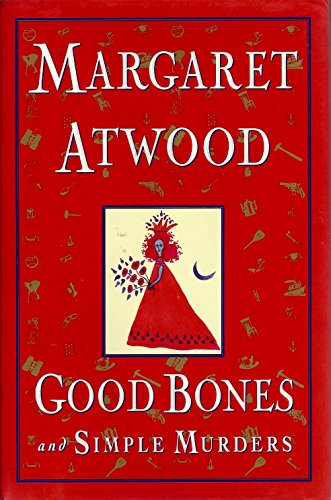
Synopsis
In this collection of short works that defy easy categorization, Margaret Atwood displays, in condensed and crystallized form, the trademark wit and viruosity of her best-selling novels, brilliant stories, and insightful poetry. Among the jewels gathered here are Gertrude offering Hamlet a piece of her mind, the real truth about the Little Red Hen, a reincarnated bat explaining how Bram Stoker got Dracula all wrong, and the five methods of making a man (such as the "Traditional Method": "Take some dust off the ground. Form. Breathe into the nostrils the breath of life. Simple, but effective!") There are parables, monologues, prose poems, condensed science fiction, reconfigured fairy tales, and other miniature masterpieces--punctuated with charming illustrations by the author. A must for her fans, and a wonderful gift for all who savor the art of exquisite prose, Good Bones And Simple Murders marks the first time these writings have been available in a trade edition in the United States.
"synopsis" may belong to another edition of this title.
About the Author
Margaret Atwood was born in Ottawa in 1939, and grew up in northern Quebec and Ontario, and later in Toronto. She has lived in numerous cities in Canada, the U.S., and Europe.
She is the author of more than thirty books – novels, short stories, poetry, literary criticism, social history, and books for children.
Atwood’s work is acclaimed internationally and has been published around the world. Her novels include The Handmaid’s Tale and Cat’s Eye – both shortlisted for the Booker Prize; The Robber Bride; Alias Grace, winner of the prestigious Giller Prize in Canada and the Premio Mondello in Italy, and a finalist for the Booker Prize, the Orange Prize, and the International IMPAC Dublin Literary Award; and The Blind Assassin, winner of the Booker Prize and a finalist for the International IMPAC Dublin Literary Award. Her new novel is Oryx and Crake (2003). She is the recipient of numerous honours, such as The Sunday Times Award for Literary Excellence in the U.K., the National Arts Club Medal of Honor for Literature in the U.S., Le Chevalier dans l’Ordre des Arts et des Lettres in France, and she was the first winner of the London Literary Prize. She has received honorary degrees from universities across Canada, and one from Oxford University in England.
Margaret Atwood lives in Toronto with novelist Graeme Gibson.
From the Inside Flap
ection of short works that defy easy categorization, Margaret Atwood displays, in condensed and crystallized form, the trademark wit and viruosity of her best-selling novels, brilliant stories, and insightful poetry. Among the jewels gathered here are Gertrude offering Hamlet a piece of her mind, the real truth about the Little Red Hen, a reincarnated bat explaining how Bram Stoker got Dracula all wrong, and the five methods of making a man (such as the "Traditional Method": "Take some dust off the ground. Form. Breathe into the nostrils the breath of life. Simple, but effective!") There are parables, monologues, prose poems, condensed science fiction, reconfigured fairy tales, and other miniature masterpieces--punctuated with charming illustrations by the author. A must for her fans,
Reviews
If Atwood keeps a journal, perhaps some of the brief selections in this slender volume-postmodern fairy tales, caustic fables, inspired parodies, witty monologues-come from that source. The 35 entries offer a sometimes whimsical, sometimes sardonic view of the injustices of life and the battles of the sexes. Such updated fairy tales as "The Little Red Hen Tells All" (she's a victim of male chauvinism) and "Making a Man" (the Gingerbread man is the prototype) are seen with a cynical eye and told in pungent vernacular. "Gertrude Talks Back" is a monologue by Hamlet's mother, a randy woman ready for a roll in the hay, who is exasperated with her whiny, censorious teenage son. Several pieces feature women with diabolical intentions-witches, malevolent goddesses, etc. There are science fiction scenarios, anthropomorphic confessionals ("My Life as a Bat") and an indictment of overly aggressive women that out-Weldons Fay Weldon. While each of these entries is clever and sharply honed, readers will enjoy dipping into them selectively; a sustained reading may call up an excess of bile. Atwood has provided striking black-and-white illustrations.
Copyright 1994 Reed Business Information, Inc.
Atwood (The Robber Bride, 1993, etc.) is always at her worst when her acerbic sneer overwhelms other elements, and there is barely room for anything else in these short-short works. With the laundry-list mentality usually reserved for dead authors, this collection gathers up pieces that have appeared in magazines and earlier collections and simply regroups them according to a criterion that has more to do with brevity than quality. Most lack structure and read like beginning ideas rather than finished stories. Some try to turn fairy tales around, but they tend to be unfocused. In ``Unpopular Gals,'' an ``ugly stepsister'' rails against fairy-tale conventions like well-behaved daughters and the fact that ``there are never any evil stepfathers.'' In ``There Was Once,'' the narrator tries to write a fairy tale but keeps backtracking to avoid sounding ``pass‚'' and inaccurate. ``Women's Novels'' also attempts literary revisionism, but its stabs at humor are blunt (``Women's novels leave out parts of the men as well. Sometimes it's the stretch between the belly button and the knees, sometimes it's the sense of humor''). ``Making a Man'' gives instructions for just that, and again, jokes about making males out of marzipan and gingerbread do not go any deeper. ``Happy Endings'' fares a little better with a list of possible scenarios for a love relationship, prefaced by the warning to read only the first ``If you want a happy ending,'' but it is the exception among smug fluff like the poem ``Let Us Now Praise Stupid Women'' (``all those who dry their freshly shampooed poodles in the microwave'') and ``Liking Men,'' an examination of men and their parts that veers far off-track. Atwood has clearly grasped the differences between men and women, but her mistake lies in believing that she is the only one who has. Readers will resent paying what averages out to about ten dollars per hour for this. -- Copyright ©1994, Kirkus Associates, LP. All rights reserved.
This collection of quirky, clever, and devilishly funny sketches, parodies, and fractured fairy tales is a scream. Free from the structural demands of novels, short stories, and poetry, Atwood infuses these bracing little narratives with the full force of her drollness, anger, shrewdness, sass, and humor. Atwood has never forgotten the hard lessons of girlhood, and she continues to question the roots of our assumptions about gender roles, testing our shaky sense of progress toward equality. Her fascination with women's roles in life and literature leads her to muse on the necessity of "stupid women" in stories, to compare men's novels with women's novels, and to revisit old tales such as "Bluebeard" and "The Little Red Hen." In "Making a Man" and "Simmering," men take quite a beating; at one point, she declares, "Men's bodies are the most dangerous things on earth." After further reflections on sex, war, and relationships--and a satire about applying political-correctness standards to literature--Atwood moves on to some devastating views of our species and our future. These marvelously incendiary creations are like sparks thrown off from Atwood's longer works, crackling and popping brightly against the night sky, making us laugh and shiver. Donna Seaman
Gertrude hounding Hamlet? A bat critiquing Bram Stoker? There's even more in Atwood's witty new collection.
Copyright 1994 Reed Business Information, Inc.
"About this title" may belong to another edition of this title.
Other Popular Editions of the Same Title

Search results for Good Bones and Simple Murders

Stock Image
Good Bones and Simple Murders
Seller: Orion Tech, Kingwood, TX, U.S.A.
Seller rating 5 out of 5 stars

hardcover. Condition: Fair. Seller Inventory # 0385471106-4-37351189
Seller Image
Good Bones and Simple Murders
Seller: Aspen Book Co., Denver, CO, U.S.A.
Seller rating 5 out of 5 stars
Condition: good. A well-loved companion. Corners and cover might show a little wear, and you could find some notes or highlights. The dust jacket might be MIA, it might have been a library book and extras aren't guaranteedâ"but the story's all there! Seller Inventory # PKV.0385471106.G
Stock Image
Good Bones and Simple Murders
Seller: World of Books (was SecondSale), Montgomery, IL, U.S.A.
Seller rating 5 out of 5 stars
Condition: Acceptable. Item in acceptable condition! Textbooks may not include supplemental items i.e. CDs, access codes etc. Seller Inventory # 00103092576
Stock Image
Good Bones and Simple Murders
Seller: World of Books (was SecondSale), Montgomery, IL, U.S.A.
Seller rating 5 out of 5 stars
Condition: Good. Item in good condition. Textbooks may not include supplemental items i.e. CDs, access codes etc. Seller Inventory # 00094076459
Stock Image
Good Bones and Simple Murders
Seller: World of Books (was SecondSale), Montgomery, IL, U.S.A.
Seller rating 5 out of 5 stars
Condition: Good. Good condition ex-library book with usual library markings and stickers. Seller Inventory # 00103503812
Stock Image
Good Bones and Simple Murders
Seller: ThriftBooks-Phoenix, Phoenix, AZ, U.S.A.
Seller rating 5 out of 5 stars
Hardcover. Condition: Good. No Jacket. Pages can have notes/highlighting. Spine may show signs of wear. ~ ThriftBooks: Read More, Spend Less. Seller Inventory # G0385471106I3N00
Stock Image
Good Bones and Simple Murders
Seller: ThriftBooks-Dallas, Dallas, TX, U.S.A.
Seller rating 5 out of 5 stars
Hardcover. Condition: Good. No Jacket. Former library book; Pages can have notes/highlighting. Spine may show signs of wear. ~ ThriftBooks: Read More, Spend Less. Seller Inventory # G0385471106I3N10
Stock Image
Good Bones and Simple Murders
Seller: ThriftBooks-Dallas, Dallas, TX, U.S.A.
Seller rating 5 out of 5 stars
Hardcover. Condition: Good. No Jacket. Pages can have notes/highlighting. Spine may show signs of wear. ~ ThriftBooks: Read More, Spend Less. Seller Inventory # G0385471106I3N00
Stock Image
Good Bones and Simple Murders
Seller: ThriftBooks-Atlanta, AUSTELL, GA, U.S.A.
Seller rating 5 out of 5 stars
Hardcover. Condition: Fair. No Jacket. Readable copy. Pages may have considerable notes/highlighting. ~ ThriftBooks: Read More, Spend Less. Seller Inventory # G0385471106I5N00
Stock Image
Good Bones and Simple Murders
Seller: ThriftBooks-Atlanta, AUSTELL, GA, U.S.A.
Seller rating 5 out of 5 stars
Hardcover. Condition: Fair. No Jacket. Former library book; Readable copy. Pages may have considerable notes/highlighting. ~ ThriftBooks: Read More, Spend Less. Seller Inventory # G0385471106I5N10