
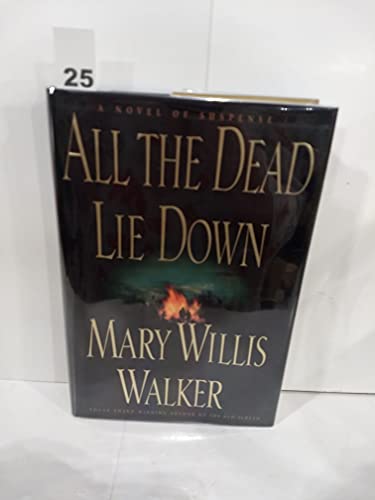
Synopsis
Following her triumph with Under the Beetle's Cellar, Edgar Award-winning author Mary Willis Walker returns with an emotionally charged double mystery that will leave you breathless and begging for more.
Her first novel, Zero at the Bone, won both the Agatha and Macavity awards and was nominated for an Edgar. Her second, The Red Scream, won the Edgar Award for Best Novel of 1994. Her third, Under the Beetle's Cellar, won the Hammett Prize, the Macavity Award, and the Anthony for 1995. With All the Dead Lie Down, she becomes one of those outstanding crime writers whose work has joined the ranks of bestselling mainstream fiction.
When true-crime reporter Molly Cates's father died more than twenty-five years ago, his death was ruled a suicide, and Molly's obsessive efforts to prove otherwise led to nothing but anguish and the breakup of her family. Now new information comes her way and she reopens the old investigation with a vengeance, but the answers she finally wrests from the past leave her with a moral dilemma she never anticipated. Her quest becomes even more painful when Molly encounters a homeless woman who insists she knows about a secret plot to kill everyone in the Texas legislature. By the time she convinces Molly it's true, it may be too late to prevent disaster.
As the Philadelphia Inquirer has said, "Walker can push the scary buttons, but she can also be poignant. And funny. And her sense of place is never less than authoritative." Once again, Mary Willis Walker has written a novel no one will be able to put down, as rich in character and emotion as it is in plot and heart-stopping suspense.
"synopsis" may belong to another edition of this title.
About the Author
Mary Willis Walker is the author of Zero at the Bone, which won both the Agatha and Macavity awards and was nominated for an Edgar; The Red Scream, winner of the Edgar Award; and Under the Beetle's Cellar, recipient of the Hammett Prize, the Anthony Award, and the Macavity Award. She lives in Austin, Texas, where she is now at work on her fifth novel.
From the Inside Flap
r triumph with Under the Beetle's Cellar, Edgar Award-winning author Mary Willis Walker returns with an emotionally charged double mystery that will leave you breathless and begging for more.
Her first novel, Zero at the Bone, won both the Agatha and Macavity awards and was nominated for an Edgar. Her second, The Red Scream, won the Edgar Award for Best Novel of 1994. Her third, Under the Beetle's Cellar, won the Hammett Prize, the Macavity Award, and the Anthony for 1995. With All the Dead Lie Down, she becomes one of those outstanding crime writers whose work has joined the ranks of bestselling mainstream fiction.
When true-crime reporter Molly Cates's father died more than twenty-five years ago, his death was ruled a suicide, and Molly's obsessive efforts to prove otherwise led to nothing but anguish and the breakup of her family. Now new information comes her way a
Reviews
While napping under the deck of an Austin, Tex., restaurant, a homeless woman called Cow Lady is awakened by talk overhead of a lethal gas soon to be released in the Texas State Capitol building. From there, Walker switches to the Capitol building, where Molly Cates, an investigative reporter last seen in Under the Beetle's Cellar (1995), is working on a story about the upcoming vote on a handgun bill. Cates runs into the man who had been sheriff when her father died 25 years earlier. Although her father's death by gunshot was judged suicide, Cates has never given up her belief that he was murdered and that the sheriff suppressed evidence of the crime. She's determined to resume her intensive personal investigation, despite the advice of her lover (who is also her former husband) and old family friends, including a state senator and his wife. Cates is out of town when a homeless woman?not Cow Lady but wearing Cow Lady's black and white coat?is murdered. From its compelling beginning to the extended conclusion, which moves from the depths of a garbage dump to the Capitol, Walker conjures a memorable, disparate cast. Only a few seams show as she connects the political conspiracy, the homeless community and the unexpected?and entirely satisfying?explanation for the death of Cates's father.
Copyright 1998 Reed Business Information, Inc.
Though she's put in her time on wild and wooly cases (Under the Beetle's Cellar, 1995, etc.), Lone Star Monthly writer Molly Cates has never run her biggest story to earth: the mystery of her father Vernon's death, labeled a suicide by everybody but Molly for nearly 30 years. Now a chance sighting of Franny Lawrence Quinlan, Vernon's ex-fiance, and Olin Crocker, the crooked sheriff Molly is convinced killed the investigation, puts her back on the scent, even though everybody she talks tofrom her godparents, Parnell and Rose Morrisey, to Frank Quinlan, the rival she was convinced had pulled the trigger to prevent Vernon's expos of his family's oil companytells her the evidence of suicide is clear, and she'll be sorry if she reopens the case. Meantime, a second, even more momentous story is knocking on her door, if only she'd listen: Sarah Jane Hurley, a.k.a. Cow Lady, a friend of a retarded bag lady Molly interviewed for a story on street people, has overheard a plot to end the debate on a proposed law to allow concealed handguns by blowing up the Senate chambers, together with all those mostly unarmed legislators, in the Austin State House. Searingly effective grace notes by the dozenMolly's merciless badgering of her senile Aunt Harriet for evidence, her interview with a feisty former hooker, her fear that plotting revenge against Olin Crocker is turning her into one of the vigilantes she despisesbring Walker's conventional double plot to a vivid life. (Literary Guild selection; Mystery Guild selection; author tour) -- Copyright ©1998, Kirkus Associates, LP. All rights reserved.
Excerpt. © Reprinted by permission. All rights reserved.
The Man in the Moon looked out of the moon,
Looked out of the moon and said,
"'Tis time for all children on the earth
To think about getting to bed!"
--Mother Goose
Sarah Jane Hurley wakes with a wetness on her fingertips. She raises her hand to her eyes and tilts it to catch the narrow ribbon of moonlight shining through the slats of the deck above. Blood. Yes, it's blood. Fee, fi, fo, fum. On her fingertips and under her nails. Fresh blood, shiny and new. Her own blood. Must've been scratching her bites in her sleep. She's pulled some scabs off and they've bled again. It's happened so often she doesn't feel it anymore. It doesn't even hurt.
She brings her hand closer to her face and studies the blood, surprised: it's so beautiful--bright and shiny as a brand-new red Crayola--the same as when she was a girl. Way back then, lying in the hammock in her gramma's backyard in Galveston, she'd hold very still and let a mosquito land on her arm. Barely breathing, she'd watch its stinger pierce her skin, her perfect, smooth ten-year-old skin--summer-tanned, stretched tight over thin arms. She'd hold her breath and watch the insect fatten itself. She'd wait until it was full, and then she'd raise a hand and slap down hard--splat. And, wonder of wonders, she would see her own bright blood smeared on her skin next to the squashed mosquito.
Sarah Jane sticks her tongue out and touches it to a bloody fingertip. Salty, rusty taste. Just like back then. But it should taste different now. It should taste like cheap wine and stale cigarette smoke and day-old pizza scrounged from Dumpsters and cold, scummy coffee--all those snips and snails that make up her body now.
But, somehow, she still has the same blood as that young girl in the hammock, that smooth-skinned, sugar-and-spice child. Even though now her skin is ruined--reddened and weathered, and even though she's covered with insect bites and scabs and scars and cuts and bruises she can't even remember how she got.
Yes, her blood should look different. But it doesn't. It is still bright red and wet and hopeful. As though she might be the same inside--Sarah Jane Hurley, good girl. "There was a little girl who had a little curl," Gramma would say, stroking Sarah Jane's curly hair, "right in the middle of her forehead. And when she was good, she was very, very good." That was when Sarah Jane talked proper English and behaved in the ladylike way Gramma wanted her to. And when she held on to her temper and didn't let people make her mad all the time.
Sarah Jane screws her face up in disgust. Ladylike? What a joke! If Gramma were alive now, she'd cross the street to avoid her, such a filthy, hopeless old hag she's become. "But when she was bad she was horrid." Gramma said that too--when Sarah Jane acted just like her no-good mother and got into all that trouble as a teenager. But even Gramma didn't imagine just how horrid Sarah Jane could be, that she would end up like this--a homeless old drunk. And that wasn't even the worst of it. She had far worse to account for than just ending up a bum.
She shakes her head to stop this train of thought; she's letting herself get sucked into that old rearview-mirror trap. She won't think about what's done and can't be changed. She wipes her bloody fingers off on the dirty black and white coat that's wrapped around her and tries to go back to sleep. She is just drifting off when she hears noises--some sharp bangs and thuds above her. Thunder? No. Footsteps. Well, damn! There's not supposed to be anyone up there. At lunchtime, sure, they let people eat out there, but then the deck closes and it belongs to her. After dark, it's all hers.
A bright light comes on, chasing away the moonlight.
Sarah Jane looks up at the wooden deck, at the thin stripes of harsh floodlight between the slats. Carefully she turns over on her back, keeping her big canvas bag under her head. She tries not to make any noise, not to rustle the flattened cardboard refrigerator carton she is lying on. She stares up at the deck, three feet above. Black forms break up the yellow stripes. The lines of light flicker. A clopping right over her head makes her blink. Then a scraping noise.
Someone's sitting down. Damn. This has never happened, in the . . . how long has it been? More than a year. No one has ever sat down on the deck after dark. Occasionally someone would wander out, but they would see it was closed and leave.
Now there are voices overhead, male voices. A smooth, phony-type voice is droning. She catches some words. "Full moon tonight, sir. Real pretty. Sure it's not too cool for you out here? Technically, the deck is closed, but since your friend needs to smoke--"
A loud laugh barks out. "Fine. Real fine. You just be sure and tell Mr. Vogel I'm out here when he comes. And, pardner--let's keep it private out here, know what I'm saying?" This voice is one of those bossy, king-of-the-world voices Sarah Jane hates the most. It's the kind of voice that tells you to get off the bench, get out of the park, leave the library, move along, 'cause he owns the world and you don't.
"Would you like something to drink while you're waiting?" the smooth voice overhead croons.
Oh, my. Sarah Jane lets her eyes close. A drink--that's the ticket. That's the way you keep your eyes off that old rearview mirror. That's how you get beyond pain.
A set of footsteps retreats and a door closes.
It's quiet, except for the tapping of a quick, nervous toe above. This makes the light dance in a jittery pattern and jangles Sarah Jane's nerves. Now she can't go back to sleep, but she's afraid to move around, or the toe-tapper up there will hear her. She'll have to keep real quiet or they'll call the cops on her like they threatened to do last time. And that would be the end. They'd find out her real name and put it in their computer and come up with what happened in Houston, and they would lock her up for sure. Then she'd be kaput, done in. God, she couldn't even manage school, or working steady, or being married or any of those closed-in things people are supposed to do. She'd never survive jail.
So she waits without making a sound. She's pretty good at waiting; it's the one thing she's been practicing for years--waiting for fate to come along and tell her what to do next. It's quiet now except for a faint buzz of voices and dishes clinking inside the Creekside Grill and, of course, the toe tapping, which never lets up--tappety, tap, tap. That's one nervous dude up there. His edginess vibrates her body, speaks to her own skittish nervous system. Like Morse code, it tells her his skin feels too tight, his blood too thick, his veins too narrow, his hair follicles too full of living roots. It makes him tic and tap and itch.
Sarah Jane itches too--her bites are driving her crazy. Goddamn fire ants. Buggers act like they own the world, too. Maybe they do. Or will. When people destroy everything else, those mean little red ants will inherit the earth. She pictures it--a round planet still spinning, but barren, no lakes or trees or buildings, nothing but millions and millions of those dirt mounds that fire ants push up. When all is said and done, concentrated meanness will inherit the earth.
Finally the deck shudders with more footsteps. One set sounds like a giant wearing jackboots. "Here he is, sir," says the phony, suck-up voice. "You gentlemen make yourselves comfortable out here. Your waiter will be right out."
The wimpy footsteps retreat and the door closes. "Well, pardner," Toe-tapper says, "it's getting to be--"
"Wait!" says a new voice. "I want to look around." This voice is low and growly, much older, with some kind of foreign accent. It matches the heavy footsteps that rattle the deck. The guy must weigh a ton. Clumpety, clump. The noise reminds Sarah Jane of something--a nursery rhyme, maybe--where someone goes tramp, tramp over a bridge and someone else is hiding under that bridge. Now how did that one go? Gramma read it to her and she used to read it to Tom and Ellie back in the good days of stories and nursery rhymes, when she was still trying to be a real mother, before everything went wrong. It had to do with goats.
"Looks all right," says the guttural voice. A memory zings her: Gruff! Billy Goat Gruff! And the biggest goat had a threatening, kick-butt voice like this guy's. She can't quite recall how the story went. She'll look it up at the library--if she can sneak back in.
Overhead a chair scrapes on wood.
"Glad to see you're a careful professional," Toe-tapper says. "You ready, pardner?"
"Ready to get paid," the guttural voice growls. "I've incurred expenses."
"Hey, Mr. V., we agreed. For the cause--half up front, half on completion. We're good for it. The posse's got real deep pockets."
"So I hear."
Sarah Jane wishes they'd pipe down or move indoors so she can go back to sleep.
"You got the stuff all ready?" Toe-tapper asks.
"Yah." Old Billy Goat Gruff is a man of few words.
"It's time for you to take a tour of the Capitol, Mr. V. Free public tours every fifteen minutes. See how your tax dollar's been spent."
Sarah Jane tunes in here. The Capitol--she passes it on her rounds every day. She's wondered if it would be a good place to cop some A/C on hot days.
"They've done a real pretty job of renovating the old girl," Toe-tapper is saying, "but for a hundred and eighty-seven mil, they ought to, huh? Follow the guide and look real good at the Senate chamber."
"The Senate chamber?"
"Yessir. That's where you're gonna do your thing. You'...
"About this title" may belong to another edition of this title.
Other Popular Editions of the Same Title

Search results for All the Dead Lie Down

Stock Image
All the Dead Lie Down
Seller: World of Books (was SecondSale), Montgomery, IL, U.S.A.
Seller rating 5 out of 5 stars

Condition: Good. Item in good condition. Textbooks may not include supplemental items i.e. CDs, access codes etc. Seller Inventory # 00084443680
Stock Image
All the Dead Lie Down
Seller: World of Books (was SecondSale), Montgomery, IL, U.S.A.
Seller rating 5 out of 5 stars
Condition: Very Good. Item in very good condition! Textbooks may not include supplemental items i.e. CDs, access codes etc. Seller Inventory # 00082962212
Stock Image
All the Dead Lie Down
Seller: New Legacy Books, Annandale, NJ, U.S.A.
Seller rating 5 out of 5 stars
hardcover. Condition: Good. The dust jacket shows normal wear. Fast shipping and order satisfaction guaranteed. A portion of your purchase benefits Non-Profit Organizations, First Aid and Fire Stations! Seller Inventory # 5FSZKH000N36
Stock Image
All the Dead Lie Down
Seller: Once Upon A Time Books, Siloam Springs, AR, U.S.A.
Seller rating 4 out of 5 stars

hardcover. Condition: Good. This is a used book in good condition and may show some signs of use or wear . This is a used book in good condition and may show some signs of use or wear . Seller Inventory # mon0000821780
Stock Image
All the Dead Lie Down
Seller: HPB Inc., Dallas, TX, U.S.A.
Seller rating 5 out of 5 stars
hardcover. Condition: Very Good. Connecting readers with great books since 1972! Used books may not include companion materials, and may have some shelf wear or limited writing. We ship orders daily and Customer Service is our top priority! Seller Inventory # S_466704063
Stock Image
All the Dead Lie Down
Published by
Doubleday Religious Publishing Group, The, 1998
ISBN 10: 0385478585
ISBN 13: 9780385478588
Used
Hardcover
First Edition
Seller: Better World Books, Mishawaka, IN, U.S.A.
Seller rating 5 out of 5 stars
Condition: Very Good. 1st. Former library copy. Pages intact with possible writing/highlighting. Binding strong with minor wear. Dust jackets/supplements may not be included. Includes library markings. Stock photo provided. Product includes identifying sticker. Better World Books: Buy Books. Do Good. Seller Inventory # 16441648-6
Stock Image
All the Dead Lie Down
Published by
Doubleday Religious Publishing Group, The, 1998
ISBN 10: 0385478585
ISBN 13: 9780385478588
Used
Hardcover
First Edition
Seller: Better World Books, Mishawaka, IN, U.S.A.
Seller rating 5 out of 5 stars
Condition: Good. 1st. Pages intact with minimal writing/highlighting. The binding may be loose and creased. Dust jackets/supplements are not included. Stock photo provided. Product includes identifying sticker. Better World Books: Buy Books. Do Good. Seller Inventory # 7678488-6
Stock Image
All the Dead Lie Down
Seller: ThriftBooks-Atlanta, AUSTELL, GA, U.S.A.
Seller rating 5 out of 5 stars
Hardcover. Condition: As New. No Jacket. Pages are clean and are not marred by notes or folds of any kind. ~ ThriftBooks: Read More, Spend Less. Seller Inventory # G0385478585I2N00
Stock Image
All the Dead Lie Down
Seller: ThriftBooks-Dallas, Dallas, TX, U.S.A.
Seller rating 5 out of 5 stars
Hardcover. Condition: As New. No Jacket. Pages are clean and are not marred by notes or folds of any kind. ~ ThriftBooks: Read More, Spend Less. Seller Inventory # G0385478585I2N00
Stock Image
All the Dead Lie Down
Seller: Wonder Book, Frederick, MD, U.S.A.
Seller rating 5 out of 5 stars
Condition: Very Good. Very Good condition. Very Good dust jacket. A copy that may have a few cosmetic defects. May also contain light spine creasing or a few markings such as an owner's name, short gifter's inscription or light stamp. Seller Inventory # M02C-02004