
Synopsis
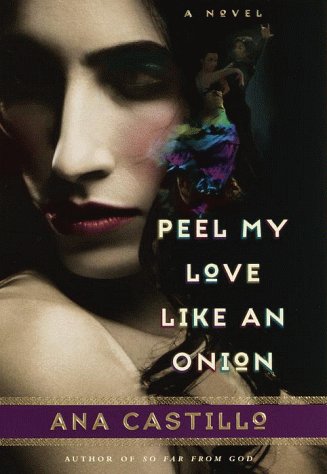
Peel My Love Like an Onion is the breakthrough novel from Ana Castillo, author of the wildly praised So Far from God--a lyrical, steamy, and moving story of a love triangle set in the colorful world of flamenco dancing.
Carmen "La Coja" ("the cripple") Santos is a flamenco dancer of local renown in Chicago, despite the obstacle of a handicapped leg, the legacy of a childhood attack of polio. From the beginning of her professional career, she has carried on an affair with Agustín, the married director of her troupe--a romance that is going stale from overfamiliar lust and an absence of honesty.
But when she begins a passionate liaison with the younger Manolo, Agustín's godson and a dancer of natural genius, an angry rivalry is sparked. Add to that the looming reassertion of her crippling disease and Carmen's vexed relations with her mother, one of the most exasperating parents in recent literature, and you have all the ingredients for a love story à la Ana Castillo--equal parts soap opera, tragicomedy, and rhapsody. Laced with sarcastic asides and dead-on observations, Peel My Love Like an Onion is a universal work imbued with love's power to vex and exalt.
"synopsis" may belong to another edition of this title.
About the Author
Ana Castillo is also the author of the novels The Mixquiahuala Letters and Sapogonia (available in Anchor paperback editions), the story collection Loverboys, the critical study Massacre of the Dreamers, and the poetry collection My Father Was a Toltec. She has won a Carl Sandburg Prize, a Southwestern Booksellers Award, and an American Book Award. She lives in Chicago.
From the Back Cover
"This is the best of Ana Castillo: sassy, satiric and stunningly lyrical. Bravo, Ana!"
--Julia Alvarez
"Ana Castillo's new novel is a celebration of life lived to the hilt. Sung to the clapping of flamenco palmas, it honors freedom and the capacity to survive against all odds. It is a refreshing wedding of spitfire Chicagoan humor to Mexican-American spunk. In a limpid, direct style that blends the poetic and the satiric, this book will make you laugh and cry at the same time."
--Rosario Ferré
Praise for Ana Castillo and So Far from God:
"Goddamn. This Ana Castillo has gone and done what I always wanted to do--written a Chicana telenovela--Wacky, wild, y bien funny."
--Sandra Cisneros
"Could be the offspring of a union between One Hundred Years of Solitude and 'General Hospital'--a magical melodramatic love child who won't sit down or--the reader can only hope--will never shut up--impossible to resist."
--Barbara Kingsolver, Los Angeles Times Book Review
"Ana Castillo is immensely insightful in every sense of the word. Her work, anything and everything written by her--must be read if one is to gain understanding of the vast landscape of soul and life lived with vitality."
--Clarissa Pinkola Estés, author of Women Who Run with the Wolves
"History may one day proclaim So Far from God the breakthrough novel about Chicano life that Ana Castillo--was born to write--.Compulsively readable, lilting and profound--.A teaching story that delights as much as it instructs, bringing us memorable characters whose lives stay with us long after the book's end."
--San Francisco Chronicle
From the Inside Flap
y Love Like an Onion is the breakthrough novel from Ana Castillo, author of the wildly praised So Far from God--a lyrical, steamy, and moving story of a love triangle set in the colorful world of flamenco dancing.
Carmen "La Coja" ("the cripple") Santos is a flamenco dancer of local renown in Chicago, despite the obstacle of a handicapped leg, the legacy of a childhood attack of polio. From the beginning of her professional career, she has carried on an affair with Agustín, the married director of her troupe--a romance that is going stale from overfamiliar lust and an absence of honesty.
But when she begins a passionate liaison with the younger Manolo, Agustín's godson and a dancer of natural genius, an angry rivalry is sparked. Add to that the looming reassertion of her crippling disease and Carmen's vexed relations with her mother, one of the most exasperating parents in recent literature, and you have all the ingredients fo
Reviews
Confirming her reputation as a talented writer, Castillo's (So Far from God) sardonic and seductive novel flowers at the exotic intersection of Chicago's flamenco, Gypsy and Chicano communities, where Carmen Santos, a defiant ex-flamenco dancer, struggles with the end of her career and the dissolution of a passionate love triangle. Left with a crippled leg after a childhood bout of polio, Carmen has always been defined by those around herAher parents, the school for the disabled she attended, her lovers and her public, who know her as "La Coja" (the cripple). It is only when she is dancing that she is sure of her identity, and as polio belatedly reasserts itself in her 40-year-old body, she feels she is losing the core of her existence. Then, like her legs, her two Gypsy loversAAgust!n, the married leader of her troupe, and Manolo, a fiery young dancer and Agust!n's godsonAabandon her. After 17 years as a dancer and a sensual being, Carmen is reduced to working in a sweatshop, at an airport pizza joint and as a corn-on-the-cob peddler. Most difficult of all, she is forced to move back into the family home, where her crotchety mother erodes her spirit. Dependent, stubborn, naive and heartbreakingly vulnerable, Carmen is a realistically flawed and lively survivor. In the person of her indomitable protagonist, Castillo's trademark feminist and border-crossing concerns acquire a new depth and complexity. Her writing has matured, and she keeps her own voice unobtrusive, stitching a seamless narrative. The pace here does not match the breakneck velocity of her previous works, nor does the novel strain for elaborate effects or call upon magic realism, yet its verve is unflinching. As careful an achievement as the patient peeling of an onion, this compulsively readable narrative should delight, and expand, Castillo's audience. Agent, Susan Bergholz. Author tour. (Sept.) FYI: Castillo's first and second novels, The Mixquiahuala Letters and Sapogonia, will be reissued in trade paperback by Anchor.
Copyright 1999 Reed Business Information, Inc.
Castillo (Loverboys, 1996, etc.) covers familiar territory herethe trials and tribulations of passion, displacement, and cultural identitybut offers a pleasing combination of the light and cheeky with the lyrically romantic. Forty-year-old Carmen La Coja (the cripple) finds herself at the crossroads of life, though both paths seem to lead into the abyss. Once locally renowned as a flamenco dancer (despite her one polio-afflicted leg), Carmen now finds herself doing piece work in a Chicago sweatshop and trying to cope with both the devastating reemergence of her polio and the abandonment of her two lovers. Splicing the dismal present with her glorious past, Carmen tells of her 17-year relationship with Agustn, her dance troupe's dictatorial leader and her passionate one-year affair with his godson Manolo. The complicated triangle is alternately concerned with the heartstrings of love and the rigid customs of culture; both Agustn and Manolo are Romany and follow a strict code of conventions, including a ban on marriage outside of the tribe. Though Latina, Carmen is accepted as a fellow gypsy, which serves to further splinter her identity-doting daughter to a mother whose disappointment is all too palatable, disabled dancer, muse to one man and siren to another. When Carmen issues an ultimatum to Manolohell be loyal to Agustn or to her?the two men disappear, leaving Carmen for five long years yearning for the erotic memory of Manolo and the comfort of Agustn. Then both suddenly reappear in her life, with the same old demands and dilemmas. How she resolves her not-so-unpleasant quandary is a testament to her newly discovered sense of self as a singer and the old resilience that brought dance to an immovable leg. Observant and witty, if not altogether exceptional: Castillo creates a poignant portrait of passion lost and regained. -- Copyright ©1999, Kirkus Associates, LP. All rights reserved.
Carmen "La Coja" ("The Cripple") is a flamenco dancer despite her bad leg (she had polio as a child). This is not, however, a sentimental story about her triumph over tragedy, though in an inspired early passage we do see her struggle to learn to dance. The tale spun by Castillo (So Far from God) instead focuses on an older Carmen, past her prime and piecing herself together after a tangle of romances has unraveled. Peel her love like an onion, and you get layer after layer of confusion and betrayal: just as her long affair with August!n, the double-dealing manager of her troupe, begins to stall, she falls passionately in love with August!n's "godson," the talented and charismatic Manolo. Yes, Manolo loves her ("I will never be alone as long as I love you'), but that doesn't stop him from heading off to Spain with August!n. Carmen feels pretty wind-whipped by his desertion but keeps standingAthroughout, this tough little dancer never really hits the groundAand in the end she finds her voice, literally: she can't dance any more (except for herself), but she has a new recording contract. Lyrical and sharply told, though this tale has been heard before: of course Carmen will triumph, and what makes Manolo so special, anyway? For most fiction collections.ABarbara Hoffert, "Library Journal"
Copyright 1999 Reed Business Information, Inc.
Castillo, a poet as well as a fiction writer, presents a decidedly contemporary yet undeniably mythic heroine in her new novel, the first since the acclaimed So Far from God (1993). Carmen "La Coja" (the cripple) Santos, a self-described "Chicago Mexican," suffered a bout with polio that severely damaged her left leg. An inspired teacher insists that she learn to dance, and, possessed of great duende, or soul, Carmen embraces this impossible dream and becomes a celebrated flamenco dancer. But the journey from gimp to artiste is as difficult emotionally as it is physically, and Castillo has Carmen tell the story of her arduous quest in an astringently frank narrative that is punctuated with sharp social commentary and unsparing musings on the vagaries of love. Nothing is easy. Carmen's obstinate and unaffectionate mother gives her as much trouble as her shriveled leg, and her love affairs with the gypsy director of the dance troupe and his sexy godson are complex and volatile. Strong-willed, passionate, and independent, Carmen conceals her game leg and her vulnerability with long colorful skirts, wisecracking matter-of-factness, and pride. Castillo has almost created an icon, but Carmen's spirit imbues her with full-blooded humanity. Donna Seaman
Excerpt. © Reprinted by permission. All rights reserved.
Uno: I remember him dark.
I remember him dark. Or sometimes I remember it darkly. Yes, he was dark. He still is except that it is not easy to think of him as still existing, and everywhere my gaze turns he isn't there. What's the expression? Water, water everywhere . . . I was full--a vessel, a huge pre-Columbian pot, a copal-burning brassier, a funeral urn, a well, Jill's bucket up and down, a bruja's kettle simmering over the fire.
I was in love once. When you are in love no single metaphor is enough. No metaphor appears just a tad cliched. You are dizzy with desire. Yes, dizzy, virtual vertigo. Someone catch me, I'm falling in love. Nothing too serious, no ambulance will be necessary. Just a few days of bed rest is needed, I'm sure. With him.
Your very saliva tastes sweet in your own mouth, as a friend once stated, matter-of-fact-like. The science of being in love. She looked around the table, a group of middle-aged women having an evening out. We had all been in love at some time, hadn't we? Surely we knew about saliva and its emotionally triggered alchemy. You know what I mean? When you're in love even tap water tastes sweet. Your own saliva is sweet! she insisted in her Argentine accent. We looked around too, smiling a bit uncomfortably. We looked down at our fancy coffee and desserts. We were thankful when our waiter broke the silence and poured more coffee, dropped those little plastic containers of cream on the table. You know what I mean? Don't you? she asked again.
Maybe that's love in Buenos Aires.
But you must be really in love for the cliche to bounce back like a boomerang smack dab between the eyes with the ring of the gospel truth to your born-again ears.
Nevertheless it happens. Love that is riddled with cliches but has never happened to either of you quite that way before, therefore it cannot be a cliche for you. Love that happens abruptly, without warning like a summer shower. (You see what I mean about metaphors?) And yes, it is light and warm and sudden. The rainbow appears afterward on your power walk at the end of a long, stressed-out day, and the city is gray all over and your mother is in the hospital and your best friend's brother is fighting AIDS and you remember the night you slept with him when you were not in love and neither was he, a long time ago.
You put on your new cross-trainers assembled in a foreign land by women and children at slave wages so you try not to think of what you paid for them, and begin to walk the streets of your city at sunset. You say your city the way some Americans say this is their country. You never feel right saying that--my country. For some reason looking Mexican means you can't be American. And my cousins tell me, the ones who've gone to Mexico but who were born on this side like me, that over there they're definitely not Mexican. Because you were born on this side pocha is what you're called there, by your unkind relatives and strangers on the street and even waiters in restaurants when they overhear your whispered English and wince at your bad Spanish. Still, you try at least. You try like no one else on earth tries to be in two places at once. Being pocha means you try here and there, this way and that, and still you don't fit. Not here and not there.
But you can say this is my city because Chicago is big and small enough to be your city, to be anybody's city who wants it, anybody at all. Like Nelson Algren said right around the time you were born--Chicago . . . forever keeps two faces . . . One face for Go-Getters and one for Go-Get-It-Yourselfers. One for the good boy and one for the bad.
And I loved the good boy and the bad one and sometimes they were one and the same.
Once while I was in the ticket line at the airport in Frankfurt I watched a family for an hour or so that looked like it could have been his but I knew it wasn't. I never saw the man's face, just the heavy mat of Mediterranean hair, his wife, short, a little round around the middle, and their two babies. I tried to see his face to make sure it wasn't him. Not that it could have been him. He didn't have two babies. Does he now?
I was in Germany doing my last gig. Nothing sadder than a washed-up dancer. I was beyond sad. One day you turn thirty-six years old. The sum of your education is a high school diploma. No other skills but to dance as a gimp flamenco dancer, and your polio-inflicted condition is suddenly worsening. Nowhere to go but down, like Bizet must have felt at that age when the debut of his opera flopped and he went home and died of a broken heart.
My mother kept insisting I start cashiering again at someplace like El Burrito Grande. El Burrito Grande had closed down years ago and been replaced by a McDonald's. If she had once gotten up every morning at four-thirty to catch the bus to her job at the factory, my mother said, she couldn't see why I thought I was too good for everyday work. We needed the dryer repaired. She wanted a car. If we got a car, she said she would learn to drive. If I could make my living as a dancer, she could become a bus driver, she said.
But I had spent all my adult life living for the night. I didn't want anything to do with the day. And if this robbery of not only my livelihood but my very sense of being wasn't criminal enough, I had been left like a virgin bride at the altar. Left in a cowardly way, without notice. Left one Sunday without a Mass. My milkless breasts and my love that I had offered and given of so freely discarded like compost to be buried.
Still, I woke and went to bed with Manolo on my mind, except that when I thought of him since he left, his new name was Turd. As I had a bowl of cereal I cursed Turd. I cursed him when I had my afternoon espresso and cognac. Too many years of strong coffee and liquor with Manolio, Agustin, our friends, and bohemian lifestyle as my mother always called it, made some habits hard to break. One of them was loving passionately and another was being loved like the most beautiful woman in the world.
A friend suggested that I see a doctor, as if a doctor could give me a new leg, another spine, make me fifteen years younger. The doctor sent me to a therapist who then advised me to take a ceramics course at City College to channel all that creative fire burning inside me. Six months later I moved to the desert with my savings accumulated from tips, from gigs--at night clubs, community centers, convalescent homes and anywhere our ensemble could descend upon for a few bucks over half of my life--and I lived completely alone for two long years. I tried my hand as a potter and put on the veil. That's what the Spanish Catholic artistas I met there call it when they retreat to do their work. They take a vow of solitude if not silence and become novices. There's a lot of time for reflection while sweeping the tumbleweed and dust off the patio.
When Manolio went away and I stopped dancing I wanted to return to the earth, bathe in it, live inside the planet. But what did I know of the desert or clay? What did I know of the music of silences? I only knew dance, the sound of my heels on the hard wooden platform.
When the second winter of howling winds and sleeping alone was over I returned to the city of my birth. I wasn't cut out for living alone in the desert and came back to my natural urban habitat. I wasn't a potter either, just a dancer who couldn't dance anymore.
"About this title" may belong to another edition of this title.
Other Popular Editions of the Same Title

Search results for Peel My Love Like an Onion

Stock Image
Peel My Love Like an Onion
Seller: World of Books (was SecondSale), Montgomery, IL, U.S.A.
Seller rating 5 out of 5 stars

Condition: Good. Item in good condition. Textbooks may not include supplemental items i.e. CDs, access codes etc. Seller Inventory # 00096003651
Stock Image
Peel My Love Like an Onion
Seller: Greenworld Books, Arlington, TX, U.S.A.
Seller rating 5 out of 5 stars
Condition: very_good. Fast Free Shipping â" Very Good condition book with a firm cover and clean pages. Shows normal use and some light wear or limited notes markings. A solid, nice copy to enjoy. Seller Inventory # GWV.0385496761.VG
Stock Image
Peel My Love Like an Onion
Seller: ThriftBooks-Atlanta, AUSTELL, GA, U.S.A.
Seller rating 5 out of 5 stars
Hardcover. Condition: Very Good. No Jacket. May have limited writing in cover pages. Pages are unmarked. ~ ThriftBooks: Read More, Spend Less. Seller Inventory # G0385496761I4N00
Stock Image
Peel My Love Like an Onion
Seller: ThriftBooks-Dallas, Dallas, TX, U.S.A.
Seller rating 5 out of 5 stars
Hardcover. Condition: Very Good. No Jacket. May have limited writing in cover pages. Pages are unmarked. ~ ThriftBooks: Read More, Spend Less. Seller Inventory # G0385496761I4N00
Stock Image
Peel My Love Like an Onion
Published by
Doubleday Religious Publishing Group, The, 1999
ISBN 10: 0385496761
ISBN 13: 9780385496766
Used
Hardcover
First Edition
Seller: Better World Books, Mishawaka, IN, U.S.A.
Seller rating 5 out of 5 stars
Condition: Very Good. 1st ed. Pages intact with possible writing/highlighting. Binding strong with minor wear. Dust jackets/supplements may not be included. Stock photo provided. Product includes identifying sticker. Better World Books: Buy Books. Do Good. Seller Inventory # 18064262-75
Stock Image
Peel My Love Like an Onion
Published by
Doubleday Religious Publishing Group, The, 1999
ISBN 10: 0385496761
ISBN 13: 9780385496766
Used
Hardcover
First Edition
Seller: Better World Books, Mishawaka, IN, U.S.A.
Seller rating 5 out of 5 stars
Condition: Good. 1st ed. Former library copy. Pages intact with minimal writing/highlighting. The binding may be loose and creased. Dust jackets/supplements are not included. Includes library markings. Stock photo provided. Product includes identifying sticker. Better World Books: Buy Books. Do Good. Seller Inventory # 18546457-6
Stock Image
Peel My Love Like an Onion
Seller: HPB-Diamond, Dallas, TX, U.S.A.
Seller rating 5 out of 5 stars
hardcover. Condition: Very Good. Connecting readers with great books since 1972! Used books may not include companion materials, and may have some shelf wear or limited writing. We ship orders daily and Customer Service is our top priority! Seller Inventory # S_458706937
Stock Image
Peel My Love Like an Onion
Published by
Doubleday, New York, New York, U.S.A., 1999
ISBN 10: 0385496761
ISBN 13: 9780385496766
Used
Hardcover
Seller: The Yard Sale Store, Narrowsburg, NY, U.S.A.
Seller rating 5 out of 5 stars
Hardcover. Condition: Good. RELIABLE library withdrawal with a NICE dust jacket in the plastic, protective cover. Stamped at the page edge with a card pocket page on the inside. Light scuff to the plastic cover. This edition is PRESENTABLE! Seller Inventory # HCLibDec8VI70
Stock Image
Peel My Love Like an Onion
Published by
Doubleday, U.S.A., 1999
ISBN 10: 0385496761
ISBN 13: 9780385496766
Used
Hardcover
First Edition
Seller: Anima Books, Fort Washington, MD, U.S.A.
Seller rating 5 out of 5 stars
Hardcover. Condition: Very Good. Dust Jacket Condition: Very Good. 1st Edition. First edition, first printing. Very good in very good DJ. Ex-library with the usual stamps and stickers. Seller Inventory # 000357
Stock Image
Peel My Love Like an Onion
Published by
Doubleday September 1999, 1999
ISBN 10: 0385496761
ISBN 13: 9780385496766
Used
Hardcover
Seller: Books End Bookshop, Syracuse, NY, U.S.A.
Seller rating 4 out of 5 stars

Hardcover. Condition: Very Good. Dust Jacket Condition: Very Good-. Bookclub. Seller Inventory # 25189