
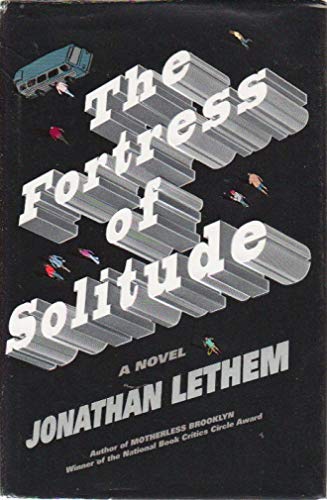
Synopsis
This is the story of two boys, Dylan Ebdus and Mingus Rude. They are friends and neighbors, but because Dylan is white and Mingus is black, their friendship is not simple. This is the story of their Brooklyn neighborhood, which is almost exclusively black despite the first whispers of something that will become known as "gentrification."
This is the story of 1970s America, a time when the most simple human decisions—what music you listen to, whether to speak to the kid in the seat next to you, whether to give up your lunch money—are laden with potential political, social and racial disaster. This is the story of 1990s America, when no one cared anymore.
This is the story of punk, that easy white rebellion, and crack, that monstrous plague. This is the story of the loneliness of the avant-garde artist and the exuberance of the graffiti artist.
This is the story of what would happen if two teenaged boys obsessed with comic book heroes actually had superpowers: They would screw up their lives.
This is the story of joyous afternoons of stickball and dreaded years of schoolyard extortion. This is the story of belonging to a society that doesn't accept you. This is the story of prison and of college, of Brooklyn and Berkeley, of soul and rap, of murder and redemption.
This is the story Jonathan Lethem was born to tell. This is THE FORTRESS OF SOLITUDE.
"synopsis" may belong to another edition of this title.
About the Author
JONATHAN LETHEM is the author of five novels, including Gun, With Occasion Music, and Girl in Landscape. His most recent, Motherless Brooklyn, was named Novel of the Year by Esquire and won The National Book Critics Circle Award and the Salon Book Award. He is also the author of the story collection, The Wall of the Sky, the Wall of the Eye and the novella This Shape We’re In. He edited The Vintage Book of Amnesia, guest-edited The Year’s Best Music Writing 2002, and was the founding fiction editor of Fence Magazine. His writings have appeared in The New Yorker, Rolling Stone, McSweeney’s, and many other periodicals. He lives in Brooklyn, New York.
From the Back Cover
“Lethem has done a number of things here, any one of which is impossible for any but the very finest novelists. He has vividly and lovingly and truthfully, through thrilling evocation of its music, its popular culture, its street games, argot, pharmacology, social mores and racial politics, recreated a world, a moment in history that I would have thought lost and irrecoverable. He has created, in young Dylan, a genuine literary hero. He has reinvented and reinvigorated the myths of the superhero, of black-white relations, of New York City itself. But most of all, from my point of view, he captures precisely–as only a great novelist can–how it feels to love the world that is, on a daily basis, kicking your ass.”
--Michael Chabon, Pulitzer Prize-winning author of The Amazing Adventures of Kavalier and Clay and Wonder Boys
“THE FORTRESS OF SOLITUDE is luminous, stinging with truth and life. A story of two boys, a Brooklyn story, an American story that gives in its very specificity the force of the universal.”
--Paula Fox, author of Desperate Characters and Borrowed Finery
"Wondrous and sweeping, this story evokes perfectly the nuances of friendship and the often odd arrangement called family. The drum of loss beats poignantly beneath the surface, as this tale moves from the streets of Brooklyn to the West Coast and back, presenting us the with baffling and tender gift of acceptance."
--Elizabeth Strout, author of Amy and Isabelle
"The Fortress of Solitude is a grim, brave, soaring American masterpiece."
--Richard Russo
From the Inside Flap
This is the story of two boys, Dylan Ebdus and Mingus Rude. They are friends and neighbors, but because Dylan is white and Mingus is black, their friendship is not simple. This is the story of their Brooklyn neighborhood, which is almost exclusively black despite the first whispers of something that will become known as "gentrification."
This is the story of 1970s America, a time when the most simple human decisions what music you listen to, whether to speak to the kid in the seat next to you, whether to give up your lunch money are laden with potential political, social and racial disaster. This is the story of 1990s America, when no one cared anymore.
This is the story of punk, that easy white rebellion, and crack, that monstrous plague. This is the story of the loneliness of the avant-garde artist and the exuberance of the graffiti artist.
This is the story of what would happen if two teenaged boys obsessed with comic book heroes actually had superpowers: They would screw up their lives.
This is the story of joyous afternoons of stickball and dreaded years of schoolyard extortion. This is the story of belonging to a society that doesn't accept you. This is the story of prison and of college, of Brooklyn and Berkeley, of soul and rap, of murder and redemption.
This is the story Jonathan Lethem was born to tell. This is THE FORTRESS OF SOLITUDE.
Reviews
If there still remains any doubt, this novel confirms Lethem's status as the poet of Brooklyn and of motherless boys. Projected through the prism of race relations, black music and pop art, Lethem's stunning, disturbing and authoritatively observed narrative covers three decades of turbulent events on Dean Street, Brooklyn. When Abraham and Rachel Ebdus arrive there in the early 1970s, they are among the first whites to venture into a mainly black neighborhood that is just beginning to be called Boerum Hill. Abraham is a painter who abandons his craft to construct tiny, virtually indistinguishable movie frames in which nothing happens. Ex-hippie Rachel, a misguided liberal who will soon abandon her family, insists on sending their son, Dylan, to public school, where he stands out like a white flag. Desperately lonely, regularly attacked and abused by the black kids ("yoked," in the parlance), Dylan is saved by his unlikely friendship with his neighbor Mingus Rude, the son of a once-famous black singer, Barnett Rude Jr., who is now into cocaine and rage at the world. The story of Dylan and Mingus, both motherless boys, is one of loyalty and betrayal, and eventually different paths in life. Dylan will become a music journalist, and Mingus, for all his intelligence, kindness, verbal virtuosity and courage, will wind up behind bars. Meanwhile, the plot manages to encompass pop music from punk rock to rap, avant-garde art, graffiti, drug use, gentrification, the New York prison system-and to sing a vibrant, sometimes heartbreaking ballad of Brooklyn throughout. Lethem seems to have devoured the '70s, '80s and '90s-inhaled them whole-and he reproduces them faithfully on the page, in prose as supple as silk and as bright, explosive and illuminating as fireworks. Scary and funny and seriously surreal, the novel hurtles on a trajectory that feels inevitable. By the time Dylan begins to break out of the fortress of solitude that has been his life, readers have shared his pain and understood his dreams.
Copyright 2003 Reed Business Information, Inc.
Dylan Ebdus is a white kid on a black-and-brown street. As he struggles through public school in 1970s Brooklyn, he is "yoked"--put in a headlock--and frisked for change on a daily basis. Testing into a good Manhattan school, he steps into a long-lasting role: vulnerable among street kids, he's street-smart compared to his new, privileged pals, and loathes himself as a poseur with both crowds. When he finds a ring that grants the power of flight, he's afraid to use it, but his black friend, Mingus, is not. They try their hand at crime fighting, but like many teenage endeavors, the project fizzles out. Lethem is a tremendous writer, and in the first half he uses magnificent language to capture the complexity of a child's worldview. When he jump-cuts to Dylan's adulthood, however, his switch to a more conventional narrative style is disappointing. The story regains momentum when Dylan rediscovers the ring and a new power it offers, then returns to his old street and ponders a sacrifice: whether to give the ring to the boy who yoked him the most. Lethem explores many avenues: the origins of gentrification, the development of soul music, the genealogy of graffiti, the seeds of the crack epidemic. The different concepts converge in the closing pages, but this often-excellent novel labors under the weight of its ambition. Keir Graff
Copyright © American Library Association. All rights reserved
Excerpt. © Reprinted by permission. All rights reserved.
FROM CHAPTER 7
...It was entirely possible that one song could destroy your life. Yes, musical doom could fall on a lone human form and crush it like a bug. The song, that song, was sent from somewhere else to find you, to pick the scab of your whole existence. The song was your personal shitty fate, manifest as a throb of pop floating out of radios everywhere.
At the very least the song was the soundtrack to your destruction, the theme. Your days reduced to a montage cut to its cowbell beat, inexorable doubled bass line and raunch vocal, a sort of chanted sneer, surrounded by groans of pleasure. The stutter and blurt of what—a tuba? French horn? Rhythm guitar and trumpet, pitched to mockery. The singer might as well have held a gun to your head. How it could have been allowed to happen, how it could have been allowed on the radio? That song ought to be illegal. It wasn’t racist—you’ll never sort that one out, don’t even start—so much as anti-you.
Yes they were dancing, and singing, and movin’ to the groovin’, and just when it hit me, somebody turned around and shouted—
Every time your sneakers met the street, the end of that summer, somebody was hurling it at your head, that song.
Forget what happens when you start haunting the green-tiled halls of Intermediate School 293.
September 7, 1976, the week Dylan Ebdus began seventh grade in the main building on Court Street and Butler, Wild Cherry’s “Play That Funky Music” was the top song on the rhythm and blues charts. Fourteen days later it topped Billboard’s pop charts. Your misery’s anthem, -number--one song in the nation.
Sing it through gritted teeth: WHITE BOY!
Lay down the boogie and play that funky music ’til you die.
When Dylan Ebdus first spotted Arthur Lomb the other boy was feigning pain in the far corner of the schoolyard. At some distance Dylan heard the cries and turned from the entrance of the school to look. Catching sight of Arthur Lomb was like noticing the flight and fall of a bird across a distance of -leaf--blurred sky, that flicker at the corner of vision, the abrupt plummeting. Like the flying man too, something Dylan did and didn’t wish to have noticed. It occurred at that moment of slippage after the bell had rung and the gym teachers who patrolled the yard had returned inside, ahead of the flood of students, so the yard became a lawless zone, that terrible sudden reframing of space which could happen anywhere, even inside the corridors of the school. Nevertheless it was a clumsy mistake for the boy now cringing on the ground to be caught so far from the yard’s entrance, a mistake Dylan felt he couldn’t forgive. He wouldn’t have forgiven it in himself.
Arthur Lomb fell to his knees and clutched his chest and keened. His words were briefly audible across the depopulating yard.
“I can’t breathe!”
Then, each syllable riding a sharp insuck of air, “I!” Pause. “Can’t!” Pause. “Breathe!”
Arthur Lomb was pretending asthma or some other weakness. It was an identifiable method: preemptive suffering. Nobody could do much with a kid who was already crying. He’d become useless, untillable soil. He had no spirit to crush and it was faintly disgusting, in poor taste. Anyway, this weirdly gasping kid might not know the rules and talk, tattle to some distant cloddish figure of authority what he imagined had been done to him. He might even be truly sick, fucked up, in pain, who knew? Your only option was to say dang, white boy, what’s your problem? I didn’t even touch you. And move on.
Dylan admired the strategy, feeling at once a cool quiver of recognition and a hot bolt of shame. He felt that he was seeing his double, his stand-in. It was at least true that any punishment Arthur Lomb endured was likely otherwise Dylan’s, or anyway that a gang of black kids couldn’t knock Dylan to the pavement or put him in a yoke at the exact moment they were busy doing it to Arthur Lomb.
From that point on Arthur Lomb’s reddish hair and hunched shoulders were easy to spot, though he and Dylan had different homerooms, and schedules which kept them from overlapping anywhere except the schoolyard at lunch hour. Arthur Lomb dressed in conspicuous striped polo shirts and wore soft brown shoes. His pants were often highwaters. Dylan once heard a couple of black girls serenading Arthur Lomb with a couplet he hadn’t himself elicited since fourth grade, snapping their fingers and harmonizing high and low like a doo-wop group: the flood is over, the land is dry, so why do you wear your pants so high?
Arthur Lomb carried an enormous and bright blue backpack, an additional blight. All his schoolbooks must be inside, or maybe a couple of stone tablets. The bag itself would have tugged Arthur Lomb to the ground if he’d stood up straight. As it was the bag glowed as a target, begged to be jerked downward to crumple Arthur Lomb to the corridor floor to enact his shortness-of-breath routine. Dylan had seen it done five times already before he and Arthur Lomb ever spoke. Dylan had even heard kids chanting the song at Arthur Lomb as they slapped at his reddened neck or the top of his head while he squirmed on the floor. Play that fucking music, white boy! Stretching the last two words to a groaning, derisive, Bugs--Bunnyesque whyyyyyyyboy!
There were just three other white kids in the school, all girls, with their own girl factors to work out. One shared Dylan’s homeroom, an Italian girl, black-haired and sullen and tiny, dwarfed by the girls all around them who exploded with hormonal authority. The black and Puerto Rican girls had risen to some other place where they were rightly furious at anything in view, jostling at one another and at the teachers in a rage of sex. However, their very size offered an approach: it was feasible to pass unseen below. Homeroom was a place for honing silence in a theater of noise and so the Italian girl and Dylan never spoke. As for Arthur Lomb, Dylan supposed he and the other boy had been kept apart intentionally by some unseen pitying intelligence, to avoid making both more conspicuous in their resemblance. This was a policy Dylan endorsed heartily, whether it existed outside of his own brain or not. Even at that remove, Arthur Lomb bore the mingled stink of Dylan’s oppression mixed with his own, so that it was hard to tell where one began and the other left off. Dylan wasn’t in any hurry to get closer. Really, he wanted no part of Arthur Lomb.
It was the library where they finally spoke. Dylan and Arthur Lomb’s two homerooms had been deposited there together for a period, the school librarian covering some unexplained absence of teachers for an afternoon, a blip in the routine nobody cared about anyway. Most kids sent to the library never arrived there, ended up outside the building instead, taking the word as a euphemism for class dismissed. So the I.S. 293 library was drab but peaceful, an eddy of calm. Below a poster advertising A Hero Ain’t Nothin’ But a Sandwich, a book the library didn’t actually offer, Dylan placed himself against a wall and flipped open issue number two of the Marvel Comics adaptation of Logan’s Run. As the period ticked away glacially, Arthur Lomb buzzed him twice, squinting to see the title of the comic, then pursing lips in false concentration as he mimed browsing the half--empty shelves nearby, before stepping close enough for Dylan to hear him speak in an angry, clenched whisper.
“That guy George Perez can’t draw Farrah Fawcett to save his life.”
This was a startling allusion to several bodies of knowledge simultaneously. Dylan could only glare, his curiosity mingled with the certainty that he and Arthur Lomb were more objectionable, more unpardonable, together than apart. Up close Arthur Lomb had a blinky agitated quality to his features which made Dylan himself want to knock him down. His face seemed to reach for something, his features like a grasping hand. Dylan wondered if there might be a pair of glasses tucked in the background somewhere, perhaps in a side pocket of the monumental blue backpack.
Dylan hurried the comic book into his binder. He’d bought it on Court Street at luchtime and debated allowing it to be seen inside the school, a breach of general good sense. It was a lousy comic, though, stiff with fidelity to the movie, and Dylan had decided he wouldn’t care anymore than he’d be surprised if it was taken away. This, a conversation with his homely double, wasn’t the price he’d expected to pay. But Arthur Lomb seemed to sense the dent he’d made in Dylan’s attention and pressed on.
He smirked again at the comic book where it had vanished into the binder.
“Seen it?”
“What?”
“Logan’s Run.”
Fuck you looking at? Dylan wanted to shriek at Arthur Lomb, before it was too late, before Dylan succumbed to his loneliness and allowed himself to meet Arthur, the other white boy.
“Not yet,” Dylan said instead.
“Farrah Fawcett is a fox.”
Dylan didn’t answer. He couldn’t know, and was only chagrined that he even knew what Arthur Lomb was talking about.
“Don’t feel bad. I bought ten copies of Logan’s Run #1.” Arthur Lomb spoke in a hurried whisper, showing some awareness of his surroundings, but compelled to spill what he had, to force Dylan know to him. “You have to buy number ones, it’s an investment. I’ve got ten of Eternals, ten of 2001, ten of Omega, ten of Ragman, ten of Kobra. And all those comics stink. You ...
"About this title" may belong to another edition of this title.
Other Popular Editions of the Same Title

Search results for The Fortress of Solitude: A Novel

Stock Image
The Fortress of Solitude: A Novel
Seller: Gulf Coast Books, Cypress, TX, U.S.A.
Seller rating 5 out of 5 stars

Hardcover. Condition: Good. Seller Inventory # 0385500696-3-20990281
Stock Image
The Fortress of Solitude: A Novel
Seller: World of Books (was SecondSale), Montgomery, IL, U.S.A.
Seller rating 5 out of 5 stars
Condition: Acceptable. Item in acceptable condition! Textbooks may not include supplemental items i.e. CDs, access codes etc. Seller Inventory # 00093790242
Stock Image
The Fortress of Solitude: A Novel
Seller: World of Books (was SecondSale), Montgomery, IL, U.S.A.
Seller rating 5 out of 5 stars
Condition: Good. Item in good condition. Textbooks may not include supplemental items i.e. CDs, access codes etc. Seller Inventory # 00087147107
Seller Image
The Fortress of Solitude: A Novel
Seller: Greenworld Books, Arlington, TX, U.S.A.
Seller rating 5 out of 5 stars
Condition: very_good. Fast Free Shipping â" Very Good condition book with a firm cover and clean pages. Shows normal use and some light wear or limited notes markings. A solid, nice copy to enjoy. Seller Inventory # GWV.0385500696.VG
Stock Image
The Fortress of Solitude: A Novel
Seller: BooksRun, Philadelphia, PA, U.S.A.
Seller rating 5 out of 5 stars
Hardcover. Condition: Fair. With dust jacket. The item might be beaten up but readable. May contain markings or highlighting, as well as stains, bent corners, or any other major defect, but the text is not obscured in any way. Seller Inventory # 0385500696-7-1-29
Seller Image
The Fortress of Solitude: A Novel
Seller: Zoom Books East, Glendale Heights, IL, U.S.A.
Seller rating 5 out of 5 stars
Condition: good. Book is in good condition and may include underlining highlighting and minimal wear. The book can also include "From the library of" labels. May not contain miscellaneous items toys, dvds, etc. . We offer 100% money back guarantee and 24 7 customer service. Seller Inventory # ZEV.0385500696.G
Stock Image
The Fortress of Solitude: A Novel
Seller: Once Upon A Time Books, Siloam Springs, AR, U.S.A.
Seller rating 4 out of 5 stars

hardcover. Condition: Acceptable. This is a used book. It may contain highlighting/underlining and/or the book may show heavier signs of wear . It may also be ex-library or without dustjacket. This is a used book. It may contain highlighting/underlining and/or the book may show heavier signs of wear . It may also be ex-library or without dustjacket. Seller Inventory # mon0003457319
Stock Image
The Fortress of Solitude: A Novel
Seller: ThriftBooks-Dallas, Dallas, TX, U.S.A.
Seller rating 5 out of 5 stars
Hardcover. Condition: Very Good. No Jacket. Former library book; May have limited writing in cover pages. Pages are unmarked. ~ ThriftBooks: Read More, Spend Less. Seller Inventory # G0385500696I4N10
Stock Image
The Fortress of Solitude: A Novel
Seller: ThriftBooks-Atlanta, AUSTELL, GA, U.S.A.
Seller rating 5 out of 5 stars
Hardcover. Condition: Very Good. No Jacket. Missing dust jacket; May have limited writing in cover pages. Pages are unmarked. ~ ThriftBooks: Read More, Spend Less. Seller Inventory # G0385500696I4N01
Stock Image
The Fortress of Solitude: A Novel
Seller: Half Price Books Inc., Dallas, TX, U.S.A.
Seller rating 5 out of 5 stars
hardcover. Condition: Very Good. Connecting readers with great books since 1972! Used books may not include companion materials, and may have some shelf wear or limited writing. We ship orders daily and Customer Service is our top priority! Seller Inventory # S_457872622