
Items related to Moral Disorder: and Other Stories
Synopsis
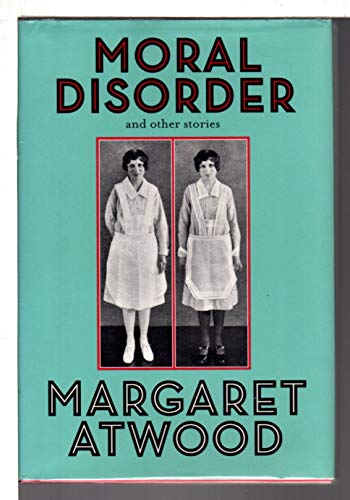
Margaret Atwood is acknowledged as one of the foremost writers of our time. In Moral Disorder, she has created a series of interconnected stories that trace the course of a life and also the lives intertwined with it—those of parents, of siblings, of children, of friends, of enemies, of teachers, and even of animals. As in a photograph album, time is measured in sharp, clearly observed moments. The ’30s, the ’40s, the ’50s, the ’60s, the ’70s, the ’80s, the ’90s, and the present —all are here. The settings vary: large cities, suburbs, farms, northern forests.
“The Bad News” is set in the present, as a couple no longer young situate themselves in a larger world no longer safe. The narrative then switches time as the central character moves through childhood and adolescence in “The Art of Cooking and Serving,” “The Headless Horseman,” and “My Last Duchess.” We follow her into young adulthood in “The Other Place” and then through a complex relationship, traced in four of the stories: “Monopoly,” “Moral Disorder,” “White Horse,” and “The Entities.” The last two stories, "The Labrador Fiasco" and "The Boys at the Lab," deal with the heartbreaking old age of parents but circle back again to childhood, to complete the cycle.
By turns funny, lyrical, incisive, tragic, earthy, shocking, and deeply personal, Moral Disorder displays Atwood’s celebrated storytelling gifts and unmistakable style to their best advantage. As the New York Times has said: "The reader has the sense that Atwood has complete access to her people's emotional histories, complete understanding of their hearts and imaginations.”
"synopsis" may belong to another edition of this title.
About the Author
MARGARET ATWOOD’s books have been published in over thirty-five countries. She is the author of more than forty books of fiction, poetry, and critical essays. In addition to The Handmaid's Tale, her novels include Cat's Eye—shortlisted for the Booker Prize; Alias Grace, which won the Giller Prize in Canada and the Premio Mondello in Italy; The Blind Assassin, winner of the 2000 Booker Prize; and her most recent, Oryx and Crake—shortlisted for the Man Booker Prize 2003. She lives in Toronto with writer Graeme Gibson.
Reviews
A young writer, like a young woman, has a narrow strip of experience from which to contemplate an unknown future, empty and waiting for its form. An older writer, reminded of mortality by aging knees and dying parents, has the consolation of seeing everything in rich detail, meaningful and apparently pointless together. Moral Disorder is about a whole life, the life of Nell, married to Tig, or Gilbert. It is told in segments, stories concentrating on particular gritty or glittering episodes or problems. It covers every decade from the 1930s to the present. Margaret Atwood balances the apparently random -- disorderly -- events and memories against the sense we all have that a life as a whole has its own shape, possibly a destiny.
Moral Disorder is a perfect title -- apparently one from a novel abandoned by Atwood's husband, which fits. And the work, with its isolated tales, some in the first person, some in the third, is a perfect shape for contemplating life and death. It is like our memories: There are things that persist in refusing to be forgotten, are as clear as the day they happened, whereas all sorts of more apparently significant things vanish into dust or persist only in old newspapers and fashion magazines. A life, unlike a biography, does not unfold in a neat progression. Nor is it entirely incoherent. Each of these stories coheres round a defined patch of Nell's life, and each has its own cluster of brilliantly described and unforgettable things, which are as important as the people.
In "The Art of Cooking and Serving," the 11-year-old Nell is knitting a layette for an unborn sister -- the garments' slight lopsidedness and lumpiness unforgettable -- and reading a book of household advice that gives her a vision of a perfect life ahead, with table centerpieces and housemaids in daytime dress or dressed with black stockings and organdy collar and cuffs for afternoon tea and dinner. In "The Other Place," the young graduate is living in a bedsit with a gilt mirror and a horrible green satin bedspread. In "Monopoly" and in "Moral Disorder" itself, Nell is living with a married man (knitting again) in a ramshackle farm and attached, as one is at that age, to the Earth, which is madly overloaded with too much flesh, feathers, fur, vegetables, pots, pans and rapidly changing seasons. Only Atwood could have written the fat white horse called Gladys and the intransigent lamb (and the abattoir where he ends) with such grim and delicious comedy. Atwood remarks dryly that at that stage, Nell "still thought life on a farm represented some superior form of authenticity."
Houses, too, mark the shape of a life, not least as containers for the memorable things. Tig's ex-wife, Oona -- a 1970s cookery and good-life guru in a caftan, author of Femagician's Box of Tricks -- falls on bad times and needs a manageable house, which Nell, her supplanter, provides. It is discovered by Lillie, a concentration camp survivor turned real estate agent, incurably imaginative about what can be done to hideous or uncomfortable houses. In this house, Oona dies in the kitchen, her son bleeds on the floor breaking in to help her, and Nell calls in a "feng shui friend, who found her an expert in crystals and purification." The "crystal person, whose name was Susan" discovers a "channel where the entities come and go" that has to be purified. The house is sold to two gay men, who mistake the entities for "aunties" and find it all funny. Nell thinks about the "entities," which can be seen as shorthand for the things and memories from which Atwood has movingly and artfully constructed her book.
"All that anxiety and anger, those dubious good intentions, those tangled lives, that blood," she writes. "I can tell about it or I can bury it. In the end, we'll all become stories. Or else we'll become entities. Maybe it's the same."
I understood only slowly how integral to the whole book was the contrast between blood, pain, sickness and death and those visions of a planned future purveyed by household advice, television images, children's stories. The child Nell had a book in which the ideal home with the ideal mother had white frilly curtains that haunt her as something that must be in the future until they are tried and found impractical. Nell, in a lopsided, ungainly and morally disordered way, does attach herself to the human community of men, women, children and work. But she has a recurrent dream, all her life, of the "other place," a place still haunted by the gilt mirror and the "green satin bedspread, which has taken on a life of its own and is able to morph into cushions, or sofas, or armchairs, or even -- once -- a hammock." In this dream, like the hero of Henry James's chilling "The Beast in the Jungle," whose doom is to be the only human to whom nothing happens, she understands: "I'll have to be all by myself, forever. I've missed the life that was supposed to be mine." And she is aware, in a room she hasn't yet entered, of an imprisoned child.
"We are such stuff/ As dreams are made on," says Prospero, "And our little life/ Is rounded with a sleep." Moral Disorder is cunningly constructed of the vagaries of memory and is rounded by Alzheimer's and forgetting. Nell, Tig and Nell's sister test themselves for failing memory as they ruefully allow for failing knees. There is a moving, evocative story of Nell's father, after a stroke, inhabiting a story Nell reads to him, of three explorers disastrously astray in Labrador. There is a plain and very sad tale of Nell's mother, reduced to immobility, her memories slipping away, though living on, briefly, in a different form, in Nell's own memories. The mother dreams a repeating dream of being lost, and no one, no thing, being there, only the empty sky and a logjam she tries to climb. This tale, like all these tales, is both grim and delightful, because it is triumphantly understood and excellently written.
Reviewed by A.S. Byatt
Copyright 2006, The Washington Post. All Rights Reserved.
Margaret Atwood has expressed her social vision, played with narrative form, and written about enigmatic women, sexism, and family in more than 40 books, including the acclaimed The Handmaid's Tale, Cat's Eye, and The Blind Assassin. Her newest collection contains the same dazzling intellect, writing, and suspense as her previous fiction, but critics call this semiautobiographical effort more compassionate, rich, and emotionally resonant. The stories embedded in this novel of sorts, far from being randomly ordered, speak to each other and Nell's personal growth as she becomes caretaker to her sister, husband, and parents. The only problem? "The stories are so compelling," admits the Rocky Mountain News, "that they leave us wishing for a fuller, more novelistic treatment."
Copyright © 2004 Phillips & Nelson Media, Inc.
An intriguing patchwork of poignant episodes, Atwood's latest set of stories (after The Tent) chronicles 60 years of a Canadian family, from postwar Toronto to a farm in the present. The opening piece of this novel-in-stories is set in the present and introduces Tig and Nell, married, elderly and facing an uncertain future in a world that has become foreign and hostile. From there, the book casts back to an 11-year-old Nell excitedly knitting garments for her as yet unborn sister, Lizzie, and continues to trace her adolescence and young adulthood; Nell rebels against the stern conventions of her mother's Toronto household, only to rush back home at 28 to help her family deal with Lizzie's schizophrenia. After carving out a "medium-sized niche" as a freelance book editor, Nell meets Oona, a writer, who is bored with her marriage to Tig. Oona has been searching for someone to fill "the position of second wife," and she introduces Nell to Tig. Later in life, Nell takes care of her once vital but now ravaged-by-age parents. Though the episodic approach has its disjointed moments, Atwood provides a memorable mosaic of domestic pain and the surface tension of a troubled family. (Sept. 19)
Copyright © Reed Business Information, a division of Reed Elsevier Inc. All rights reserved.
Atwood's brilliant and bracing novels appear apace, yet it's been 15 years since her last short story collection, Wilderness Tips. Atwood now returns to the form in a book of interconnected tales that span the life of a skeptical, stoic, book-loving woman named Nell. Swooping back and forth in time and mordantly assessing everything from fashion to the counterculture to real estate, Atwood touches down to illuminate Nell at age 11, knitting furiously while awaiting the arrival of an unexpected sibling. Lizzie turns out to be an exceedingly anxious child, and their exhausted mother leans too heavily on Nell for help. At once fascinated and repelled by the domestic arts, Nell strives to remain unencumbered during her sojourns as an "itinerate brain" at various universities, fending off married academics until she finally falls for one. Tig's dreadfully imperial wife, mother of his two sons, plagues them even after they flee to a farm, where Tig and Nell live in a fever of hard work and earthy sensuousness. Atwood's meticulous stories exert a powerful centrifugal force, pulling the reader into a whirl of droll cultural analysis and provocative emotional truths. Gimlet-eyed, gingery, and impishly funny, Atwood dissects the inexorable demands of family, the persistence of sexism, the siege of old age, and the complex temperaments of other species (the story about the gift horse is to die for). Shaped by a Darwinian perspective, political astuteness, autobiographical elements, and a profound trust in literature, Atwood's stories evoke humankind's disastrous hubris and phenomenal spirit with empathy and bemusement. Donna Seaman
Copyright © American Library Association. All rights reserved
Excerpt. © Reprinted by permission. All rights reserved.
THE HEADLESS HORSEMANFor Halloween that year — the year my sister was two — I dressed up as the Headless Horseman. Before, I’d only ever been ghosts and fat ladies, both of which were easy: all you needed was a sheet and a lot of talcum powder, or a dress and a hat and some padding. But this year would be the last one I’d ever be able to disguise myself, or so I believed. I was getting too old for it — I was almost finished with being thirteen — and so I felt the urge to make a special effort. Halloween was my best holiday. Why did I like it so much? Perhaps because I could take time off from being myself, or from the impersonation of myself I was finding it increasingly expedient, but also increasingly burdensome, to perform in public. I got the Headless Horseman idea from a story we’d read in school. In the story, the Headless Horseman was a grisly legend and also a joke, and that was the effect I was aiming for. I thought everyone would be familiar with this figure: if I’d studied a thing in school I assumed it was general knowledge. I hadn’t yet discovered that I lived in a sort of transparent balloon, drifting over the world without making much contact with it, and that the people I knew appeared to me at a different angle from the one at which they appeared to themselves; and that the reverse was also true. I was smaller to others, up there in my balloon, than I was to myself. I was also blurrier. I had an image of how the Headless Horseman was supposed to look. He was said to ride around at night with nothing on top of his shoulders but a neck, his head held in one arm, the eyes fixing the horrified viewer in a ghastly glare. I made the head out of papier mâché, using strips of newspaper soaked in a flour-and-water paste I cooked myself, as per the instructions in The Rainy Day Book of Hobbies. Earlier in my life — long ago, at least two years ago — I’d had a wistful desire to make all the things suggested in this book: animals twisted out of pipe cleaners, balsa-wood boats that would whiz around when you dropped cooking oil into a hole in the middle, and a tractor thing put together out of an empty thread spool, two matchsticks, and a rubber band; but somehow I could never find the right materials in our house. Cooking up paste glue was simple, however: all you needed was flour and water. Then you simmered and stirred until the paste was translucent. The lumps didn’t matter, you could squeeze them out later. The glue got quite hard when it was dry, and I realized the next morning that I should have filled the pot with water after using it. My mother always said, “A good cook does her own dishes.” But then, I reflected, glue was not real cooking. The head came out too square. I squashed it at the top to make it more like a head, then left it down by the furnace to dry. The drying took longer than I’d planned, and during the process the nose shrank and the head began to smell funny. I could see that I should have spent more time on the chin, but it was too late to add on to it. When the head was dry enough, at least on the outside, I painted it what I hoped was a flesh colour — a wishy-washy bathrobe pink — and then I painted two very white eyeballs with black pupils. The eyes came out a little crossed, but it couldn’t be helped: I didn’t want to make the eyeballs grey by fooling around with the black pupils on the damp white paint. I added dark circles under the eyes, and black eyebrows, and black enamel hair that appeared to have been slicked down with brilliantine. I painted a red mouth, with a trickle of shiny enamel blood coming down from one corner. I’d taken care to put a neck stub on the bottom of the head, and I painted this red — for where the head had been severed — with a white circle in the middle of the bottom part, for the neck bone. The body of the Horseman took some thought. I made a cape out of a piece of black fabric left over from a now-obsolete puppet stage of mine, gathering it at the neck end — designed to sit on top of my head — and sewing buttons down the front, and cutting two inconspicuous holes at eye level so I’d be able to see out. I borrowed my mother’s jodhpurs and riding boots, left over from before she was married — she hadn’t ridden a horse since her wedding day, she was in the habit of saying, proudly or regretfully. Probably it was both. But I didn’t pay much attention to my mother’s tone of voice, then: I had to tune it out in order to charge full speed ahead with what I myself was doing. The riding boots were too big, but I made up for that with hockey socks. I safety-pinned the jodhpurs around the waist to keep them from falling down. I got hold of some black winter gloves, and improvised a horse whip out of a stick and a piece of leather I’d scrounged from the box of archery materials. Archery had once been popular with my father, and then with my brother; but my father had given it up, and the box had been abandoned in the trunk room in the cellar, now that my brother had to study so much. I tried on the entire outfit in front of my mirror, with the head held in the crook of my arm. I could scarcely see myself through the eyeholes, but the dark shape looming in the glass, with two sinister eyeballs staring out balefully from somewhere near the elbow, looked pretty good to me. On the night itself I groped my way out the door and joined my best friend of the moment, whose name was Annie. Annie had done herself up as Raggedy Ann, complete with a wig of red wool braids. We’d taken flashlights, but Annie had to hold my arm to guide me through the darker patches of the night, which were numerous in the badly lit suburb we were traversing. I should have made the eyeholes bigger. We went from door to door, shouting, “Shell out! Shell out!” and collecting popcorn balls and candy apples and licorice twists, and the Halloween toffees wrapped in orange and black waxed paper with designs of pumpkins and bats on them of which I was especially fond. I loved the sensation of prowling abroad in the darkness — of being unseen, unknown, potentially terrifying, though all the time retaining, underneath, my own harmless, mundane, and dutiful self. There was a full moon, I think; there ought to have been one.The air was crisp; there were fallen leaves; jack-o-lanterns burned on the porches, giving off the exciting odour of singed pumpkin. Everything was as I’d imagined it beforehand, though already I felt it slipping away from me. I was too old, that was the problem. Halloween was for little children. I’d grown beyond it, I was looking down on it from my balloon. Now that I’d arrived at the moment I’d planned for, I couldn’t remember why I’d gone to all that trouble. I was disappointed, too, at the response of the adults who answered the doors. Everyone knew who my friend Annie was portraying — “Raggedy Annie!” they cried with delight, they even got the pun — but to me they said, “And who are you supposed to be?” My cape had a muffling effect, so I often had to repeat the answer twice. “The Headless Horseman.” “The headless what?” Then, “What’s that you’re holding?” they would go on to say. “It’s the head. Of the Headless Horseman.” “Oh yes, I see.” The head would then be admired, though in the overdone way adults had of admiring a thing when they secretly thought it was inept and laughable. It didn’t occur to me that if I’d wanted my costume to be understood immediately I should have chosen something more obvious. However, there was one member of the audience who’d been suitably impressed. It was my little sister, who hadn’t yet gone to bed when I’d made my way through the living room en route to the door. She’d taken one look at the shambling black torso and the big boots and the shiny-haired, frowning, bodiless head, and had begun to scream. She’d screamed and screamed, and hadn’t been reassured when I’d lifted up the cape to show that it was really only me underneath. If anything, that had made it worse. Do you remember the head?” I ask my sister. We’re in her rackety car, driving over to see our mother, who is now very old, and bedridden, and blind. My sister doesn’t ask, “What head?” She knows what head. “It looked like a pimp,” she says. “With that greaser hair.” Then she says, “Smart move, Fred.” She talks out loud to other, inferior drivers when she’s driving, a thing she does adroitly. All of the other drivers are named Fred, even the women. “How do you know what a pimp looks like?” “You know what I mean.” “A dead pimp, then,” I say. “Not completely dead. The eyes followed you around the room like those 3-D Jesuses.” “They couldn’t have. They were sort of crossed.” “They did, though. I was afraid of it.” “You played with it, later,” I say. “When you were older. You used to make it talk.” “I was afraid of it anyway,” she says. “That’s right, Fred, take the whole road.” “Maybe I warped you in childhood,” I say. “Something did,” she says, and laughs. For a while after that Halloween, the head lived in the trunk room, which contained not only two steamer trunks filled with things of my mother’s from her previous life — tea cloths she’d embroidered for her trousseau, long kid gloves she’d saved — but also a number of empty suitcases, and the metal box of fly-tying equipment, and the archery materials, and an assortment of miscellaneous items I used to rummage through and pilfer. The head was on an upper shelf, the one with the battered skates and the leather boots — my father’s, also my mother’s. Foot, foot, f...
"About this title" may belong to another edition of this title.
Search results for Moral Disorder: and Other Stories

Stock Image
Moral Disorder: And Other Stories
Seller: World of Books (was SecondSale), Montgomery, IL, U.S.A.
Seller rating 5 out of 5 stars

Hardback. Condition: Fair. A brilliant collection of connected short stories following the life of a single woman, from the #1 New York Times bestselling author of The Handmaid's Tale. In these eleven tales, Margaret Atwood brings to life the story of one remarkable character, following her from girlhood in the 1930s, through her coming-of-age in the 50s and 60s, and into the present day where, no longer young, she reflects on the new state of the world. Each story focuses on the ways relationships transform a life: a woman's complex love for a married man, the grief upon the death of parents and the joy with the birth of children, and the realization of what growing old with someone you love really means. By turns funny, lyrical, incisive, earthy, shocking, and deeply personal, Moral Disorder displays Atwood's celebrated storytelling gifts and unmistakable style to their best advantage. Seller Inventory # 00099071519
Stock Image
Moral Disorder: And Other Stories
Seller: World of Books (was SecondSale), Montgomery, IL, U.S.A.
Seller rating 5 out of 5 stars
Hardback. Condition: Good. A brilliant collection of connected short stories following the life of a single woman, from the #1 New York Times bestselling author of The Handmaid's Tale. In these eleven tales, Margaret Atwood brings to life the story of one remarkable character, following her from girlhood in the 1930s, through her coming-of-age in the 50s and 60s, and into the present day where, no longer young, she reflects on the new state of the world. Each story focuses on the ways relationships transform a life: a woman's complex love for a married man, the grief upon the death of parents and the joy with the birth of children, and the realization of what growing old with someone you love really means. By turns funny, lyrical, incisive, earthy, shocking, and deeply personal, Moral Disorder displays Atwood's celebrated storytelling gifts and unmistakable style to their best advantage. Seller Inventory # 00110723258
Seller Image
Moral Disorder: and Other Stories
Seller: Greenworld Books, Arlington, TX, U.S.A.
Seller rating 5 out of 5 stars
Condition: very_good. Fast Free Shipping â" Very Good condition book with a firm cover and clean pages. Shows normal use and some light wear or limited notes markings. A solid, nice copy to enjoy. Seller Inventory # GWV.0385503849.VG
Stock Image
Moral Disorder: and Other Stories
Published by
Nan A. Talese (edition First Edition), 2006
ISBN 10: 0385503849
ISBN 13: 9780385503846
Used
Hardcover
First Edition
Seller: BooksRun, Philadelphia, PA, U.S.A.
Seller rating 5 out of 5 stars
Hardcover. Condition: Very Good. First Edition. With dust jacket. It's a well-cared-for item that has seen limited use. The item may show minor signs of wear. All the text is legible, with all pages included. It may have slight markings and/or highlighting. Seller Inventory # 0385503849-11-1-29
Stock Image
Moral Disorder: and Other Stories
Seller: Idaho Youth Ranch Books, Boise, ID, U.S.A.
Seller rating 5 out of 5 stars
Condition: Good. EX-LIBRARY. A copy that has been read, but remains in clean condition. All pages are intact, and the cover is intact (including dust cover, if applicable). The spine may show signs of wear. Pages can include limited notes and highlighting, and the copy can include "From the library of" labels or limited small stickers. Book may have a remainder mark or be a price cutter. Seller Inventory # DU-06-05-05-0117
Stock Image
Moral Disorder: and Other Stories
Seller: HPB-Red, Dallas, TX, U.S.A.
Seller rating 5 out of 5 stars
hardcover. Condition: Very Good. Connecting readers with great books since 1972! Used textbooks may not include companion materials such as access codes, etc. May have some wear or limited writing/highlighting. We ship orders daily and Customer Service is our top priority! Seller Inventory # S_454637785
Stock Image
Moral Disorder: and Other Stories
Seller: ThriftBooks-Atlanta, AUSTELL, GA, U.S.A.
Seller rating 5 out of 5 stars
Hardcover. Condition: Fair. No Jacket. Former library book; Readable copy. Pages may have considerable notes/highlighting. ~ ThriftBooks: Read More, Spend Less. Seller Inventory # G0385503849I5N10
Stock Image
Moral Disorder: and Other Stories
Seller: ThriftBooks-Reno, Reno, NV, U.S.A.
Seller rating 5 out of 5 stars
Hardcover. Condition: Good. No Jacket. Missing dust jacket; Pages can have notes/highlighting. Spine may show signs of wear. ~ ThriftBooks: Read More, Spend Less. Seller Inventory # G0385503849I3N01
Stock Image
Moral Disorder: and Other Stories
Seller: ThriftBooks-Atlanta, AUSTELL, GA, U.S.A.
Seller rating 5 out of 5 stars
Hardcover. Condition: Good. No Jacket. Missing dust jacket; Pages can have notes/highlighting. Spine may show signs of wear. ~ ThriftBooks: Read More, Spend Less. Seller Inventory # G0385503849I3N01
Stock Image
Moral Disorder: and Other Stories
Seller: ThriftBooks-Dallas, Dallas, TX, U.S.A.
Seller rating 5 out of 5 stars
Hardcover. Condition: Good. No Jacket. Missing dust jacket; Pages can have notes/highlighting. Spine may show signs of wear. ~ ThriftBooks: Read More, Spend Less. Seller Inventory # G0385503849I3N01