
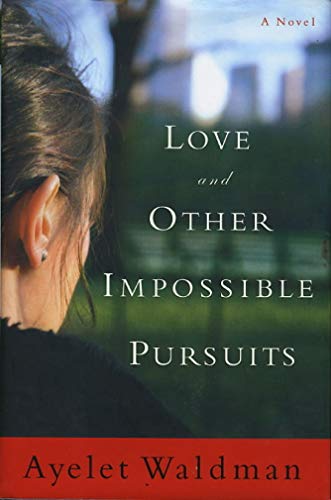
Items related to Love and Other Impossible Pursuits
Synopsis
With wry candor and tender humor, acclaimed novelist Ayelet Waldman has crafted a strikingly beautiful novel for our time, tackling the absurdities of modern life and reminding us why we love some people no matter what.
For Emilia Greenleaf, life is by turns a comedy of errors and an emotional minefield. Yes, she’s a Harvard Law grad who married her soul mate. Yes, they live in elegant comfort on the Upper West Side of Manhattan. But with her one-and-only, Jack, came a stepson—a know-it-all preschooler named William who has become her number one responsibility every Wednesday afternoon. With William, Emilia encounters a number of impossible pursuits—such as the pursuit of cab drivers who speed away when they see William’s industrial-strength car seat and the pursuit of lactose-free, strawberry-flavored, patisserie-quality cupcakes, despite the fact that William’s allergy is a figment of his over-protective mother’s imagination.
As much as Emilia wants to find common ground with William, she becomes completely preoccupied when she loses her newborn daughter. After this, the sight of any child brings her to tears, and Wednesdays with William are almost impossible. When his unceasing questions turn to the baby’s death, Emilia is at a total loss. Doesn’t anyone understand that self-pity is a full-time job? Ironically, it is only through her blundering attempts to bond with William that she finally heals herself and learns what family really means.
"synopsis" may belong to another edition of this title.
About the Author
AYELET WALDMAN is the author of Daughter’s Keeper and of the Mommy-Track mystery series. Her writing has appeared in the New York Times, the Believer, Child magazine, and other publications, and she has a regular column on Salon.com. She and her husband, the novelist Michael Chabon, live in Berkeley, California, with their four children.
Reviews
In the opening scene of Love and Other Impossible Pursuits, Ayelet Waldman's compelling and artfully drawn new novel, Emilia Greenleaf is making her way through Central Park on her way to pick up her stepson, William, from daycare. The park, her refuge since childhood, holds the solitude she craves -- if only she can make it past the playgrounds. Emilia's infant daughter, Isabel, has recently died, exiling Emilia from the careless camaraderie of mothers and leaving her marriage to Jack Woolf in danger of collapse. Isabel's death leaves Emilia, also, to cope with William, Jack's child from his first marriage. Emilia wants to love William, if only for Jack's sake, though he is a guilt-inducing reminder that her affair with his father inflicted lasting damage. But now that Isabel has died, Emilia finds William's presence insufferable. Her honesty on this point does not make her an immediately likable character, but it does steer this novel of a bereaved mother away from any hint of bathos. Emilia's voice is terrific -- sharp, witty, funny, resilient, sarcastic, passionate and very angry. She derides support groups, pushes away friends, tries the nearly unbelievable patience of all who love her until, at a crucial moment, Jack finally says, "It's not a get-out-of-jail-free card, Emilia. Isabel's death doesn't entitle you to do and say whatever the hell you want, to hurt whomever you want." Grief does give a strange, unwelcome power to the griever, and adults defer to Emilia's loss, keeping a safe distance in various ways. William, however, must spend each Wednesday afternoon with her -- and she with him. William is a remarkable boy, precocious and serious, prone to pointing out to everyone within hearing that he's lactose intolerant. Emilia describes him as being like "a very small sixty-two-year-old man." But William is just 5 years old, still struggling with his parents' divorce and with the very idea of death. Emilia's feelings are the least of his concerns. In one partic ularly wrenching moment, William, while instructing Emilia on the intricacies of eBay, suggests pragmatically that they sell Isabel's things online. After all, since she's dead, she's not going to use them. The moment is so painful that it's hard to remember he's just a child, and Emilia's harsh response feels justified. Or it does until Jack comes home and sees past William's terrible suggestion to his innocence and confusion -- and his fear. This complex dynamic shapes and propels the book -- there's a continual tug-of-war of sympathy -- and so does the growing awareness that Emilia, for all her candor, is not a completely trustworthy narrator. Indeed, her unreliability is one of the sources of this novel's tension and power. This is the story of a woman struggling through her grief, yes, but it's also the story of a woman forced by loss to re-evaluate her past and her choices, even her desires. She tries hard to connect with William and repair her family, but in pursuit of the perfect moment -- the moment when she can imagine "how we must look to an observer, a mother and her young son, laughing and running through the rain" -- she forgets about William himself, the boy right beside her, shivering with cold. The novel is beautifully paced and unfolds seamlessly, but as it builds, there's a disconcerting sense that Emilia is not telling the whole story -- and she isn't. Emilia isn't being duplicitous; she's simply lost in this landscape without a map. There's one vital truth she cannot see; another that she cannot admit. The novel turns on the moment when Jack's boundless patience finally runs out and they face off at last, opening the path to a complete rift or to healing. Absolution comes for Emilia from an unexpected source, and she is able, finally, to emerge from her grief, to forgive her betrayals and those of others -- to forgive even the fact that love is not the stuff of fairy tales but something that grows from the ordinary moments, good and bad, that make a life. There are maps of Central Park, but Emilia, though often lost there, never buys one, sensing perhaps that the truest discoveries are made by plunging off the path into unknown territory, willingly or not. At the end of this absorbing novel, Isabel is still dead, and William still asks too many questions, but Emilia herself is movingly, powerfully transformed, having journeyed through the most difficult terrain a parent can imagine, learning on her way to appreciate life's "accidental beauty," its unexpected and inexplicable moments of grace. -- Kim Edwards is the author of "The Memory Keeper's Daughter" and "The Secrets of a Fire King." Reviewed by Kim Edwards
Copyright 2006, The Washington Post. All Rights Reserved.
A few critics drew parallels between Emilia's life and the author's own; after all, Waldman achieved some sort of fame last year after she publicly announced that she loved her husband, novelist Michael Chabon, more than her four children. Alter-ego or not, Emilia and her evolving relationship with William take center stage here. But while some critics saw Emilia as narcissistic and wallowing in self-pity, others viewed her as a witty, resilient woman honest with her foibles. Critics similarly split over the characterization of William. A predictable plot, some stilted writing, and a tidy ending caused some displeasure, but the general consensus was that Waldman's heartfelt novel says something new about the expectations of women—and of oneself.
Copyright © 2004 Phillips & Nelson Media, Inc.
How a five-year-old manages to make the adults in his life hew to the love he holds for them is the sweet treat in this honest, brutal, bitterly funny slice of life. When Emelia's day-old daughter, Isabel, succumbs to SIDS, her own life stalls. She can't work; she can't sleep; Central Park, once her personal secret garden, now is a minefield of happy mother-child dyads. Since Isabel's death, husband Jack's only solace for the guilt of breaking up his sexless marriage with Carolyn for Emelia's (now-absent) passion and love is joint custody of William, now five. What Emelia cannot bear most are Wednesdays, when she must cross the park to collect William at the 92nd Street Y preschool and take another shot at stepmotherhood. Carolyn, William's furious mother and a renowned Upper East Side OB/GYN, lives to nab Emelia for mistakes in handling him. Carolyn's indicting phone calls raise the already sky-high tension in Jack and Emelia's home, but they don't compare with Carolyn's announcement that, at age 42, she is pregnant. The news pushes Emelia to confess to Jack two things she shouldn't. William is charmingly realized, and Waldman (Daughter's Keeper) has upper bourgeois New York down cold. The result is a terrific adult story. (Feb. 21)
Copyright © Reed Business Information, a division of Reed Elsevier Inc. All rights reserved.
*Starred Review* Waldman's moving second novel limns one woman's grief over the loss of her infant daughter. Emilia Greenleaf adores her husband, Jack, but her inability to connect with her five-year-old stepson, William, has only loomed larger since the death of her own baby, Isabel, just one day after Emilia and Jack brought her home from the hospital. William is a thoughtful, analytical child whose constant commentary and stubbornness never fail to get under Emilia's skin, and Emilia's impatience with him is something his mother, Jack's first wife, Carolyn, never fails to use against Emilia. Emilia makes a few futile attempts to bond with William, including taking him to her beloved Central Park, but she grows more and more frustrated each time she fails. Jack doesn't understand Emilia's coldness until he learns she is guarding a secret she fears will destroy their marriage. The beauty of Waldman's writing is her ability to get to the heart of Emilia's complicated and often-conflicting feelings, making Emilia a sympathetic and likable character even at her most frustrating. Waldman avoids contrivances and easy answers even as she moves the novel toward a surprising and rewarding conclusion. Kristine Huntley
Copyright © American Library Association. All rights reserved
Excerpt. © Reprinted by permission. All rights reserved.
Chapter 1
Usually, if I duck my head and walk briskly, I can make it past the playground at West Eighty-first Street. I start preparing in the elevator, my eyes on the long brass arrow as it ticks down from the seventh, sixth, fifth, fourth floor. Sometimes the elevator stops and one of my neighbors gets on, and I have no choice but to crack the carapace of my solitude, and pretend civility. If it's one of the younger ones, the guitar player with the brush of red hair and the peeling skin, say, or the movie executive in the rumpled jeans and the buttery leather coat, it's enough to muster a polite nod of the head. The older ones require more. The steel-haired women in the self-consciously bohemian dresses, folds of purple peeping from under the hems of black wool capes, demand conversation about the weather, or the spot of wear on the Oriental carpet runner in the lobby, or the front page of the arts section. That is quite nearly too much to bear, because don't they see that I am busy? Don't they realize that obsessive self-pity is an all-consuming activity that leaves no room for conversation? Don't they know that the entrance to the park lies right next to the Eighty-first Street playground and that if I am not completely prepared, if I do not clear my mind, stop my ears to all sounds other than my own breathing, it is entirely possible--likely even--that instead of striding boldly past the playground with my eyes on the bare gray branches of the trees, I will collapse outside the playground gate, the shrill voices of the children keening in my skull? Don't they understand, these ladies with their petitions and their dead banker husbands and bulky Tod's purses, that if I let them distract me with talk of Republicans stealing elections or whether Mrs. Katz from 2B saw Anthony the new doorman asleep behind the desk last Tuesday night, I will not make it past the playground to the refuge of the park beyond? Don't they get that the barbaric assault of their voices, the impatient thumping of their Lucite canes as they wait insistently for my mumbled replies, will prevent me from getting to the only place in the entire city where I am able to approximate serenity? They will force me instead to trudge along the Seventy-ninth Street Transverse, pressed against the grimy stone walls, inhaling exhaust fumes from crosstown buses all the way to the East Side. Or worse, they will force me to take a cab.
Today, thank God, the elevator is empty all the way to the lobby.
"Have a nice walk, Mrs. Woolf," Ivan says as he holds the door open for me.
That started the day after our wedding. The first few times I tried to explain that I was still Ms. Greenleaf. I know Ivan understood. He's not an idiot. But he merely smiled, nodded, and said, "Of course, Ms. Greenleaf," and then greeted me with a "Good morning, Mrs. Woolf," the next day. At least it was better than when I'd first moved in with Jack. Then I had muttered something like, "Oh, no, please call me Emilia." Ivan hadn't even bothered to smile and nod. He had stared at me from behind his thick black glasses, shaken his head as if he were my fifth-grade teacher and I'd disappointed him by forgetting my homework or, worse, using foul language in class. "No, Ms. Greenleaf," he had said. That was all. Not "I couldn't," or "I wouldn't feel right." Just, "No." Because of course he would never call someone in the building by her first name; it was appalling to have suggested it at all.
Today I smile, nod, and walk out the door and across the street to the park.
February is the longest month of the year.
Winter has been on us for so very long and spring seems like it might never come. The sky is gray and thick with clouds, the kind of clouds that menace the city, threatening not Christmas postcard snow, or a downpour of cold clean rain, but bitter needles that immediately melt the snow, so that it feels like what is coming down from the sky is actually yellow-gray slush. The sidewalks are banked by mounds of black-fringed snow and every step off the curb is a game of Russian roulette which might end with glacial black water sloshing around your ankle, soaking your sock and shoe. Normally I hunker down; I build fires in the fireplace, wrap myself in chenille throws and wool socks, reread Jane Austen, and will the short, dark days to creep by more quickly. This year, however, I long to embrace the unrelenting grimness of New York in February. This year I need February. Even now, at the end of January, it is as if the city has noticed my dejection and proceeded to prove its commiseration. The trees in the park seem particularly bare; they poke at the dreary sky with lifeless branches that have lost not just their leaves but the very hope of leaves. The grass has turned brown and been kicked away, leaving a mire covered by a scrim of dog-shit-spotted ice. The Bridle Path and the path along the Reservoir are muddy and have buckled in places, gnarled roots and knots marring the once smooth surfaces and tripping up the fleece-clad runners.
But the Diana Ross Playground is full of children. New York children will play outside in all weather, except the most inclement, their nannies and mothers desperate to escape the confines of even the most spacious apartments. On the dreariest winter day, when the swings are wet enough to soak water-repellent snow pants right through, when the expensive, cushiony ground cover is frozen to a bone-breaking hardness, when the last bit of metal left in the meticulously childproofed playground is cold enough to cause a plump pink tongue to stick fast to it, until an unflappable Dominican nanny pours the last inch of a Starbucks mocha over the joined bit of flesh and teeter-totter, the kids are there, screaming their little-kid screams and laughing their little-kid laughs. I quicken my step until I am galumphing along at an ungainly jog, my extra weight pounding into my widened hips, my bones aching with every jarring thump of heel to path.
I allow myself to slow to a gasping walk as soon as the children's voices fade into the background hum of the rest of the park. In the summer Central Park sounds like the countryside--or a version of the countryside where birdsong competes with the hiss of skateboard wheels on cement and with the flutes of Peruvian buskers playing Andean melodies as interpreted by Simon and Garfunkel. In the spring, when the cherry trees are in full blush and the hillocks around Sheep Meadow are covered in yellow daffodils, it is easy to love Central Park. In the summer, when the Shakespeare Garden is a tangle of blossoms and wedding ceremonies and you cannot walk two feet without stumbling over a bank of asters or a dog playing Frisbee, loving Central Park is a breeze. In the winter, though, the pigeons fly under the naked elms, keeping close to where the conscientious, lonely old ladies with their paper bags of bread crusts congregate on the snow-dampened benches of the Mall. In the winter, the park is left to those of us whose love is most true, those of us who don't need swags and fringes of wisteria, those of us for whom snow-heavy black locust trees, mud-covered hills, and the sound of the wind creaking through bare branches are enough. I have always understood that it is in the escape provided by these 843 acres that real beauty lies. The pastel Mardi Gras of spring and summer and the brilliant burnt reds and oranges of autumn are just foofaraw.
I cut north to the trail along the Reservoir. There is one more playground in my path, but it is far enough away that I can keep my eyes averted from the Lincoln Log play structure and the red-and-yellow slide. It is late for the mommies with jogging strollers, and if my luck holds I will miss them entirely. Last Wednesday I left a couple of hours early, to meet a friend who had decided that a morning of shoe shopping would bounce me out of my despondency, would turn me back into someone whose company she enjoyed. Mindy did not, of course, say that. Mindy said that her husband had given her a pair of Manolo Blahniks for her birthday in the size she had led him to believe that she wore, and she needed to see if the store carried the shoe in a ten and a half.
On that day, I came upon a whole row of new mothers crouched down in back of their strollers, their postpartum-padded behinds thrust out, their hands gripping the handles as they rose up to their toes and then squatted back down, cooing all the while to their well-bundled infants who squawked, laughed, or slept in $750 strollers, Bugaboo Frogs just like the one parked in the hallway outside our apartment, next to the spindly table with the silk orchids. The blue denim Bugaboo that kicks me in the gut every time I stand waiting for the elevator. They squatted and rose in unison, this group of mommies, and none of them said a word when I stopped in front of them and grunted as if I'd been punched. They looked at me, and then back at each other, but no one spoke, not when I started to cry, and not when I turned and ran, back along the path, past the first playground and then the second, and then back out onto Central Park West.
Today I am lucky. The mommies have stayed in, or are sharing a post-workout latte. I don't see one until I am on the Bridle Path on the East Side. She runs by me so fast that I barely have time to register the taut balls of her calves pumping in shiny pink running pants, her ears covered in matching fur earmuffs. The babies in her double jogging stroller are tiny purple mounds, pink noses, and then gone. Too fast to cause me anything but a momentary blaze of pain.
At Ninetieth Street, having made it safely and sanely across the park, I look at my watch. Shit. I am late, again, with only five minutes to make it up to Ninety-second and then all the way across to Lex. I quicken my pace, pinching my waist against the stitch in my side. The tails of my long coat flap against my legs, and with my other hand I do my best to hold the coat closed. I can button it now, but it looks dre...
"About this title" may belong to another edition of this title.
Search results for Love and Other Impossible Pursuits

Stock Image
Love and Other Impossible Pursuits
Seller: World of Books (was SecondSale), Montgomery, IL, U.S.A.
Seller rating 5 out of 5 stars

Hardback. Condition: Fair. In this moving, wry, and candid novel, widely acclaimed novelist Ayelet Waldman takes us through one woman's passage through love, loss, and the strange absurdities of modern life. Emilia Greenleaf believed that she had found her soulmate, the man she was meant to spend her life with. But life seems a lot less rosy when Emilia has to deal with the most neurotic and sheltered five-year-old in New York City: her new stepson William. Now Emilia finds herself trying to flag down taxis with a giant, industrial-strength car seat, looking for perfect, strawberry-flavored, lactose-free cupcakes, receiving corrections on her French pronunciation from her supercilious stepson - and attempting to find balance in a new family that's both larger, and smaller, than she bargained for. In Love and Other Impossible Pursuits Ayelet Waldman has created a novel rich with humor and truth, perfectly characterizing one woman's search for answers in a crazily uncertain world. Seller Inventory # 00097930729
Stock Image
Love and Other Impossible Pursuits
Seller: World of Books (was SecondSale), Montgomery, IL, U.S.A.
Seller rating 5 out of 5 stars
Hardback. Condition: Good. In this moving, wry, and candid novel, widely acclaimed novelist Ayelet Waldman takes us through one woman's passage through love, loss, and the strange absurdities of modern life. Emilia Greenleaf believed that she had found her soulmate, the man she was meant to spend her life with. But life seems a lot less rosy when Emilia has to deal with the most neurotic and sheltered five-year-old in New York City: her new stepson William. Now Emilia finds herself trying to flag down taxis with a giant, industrial-strength car seat, looking for perfect, strawberry-flavored, lactose-free cupcakes, receiving corrections on her French pronunciation from her supercilious stepson - and attempting to find balance in a new family that's both larger, and smaller, than she bargained for. In Love and Other Impossible Pursuits Ayelet Waldman has created a novel rich with humor and truth, perfectly characterizing one woman's search for answers in a crazily uncertain world. Seller Inventory # 00097332576
Stock Image
Love and Other Impossible Pursuits
Seller: World of Books (was SecondSale), Montgomery, IL, U.S.A.
Seller rating 5 out of 5 stars
Hardback. Condition: Very Good. In this moving, wry, and candid novel, widely acclaimed novelist Ayelet Waldman takes us through one woman's passage through love, loss, and the strange absurdities of modern life. Emilia Greenleaf believed that she had found her soulmate, the man she was meant to spend her life with. But life seems a lot less rosy when Emilia has to deal with the most neurotic and sheltered five-year-old in New York City: her new stepson William. Now Emilia finds herself trying to flag down taxis with a giant, industrial-strength car seat, looking for perfect, strawberry-flavored, lactose-free cupcakes, receiving corrections on her French pronunciation from her supercilious stepson - and attempting to find balance in a new family that's both larger, and smaller, than she bargained for. In Love and Other Impossible Pursuits Ayelet Waldman has created a novel rich with humor and truth, perfectly characterizing one woman's search for answers in a crazily uncertain world. Seller Inventory # 00091917628
Seller Image
Love and Other Impossible Pursuits
Seller: Vive Liber Books, Somers, CT, U.S.A.
Seller rating 5 out of 5 stars
Condition: good. Good condition USED book. Pages are clean with normal wear. May have limited markings inside from previous owner. Seller Inventory # VLM.4S3
Stock Image
Love and Other Impossible Pursuits
Published by
Doubleday (edition First Edition), 2006
ISBN 10: 0385515308
ISBN 13: 9780385515306
Used
Hardcover
First Edition
Seller: BooksRun, Philadelphia, PA, U.S.A.
Seller rating 5 out of 5 stars
Hardcover. Condition: Very Good. First Edition. With dust jacket. It's a well-cared-for item that has seen limited use. The item may show minor signs of wear. All the text is legible, with all pages included. It may have slight markings and/or highlighting. Seller Inventory # 0385515308-8-1-29
Stock Image
Love and Other Impossible Pursuits
Seller: Wonder Book, Frederick, MD, U.S.A.
Seller rating 5 out of 5 stars
Condition: Very Good. Very Good condition. Very Good dust jacket. A copy that may have a few cosmetic defects. May also contain light spine creasing or a few markings such as an owner's name, short gifter's inscription or light stamp. Seller Inventory # L14B-02552
Stock Image
Love and Other Impossible Pursuits
Seller: ThriftBooks-Atlanta, AUSTELL, GA, U.S.A.
Seller rating 5 out of 5 stars
Hardcover. Condition: Good. No Jacket. Former library book; Pages can have notes/highlighting. Spine may show signs of wear. ~ ThriftBooks: Read More, Spend Less. Seller Inventory # G0385515308I3N10
Stock Image
Love and Other Impossible Pursuits
Seller: ThriftBooks-Atlanta, AUSTELL, GA, U.S.A.
Seller rating 5 out of 5 stars
Hardcover. Condition: As New. No Jacket. Pages are clean and are not marred by notes or folds of any kind. ~ ThriftBooks: Read More, Spend Less. Seller Inventory # G0385515308I2N00
Stock Image
Love and Other Impossible Pursuits
Published by
Doubleday Religious Publishing Group, The, 2006
ISBN 10: 0385515308
ISBN 13: 9780385515306
Used
Hardcover
First Edition
Seller: Better World Books, Mishawaka, IN, U.S.A.
Seller rating 5 out of 5 stars
Condition: Good. First Edition. Pages intact with minimal writing/highlighting. The binding may be loose and creased. Dust jackets/supplements are not included. Stock photo provided. Product includes identifying sticker. Better World Books: Buy Books. Do Good. Seller Inventory # 17000980-75
Stock Image
Love and Other Impossible Pursuits
Published by
Doubleday Religious Publishing Group, The, 2006
ISBN 10: 0385515308
ISBN 13: 9780385515306
Used
Hardcover
First Edition
Seller: Better World Books, Mishawaka, IN, U.S.A.
Seller rating 5 out of 5 stars
Condition: Very Good. First Edition. Former library copy. Pages intact with possible writing/highlighting. Binding strong with minor wear. Dust jackets/supplements may not be included. Includes library markings. Stock photo provided. Product includes identifying sticker. Better World Books: Buy Books. Do Good. Seller Inventory # 14806165-75