
Synopsis
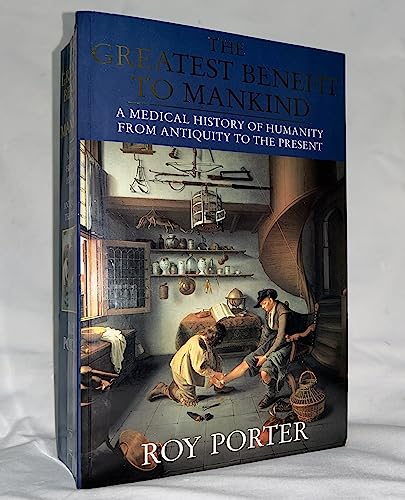
A panoramic, illustrated history explores the development of medicine against the backdrop of the religious, scientific, philosophical, and political beliefs of each age, and unearths a treasure trove of medicinal oddities.
"synopsis" may belong to another edition of this title.
About the Author
Roy Porter is professor of the social history of medicine at the Wellcome Institute for the History of Science in London. He is the editor of the Norton History of Science series and, most recently, the author of the best-selling London: A Social History, among many other books.
Reviews
There has not been a book of this scope since Garrison's An Introduction to the History of Medicine (Philadelphia: W.B. Saunders), the fourth edition of which appeared in 1929. In reviving the single-authored, encyclopedic, universal history, Roy Porter seeks to make serviceable for the 21st-century reader a model that ultimately derives from the positivistic German medical handbuch of the 19th century. That he has mixed success is probably due more to the way readers and writers have changed than to any deficiencies on his part.
Best known for his prolific contributions to the social history of medicine, especially the history of popular healers and mental illness, Porter here demonstrates a confident familiarity with the "great doctors" and much else. Although discussions of the former constitute the core of the book, discussions of the latter are substantive and brilliantly condensed and conveyed. Porter's recurrent examinations of epidemiology, public health and demography, medical institutions, the social role of medicine and its practitioners, women and medicine, and treatment of mental disorders at various periods reveal admirably how medical historiography has broadened and deepened since Garrison's era.
Nearly half the text of this book follows a chronologic course from prehistoric times to the end of the 18th century (including surveys of Islamic, Indian, and Chinese medicine), whereas the past two centuries are approached thematically and, as Porter acknowledges, selectively. There are chapters on "Medicine, State, and Society" and "Medicine and the People," as well as chapters dealing with medical practice and research.
Throughout the book, Porter presents masterly introductory and concluding summaries of each section in a fluent, often amusing, and sometimes irreverent style. The text is enlivened by numerous quotes from lay and medical contemporaries. Although respecting his universalist goal, Porter explains that Western medicine receives the most attention because it has largely triumphed around the world, and he draws the majority of his historical case examples of professional and social developments from Great Britain (his own area of research).
What, then, are the problems with The Greatest Benefit to Mankind? The apparently few factual errors (several with respect to Vesalius, and the erroneous statement that Dr. Guillotin invented the instrument named after him), which are inevitable in such an ambitious survey, do not pose a serious problem, nor does the judicious coverage and balanced interpretation of medical history. Instead, as the extremely informative 45-page list of further readings (usefully rated by Porter with stars for those he has found most helpful) indicates, the problem is that medical historiography, particularly since around 1980, has experienced such a boom in quantity, quality, and diversity that no single-volume total history can hope to do more than briefly summarize while pointing the reader toward more extensive sources. Although readable, this book is dauntingly crammed with information that moves by at a rapid clip. It is likely to overwhelm the novice but hold few surprises for the specialist. It will probably find its greatest use as a modern, comprehensive, and reliable reference work, a point of entry to the literature and a valuable aid to those teaching the subject.
Reviewed by Toby Gelfand, Ph.D.
Copyright © 1998 Massachusetts Medical Society. All rights reserved. The New England Journal of Medicine is a registered trademark of the MMS.
A learned, lively history of medicine ``from Stone Age to New Age, from Galen to Gallo. Unable to find a modern, readable, one-volume history of medicine for his students, Porter (A Social History of Madness, 1988, etc.), of London's Wellcome Institute for the History of Science, has filled that gap admirably with this fascinating survey of medical theory and practice through the centuries. While he looks at medicine in early societies, and Islamic, Indian, and Chinese medicine, his focus is on Western medicine, which he finds uniquely powerful and now uniquely global. He explores its foundations in ancient Greece and Rome, the impact of the new science of the Renaissance, and the initial failure of biomedical findings to deliver effective new therapies. The accomplishments of individuals are hereHarvey, Koch, Pasteur, Lister, Freud., etc.but Porter does not tell history simply through great men. The influence of French hospitals on medical education; how German laboratories created a new pathology, physiology, and pharmacology; the development of specialization; public health measures; medicine's role in the expansion of imperial powersall are included. In stylish prose, he paints a panoramic picture filled with memorable anecdotes, apt quotes, startling statistics, and sobering conclusions. At intervals he returns to specific topics, such as treatment of the insane, to demonstrate the shifts taking place in both social attitudes and medical practice. Approaching modern times, Porter reports on the great strides made in biomedical research, paying special attention to neurology, endocrinology, cancer, cardiology, genetics, and immunology. In his closing chapters, he turns to the politics of contemporary medicine, examining the changing relationship between the state and medicine and between medicine and the people. Never before, he notes, has medicine achieved so much nor attracted such great suspicion. With its triumphs ``dissolving in disorientation,'' medicine, warns Porter, must now redefine its limits. Thoroughly impressivemerits a broad lay readership in addition to med students. (40 illustrations) -- Copyright ©1998, Kirkus Associates, LP. All rights reserved.
Porter examines the history of Western medicine in its relations to society, and his many previous publications suggest that he has been preparing for this major work for some time. To write a one-volume history of medicine, one must have background, preparation, and courage. Porter has all three, and he assembles a massive amount of material after having taken the time to organize his thoughts carefully. Presenting technical terms and medical and scientific advances clearly, he addresses both the general reader and the medical student. Among the greatest pleasures he affords are his skillful weaving of quotations and analogies from novels, plays, and poems into the text and his cogent disagreement with the late epidemiologist Thomas McKeown's popular argument that medicine had little to do with the major improvements in life in the nineteenth and twentieth centuries. With its lengthy, useful, and comprehensive further reading list and detailed and accurate index, this is a book for public, college, and medical school libraries alike. William Beatty
Porter examines what healers have done and the impact of their ideas and actions. His focus is on Western medicine "because Western medicine has developed in ways which made it uniquely powerful and...uniquely global." (LJ 2/15/98)
Copyright 1999 Reed Business Information, Inc.
"About this title" may belong to another edition of this title.
Other Popular Editions of the Same Title

Search results for The Greatest Benefit to Mankind: A Medical History...

Seller Image
The Greatest Benefit to Mankind: A Medical History of Humanity
Seller: Dream Books Co., Denver, CO, U.S.A.
Seller rating 5 out of 5 stars

Condition: acceptable. This copy has clearly been enjoyedâ"expect noticeable shelf wear and some minor creases to the cover. Binding is strong, and all pages are legible. May contain previous library markings or stamps. Seller Inventory # DBV.0393046346.A
Stock Image
The Greatest Benefit to Mankind : A Medical History of Humanity from Antiquity to the Present
Published by
Norton & Company, Incorporated, W. W., 1998
ISBN 10: 0393046346
ISBN 13: 9780393046342
Used
Hardcover
Seller: Better World Books, Mishawaka, IN, U.S.A.
Seller rating 5 out of 5 stars
Condition: Good. Pages intact with minimal writing/highlighting. The binding may be loose and creased. Dust jackets/supplements are not included. Stock photo provided. Product includes identifying sticker. Better World Books: Buy Books. Do Good. Seller Inventory # 4387796-6
Stock Image
The Greatest Benefit to Mankind : A Medical History of Humanity from Antiquity to the Present
Published by
Norton & Company, Incorporated, W. W., 1998
ISBN 10: 0393046346
ISBN 13: 9780393046342
Used
Hardcover
Seller: Better World Books, Mishawaka, IN, U.S.A.
Seller rating 5 out of 5 stars
Condition: Good. Former library copy. Pages intact with minimal writing/highlighting. The binding may be loose and creased. Dust jackets/supplements are not included. Includes library markings. Stock photo provided. Product includes identifying sticker. Better World Books: Buy Books. Do Good. Seller Inventory # 4894655-6
Stock Image
The Greatest Benefit to Mankind: A Medical History of Humanity
Published by
W W Norton & Co Inc (edition 1), 1997
ISBN 10: 0393046346
ISBN 13: 9780393046342
Used
Hardcover
Seller: BooksRun, Philadelphia, PA, U.S.A.
Seller rating 5 out of 5 stars
Hardcover. Condition: Fair. 1. With dust jacket. The item might be beaten up but readable. May contain markings or highlighting, as well as stains, bent corners, or any other major defect, but the text is not obscured in any way. Seller Inventory # 0393046346-7-1-29
Stock Image
The Greatest Benefit to Mankind: A Medical History of Humanity
Seller: ThriftBooks-Atlanta, AUSTELL, GA, U.S.A.
Seller rating 5 out of 5 stars
Hardcover. Condition: Fair. No Jacket. Missing dust jacket; Readable copy. Pages may have considerable notes/highlighting. ~ ThriftBooks: Read More, Spend Less. Seller Inventory # G0393046346I5N01
Stock Image
The Greatest Benefit to Mankind: A Medical History of Humanity
Seller: ThriftBooks-Dallas, Dallas, TX, U.S.A.
Seller rating 5 out of 5 stars
Hardcover. Condition: Fair. No Jacket. Readable copy. Pages may have considerable notes/highlighting. ~ ThriftBooks: Read More, Spend Less. Seller Inventory # G0393046346I5N00
Stock Image
The Greatest Benefit to Mankind: A Medical History of Humanity
Seller: ThriftBooks-Reno, Reno, NV, U.S.A.
Seller rating 5 out of 5 stars
Hardcover. Condition: Fair. No Jacket. Readable copy. Pages may have considerable notes/highlighting. ~ ThriftBooks: Read More, Spend Less. Seller Inventory # G0393046346I5N00
Stock Image
The Greatest Benefit to Mankind: A Medical History of Humanity
Seller: ThriftBooks-Dallas, Dallas, TX, U.S.A.
Seller rating 5 out of 5 stars
Hardcover. Condition: Good. No Jacket. Missing dust jacket; Pages can have notes/highlighting. Spine may show signs of wear. ~ ThriftBooks: Read More, Spend Less. Seller Inventory # G0393046346I3N01
Stock Image
The Greatest Benefit to Mankind: A Medical History of Humanity
Seller: ThriftBooks-Dallas, Dallas, TX, U.S.A.
Seller rating 5 out of 5 stars
Hardcover. Condition: Fair. No Jacket. Missing dust jacket; Readable copy. Pages may have considerable notes/highlighting. ~ ThriftBooks: Read More, Spend Less. Seller Inventory # G0393046346I5N01
Seller Image
The Greatest Benefit to Mankind: A Medical History of Humanity
Seller: Greenworld Books, Arlington, TX, U.S.A.
Seller rating 5 out of 5 stars
Condition: good. Fast Free Shipping â" Good condition. It may show normal signs of use, such as light writing, highlighting, or library markings, but all pages are intact and the book is fully readable. A solid, complete copy that's ready to enjoy. Seller Inventory # GWV.0393046346.G