
Synopsis
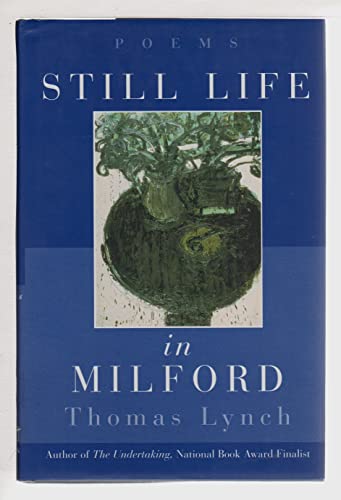
A collection of poems by the highly acclaimed author of The Undertaking: Life Studies from the Dismal Trade. In his first American collection since 1987, Thomas Lynch tenders poems on life and death, history and memory, the local and the larger geographies. From Latin wellsprings in Gregorian hymns, through inherited idioms of West Clare and meditations in a London park, to the plainchants of middle America, Lynch follows the forces of language. The ordinary artifacts of daily life and common speech are assembled into poems of uncommon elegance and grace. Colloquy and narrative, soliloquy and tribute: Still Life in Milford engages the full register of the poet's voices-as elegist, witness, obituarist, straight-man, and passerby-to achieve a disturbing and instructive harmony.
"synopsis" may belong to another edition of this title.
Reviews
Hot off the success of Lynchs recent memoir of his grim trade, The Undertaking (1997), comes his second American collection of verse, which includes the poems published previously in a British edition. A solid though hardly expert craftsman, Lynch imagines himself a witness to ordinary life, even if hes better at elegy than commencement. And its true: almost a clich of an Irish Catholic, he dwells on death, sex, and the romance of the old country. Numerous poems linger on his fathers bad health and eulogize his eventual death, which induces near panic in the poet who, elsewhere, dreams of him (Kisses). Of course, Lynchs job brings him close to death on a daily basis: One of Jacks is an autopsy in clinical detail; That Scream If You Ever Heard It effectively rubs our noses in the gore; and Couplets brilliantly outlines his work, which he hopes to pass on to his sons. A sonnet sequence, inspired by Gregorian hymns, surveys the sexual obsessions of a Catholic youth, from a not-so-sorry confession of sin to moments of guilt-ridden horniness, even as he later understands we invoke God most often in bed and at the grave side. Least effective are Lynchs tales from Ireland, some of which imagine a mythic hermit named Argyle, who challenges the Churchs authority, and others pay homage to Nora Lynch, the spinster relative who maintains the family property in West Clare. The considerable pleasures of this ample volume outweigh the sloppy bursts of sentiment and blarney: Lynchs crystal- clear voice often serves him well. -- Copyright ©1998, Kirkus Associates, LP. All rights reserved.
Lynch's poems are strongly crafted yet modest in tone, a reflection, perhaps, of his work as a funeral director, a calling that has trained him to tuck death's enormous mystery into the structures of ritual and casket and, by extension, to fit the immensity of his emotions into the precision of poetic forms. He has written about his trade in a superb essay collection, The Undertaking (1997), and death is a conspicuous force in many of his lucid, witty, and generous poems, which focus, too, on the ever-percolating conflict between body and spirit. Lines like "Sometimes I look into the eyes of corpses" leap off the page with their curious blend of drama and pragmatism, and Lynch's belief that we are "better at elegy than commencement" is expressed passionately in a series of poems inspired by his Irish heritage, including "The Moveen Notebooks," a beautiful long poem dedicated to Nora Lynch, a much beloved relative from whom he inherited an ancestral cottage in County Clare, the source of much of his creative power. Donna Seaman
Lynch first came to our attention in 1987 with Skating with Heather Grace (LJ 3/1/87), an extraordinary book about ordinary life that spoke quietly and directly to readers. Since then, he has distinguished himself with the award-winning The Undertaking, a fine account that expands on his profession as a funeral director. That job clearly gives one time to consider issues of faith and mortality, and it's not surprising that the poems in this strong new collection deal largely with just such issues. Here, Lynch recalls his religious upbringing while considering "the problem of evil" and trying to maintain his equilibrium when faced with "another heartsore Friday full of sun." As he muses in one poem, "I had a nunnish upbringing. I served/ six-twenty Mass on weekdays for a priest/ who taught me...to keep/ a running tally of the things I'd done/ against the little voice in me the nuns/ were always saying I should listen to." These poems are undeniably?and understandably?dark-toned, but they make you think. For all poetry collections.?Barbara Hoffert, "Library Journal"
Copyright 1998 Reed Business Information, Inc.
"About this title" may belong to another edition of this title.
Other Popular Editions of the Same Title

Search results for Still Life in Milford: Poems

Stock Image
Still Life in Milford: Poems
Seller: World of Books (was SecondSale), Montgomery, IL, U.S.A.
Seller rating 5 out of 5 stars

Condition: Very Good. Item in very good condition! Textbooks may not include supplemental items i.e. CDs, access codes etc. Seller Inventory # 00095402070
Stock Image
Still Life in Milford: Poems
Seller: World of Books (was SecondSale), Montgomery, IL, U.S.A.
Seller rating 5 out of 5 stars
Condition: Good. Item in good condition. Textbooks may not include supplemental items i.e. CDs, access codes etc. Seller Inventory # 00093403698
Seller Image
Still Life in Milford: Poems
Seller: Reliant Bookstore, El Dorado, KS, U.S.A.
Seller rating 5 out of 5 stars
Condition: very_good. This book is in excellent condition. There may be minimal writing on the inside cover or cover page. Cover image on the book may vary from photo. Ships out quickly in a secure plastic mailer. Seller Inventory # RDV.0393046591.VG
Stock Image
Still Life in Milford : Poems
Published by
Norton & Company, Incorporated, W. W., 1998
ISBN 10: 0393046591
ISBN 13: 9780393046595
Used
Hardcover
Seller: Better World Books, Mishawaka, IN, U.S.A.
Seller rating 5 out of 5 stars
Condition: Good. Former library copy. Pages intact with minimal writing/highlighting. The binding may be loose and creased. Dust jackets/supplements are not included. Includes library markings. Stock photo provided. Product includes identifying sticker. Better World Books: Buy Books. Do Good. Seller Inventory # 2308621-75
Stock Image
Still Life in Milford: Poems
Seller: ThriftBooks-Atlanta, AUSTELL, GA, U.S.A.
Seller rating 5 out of 5 stars
Hardcover. Condition: Very Good. No Jacket. May have limited writing in cover pages. Pages are unmarked. ~ ThriftBooks: Read More, Spend Less. Seller Inventory # G0393046591I4N00
Stock Image
Still Life in Milford: Poems
Seller: ThriftBooks-Dallas, Dallas, TX, U.S.A.
Seller rating 5 out of 5 stars
Hardcover. Condition: As New. No Jacket. Pages are clean and are not marred by notes or folds of any kind. ~ ThriftBooks: Read More, Spend Less. Seller Inventory # G0393046591I2N00
Stock Image
Still Life in Milford: Poems
Seller: ThriftBooks-Dallas, Dallas, TX, U.S.A.
Seller rating 5 out of 5 stars
Hardcover. Condition: Very Good. No Jacket. May have limited writing in cover pages. Pages are unmarked. ~ ThriftBooks: Read More, Spend Less. Seller Inventory # G0393046591I4N00
Stock Image
Still Life in Milford: Poems
Seller: Wonder Book, Frederick, MD, U.S.A.
Seller rating 5 out of 5 stars
Condition: Very Good. Very Good condition. Very Good dust jacket. A copy that may have a few cosmetic defects. May also contain light spine creasing or a few markings such as an owner's name, short gifter's inscription or light stamp. Seller Inventory # P15G-01979
Stock Image
Still Life in Milford: Poems
Seller: Wonder Book, Frederick, MD, U.S.A.
Seller rating 5 out of 5 stars
Condition: As New. Like New condition. Very Good dust jacket. A near perfect copy that may have very minor cosmetic defects. Seller Inventory # J09O-00407
Stock Image
Still Life in Milford: Poems
Seller: HPB-Diamond, Dallas, TX, U.S.A.
Seller rating 5 out of 5 stars
hardcover. Condition: Very Good. Connecting readers with great books since 1972! Used books may not include companion materials, and may have some shelf wear or limited writing. We ship orders daily and Customer Service is our top priority! Seller Inventory # S_462910049