
Einstein's Cosmos: How Albert Einstein's Vision Transformed Our Understanding of Space and Time (Great Discoveries) - Hardcover
Book 2 of 12: Great Discoveries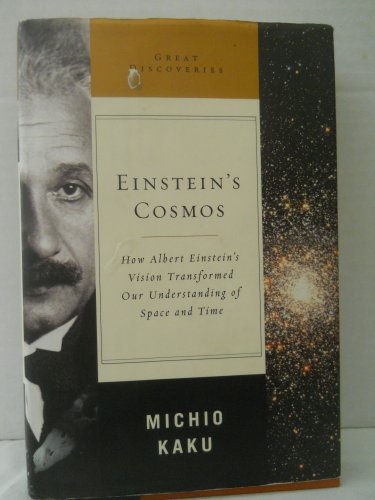
Synopsis
A dazzling tour of the universe as Einstein saw it.
"synopsis" may belong to another edition of this title.
About the Author
Michio Kaku, a theoretical physicist, famed futurist and acclaimed public speaker, is the author of numerous New York Times bestselling books including The Future of the Mind, Physics of the Future, and Physics of the Impossible. He hosts Science Fantastic, a nationally broadcast radio show, and lives in New York City.
Reviews
Thanks to Kaku's insight (he is a theoretical physicist) and his flair for explaining dense scientific concepts (he is a best-selling author), this brief book weaves Einstein's life and work into a seamless, hard-to-put-down narrative. The organizing metaphor is how Einstein thought in terms of simple physical pictures--speeding trains, falling elevators, moving clocks. Excellent for the neophyte or readers who want to refresh their knowledge about Einstein without being talked down to or bored.
Editors of Scientific American
Recent popular works about Einstein have magnified select details of his life, such as his tempestuous marriage to Mileva Maric (Einstein in Love, by Dennis Overbye, 2000) or his FBI file (The Einstein File, by Fred Jerome [BKL Ap 1 03]). Such topics are reduced to paragraphs in Kaku's presentation, for Einstein's life ranks second to his science here. Accordingly, Kaku divides his narrative into the three great segments of Einstein's scientific arc: the theory of special relativity in 1905; the theory of general relativity in 1916; and the balance of Einstein's intellectual life. The latter was spent searching for a unified field theory and saw the rise of his phenomenal celebrity, which his peers regarded as a dubious dissipation of genius. However, such lamentations were premature, according to Kaku, who explicates recent discoveries that show Einstein was only audaciously ahead of his scientific time, as usual. An expert in quantum mechanics and string theory, Kaku is an equally able popular writer, vividly evoking the pictorial imagination behind Einstein's revolutionary thinking. Gilbert Taylor
Copyright © American Library Association. All rights reserved
"About this title" may belong to another edition of this title.
Other Popular Editions of the Same Title

Search results for Einstein's Cosmos: How Albert Einstein's Vision...

Seller Image
Einstein's Cosmos: How Albert Einstein's Vision Transformed Our Understanding of Space and Time (Great Discoveries)
Seller: Goodwill of Colorado, COLORADO SPRINGS, CO, U.S.A.
Seller rating 5 out of 5 stars

Condition: good. All pages and cover are intact. Dust jacket included if applicable, though it may be missing on hardcover editions. Spine and cover may show minor signs of wear including scuff marks, curls or bends to corners as well as cosmetic blemishes including stickers. Pages may contain limited notes or highlighting. "From the library of" labels may be present. Shrink wrap, dust covers, or boxed set packaging may be missing. Bundled media e.g., CDs, DVDs, access codes may not be included. Seller Inventory # COLV.039305165X.G
Stock Image
Einstein's Cosmos: How Albert Einstein's Vision Transformed Our Understanding of Space and Time (Great Discoveries)
Seller: World of Books (was SecondSale), Montgomery, IL, U.S.A.
Seller rating 5 out of 5 stars
Condition: Very Good. Item in very good condition! Textbooks may not include supplemental items i.e. CDs, access codes etc. Seller Inventory # 00103233617
Stock Image
Einstein's Cosmos: How Albert Einstein's Vision Transformed Our Understanding of Space and Time (Great Discoveries)
Seller: ThriftBooks-Dallas, Dallas, TX, U.S.A.
Seller rating 5 out of 5 stars
Hardcover. Condition: Good. No Jacket. Missing dust jacket; Pages can have notes/highlighting. Spine may show signs of wear. ~ ThriftBooks: Read More, Spend Less. Seller Inventory # G039305165XI3N01
Stock Image
Einstein's Cosmos: How Albert Einstein's Vision Transformed Our Understanding of Space and Time (Great Discoveries)
Seller: ThriftBooks-Dallas, Dallas, TX, U.S.A.
Seller rating 5 out of 5 stars
Hardcover. Condition: Very Good. No Jacket. Former library book; May have limited writing in cover pages. Pages are unmarked. ~ ThriftBooks: Read More, Spend Less. Seller Inventory # G039305165XI4N10
Stock Image
Einstein's Cosmos: How Albert Einstein's Vision Transformed Our Understanding of Space and Time (Great Discoveries)
Seller: ThriftBooks-Atlanta, AUSTELL, GA, U.S.A.
Seller rating 5 out of 5 stars
Hardcover. Condition: Good. No Jacket. Missing dust jacket; Pages can have notes/highlighting. Spine may show signs of wear. ~ ThriftBooks: Read More, Spend Less. Seller Inventory # G039305165XI3N01
Stock Image
Einstein's Cosmos : How Albert Einstein's Vision Transformed Our Understanding of Space and Time
Published by
Norton & Company, Incorporated, W. W., 2004
ISBN 10: 039305165X
ISBN 13: 9780393051650
Used
Hardcover
Seller: Better World Books, Mishawaka, IN, U.S.A.
Seller rating 5 out of 5 stars
Condition: Good. Former library copy. Pages intact with minimal writing/highlighting. The binding may be loose and creased. Dust jackets/supplements are not included. Includes library markings. Stock photo provided. Product includes identifying sticker. Better World Books: Buy Books. Do Good. Seller Inventory # GRP80320769
Stock Image
Einstein's Cosmos: How Albert Einstein's Vision Transformed Our Understanding of Space and Time (Great Discoveries)
Seller: Half Price Books Inc., Dallas, TX, U.S.A.
Seller rating 5 out of 5 stars
Hardcover. Condition: Very Good. Connecting readers with great books since 1972! Used books may not include companion materials, and may have some shelf wear or limited writing. We ship orders daily and Customer Service is our top priority! Seller Inventory # S_443370631
Stock Image
Einstein's Cosmos: How Albert Einstein's Vision Transformed Our Understanding of Space and Time (Great Discoveries)
Seller: HPB-Emerald, Dallas, TX, U.S.A.
Seller rating 5 out of 5 stars
hardcover. Condition: Very Good. Connecting readers with great books since 1972! Used books may not include companion materials, and may have some shelf wear or limited writing. We ship orders daily and Customer Service is our top priority! Seller Inventory # S_454620914
Stock Image
Einstein's Cosmos: How Albert Einstein's Vision Transformed Our Understanding of Space and Time (Great Discoveries)
Seller: HPB-Diamond, Dallas, TX, U.S.A.
Seller rating 5 out of 5 stars
Hardcover. Condition: Very Good. Connecting readers with great books since 1972! Used books may not include companion materials, and may have some shelf wear or limited writing. We ship orders daily and Customer Service is our top priority! Seller Inventory # S_467928770
Stock Image
Einstein's Cosmos: How Albert Einstein's Vision Transformed Our Understanding of Space and Time (Great Discoveries)
Seller: HPB-Movies, Dallas, TX, U.S.A.
Seller rating 4 out of 5 stars

hardcover. Condition: Very Good. Connecting readers with great books since 1972! Used books may not include companion materials, and may have some shelf wear or limited writing. We ship orders daily and Customer Service is our top priority! Seller Inventory # S_473677172