
Items related to No Two Alike: Human Nature and Human Individuality
Synopsis
A groundbreaking theory of personality.
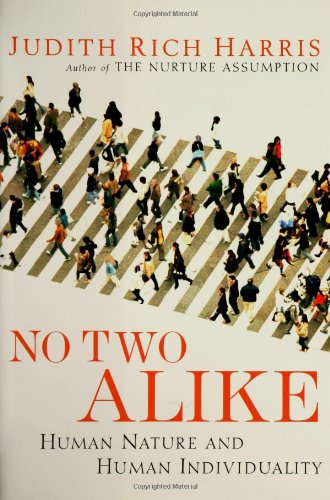
The author of the controversial book The Nurture Assumption tackles the biggest mystery in all of psychology: What makes people differ so much in personality and behavior? It can't just be "nature and nurture," because even identical twins who grow up together―same genes, same parents―have different personalities. And if psychologists can't explain why identical twins are different, they also can't explain why each of us differs from everyone else. Why no two people are alike. Harris turns out to be well suited for the role of detective―it isn't easy to pull the wool over her eyes. She rounds up the usual suspects and shows why none of the currently popular explanations for human differences―birth order effects, for example, or interactions between genes and environment―can be the perpetrator she is looking for. None of these theories can solve the mystery of human individuality. The search for clues carries Harris into some fascinating byways of science. The evidence she examines ranges from classic experiments in social psychology to cutting-edge research in neuroscience. She looks at studies of twins, research on autistic children, observations of chimpanzees, birds, and even ants. Her solution is a startlingly original one: the first completely new theory of personality since Freud's. Based on a principle of evolutionary psychology―the idea that the human mind is a toolbox of special-purpose devices―Harris's theory explains how attributes we all have in common can make us different. This is the story of a scientific quest, but it is also the personal story of a courageous and innovative woman who refused to be satisfied with "what everyone knows is true." 12 b/w illustrations"synopsis" may belong to another edition of this title.
About the Author
Judith Rich Harris is an independent investigator and a former writer of textbooks in child development. She lives in New Jersey with her husband.
Reviews
Why do identical twins who grow up together differ in personality? Harris attempts to solve that mystery. Her initial thesis in The Nurture Assumption: Why Children Turn Out the Way They Do is replaced here with a stronger, more detailed one based on evolutionary psychology. Reading this book is akin to working your way through a mystery novel—complete with periodic references to Sherlock Holmes. And Harris has a knack for interspersing scientific and research-laden text with personal anecdotes. Initially, she refutes five red herring theories of personality differences, including differences in environment and gene-environment interactions. Eventually, Harris presents her own theory, starting from modular notions of the brain (as Steven Pinker puts it, "the mind is not a single organ but a system of organs"). Harris offers a three-systems theory of personality: there's the relationship system, the socialization system and the status system. And while she admits her theory of personality isn't simple, it is thought provoking. Harris ties up the loose ends of the new theory, showing how the development of the three systems creates personality. Harris's writing is highly entertaining, which will help readers stick with her through the elaboration of a fairly complex theory. 12 b&w illus. (Feb.)
Copyright © Reed Business Information, a division of Reed Elsevier Inc. All rights reserved.
Where does adult personality come from? Why are we all different? These are the questions energizing Judith Rich Harris’s new book.
Harris, a former textbook author turned popular writer, dives right in, sharpening her focus by looking at identical twins. After subtracting the share contributed by their mutual genes—about 45 percent—studies show that adult identical twins are no more alike in personality than people plucked at random from a crowd, even though the siblings were raised in the same home, by the same parents, with identical schooling.
Where, then, do personality differences come from? Harris begins, in a savage fashion familiar to readers of her Nurture Assumption, by recounting factors that do not contribute to personality differences. She debunks dozens of studies by psychologists—especially the "developmentalists" and "interventionists" who believe that better parenting or school environments can affect how children turn out—by pointing out where they have fudged numbers and twisted results. She rejects the basis of psychoanalysis, stating there is no evidence that talking about childhood experiences has therapeutic value. She also maintains that learned behaviors do not readily transfer from one situation to another, noting that even babies behave differently to fit different environments.
To answer her opening questions, Harris then develops a complex scheme based on "the modular mind," a framework set forth by Harvard University evolutionary psychologist Steven Pinker and others. (Harris herself has no doctorate and is housebound by systemic sclerosis and lupus, two autoimmune disorders.) She describes three modules—the relationship system, the socialization system and the status system—and explains how each contributes its part to making us who we are. The relationship system starts in the cradle as infants study and learn the faces and voices of the people around them, collecting information that helps form personality. The socialization system adapts people to their culture. The status system takes all the information collected during childhood and adolescence and shapes and modifies our personalities in accord with our environments.
Harris’s last chapter lays out her theory in tabular form, explaining how each module interacts with the others to produce our distinct personalities. It is lavishly footnoted, like the rest of the book, shoring up her strategy of pointing out the failings of other models and then proposing her own. Her goal, she writes, is to explain the variations in personality that cannot be attributed to variations in people’s genes. After saying she believes she has succeeded, she throws down her gauntlet: "I will leave it to other people to test my theory."
Jonathan Beard
The controversial author of The Nurture Assumption (1998)--in which it was argued that peer relations, not nature or nurture, were the driving force in child development--continues her exploration of what makes us the way we are. This time Harris offers a "scientific detective story" aimed at uncovering the secret of human individuality. Armed with new psychological theories and cutting-edge, high-tech tools, Harris takes a multidisciplinary approach to answering the nagging question of why identical twins raised in the same household often differ, sometimes dramatically, in personality? Harris delivers an answer (and, yes, it's sure to be controversial), but it's the quest itself that will prove most fascinating for general readers, who will marvel at the step-by-step accumulation of facts, as the author marshals her argument by adeptly juggling a wide array of tools, from new theories of evolutionary psychology to behavioral genetics and linguistics. Expect some off-the-book-page attention. David Pitt
Copyright © American Library Association. All rights reserved
"About this title" may belong to another edition of this title.
Search results for No Two Alike: Human Nature and Human Individuality

Stock Image
No Two Alike: Human Nature and Human Individuality
Seller: Gulf Coast Books, Cypress, TX, U.S.A.
Seller rating 5 out of 5 stars

hardcover. Condition: Good. Seller Inventory # 0393059480-3-34596448
Stock Image
No Two Alike: Human Nature and Human Individuality
Seller: World of Books (was SecondSale), Montgomery, IL, U.S.A.
Seller rating 5 out of 5 stars
Condition: Good. Good condition ex-library book with usual library markings and stickers. Seller Inventory # 00108138273
Stock Image
No Two Alike: Human Nature and Human Individuality
Seller: World of Books (was SecondSale), Montgomery, IL, U.S.A.
Seller rating 5 out of 5 stars
Condition: Good. Item in good condition. Textbooks may not include supplemental items i.e. CDs, access codes etc. Seller Inventory # 00109879059
Seller Image
No Two Alike: Human Nature and Human Individuality
Seller: Greenworld Books, Arlington, TX, U.S.A.
Seller rating 5 out of 5 stars
Condition: good. Fast Free Shipping â" Good condition. It may show normal signs of use, such as light writing, highlighting, or library markings, but all pages are intact and the book is fully readable. A solid, complete copy that's ready to enjoy. Seller Inventory # GWV.0393059480.G
Stock Image
No Two Alike: Human Nature and Human Individuality
Published by
W. W. Norton & Company (edition ), 2006
ISBN 10: 0393059480
ISBN 13: 9780393059489
Used
Hardcover
Seller: BooksRun, Philadelphia, PA, U.S.A.
Seller rating 5 out of 5 stars
Hardcover. Condition: Very Good. With dust jacket. It's a well-cared-for item that has seen limited use. The item may show minor signs of wear. All the text is legible, with all pages included. It may have slight markings and/or highlighting. Seller Inventory # 0393059480-11-1-29
Stock Image
No Two Alike: Human Nature and Human Individuality
Seller: ThriftBooks-Reno, Reno, NV, U.S.A.
Seller rating 5 out of 5 stars
Hardcover. Condition: Good. No Jacket. Pages can have notes/highlighting. Spine may show signs of wear. ~ ThriftBooks: Read More, Spend Less. Seller Inventory # G0393059480I3N00
Stock Image
No Two Alike: Human Nature and Human Individuality
Seller: ThriftBooks-Atlanta, AUSTELL, GA, U.S.A.
Seller rating 5 out of 5 stars
Hardcover. Condition: Good. No Jacket. Former library book; Pages can have notes/highlighting. Spine may show signs of wear. ~ ThriftBooks: Read More, Spend Less. Seller Inventory # G0393059480I3N10
Stock Image
No Two Alike: Human Nature and Human Individuality
Seller: ThriftBooks-Dallas, Dallas, TX, U.S.A.
Seller rating 5 out of 5 stars
Hardcover. Condition: Very Good. No Jacket. Missing dust jacket; May have limited writing in cover pages. Pages are unmarked. ~ ThriftBooks: Read More, Spend Less. Seller Inventory # G0393059480I4N01
Stock Image
No Two Alike: Human Nature and Human Individuality
Seller: ThriftBooks-Atlanta, AUSTELL, GA, U.S.A.
Seller rating 5 out of 5 stars
Hardcover. Condition: Good. No Jacket. Pages can have notes/highlighting. Spine may show signs of wear. ~ ThriftBooks: Read More, Spend Less. Seller Inventory # G0393059480I3N00
Stock Image
No Two Alike: Human Nature and Human Individuality
Seller: ThriftBooks-Dallas, Dallas, TX, U.S.A.
Seller rating 5 out of 5 stars
Hardcover. Condition: Good. No Jacket. Pages can have notes/highlighting. Spine may show signs of wear. ~ ThriftBooks: Read More, Spend Less. Seller Inventory # G0393059480I3N00