
Items related to Maps of Meaning: The Architecture of Belief
Synopsis
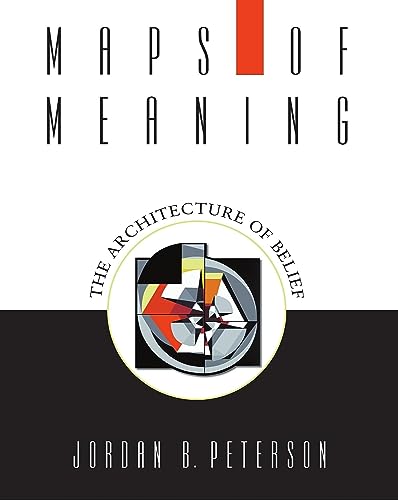
Why have people from different cultures and eras formulated myths and stories with similar structures? What does this similarity tell us about the mind, morality, and structure of the world itself? From the author of 12 Rules for Life: An Antidote to Chaos comes a provocative hypothesis that explores the connection between what modern neuropsychology tells us about the brain and what rituals, myths, and religious stories have long narrated. A cutting-edge work that brings together neuropsychology, cognitive science, and Freudian and Jungian approaches to mythology and narrative, Maps of Meaning presents a rich theory that makes the wisdom and meaning of myth accessible to the critical modern mind.
"synopsis" may belong to another edition of this title.
About the Author
Jordan B. Peterson is a clinical psychologist and Professor at the University of Toronto and was formerly at Harvard University. He has published numerous articles on drug abuse, alcoholism and aggression.
From the Back Cover
Jordan Peterson's book is a brilliant enlargement of our understanding of human motivation. He follows a path that has been recommended by many scientist-scholars in the past - but one that is, in practice, so extraordinarily demanding that it is hardly ever done well. Peterson synthesizes research and scholarly literatures ranging from neuroscience to archaeology. He aligns the finds of those literatures with the writings of such authors as Jung, Nietzsche, Dostoevsky, and Solzhenitsyn. There is loving detail in this book - reflection, thoughtfulness, careful study, a passionate desire to understand. This is a beautiful work. (Sheldon H. White, Chair, Department of Psychology, Harvard University).
From the Inside Flap
Why would people in different places and times formulate myths and stories with similar symbols and meanings? Are groups of people with different religious or ideological beliefs doomed to eternal conflict? Are the claims of science and religion truly irreconcilable? What might be done to decrease the individual propensity for group-fostered cruelty? Maps of Meaning addresses these questions with a provocative new hypothesis that explores the connection between what modern neuropsychology tells us about the brain and what rituals, myths and religious stories have long narrated. Peterson's ambitious interdisciplinary odyssey draws insights from the worlds of religion, cognitive science and Jungian approaches to mythology and narrative. Maps of Meaning offers a critical guide to the riches of archaic and modern thought and invaluable insights into human motivation and cognition.
Excerpt. © Reprinted by permission. All rights reserved.
Self-consciousness means knowledge of individual vulnerability. The process by which this knowledge comes to be can destroy faith in individual worth. This means - in concrete terms - that an individual may come to sacrifice his own experience, in the course of development, because its pursuit creates social conflict, or exposes individual inadequacy. However, it is only through such conflict that change takes place, and weakness must be recognized, before it can be transformed into strength. This means that the sacrifice of individuality eliminates any possibility that individual strength can be discovered or developed, and that the world itself might progress.
Individuals whose life is without meaning hate themselves, for their weakness, and hate life, for making them weak. This hatred manifests itself in absolute identification with destructive power, in its mythological, historical and biological manifestations; manifests itself in the desire for the absolute extinction of existence. Such identification leads man to poison whatever he touches, to generate unnecessary misery in the face of inevitable suffering, to turn his fellows against themselves, to intermingle earth with hell - merely to attain vengeance upon God and his creation.
The human purpose, if such a thing can be considered, is to pursue meaning - to extend the domain of light, of consciousness - in spite of limitation. A meaningful event exists on the boundary between order and chaos. The pursuit of meaning exposes the individual to the unknown in gradual fashion, allowing him to develop strength and adaptive ability in proportion to the seriousness of his pursuit. It is during contact with the unknown that human power grows, individually and then historically. Meaning is the subjective experience associated with that contact, in sufficient proportion. The great religious myths state that continued pursuit of meaning, adopted voluntarily and without self-deception, will lead the individual to discover his identity with God. This "revealed identity" will make him capable of withstanding the tragedy of life. Abandonment of meaning, by contrast, reduces man to his mortal weaknesses. This makes him hate life, and work towards its elimination.
Meaning is the most profound manifestation of instinct. Man is a creature attracted by the unknown; a creature adapted for its conquest. The subjective sense of meaning is the instinct governing rate of contact with the unknown. Too much exposure turns change to chaos; too little promotes stagnation and degeneration. The appropriate balance produces a powerful individual, confident in the ability to withstand life, ever more able to deal with nature and society, ever closer to the heroic ideal. Each individual, constitutionally unique, finds meaning in different pursuits, if he has the courage to maintain his difference. Manifestation of individual diversity, transformed into knowledge that can be transferred socially, changes the face of history itself, and moves each generation of man farther into the unknown.
Social and biological conditions define the boundaries of individual existence. The unfailing pursuit of interest provides the subjective means by which these conditions can be met, and their boundaries transcended. Meaning is the instinct that makes life possible. When it is abandoned, individuality loses its redeeming power. The great lie is that meaning does not exist, or that it is not important. When meaning is denied, hatred for life and the wish for its destruction inevitably rules:
"If you bring forth what is within you, what you bring forth will save you. If you do not bring forth what is within you, what you do not bring forth will destroy you."
"About this title" may belong to another edition of this title.
Search results for Maps of Meaning: The Architecture of Belief

Stock Image
Maps of Meaning: The Architecture of Belief
Seller: Bookmans, Tucson, AZ, U.S.A.
Seller rating 5 out of 5 stars

Paperback. Condition: Acceptable. Minor Water Damage Satisfaction 100% guaranteed. Seller Inventory # mon0002769713
Stock Image
Maps of Meaning : The Architecture of Belief
Seller: Better World Books, Mishawaka, IN, U.S.A.
Seller rating 5 out of 5 stars
Condition: Good. Pages intact with minimal writing/highlighting. The binding may be loose and creased. Dust jackets/supplements are not included. Stock photo provided. Product includes identifying sticker. Better World Books: Buy Books. Do Good. Seller Inventory # 9488548-75
Stock Image
Maps of Meaning : The Architecture of Belief
Seller: Better World Books: West, Reno, NV, U.S.A.
Seller rating 5 out of 5 stars
Condition: Very Good. Pages intact with possible writing/highlighting. Binding strong with minor wear. Dust jackets/supplements may not be included. Stock photo provided. Product includes identifying sticker. Better World Books: Buy Books. Do Good. Seller Inventory # 10150215-6
Stock Image
Maps of Meaning : The Architecture of Belief
Seller: Better World Books, Mishawaka, IN, U.S.A.
Seller rating 5 out of 5 stars
Condition: Very Good. Pages intact with possible writing/highlighting. Binding strong with minor wear. Dust jackets/supplements may not be included. Stock photo provided. Product includes identifying sticker. Better World Books: Buy Books. Do Good. Seller Inventory # 10150215-6
Stock Image
Maps of Meaning: The Architecture of Belief
Seller: Wonder Book, Frederick, MD, U.S.A.
Seller rating 5 out of 5 stars
Condition: Good. Good condition. A copy that has been read but remains intact. May contain markings such as bookplates, stamps, limited notes and highlighting, or a few light stains. Seller Inventory # J14Q-01587
Seller Image
Maps of Meaning: The Architecture of Belief
Seller: Zoom Books East, Glendale Heights, IL, U.S.A.
Seller rating 5 out of 5 stars
Condition: very_good. Book is in very good condition and may include minimal underlining highlighting. The book can also include "From the library of" labels. May not contain miscellaneous items toys, dvds, etc. . We offer 100% money back guarantee and 24 7 customer service. Seller Inventory # ZEV.0415922224.VG
Seller Image
Maps of Meaning: The Architecture of Belief
Seller: Zoom Books Company, Lynden, WA, U.S.A.
Seller rating 5 out of 5 stars
Condition: very_good. Book is in very good condition and may include minimal underlining highlighting. The book can also include "From the library of" labels. May not contain miscellaneous items toys, dvds, etc. . We offer 100% money back guarantee and 24 7 customer service. Seller Inventory # ZBV.0415922224.VG
Stock Image
Maps of Meaning: The Architecture of Belief
Seller: Bookmans, Tucson, AZ, U.S.A.
Seller rating 5 out of 5 stars
Paperback. Condition: Good. Satisfaction 100% guaranteed. Seller Inventory # mon0001909913
Stock Image
Maps of Meaning: The Architecture of Belief
Seller: New Legacy Books, Annandale, NJ, U.S.A.
Seller rating 5 out of 5 stars
paperback. Condition: Good. Fast shipping and order satisfaction guaranteed. A portion of your purchase benefits Non-Profit Organizations, First Aid and Fire Stations! Seller Inventory # mon0000126180
Seller Image
Maps of Meaning: The Architecture of Belief
Seller: Zoom Books East, Glendale Heights, IL, U.S.A.
Seller rating 5 out of 5 stars
Condition: good. Book is in good condition and may include underlining highlighting and minimal wear. The book can also include "From the library of" labels. May not contain miscellaneous items toys, dvds, etc. . We offer 100% money back guarantee and 24 7 customer service. Seller Inventory # ZEV.0415922224.G