
Synopsis
Detective Peter Decker teams up with his wife and daughter to solve a crime rooted in both the past and present.
While on routine patrol, LAPD Officer Cindy Decker rescues a newborn abandoned in an alley dumpster. But she can't call it a night until she sees the infant safe in a hospital, cared for by a professional -- in this case a male nurse with soulful eyes and lots of charm.
Now the hunt is on for the mother. Armed with advice from her overworked father, Detective Peter Decker, Cindy plunges into her inner-city Hollywood district, a world of helpless people and violent gangs. Pursuing each new lead batters her complex relationships and endangers her life.
On one side: Decker and Decker, a brilliant but combative pair. On the other: a vicious killer ready to strike again. While on routine patrol, LAPD officer Cindy Decker rescues a newborn abandoned in an alley dumpster. Cindy searches for the mother in inner -city Hollywood, following a treacherous trail filled with drug lords. But with each new lead, the twisted journey gets darker -- and endangering her very life. When Decker and Decker join forces, can this edgy duo put personal issues aside to catch a vicious culprit before he strikes again?
"synopsis" may belong to another edition of this title.
About the Author
Faye Kellerman is the author of twenty-six novels, including nineteen New York Times bestselling mysteries that feature the husband-and-wife team of Peter Decker and Rina Lazarus. She has also penned two bestselling short novels with her husband, New York Times bestselling author Jonathan Kellerman, and has teamed up with her daughter Aliza to co-write a teen novel entitled Prism. She lives in Los Angeles, California, and Santa Fe, New Mexico.
Excerpt. © Reprinted by permission. All rights reserved.
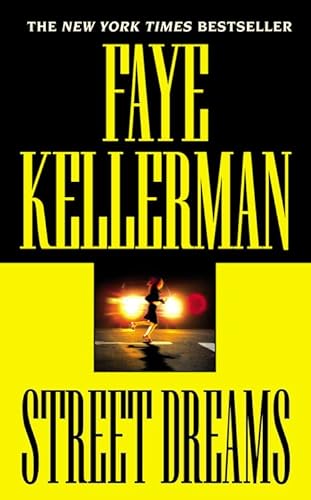
Street Dreams
By Faye KellermanWarner Vision
Copyright © 2003 Faye KellermanAll right reserved.
ISBN: 0-446-61404-1
Chapter One
I saw him frantically waving the white flag, a man admitting defeat.As I pulled the cruiser into one of the alley's parking spaces,blocking a silver Mercedes S500, I realized that the banner was, infact, a napkin. He wore a solid wall of white, the hem of a long,stained apron brushing his white jeans midshin. Though it was night,I could see a face covered with moisture. Not a surprise because theair was a chilly mist: typical May-gloom weather in L.A. I radioedmy whereabouts to the dispatcher and got out, my right hand on mybaton, the other swinging freely at my side. The alley stank ofgarbage, the odor emanating from the trash bins behind therestaurant. The flies, normally shy in the dark, were having a fieldday.The rear area of The Tango was illuminated by a strong yellowspotlight above the back door. The man in white was short,five-seven at the most, with a rough, tawny complexion, a blackmustache, and hands flapping randomly. He was agitated, talkingbullet-speed Spanish. I picked up a few words, but didn't ask him tostop and translate, because I heard the noise myself-the highpitchedwails of a baby.
"Where?" I yelled over his words. "Dnde?"
"Aqu, aqu!" He was pointing to an army-green Dumpster filled tothe brim with blue plastic refuse bags.
"Call 911." I ran to the site and pulled out several bags, tearingone open and exposing myself to a slop of wilted salad greens, mushyvegetables, and golf balls of gray meat and congealed fat. As Isifted through the trash, my clean, pressed uniform and I becameperformance art, the deep blue cloth soaking up the oils and stainsof previously pricey edibles. "I need help! Necesito ayuda! Ahorita."
"S, s!" He dashed back inside.
The crying was getting louder and that was good, but there was stillno sign of the wail's origin. My heart was slamming against my chestas I sorted through the top layer of bags. The bin was deep. Ineeded to jump inside to remove all the bags, but I didn't want tostep on anything until I had checked it out. Three men came runningout of the back door.
"Escalera!"-a ladder-I barked. "Yo necisito una escalera."
One went back inside, the other two began pulling out bags.
"Careful, careful!" I screamed. "I don't know where it is!" I usedthe word "it" because it could have been a thrown-away kitten. Whenagitated, felines sound like babies. But all of us knew it wasn't acat.
Finally, the ladder appeared and I scurried up the steps, gingerlyremoving enough bags until I could see the bottom, a disc of dirtymetal under the beam of my flashlight. I went over legs first and,holding the rim with my hands, lowered myself to the bottom. Ipicked a bag at random, checked inside, then hoisted it over the topwhen I satisfied myself that it didn't contain the source of thenoise.
Slow, Cindy, I told myself. Don't want to mess this up.
With each bag removed, I could hear myself getting closer to thesound's origin. Someone had taken the time to bury it. Fury welledinside me, but I held it at bay to do a job. At the bottom layer, Ihit pay dirt-a newborn girl with the cord still attached to hernavel, her face and body filthy, her eyes scrunched up, her criesstrong and tearless. I yelled out for something to wrap her in, andthey handed me a fresh, starched tablecloth. I wiped down the body,cleaned out the mouth and nose as best as I could, and bundled herup-umbilicus and all. I held her up so someone could take her fromme. Then I hoisted myself up and out.
The man who had flagged me down offered me a wet towel. I wiped downmy hands and face. I asked him his name.
"Martino Delacruz."
"Good job, Seor Delacruz!" I smiled at him. "Buen trabajo."
The man's eyes were wet.
Moments later, the bundle was passed back to me. I felt grubbyholding her, but obviously since I was the only woman in the crowd,I was supposed to know about these kinds of things.
Actually, I did know a thing or two about infants, having a halfsister eighteen years my junior. Her mother, Rina-my stepmother-hadbecome very ill after childbirth and guess who stepped up to theplate when my father was in a near state of collapse? (Who couldhave blamed him? Rina almost died.)
The positive side was the sisterly bonding, at least on my part.Hannah Rosie Decker was my only blood sibling, and they didn't comeany cuter or better than she. I adored her. Matter of fact, I likedmy father's family very much. Rina's sons were great kids and Iloved them and respected them as much as anyone could love andrespect step-relatives. Rina took wonderful care of my father, afeat worth noting because Dad was not the easiest person to getalong with. I knew this from firsthand experience.
"Did anyone call 911?"
"Yo hable." Delacruz handed me another clean rag to wipe my dirtyface.
"Thank you, seor." I had put a clean napkin over my shoulder andwas rocking the baby against my chest. "If you can, get some warmsugar water and dunk a clean napkin into it. Then bring it to me."
The man was off in a flash. The baby's cries had quieted to softsobs. I suddenly noticed that my own cheeks were warm and wet,thrilled that this incident had resolved positively. Delacruz wasback with the sugar water-soaked napkin. I took it and put the tipof a corner into her mouth. Immediately, she sucked greedily. In thedistance I heard a wail of sirens.
"We've got to get you to the hospital, little one. You're one heckof a strong pup, aren't you?"
I smelled as overripe as rotten fruit. I placed the infant back intoDelacruz's arms. "Por favor, give her to the ambulance people. Ineed to wash my hands."
He took the bundle and began to walk with her. It was one of thoseKodak moments, this macho man cooing in Spanish to this tiny,displaced infant. The job had its heartbreak, but it also had itsrewards.
After rotating my shoulders to release the tension, I went throughthe back door of The Tango and asked one of the dishwashers where Icould clean up. I heard a gasp and turned around. A man wearing atoque was shooing me away with dismissive hands. "Zis is a foodestablishment! You cannot come in here like zat!"
"Someone dumped a baby in the trash outside." My stare was fierceand piercing. "I just rescued her by opening up fifteen bags ofgarbage. I need to wash my hands!"
Toque was confused. "Here? A bb?"
"Yes, sir! Here! A bb!" I spotted a cloud of suds that had filledup a sink. Wordlessly, I walked over and plunged my hands insidevery warm water. What the heck! All the china went into a dishwasheranyway, right? After ridding my hands of the grime, I ran the coldwater full blast and washed my face. One of the kitchen workers wasnice enough to offer me a clean towel. I dried myself off and lookedup.
The ambulance had arrived, red strobe lights pulsing through thewindows. I pointed to Mr. Toque and gave him my steely-eyed look."Like heartburn, I'll be back. Don't go anywhere."
The EMTs had already cut the cord and were cleaning her up. Iregarded the medics as they did their job. A sturdy black woman washolding the baby in her arms while a thin white kid with aconsumptive complexion was carefully wiping down the infant's face.Both were gloved.
"How's she doing?" I asked.
They looked up. The thin kid smiled when he saw me. "Whew, you mustabeen hungry."
The kid's name tag said B. HANOVER. I gave him a hard stare and herecoiled. "Jeez. Just trying out a little levity, Officer. It breaksthe tension."
"How's she doing?" I repeated.
The woman answered. Her name was Y. Crumack. "Fine, so far ... asuccess story."
"That's always nice."
The infant's placenta had been bagged and was resting on the grounda couple of feet away. It would be taken to a pathology lab, thetissue examined for disease and genetic material that might identifyher. For no good reason, I picked up the bag.
Crumack said, "We'll need that. It has to be biopsied."
"Yeah, I know. Where are you taking her?"
"Mid-City Pediatric Hospital."
"The one on Vermont," I said.
"Only one I know," Hanover said. "Any ideas about the mom?"
"Not a clue."
"You should find her," Hanover informed me. "It would help everyoneout."
"Wow, I hadn't thought about that," I snapped. "Thanks for sharing."
"No need to get testy," Hanover sneered.
Crumack opened the back door, strapping the baby in an infant seat.The wailing had returned. I assumed that to be a positive sign. Igave her the bagged placenta and she placed it in the ambulance.
"She sounds hungry," I said.
"Starved," Crumack answered. "Her abdomen is empty."
"Her head looks ... I don't know ... elongated, maybe? What'sthat all about?"
"Probably from being pushed out of the birth canal. Main thing is,it isn't crushed. She was real lucky, considering all the thingsthat could have gone wrong. She could've swallowed something andchoked; she could've suffocated; she could've been crushed. This isan A-one outcome." She patted my shoulder. "And you're part of it."
I felt my eyes water. "Hey, don't look at me, thank Seor Delacruz,"I told her. "He's got good ears."
The man knew enough English to recognize a compliment. His smile wasbroad.
"Any idea how many hours she's been alive?" I asked the techs.
Hanover said, "Her body temperature hasn't dropped that much. Ofcourse, she was insulated in all that garbage. I'd say a fairlyrecent dump."
"So what are we talking about?" I asked. "Two hours? Four hours?"
"Maybe," Crumack said. "Six hours, max."
I checked my watch. It was ten-thirty. "So she was dumped aroundfour or five in the afternoon?"
"Sounds about right." Crumack turned to his partner. "Let's go."
I called out, "Mid-City Pediatric!"
Hanover reconfirmed it, slid behind the wheel, and shut the door,moving on out with sirens blaring and lights blazing. My arms feltincredibly empty. Although I rarely thought about my biologicalclock-I was only twenty-eight-I was suddenly pricked by maternalpangs. It felt good to give comfort. Long ago, that was my primaryreason for becoming a cop.
The clincher was my father, of course.
He had discouraged me from entering the profession. Being theridiculously stubborn daughter I was, his caveats had the oppositeeffect. There were taut moments between us, but most of that hadbeen resolved. I truly loved being a cop and not because I hadunresolved Freudian needs. Still, if I had been sired by a"psychologist dad" instead of a "lieutenant dad," I probably wouldhave become a therapist.
I unhooked my radio from my belt and called the dispatcher,requesting a detective to the scene.
(Continues...)
Excerpted from Street Dreams by Faye Kellerman Copyright © 2003 by Faye Kellerman. Excerpted by permission.
All rights reserved. No part of this excerpt may be reproduced or reprinted without permission in writing from the publisher.
Excerpts are provided by Dial-A-Book Inc. solely for the personal use of visitors to this web site.
"About this title" may belong to another edition of this title.
Other Popular Editions of the Same Title

Search results for Street Dreams

Stock Image
Street Dreams
Seller: World of Books (was SecondSale), Montgomery, IL, U.S.A.
Seller rating 5 out of 5 stars

Condition: Good. Item in good condition. Textbooks may not include supplemental items i.e. CDs, access codes etc. Seller Inventory # 00065013623
Stock Image
Street Dreams
Seller: World of Books (was SecondSale), Montgomery, IL, U.S.A.
Seller rating 5 out of 5 stars
Condition: Acceptable. Item in good condition. Textbooks may not include supplemental items i.e. CDs, access codes etc. Seller Inventory # 00054142571
Seller Image
Street Dreams
Seller: Dream Books Co., Denver, CO, U.S.A.
Seller rating 5 out of 5 stars
Condition: acceptable. This copy has clearly been enjoyedâ"expect noticeable shelf wear and some minor creases to the cover. Binding is strong, and all pages are legible. May contain previous library markings or stamps. Seller Inventory # 4EKGY3008K7G_ns
Stock Image
Street Dreams
Seller: Gulf Coast Books, Cypress, TX, U.S.A.
Seller rating 5 out of 5 stars
Mass Market Paperback. Condition: Good. Seller Inventory # 0446614041-3-18534939
Seller Image
Street Dreams
Seller: Zoom Books Company, Lynden, WA, U.S.A.
Seller rating 5 out of 5 stars
Condition: very_good. Book is in very good condition and may include minimal underlining highlighting. The book can also include "From the library of" labels. May not contain miscellaneous items toys, dvds, etc. . We offer 100% money back guarantee and 24 7 customer service. Seller Inventory # ZBV.0446614041.VG
Seller Image
Street Dreams
Seller: Zoom Books Company, Lynden, WA, U.S.A.
Seller rating 5 out of 5 stars
Condition: good. Book is in good condition and may include underlining highlighting and minimal wear. The book can also include "From the library of" labels. May not contain miscellaneous items toys, dvds, etc. . We offer 100% money back guarantee and 24 7 customer service. Seller Inventory # 5AAT2I003MXR_ns
Seller Image
Street Dreams
Seller: Greenworld Books, Arlington, TX, U.S.A.
Seller rating 5 out of 5 stars
Condition: good. Fast Free Shipping â" Good condition. It may show normal signs of use, such as light writing, highlighting, or library markings, but all pages are intact and the book is fully readable. A solid, complete copy that's ready to enjoy. Seller Inventory # GWV.0446614041.G
Seller Image
Street Dreams
Seller: Greenworld Books, Arlington, TX, U.S.A.
Seller rating 5 out of 5 stars
Condition: very_good. Fast Free Shipping â" Very Good condition book with a firm cover and clean pages. Shows normal use and some light wear or limited notes markings. A solid, nice copy to enjoy. Seller Inventory # GWV.0446614041.VG
Seller Image
Street Dreams
Seller: Bay State Book Company, North Smithfield, RI, U.S.A.
Seller rating 5 out of 5 stars
Condition: good. The book is in good condition with all pages and cover intact, including the dust jacket if originally issued. The spine may show light wear. Pages may contain some notes or highlighting, and there might be a "From the library of" label. Boxed set packaging, shrink wrap, or included media like CDs may be missing. Seller Inventory # BSM.17YUC
Stock Image
Street Dreams
Seller: Evergreen Goodwill, Seattle, WA, U.S.A.
Seller rating 5 out of 5 stars
mass_market. Condition: Acceptable. Seller Inventory # mon0000186565