
Synopsis
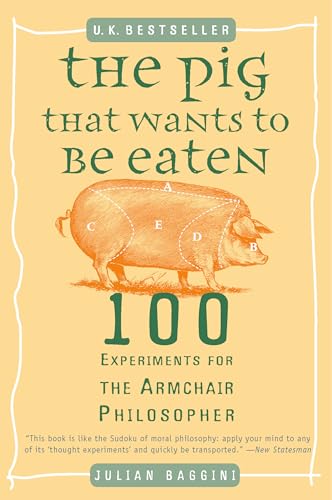
In this captivating collection of philosophical puzzles, Julian Baggini serves up a mental feast that will leave you craving more.
The perfect gift for lovers of philosophy or mining intelligent ice-breaker topics for your next party, The Pig That Wants to Be Eaten offers one hundred philosophical puzzles that stimulate thought on a host of moral, social, and personal dilemmas. Taking examples from sources as diverse as Plato and Steven Spielberg, author Julian Baggini presents abstract philosophical issues in concrete terms, suggesting possible solutions while encouraging readers to draw their own conclusions.
"synopsis" may belong to another edition of this title.
About the Author
Julian Baggini is a philosopher and the author of several books about philosophy written for a general audience. He is co-founder of The Philosophers' Magazine and lives in England. Baggini has written for numerous newspapers and magazines including the Wall Street Journal, the Financial Times, Prospect and the Guardian, as well as for the think tanks The Institute of Public Policy Research, Demos and Counterpoint.
From the Back Cover
"Thinking again is what this taut, incisive, bullet-hard book is dedicated to promoting."
The Sunday Times (London)
"This book is like the Sudoku of moral philosophy: apply your mind to any of its thought experiments while stuck on the Tube, and quickly be transported out of rush-hour hell."
New Statesman
Reviews
For Stelios, the teletransporter is the only way to travel." So begins one of the 100 philosophically based brain teasers in Baggini's clever book. Each entry includes an imagined scenario, which is based on sources from Plato to Sir Bernard Williams, followed by commentary that introduces a series of mind-bending questions and broadens the possible contexts: e.g., if Stelios's body is disintegrated and then recomposed by the transporter, is Stelios still the same person he was? Is it ever ethical to eat animals, even if they want to be eaten? Is there really an all-powerful, all-knowing and all-loving God? Is it right to do something wrong if it doesn't hurt anyone? Is torture ever a good option? Baggini, the editor of the U.K.'s Philosopher's Magazine, offers no firm answers, only hints as to where the discussion might go next. The conceit of the volume forces some repetitiveness and some simplification, but overall, it effectively explores aesthetics, ethics, language, logic, religion, mind and the self. More importantly, it's hugely entertaining. Any one of these thought experiments would serve as a great party game, keeping the conversation going for hours. (July)
Copyright © Reed Business Information, a division of Reed Elsevier Inc. All rights reserved.
"About this title" may belong to another edition of this title.
Other Popular Editions of the Same Title

Search results for The Pig That Wants to Be Eaten: 100 Experiments for...

Seller Image
The Pig That Wants to Be Eaten: 100 Experiments for the Armchair Philosopher
Seller: Goodwill of Colorado, COLORADO SPRINGS, CO, U.S.A.
Seller rating 5 out of 5 stars

Condition: good. All pages and cover are intact. Dust jacket included if applicable, though it may be missing on hardcover editions. Spine and cover may show minor signs of wear including scuff marks, curls or bends to corners as well as cosmetic blemishes including stickers. Pages may contain limited notes or highlighting. "From the library of" labels may be present. Shrink wrap, dust covers, or boxed set packaging may be missing. Bundled media e.g., CDs, DVDs, access codes may not be included. Seller Inventory # COLV.0452287448.G
Seller Image
The Pig That Wants to Be Eaten: 100 Experiments for the Armchair Philosopher
Seller: Zoom Books East, Glendale Heights, IL, U.S.A.
Seller rating 5 out of 5 stars
Condition: good. Book is in good condition and may include underlining highlighting and minimal wear. The book can also include "From the library of" labels. May not contain miscellaneous items toys, dvds, etc. . We offer 100% money back guarantee and 24 7 customer service. Seller Inventory # ZEV.0452287448.G
Seller Image
The Pig That Wants to Be Eaten: 100 Experiments for the Armchair Philosopher
Seller: -OnTimeBooks-, Phoenix, AZ, U.S.A.
Seller rating 5 out of 5 stars
Condition: good. A copy that has been read, remains in good condition. All pages are intact, and the cover is intact. The spine and cover show signs of wear. Pages can include notes and highlighting and show signs of wear, and the copy can include "From the library of" labels or previous owner inscriptions. 100% GUARANTEE! Shipped with delivery confirmation, if you're not satisfied with purchase please return item! Ships via media mail. Seller Inventory # OTV.0452287448.G
Stock Image
The Pig That Wants to Be Eaten: 100 Experiments for the Armchair Philosopher
Seller: Wonder Book, Frederick, MD, U.S.A.
Seller rating 5 out of 5 stars
Condition: Good. Good condition. A copy that has been read but remains intact. May contain markings such as bookplates, stamps, limited notes and highlighting, or a few light stains. Seller Inventory # M03A-05799
Stock Image
The Pig That Wants to Be Eaten: 100 Experiments for the Armchair Philosopher
Seller: Wonder Book, Frederick, MD, U.S.A.
Seller rating 5 out of 5 stars
Condition: Very Good. Very Good condition. A copy that may have a few cosmetic defects. May also contain light spine creasing or a few markings such as an owner's name, short gifter's inscription or light stamp. Seller Inventory # T11B-05990
Stock Image
The Pig That Wants to Be Eaten: 100 Experiments for the Armchair Philosopher
Seller: Half Price Books Inc., Dallas, TX, U.S.A.
Seller rating 5 out of 5 stars
Paperback. Condition: Very Good. Connecting readers with great books since 1972! Used books may not include companion materials, and may have some shelf wear or limited writing. We ship orders daily and Customer Service is our top priority! Seller Inventory # S_451602049
Stock Image
The Pig That Wants to Be Eaten: 100 Experiments for the Armchair Philosopher
Seller: ThriftBooks-Reno, Reno, NV, U.S.A.
Seller rating 5 out of 5 stars
Paperback. Condition: Fair. No Jacket. Readable copy. Pages may have considerable notes/highlighting. ~ ThriftBooks: Read More, Spend Less. Seller Inventory # G0452287448I5N00
Stock Image
The Pig That Wants to Be Eaten: 100 Experiments for the Armchair Philosopher
Seller: ThriftBooks-Phoenix, Phoenix, AZ, U.S.A.
Seller rating 5 out of 5 stars
Paperback. Condition: Fair. No Jacket. Readable copy. Pages may have considerable notes/highlighting. ~ ThriftBooks: Read More, Spend Less. Seller Inventory # G0452287448I5N00
Stock Image
The Pig That Wants to Be Eaten: 100 Experiments for the Armchair Philosopher
Seller: ThriftBooks-Atlanta, AUSTELL, GA, U.S.A.
Seller rating 5 out of 5 stars
Paperback. Condition: Fair. No Jacket. Readable copy. Pages may have considerable notes/highlighting. ~ ThriftBooks: Read More, Spend Less. Seller Inventory # G0452287448I5N00
Stock Image
The Pig That Wants to Be Eaten: 100 Experiments for the Armchair Philosopher
Seller: ThriftBooks-Atlanta, AUSTELL, GA, U.S.A.
Seller rating 5 out of 5 stars
Paperback. Condition: Good. No Jacket. Pages can have notes/highlighting. Spine may show signs of wear. ~ ThriftBooks: Read More, Spend Less. Seller Inventory # G0452287448I3N00