
Items related to Social Skills Activities: For Secondary Students With...
Synopsis
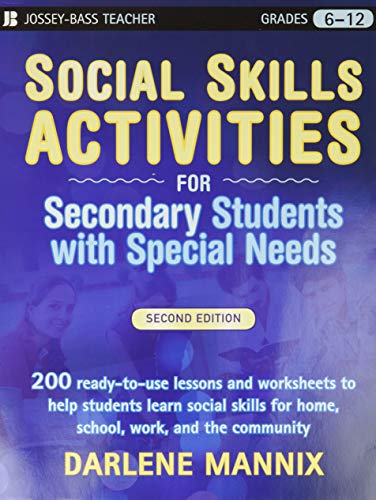
A flexible, ready-to-use activities program to help special students in grades 6-12
The updated new edition of this valuable resource offers an exciting collection of 200 ready-to-use worksheets to help adolescents build the social skills they need to interact effectively with others and learn how to apply these skills to various real-life settings, situations, and problems. The book provides 20 complete teaching units focusing on 20 basic social skills, such as being a good listener, "reading" other people, and using common sense.
"synopsis" may belong to another edition of this title.
About the Author
The Author
DARLENE MANNIX, M.A., has taught both general education and special education, and she has worked with students ranging from learning disabled and mentally challenged to language disordered and severely emotionally disturbed. Mannix is the best-selling author of numerous books for special educators including Social Skills Activities for Special Children and Life Skills Activities for Special Children.
From the Back Cover
Social Skills Activities for Secondary Students with Special Needs
SECOND EDITION
This thoroughly revised, updated, and expanded edition offers a practical resource for teachers who work with special students in grades 6-12. It is an essential aid to help middle and high school students gain the social skills necessary for success in school and in life. Designed as a self-contained program, the book outlines a flexible, ready-to-use approach (complete with reproducible activities) to help exceptional students learn and put into practice appropriate ways to behave among others. The activities offered here not only teach kids how to get along with others, but also help them learn to control a situation by actively participating and contributing to the social outcome.
Veteran special educator Darlene Mannix provides 20 complete teaching units focusing on essential social skills such as being a good listener, "reading" other people, and using common sense. These are followed by 75 reproducible worksheets that help students practice applying the social skills to real-life situations in five different settings: home, school, work, among peers, and in the community. The worksheets cover routine as well as unusual situations and can be used in any order after students have completed the basic social skills training outlined in the book.
PRAISE FOR SOCIAL SKILLS ACTIVITIES FOR SECONDARY STUDENTS WITH SPECIAL NEEDS
"Darlene Mannix's Social Skills Activities for Secondary Students with Special Needs does what many books don't do—it promotes the use of social-emotional skills with peers and adults across a variety of settings. Teachers will find this book practical and easy to use."
—NICK ELKSNIN, PH.D., NCSP, Learning & Evaluation Resources, and LINDA K. ELKSNIN, PH.D., professors emerita, The Citadel; authors, Teaching Social-Emotional Skills at School and Home
"This book helps teachers address a wide spectrum of social challenges—from those faced by all teens to the challenges seen in students with more significant skill deficits. Academic and transition teachers will find this book a useful tool for their libraries."
—CHRIS SCHNIEDERS, PH.D., director of teacher training, Frostig Center, Pasadena, California
From the Inside Flap
Social Skills Activities for Secondary Students with Special Needs
SECOND EDITION
This thoroughly revised, updated, and expanded edition offers a practical resource for teachers who work with special students in grades 6-12. It is an essential aid to help middle and high school students gain the social skills necessary for success in school and in life. Designed as a self-contained program, the book outlines a flexible, ready-to-use approach (complete with reproducible activities) to help exceptional students learn and put into practice appropriate ways to behave among others. The activities offered here not only teach kids how to get along with others, but also help them learn to control a situation by actively participating and contributing to the social outcome.
Veteran special educator Darlene Mannix provides 20 complete teaching units focusing on essential social skills such as being a good listener, "reading" other people, and using common sense. These are followed by 75 reproducible worksheets that help students practice applying the social skills to real-life situations in five different settings: home, school, work, among peers, and in the community. The worksheets cover routine as well as unusual situations and can be used in any order after students have completed the basic social skills training outlined in the book.
PRAISE FOR SOCIAL SKILLS ACTIVITIES FOR SECONDARY STUDENTS WITH SPECIAL NEEDS
"Darlene Mannix's Social Skills Activities for Secondary Students with Special Needs does what many books don't do—it promotes the use of social-emotional skills with peers and adults across a variety of settings. Teachers will find this book practical and easy to use."
—NICK ELKSNIN, PH.D., NCSP, Learning & Evaluation Resources, and LINDA K. ELKSNIN, PH.D., professors emerita, The Citadel; authors, Teaching Social-Emotional Skills at School and Home
"This book helps teachers address a wide spectrum of social challenges—from those faced by all teens to the challenges seen in students with more significant skill deficits. Academic and transition teachers will find this book a useful tool for their libraries."
—CHRIS SCHNIEDERS, PH.D., director of teacher training, Frostig Center, Pasadena, California
Excerpt. © Reprinted by permission. All rights reserved.
Social Skills Activities for Secondary Students with Special Needs
By Darlene MannixJohn Wiley & Sons
Copyright © 2009 Darlene MannixAll right reserved.
ISBN: 978-0-470-25936-8
Chapter One
Skills to Make a Good Impression
Skill 1: Making a First Impression
Skill 2: Thinking About My Behavior
Skill 3: Getting Rid of Annoying Tendencies
Skill 4: Having a Pleasant Voice and Breath
Skill 5: Being a Good Listener
Skill 6: Sharpening My Communication Skills
Skill 7: Sizing Up My Reputation
TEN TIPS FOR TEACHERS
Here are some classroom tips to help students learn to convey a pleasing, positive image to others:
1. Recognize leadership in students and affirm them by calling attention to positive examples. "You did an excellent job of collecting and organizing everyone's projects. I know I can count on you to follow through on a job."
2. Have students write a semihumorous handbook (complete with pictures) of Dos and Don'ts for various social situations. Ideas might include What to Wear on a Date to a Hockey Game, 50 Starter Statements for Meeting That Special Someone, How to Impress Your Science Teacher, and the like.
3. To develop listening skills, have students tape-record conversations with a partner for three to five minutes. Have each partner try to repeat the highlights of what the other person said. Then replay the tape. How closely did each person listen to the other?
4. Call on all students, making a special effort with the reluctant, quiet ones, so that each student knows that he or she is expected to participate in conversations and discussions within the class. Explain that teachers really like it when a student is engaged in a lively class discussion.
5. Find pictures of teenagers engaged in common social activities and have students write a bubble that says what they think each person is saying. Ask them to explain what clues they used to determine what was being said. Could this apply in any way to what they look like to others?
6. Use the term "reputation" in your discussions of manufacturers, products, places, resorts, and other things. Talk about how reputations can make a difference in what kind of car you like, what type of dog you pick for a pet, where you go out to eat, and so on. What goes into making a good reputation?
7. Bring in political cartoons that depict celebrities as caricatures. Discuss how these exaggerated attributes overlap with someone's reputation. Why are these caricatures humorous?
8. Play short segments of music or recordings of well-known people (for example, popular singer, actor, commercial with celebrity). How quickly can the student identify the person by the voice alone? Are there certain voices that they find interesting, annoying, pleasing, or other characteristics? What do they think their own voice conveys to others?
9. Talk about the movie or play My Fair Lady, in which a lower-class woman is transformed into a beautiful lady of status as a experiment. What factors contributed to changing Liza Doolittle's effect on other people? How important are language, choice of words, appearance, posture, and body movements in influencing what others think?
10. To highlight work ethic in the classroom, start a counting system, such as fifty days without a single lost assignment, seven days without a failed test, nineteen days with perfect attendance, and so on.
TEN POINTERS FOR PARENTS
Here are some ideas for parents to use at a home and in the community to help their child create a good impression on family members and community people.
1. Introduce your child to your friends or acquaintances when the opportunity comes up. Let him or her see how you use names, eye contact, and a bit of information to connect people in the environment. ("This is my son Johnny. He's the one who loves to play the guitar.")
2. Talk about what was socially appropriate for making a good impression thirty to fifty years ago. You might want to include grandparents in this activity. Some examples may include the areas of fashion (boys wore suits and ties to a lot more places, girls wore hats and gloves), conversation (ladies did not talk about certain subjects in mixed groups), and habits (smoking, drinking, and the like).
3. Before your child goes into a potentially embarrassing situation, prepare him as much as possible. "Look, I know you don't like to go to the dentist, but getting upset while sitting in the waiting room with a lot of people around is not the best time to be angry about it. Let's go over what's going to happen, and then talk about how you are planning to handle it."
4. When your child is given a job to do, have her repeat all the steps of the task back to you before turning her loose. Make sure you discuss when the job is actually finished. Agree on this at the beginning, not while the job is still in progress.
5. Help your child clarify attributes about himself that make up a good reputation by telling him some things that you think characterize him. "You are always on time!" "Everyone loves when you are the babysitter-you really get into playing with the kids."
6. Ask your child to tell you about what it takes "these days" to have a good reputation. Who are some students who are particularly admired? Are they admired for things that they do or say? Or how they think? Find out!
7. Take pictures of your child (if she doesn't resist!). Use opportunities when the family is together for events or holidays. As you look through the pictures, use them as an opportunity to talk about how your child appears to others. "Look at how tall you are!" "You have the nicest smile. I bet people think you are very friendly."
8. Pull out old high school pictures of yourself or other adult friends. After you have shared a good laugh, talk about why it was important to look like everyone else to fit in. You may find some similarities in reasons to dress, speak, dance, and engage in other activities that the previous generation did not understand.
9. Involve your child as much as possible in volunteering or community events. Most volunteer coordinators will appreciate the help, and being complimented by an adult who is not a family member will be encouraging to your child.
10. Being a good sport about sports (winning or losing) is another opportunity to express to your child the importance of how he or she appears to others. Maybe the umpire needs glasses and the referee is asleep, but a player's integrity and demeanor in unfair (perceived or real) situations say a lot about him. Sometimes you get a break; sometimes you don't.
Skill 1: Making a First Impression
INSTRUCTOR PAGES
Rationale: People make quick judgments about many things based on a first impression. How you look, what you say, how you act, and other factors convey a message. Assuming that you want to give a good impression, you would want to pay attention to these things.
Worksheet 1: What Is a Good Impression?
After reading the paragraphs comparing job applicants, students are to complete sentences that summarize the impressions made.
Answer Key:
1. look; 2. habit; 3. friendly, confident, experience; 4. impression
Worksheet 2: Your Appearance
Students are to select which of the two characters in each situation appears to be more suited for the situation.
Answer Key:
1. first; 2. second; 3. first; 4. first; 5. second; 6. first; 7. first; 8. second
Worksheet 3: Your Attitude
On this worksheet, characters are giving impressions to others about their attitude. Students are to match the attitude given with the impression that it makes.
Answer Key:
1. f; 2. d; 3. a; 4. c; 5. e; 6. b
Worksheet 4: Getting Prepared
Students are to think about the situations on the worksheet and come up with ideas for how they could best prepare to give a good impression for the message they want to convey.
Worksheet 5: Asking Appropriate Questions
Students are to discuss the inappropriateness of the questions asked by the characters on the worksheet.
Answer Key (answers may vary):
1. Bad taste
2. Embarrassing for the person
3. Too personal
4. Implies you made a mistake
5. Nosey, not his business
6. Obnoxious
Name ________________________________________________________ Date __________
Worksheet 1
What Is a Good Impression?
You are the owner of a jewelry store and need some extra help at the counter. After placing an ad in the paper, you have received several phone calls. You are planning to interview several possible workers. "Hello," a young man says to you. "I'm here to apply for the job." You notice his ripped jeans and his old shirt. His hair is long and messed up. You wonder how long it has been since he washed it! Or took a bath! "Sorry," you hear yourself saying. "I don't think you're right for the job." You had an idea of the kind of person you wanted to hire-someone who looked quite different from the young man who showed up. You were disappointed. He didn't appear to be someone you wanted for the position. You didn't like the way he looked.
Another applicant comes by. At first you are quite interested in the pretty blonde girl who comes to your office. Her hair is combed nicely, her clothes are expensive, and-thank goodness-you are sure you smell the newest perfume. "Well, so you are here to apply for the job of a clerk," you say to her. "What's your name?" She opens her mouth and does not stop talking for twenty minutes. She has told you her life story, every detail from kindergarten to shopping at the mall yesterday. You are certain that any customer who asked her a question would get much more than they bargained for. You don't like this habit.
Next.
Your next applicant is an older woman. "Good afternoon," she greets you. Her smile is friendly, and she appears to be very self-confident. You find out that she has had lots of experience in sales. She also compliments you on your ruby ring. Now you know she knows something about jewelry! "Are you able to work on weekends?" you ask her. "No problem," she answers. "I'm available whenever you need me." You close the file. "You are hired," you tell her. "I have seen all I need to see." This applicant may be a thief. She may even be a liar. But she made a good impression on you!
What is meant by making a "good impression"?
1. The first applicant for the job didn't ______________________________ right.
2. The second applicant looked nice, but she had a very annoying _________________________.
3. The third applicant appeared to be and very self ____________________. She also had lots of ________________________ in sales.
4. This applicant made a good ________________________ because she seemed to be what the employer wanted to see.
Name _____________________________________________________ Date _______________
Worksheet 2
Your Appearance
Choose which of the two characters below has the better appearance for each situation.
1. Going trick-or-treating
2. Playing football in the mud
3. Going swimming
4. Going to a formal party
5. Riding a horse
6. Taking your dog for a walk in the woods
7. Going for a job interview for mowing lawns
8. Going for a job interview for working at a hamburger place
Name ______________________________________________________________ Date _______________
Worksheet 3
Your Attitude
Match the attitude demonstrated below by the characters with the impression that it gives.
_____ 1. I don't want to talk.
_____ 2. I know what I'm doing.
_____ 3. I want you to respect me.
_____ 4. I'm interested in you.
_____ 5. I'm eager to learn
_____ 6. I'm very patient.
a. When I tell you to do something, you must do what I say, when I say, how I tell you to do it. Don't question me or what I'm planning-just do it.
b. Don't worry if you don't understand this right away; I'll keep explaining untill you get it!
c. Where did you live before you lived here? What do you like to do? Would you like to go with us to the mall?
d. Watch. You put this CD/DVD in here. Then you push these two buttons. Now wait for the light to go on.
e. Show me how you drew that! Give me a pencil, may I try?
f. Yeah. Ok. Whatever.
Name ______________________________________________________________ Date _______________
Worksheet 4
Getting Prepared
If you know you need to make a good impression, get yourself ready! What would you need to do to make your best impression in these cases?
1. Talking to the parents of a child you hope to babysit
2. Meeting a cute boy or girl after a game
3. Trying out for the school play
4. Volunteering as a nurse's aide at the hospital
5. Picking up your family's foreign exchange student at the airport
6. Interviewing for a job at the city zoo as an animal caretaker
7. Tutoring elementary students after school
8. Explaining to the track coach why you missed practice
9. Meeting the grandparents of your best friend
10. Trying to get votes to be elected class president
Name ______________________________________________________________ Date _______________
Worksheet 5
Asking Appropriate Questions
What is wrong with asking these questions in the situations below?
1. I heard your dad was sick. Do you think he's going to die?
2. Hey, your skin looks a whole lot better since you've been going to the skin doctor. Are you still going for treatments?
3. Did you dye your hair?
4. Are you really going to wear those shoes in public?
5. Was that your mother I saw at the welfare department yesterday? Doesn't she have a job yet?
6. Where are you going? When will you be back? Is Johnny going with you? May I go too?
Skill 2: Thinking About My Behavior
INSTRUCTOR PAGES
Rationale: Our behavior is another factor that influences how others view us. If you were to be picked out of a crowd, would it be because you were doing something odd and eccentric? Or because you were noticed for your kindness, leadership qualities, or some other positive behavior? It is important, whenever possible, to engage in behavior that shows your positive side. There are, of course, behaviors that people cannot control (seizures, tics, ADD impulsivity, and so on). This is all the more reason to focus on the behaviors that we can improve upon.
Worksheet 6: Picked out of a Crowd
Which of the individuals on this worksheet would be most noticeable in a crowd? Students are to discuss the reason(s) why, and whether it would be positive or negative attention.
Answer Key:
1. First boy, laughing loudly; negative
2. Second boy, having a tantrum; negative
3. Boy in the middle, wiggling; negative
4. Boy standing in front of the movie; negative
5. All of the students running around the room; negative
6. Girl yelling at person behind counter; negative
Worksheet 7: Ways to Blend In
Students are to write or describe a way that the person on the worksheet could blend into an ongoing situation.
Answer Key:
1. enter quietly and join in singing; 2. enter quietly and find a place to sit; 3. approach the friends; 4. sit at the table with the relatives
(Continues...)
Excerpted from Social Skills Activities for Secondary Students with Special Needsby Darlene Mannix Copyright © 2009 by Darlene Mannix. Excerpted by permission.
All rights reserved. No part of this excerpt may be reproduced or reprinted without permission in writing from the publisher.
Excerpts are provided by Dial-A-Book Inc. solely for the personal use of visitors to this web site.
"About this title" may belong to another edition of this title.
Search results for Social Skills Activities: For Secondary Students With...

Stock Image
Social Skills Activities for Secondary Students with Special Needs
Seller: World of Books (was SecondSale), Montgomery, IL, U.S.A.
Seller rating 5 out of 5 stars

Paperback. Condition: Good. Offers a collection of 200 ready-to-use worksheets to help adolescents build the social skills they need to interact effectively with others and learn how to apply these skills to various real-life settings, situations, and problems. Seller Inventory # 00108739391
Seller Image
Social Skills Activities: For Secondary Students With Special Needs
Seller: Zoom Books Company, Lynden, WA, U.S.A.
Seller rating 5 out of 5 stars
Condition: very_good. Book is in very good condition and may include minimal underlining highlighting. The book can also include "From the library of" labels. May not contain miscellaneous items toys, dvds, etc. . We offer 100% money back guarantee and 24 7 customer service. Seller Inventory # ZBV.0470259361.VG
Seller Image
Social Skills Activities: For Secondary Students With Special Needs
Seller: Austin Goodwill 1101, Austin, TX, U.S.A.
Seller rating 5 out of 5 stars
Condition: good. Book shows general signs of use and handling. May have light wear on the cover or edges and minimal writing or highlighting. Binding remains tight, and pages are clean and readable. Seller Inventory # CTXV.0470259361.G
Stock Image
Social Skills Activities for Secondary Students with Special Needs
Seller: World of Books Inc, Montgomery, IL, U.S.A.
Seller rating 4 out of 5 stars

Paperback. Condition: Good. Offers a collection of 200 ready-to-use worksheets to help adolescents build the social skills they need to interact effectively with others and learn how to apply these skills to various real-life settings, situations, and problems. Seller Inventory # CIN0470259361G
Seller Image
Social Skills Activities: For Secondary Students With Special Needs
Seller: -OnTimeBooks-, Phoenix, AZ, U.S.A.
Seller rating 5 out of 5 stars
Condition: very_good. Gently read. May have name of previous ownership, or ex-library edition. Binding tight; spine straight and smooth, with no creasing; covers clean and crisp. Minimal signs of handling or shelving. 100% GUARANTEE! Shipped with delivery confirmation, if you're not satisfied with purchase please return item! Ships USPS Media Mail. Seller Inventory # OTV.0470259361.VG
Stock Image
Social Skills Activities for Secondary Students with Special Needs
Published by
Wiley & Sons, Incorporated, John, 2009
ISBN 10: 0470259361
ISBN 13: 9780470259368
Used
Softcover
Seller: Better World Books, Mishawaka, IN, U.S.A.
Seller rating 5 out of 5 stars
Condition: Good. Pages intact with minimal writing/highlighting. The binding may be loose and creased. Dust jackets/supplements are not included. Stock photo provided. Product includes identifying sticker. Better World Books: Buy Books. Do Good. Seller Inventory # 14940613-75
Seller Image
Social Skills Activities: For Secondary Students With Special Needs
Seller: clickgoodwillbooks, Indianapolis, IN, U.S.A.
Seller rating 4 out of 5 stars
Condition: acceptable. Used - Acceptable: All pages and the cover are intact, but shrink wrap, dust covers, or boxed set case may be missing. Pages may include limited notes, highlighting, or minor water damage but the text is readable. Item may be missing bundled media. Seller Inventory # CSIV.0470259361.A
Stock Image
Social Skills Activities for Secondary Students with Special Needs
Seller: HPB-Emerald, Dallas, TX, U.S.A.
Seller rating 5 out of 5 stars
Paperback. Condition: Very Good. Connecting readers with great books since 1972! Used books may not include companion materials, and may have some shelf wear or limited writing. We ship orders daily and Customer Service is our top priority! Seller Inventory # S_456789833
Stock Image
Social Skills Activities for Secondary Students with Special Needs
Seller: Half Price Books Inc., Dallas, TX, U.S.A.
Seller rating 5 out of 5 stars
Paperback. Condition: Very Good. Connecting readers with great books since 1972! Used books may not include companion materials, and may have some shelf wear or limited writing. We ship orders daily and Customer Service is our top priority! Seller Inventory # S_476926773
Stock Image
Social Skills Activities for Secondary Students with Special Needs
Seller: HPB-Diamond, Dallas, TX, U.S.A.
Seller rating 5 out of 5 stars
Paperback. Condition: Very Good. Connecting readers with great books since 1972! Used books may not include companion materials, and may have some shelf wear or limited writing. We ship orders daily and Customer Service is our top priority! Seller Inventory # S_478557275