
Synopsis
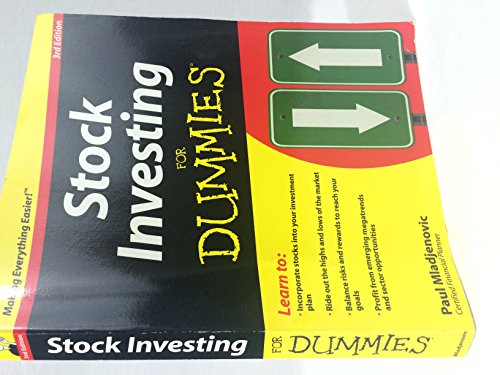
Stock Investing For Dummies, 3rd Edition includes information on stock investing in both bear and bull markets; unique investment segments; stock investing for different types of situations; and examples straight from the real world of stock investing as they have occurred in the past three years.
"synopsis" may belong to another edition of this title.
About the Author
Paul Mladjenovic is a well-known Certified Financial Planner and national speaker on investing and financial matters. He is the owner of PM Financial Services and www.SuperMoneyLinks.com, and he has been quoted or referenced by media outlets, publications, and financial Web sites. Mladjenovic is the author of the first two editions of Stock Investing For Dummies as well as Precious Metals Investing For Dummies.
From the Back Cover
Now updated! Your expert guide to building a profitable stock portfolio
Want to make money in stocks without losing your shirt? This practical guide gives you proven strategies for weathering the current economic crisis and for selecting and managing profitable investments in either a bear or bull market. You'll navigate the new economic landscape and choose the right stocks for different situations ? and you'll find fresh real-world examples that show you how to maximize your returns.
Get started with the basics ? understand stock value, assess your finances, set your investing goals, and know your investing style
Recognize the risks ? explore different kinds of risk and weigh risk against return
Make informed investing decisions ? research stocks, understand growth and income investing, and use basic economics to improve your stock strategy
Build a strong foundation for your portfolio ? investigate industries, evaluate a company's financial health, and understand the effect of politics/government on stock investing
Capitalize on emerging sector opportunities ? from precious metals to alternative energy, discover the hot sectors that will make your portfolio thrive
Build (and hold on to) your wealth ? get expert tips and tactics for utilizing brokerage orders, buying with fewer costs, and keeping the taxman at bay
Open the book and find:
The differences between stock investing and trading
How to understand and use indexes
The various types of brokers and how to choose one
New ways to gather stock information online
Methods for tracking insider trading
Early signs of megatrends that can affect your portfolio
Solutions for protecting your profits
Investing resources and financial ratios
Excerpt. © Reprinted by permission. All rights reserved.
Stock Investing For Dummies
By Paul MladjenovicJohn Wiley & Sons
Copyright © 2009 Paul MladjenovicAll right reserved.
ISBN: 978-0-470-40114-9
Chapter One
Welcome to the World of Stock Investing
In This Chapter
* Knowing the essentials
* Doing your own research
* Recognizing winners
* Exploring investment strategies
Stock investing was the hot thing during the late 1990s - a trend just like the hula hoop and pet rocks. With the new millennium, however, a reversal of fortunes has occurred as the bear market of 2000-2002 rocked our world (a bear market is a prolonged period of falling prices - in this case, stock prices). This decade has been a wild roller coaster ride that saw the market hit new highs in 2007, although it's down in ugly fashion in 2008. During this time, the public figured out that stock investing isn't for wild-eyed amateurs or dart-throwers (or the worst ... wild-eyed amateur dart-throwers!).
I wrote much of this 3rd Edition with current events and market conditions on my radar screen. The year 2008 witnessed some ominous events that will make stock investing very interesting (to say the least) for the time being. Don't let that scare you, though; informed investors have made money in all sorts of markets - good, bad, and even ugly. As I write this, the conditions are in place for an inflationary depression, but selecting stocks that can benefit from these challenging times could indeed make you much wealthier.
The purpose of this book is not only to tell you about the basics of stock investing but also to let you in on some solid strategies that can help you profit from the stock market. Before you invest your first dollar, you need to understand the basics of stock investing, which I introduce in this chapter.
Understanding the Basics
The basics are so basic that few people are doing them. Perhaps the most basic (and therefore most important) thing to grasp is the risk you face whenever you do anything (like putting your hard-earned money in an investment like a stock). When you lose track of the basics, you lose track of why you invested to begin with. Find out more about risk (and the different kinds of risk) in Chapter 4.
When the late comedian Henny Youngman was asked, "How is your wife?" he responded, "Compared to what?" This also applies to stocks. When you're asked, "How is your stock?" you can very well respond that it's doing well, especially when compared to an acceptable yardstick such as a stock index (like the S&P 500). Find out more about indexes in Chapter 5.
REMEMBER
The bottom line in stock investing is that you shouldn't immediately send your money to a brokerage account or go to a Web site and click "buy stock." The first thing you should do is find out as much as you can about what stocks are and how to use them to achieve your wealth-building goals. Chapters 2 and 3 help you take stock of your current financial situation and help you understand common approaches to stock investing.
Before you continue, I want to get straight exactly what a stock is. Stock is a type of security that indicates ownership in a corporation and represents a claim on the part of that corporation's assets and earnings. The two primary types of stocks are common and preferred. Common stock (what I cover throughout this book) entitles the owner to vote at shareholders' meetings and receive any dividends that the company issues. Preferred stock doesn't usually confer voting rights, but it does include some rights that exceed those of common stock. Preferred stockholders, for example, have priority in certain conditions, such as receiving dividends before common stockholders in the event that the corporation is going bankrupt.
Preparing to Buy Stocks
Gathering information is critical in your stock-investing pursuits. You should gather information on your stock picks two times: before you invest and after. Obviously, you should become more informed before you invest your first dollar, but you also need to stay informed about what's happening to the company whose stock you buy, and also about the industry and the general economy. To find the best information sources, check out Chapter 6.
TIP
When you're ready to invest, you need a brokerage account. How do you know which broker to use? Chapter 7 provides some answers and resources to help you choose a broker.
Knowing How to Pick Winners
When you get past the basics, you can get to the meat of stock picking. Successful stock picking isn't mysterious, but it does take some time, effort, and analysis. And the effort is worthwhile because stocks are a convenient and important part of most investors' portfolios. Read the following sections and be sure to leapfrog to the relevant chapters to get the inside scoop on hot stocks.
Recognizing stock value
Imagine that you like eggs and you're buying them at the grocery store. In this example, the eggs are like companies, and the prices represent the prices that you would pay for the companies' stock. The grocery store is the stock market. What if two brands of eggs are similar, but one costs 50 cents a carton and the other costs 75 cents? Which would you choose? Odds are that you'd look at both brands, judge their quality, and if they're indeed similar, take the cheaper eggs. The eggs at 75 cents are overpriced. The same is true of stocks. What if you compare two companies that are similar in every respect but have different share prices? All things being equal, the cheaper price has greater value for the investor.
But the egg example has another side. What if the quality of the two brands of eggs is significantly different, but their prices are the same? If one brand of eggs is stale, of poor quality, and priced at 50 cents and the other brand is fresh, of superior quality, and also priced at 50 cents, which would you get? I'd take the good brand because they're better eggs. Perhaps the lesser eggs are an acceptable purchase at 10 cents, but they're definitely overpriced at 50 cents. The same example works with stocks. A poorly run company isn't a good choice if you can buy a better company in the marketplace at the same - or a better - price.
REMEMBER
Comparing the value of eggs may seem overly simplistic, but doing so does cut to the heart of stock investing. Eggs and egg prices can be as varied as companies and stock prices. As an investor, you must make it your job to find the best value for your investment dollars. (Otherwise you get egg on your face. You saw that one coming, right?)
Understanding how market capitalization affects stock value
You can determine a company's value (and thus the value of its stock) in many ways. The most basic way is to look at the company's market value, also known as market capitalization (or market cap). Market capitalization is simply the value you get when you multiply all the outstanding shares of a stock by the price of a single share.
TIP
Calculating the market cap is easy. If a company has 1 million shares outstanding and its share price is $10, the market cap is $10 million.
Small cap, mid cap, and large cap aren't references to headgear; they're references to how large a company is as measured by its market value. Here are the five basic stock categories of market capitalization:
REMEMBER
From a safety point of view, a company's size and market value do matter. All things being equal, large cap stocks are considered safer than small cap stocks. However, small cap stocks have greater potential for growth. Compare these stocks to trees: Which tree is sturdier, a giant California redwood or a small oak tree that's just a year old? In a great storm, the redwood holds up well, while the smaller tree has a rough time. But you also have to ask yourself which tree has more opportunity for growth. The redwood may not have much growth left, but the small oak tree has plenty of growth to look forward to.
For beginning investors, comparing market cap to trees isn't so far-fetched. You want your money to branch out without becoming a sap.
REMEMBER
Although market capitalization is important to consider, don't invest (or not invest) based solely on it. It's just one measure of value. As a serious investor, you need to look at numerous factors that can help you determine whether any given stock is a good investment. Keep reading - this book is full of information to help you decide.
Sharpening your investment skills
Investors who analyze a company can better judge the value of its stock and profit from buying and selling it. Your greatest asset in stock investing is knowledge (and a little common sense). To succeed in the world of stock investing, keep in mind these key success factors:
Actually, every chapter in this book offers you valuable guidance on some essential aspect of the fantastic world of stocks. The knowledge you pick up and apply from these pages has been tested over nearly a century of stock picking. The investment experience of the past - the good, the bad, and some of the ugly - is here for your benefit. Use this information to make a lot of money (and make me proud!). And don't forget to check out the appendixes, where I provide a wide variety of investing resources and financial ratios!
Boning Up on Strategies and Tactics
Successful investing isn't just what you invest in; it's also the way you invest. I'm very big on strategies such as trailing stops and limit orders. You can find out more in Chapter 18.
Buying stocks doesn't always mean that you must buy through a broker and that it must be 100 shares. You can buy stock for as little as $25 using programs such as dividend reinvestment plans. Chapter 19 tells you more.
TIP
While you're at it, you may as well find out what the corporate insiders are doing. Why? Because corporate insiders are among the first to find out what's really going on inside a company, and that knowledge is reflected in their investing decisions, which you should pay attention to. You can find out more about insider trading and other management doings in Chapter 20.
Stock market insanity
Have you ever noticed a stock going up even though the company is reporting terrible results? How about seeing a stock nosedive despite the fact that the company is doing well? What gives? Well, judging the direction of a stock in a short-term period - over the next few days or weeks - is almost impossible.
Yes, in the short term, stock investing is irrational. The price of a stock and the value of its company seem disconnected and crazy. The key phrase to remember is "short term." A stock's price and the company's value become more logical over an extended period of time. The longer a stock is in the public's view, the more rational the performance of the stock's price. In other words, a good company continues to draw attention to itself; hence, more people want its stock, and the share price rises to better match the company's value. Conversely, a bad company doesn't hold up to continued scrutiny over time. As more and more people see that the company isn't doing well, the share price declines. Over the long run, a stock's share price and the company's value eventually become equal for the most part.
(Continues...)
Excerpted from Stock Investing For Dummiesby Paul Mladjenovic Copyright © 2009 by Paul Mladjenovic. Excerpted by permission.
All rights reserved. No part of this excerpt may be reproduced or reprinted without permission in writing from the publisher.
Excerpts are provided by Dial-A-Book Inc. solely for the personal use of visitors to this web site.
"About this title" may belong to another edition of this title.
Other Popular Editions of the Same Title

Search results for Stock Investing for Dummies

Stock Image
Stock Investing for Dummies -
Seller: World of Books (was SecondSale), Montgomery, IL, U.S.A.
Seller rating 5 out of 5 stars

Condition: Very Good. Item in very good condition! Textbooks may not include supplemental items i.e. CDs, access codes etc. Seller Inventory # 00103940784
Stock Image
Stock Investing for Dummies -
Seller: World of Books (was SecondSale), Montgomery, IL, U.S.A.
Seller rating 5 out of 5 stars
Condition: Good. Item in good condition. Textbooks may not include supplemental items i.e. CDs, access codes etc. Seller Inventory # 00103139514
Seller Image
Stock Investing for Dummies
Seller: Used Book Company, Egg Harbor Township, NJ, U.S.A.
Seller rating 3 out of 5 stars

Condition: very_good. Shows minimal signs of wear and previous use. Can include notes highlighting. A portion of your purchase benefits nonprofits! - Note: Edition & format may differ from what is shown in stock photo & item details. May not include supplementary material such as toys, access code, dvds, etc. Seller Inventory # 584ZSU000LP3_ns
Stock Image
Stock Investing for Dummies -
Seller: World of Books (was SecondSale), Montgomery, IL, U.S.A.
Seller rating 5 out of 5 stars
Condition: Good. Item in good condition and has highlighting/writing on text. Used texts may not contain supplemental items such as CDs, info-trac etc. Seller Inventory # 00104044524
Stock Image
Stock Investing for Dummies
Seller: Hawking Books, Edgewood, TX, U.S.A.
Seller rating 4 out of 5 stars

Condition: Very Good. Very Good Condition. Five star seller - Buy with confidence! Seller Inventory # X0470401141X2
Stock Image
Stock Investing for Dummies
Seller: ThriftBooks-Reno, Reno, NV, U.S.A.
Seller rating 5 out of 5 stars
Paperback. Condition: Very Good. No Jacket. May have limited writing in cover pages. Pages are unmarked. ~ ThriftBooks: Read More, Spend Less. Seller Inventory # G0470401141I4N00
Stock Image
Stock Investing for Dummies
Seller: ThriftBooks-Phoenix, Phoenix, AZ, U.S.A.
Seller rating 5 out of 5 stars
Paperback. Condition: Fair. No Jacket. Readable copy. Pages may have considerable notes/highlighting. ~ ThriftBooks: Read More, Spend Less. Seller Inventory # G0470401141I5N00
Stock Image
Stock Investing for Dummies
Seller: ThriftBooks-Reno, Reno, NV, U.S.A.
Seller rating 5 out of 5 stars
Paperback. Condition: Fair. No Jacket. Readable copy. Pages may have considerable notes/highlighting. ~ ThriftBooks: Read More, Spend Less. Seller Inventory # G0470401141I5N00
Stock Image
Stock Investing for Dummies
Seller: ThriftBooks-Dallas, Dallas, TX, U.S.A.
Seller rating 5 out of 5 stars
Paperback. Condition: Good. No Jacket. Missing dust jacket; Pages can have notes/highlighting. Spine may show signs of wear. ~ ThriftBooks: Read More, Spend Less. Seller Inventory # G0470401141I3N01
Stock Image
Stock Investing for Dummies
Seller: ThriftBooks-Phoenix, Phoenix, AZ, U.S.A.
Seller rating 5 out of 5 stars
Paperback. Condition: Good. No Jacket. Pages can have notes/highlighting. Spine may show signs of wear. ~ ThriftBooks: Read More, Spend Less. Seller Inventory # G0470401141I3N00