
Synopsis
Score your highest in a medical dosage calculations course
A recent shortage of nurses in a society with an aging population has triggered the demand for students to enter the field of medical study. A dosage calculations course is required for most students earning an applied science degree in nursing, pharmacology, or paramedic programs.
Medical Dosage Calculations For Dummies tracks a typical dosage calculations course and provides helpful content in an approachable and easy-to-understand format. Plus, you'll get examples of the various calculations made to determine the appropriate quantity of drug or solution that should be administered to patients.
- Calculating drug dosages utilizing ratio-proportion, formula, and dimensional analysis
- Systems of measurement, including metric and apothecary and other conversion equivalents for a global audience
- The ins and outs of the charting systems for MAR (Medicine Administration Records)
If you're one of the hundreds of thousands of students aspiring to enter the medical field, Medical Dosage Calculations For Dummies is your ticket for scoring your highest on exams.
"synopsis" may belong to another edition of this title.
About the Author
Dr. Richard W. Snyder, DO is an osteopathic physician, board certified in both internal medicine and nephrology. He has authored and coauthored several articles in peer-reviewed journals.
Barry Schoenborn is a longtime technical writer and is the coauthor of Technical Math For Dummies.
From the Back Cover
Score your highest in a medical dosage calculations course
Are you intimidated by the mere mention of math? Fear not! Most medical dosage calculations are simple, and this friendly guide provides helpful content in an approachable and easy-to-understand format. Tracking to a typical dosage calculations course, it gives you the practice, confidence, and skills to get a grasp on dosing in the context of real medical conditions.
- The dosage path needs basic math ― get a review of the math you need to calculate medical dosages, like systems of measurement, converting units, and more
- Just what the doctor ordered ― review the elements of a prescription, take a look at drug labels and patient safety, grasp the all-important MAR (Medication Administration Record), and get the 411 on proper medical documentation
- The many causes for calculations ― start putting your skills to practice as you work through calculations for oral, parenteral, and intravenous medications
- Special mentions ― take note of the considerations you'll make when calculating dosages for children, pregnant women, critical care patients, and others
Open the book and find:
- Step-by-step instructions for dosage calculations
- Plain-English math reviews
- Formulas for all calculation methods
- Helpful information on prescriptions and record keeping
- The anatomy of a marvelous MAR
- Tons of examples from real-life dosing scenarios
- The ten dosage calculations you really need to know
- Common dosing mistakes (and how to avoid them)
Learn to:
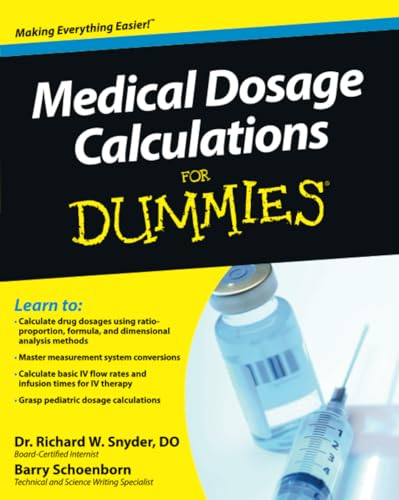
- Calculate drug dosages using ratio-proportion, formula, and dimensional analysis methods
- Master measurement system conversions
- Calculate basic IV flow rates and infusion times for IV therapy
- Grasp pediatric dosage calculations
From the Inside Flap
Score your highest in a medical dosage calculations course
Are you intimidated by the mere mention of math? Fear not! Most medical dosage calculations are simple, and this friendly guide provides helpful content in an approachable and easy-to-understand format. Tracking to a typical dosage calculations course, it gives you the practice, confidence, and skills to get a grasp on dosing in the context of real medical conditions.
- The dosage path needs basic math -- get a review of the math you need to calculate medical dosages, like systems of measurement, converting units, and more
- Just what the doctor ordered -- review the elements of a prescription, take a look at drug labels and patient safety, grasp the all-important MAR (Medication Administration Record), and get the 411 on proper medical documentation
- The many causes for calculations -- start putting your skills to practice as you work through calculations for oral, parenteral, and intravenous medications
- Special mentions -- take note of the considerations you'll make when calculating dosages for children, pregnant women, critical care patients, and others
Open the book and find:
- Step-by-step instructions for dosage calculations
- Plain-English math reviews
- Formulas for all calculation methods
- Helpful information on prescriptions and record keeping
- The anatomy of a marvelous MAR
- Tons of examples from real-life dosing scenarios
- The ten dosage calculations you really need to know
- Common dosing mistakes (and how to avoid them)
Learn to:
- Calculate drug dosages using ratio-proportion, formula, and dimensional analysis methods
- Master measurement system conversions
- Calculate basic IV flow rates and infusion times for IV therapy
- Grasp pediatric dosage calculations
Excerpt. © Reprinted by permission. All rights reserved.
Medical Dosage Calculations For Dummies
By Richard Snyder Barry SchoenbornJohn Wiley & Sons
Copyright © 2011 John Wiley & Sons, LtdAll right reserved.
ISBN: 978-0-470-93064-9
Chapter One
Brushing Upon Your Math Skills and Entering the Healthcare Field
In This Chapter
* Looking at the basics of medical math and dosage calculations
* Taking a look at healthcare careers and the need for math
* Remembering the importance of compassion, empathy, and other important skills
If you're a healthcare professional (or planning to be one), you're in one of the most important careers around today. In essence, you help healthy people stay healthy, you help sick people get well, and you help people with critical health conditions live.
Of course, nursing and all health professions involve more than just calculating and administering medications. They're vocations for comforting the sick and injured — clearly they involve much more than just "pushing meds."
However, being a successful healthcare provider means being an able mathematician. After all, the field of medicine relies extensively on administering medications, and you must be able to calculate meds correctly before you dispense them.
In any healthcare education program, medical dosage calculations come up in practically every course (or they should). In addition, most schools of nursing have one course devoted entirely to medical dosage calculations.
In this chapter, we introduce you to the math you need to know to perform basic and complex medical dosage calculations. We also provide an overview of the different careers available in the healthcare field (and show you how they all utilize medical math). Finally, we go beyond math and focus on the other essential components of being a good healthcare provider.
DID YOU KNOW?
Florence Nightingale had a great gift for mathematics. She was a pioneer in presenting information visually — especially health statistics. She has been recognized for developing a form of the pie chart now known as the polar area diagram.
Knowing What Math You Need to Know in Healthcare
In healthcare, you need to know the following three kinds of dosing math:
It's true; you'll sometimes find questions on tests in school or in practicing for the NCLEX that may never come up in real life, but you still need to be prepared for those questions. Similarly, real life will surely present you with math problems that you never practiced in school. In this section, we cover the math concepts and calculation methods you need to know to be prepared for just about any scenario in healthcare.
REMEMBER
Never despair about medical dosage calculations. Each principle in this book is easy if you look at it the right way. Medical dosing math isn't harder than you think; it's actually easier!
Nailing down basic arithmetic
Nursing and related professions require basic math skills, but don't worry if math hasn't always been your favorite subject in school. The best part about medical math is that it's easy to identify just how much math you need to know.
Basic math is essentially just arithmetic — addition, subtraction, multiplication, and division. And you mostly use multiplication and division in your dosage calculations. But don't forget that counting is math, too. For example, when you count out 4 tablets, you're doing addition (1 + 1 + 1 + 1 = 4).
In case you missed some of what you need to know math-wise in school, we cover the most important principles in Chapters 2 through 4.
Fiddling with fractions in four forms
Medical dosage calculations use fractions 90 percent of the time (or 9/10 of the time or in a 9:1 ratio). In case you're wondering, all those phrases mean the same thing.
The four forms a fraction can take are
100 units/50 mL
Of these four types, you use only two (common fractions and decimal fractions) to do most of the work in your dosage calculations.
Conquering the calculation methods
A word to the wise about the complex math used in this book: There isn't any. All the math used in medical dosage calculations is very simple. For example, one of the most common calculations you see in dosing problems is unit conversion. To convert units, you just have to know how to use some simple formulas, called conversion factors, like 1 kg (kilogram) = 2.2 lb (pounds). You use conversion factors mostly to convert mass (weight) and liquid volumes. Chapter 4 explains everything you need to know about units and conversion.
As far as figuring out drug dosage and administration, you use the following three basic calculation methods: the formula method, the ratio-proportion method, and the dimensional analysis method. Chapter 8 walks you through each method and shows you when and how to use it.
EXAMPLE
The following problem is an example of some of the math you have to do when calculating medical dosages. It uses the ratio-proportion method (see Chapter 8 for more details).
If 250 mg are in 5 mL and you need to give 333 mg, what's the dose in mL?
To find out, follow these steps:
1. Set up the following proportion:
known equivalent/known equivalent = known equivalent/desired equivalent
250 mg/5 mL = 333 mg/x mL
2. Cross-multiply and solve.
250x = 5 x 333 250x = 1,665 x = 6.66
The answer is 6.66 mL. You'd give 6.7 mL to provide the needed 333 mg.
TIP
Calculations with multiple steps may look complex, but they aren't because the math involved in each step is fairly simple. For example, when you calculate a weight-dependent dosage that you must administer intravenously, your calculations typically follow this pattern:
Living in a metric world
Dosing medications — whether you're working in a hospital, clinic, rehab center, or home setting — is built on the metric system. Don't start panicking, yet. Because the metric system is based on a system of tens, it's easy to learn and to use.
For a long time, medicine used an older system (once called the English system) with units like lb (pounds) and fl oz (fluid ounces). Medicine also used the apothecaries' system with units such as the grain, dram, and scruple. The United States still commonly uses its household system, which includes units like fl oz (fluid ounces) and Tbsp (tablespoons), but it does so mostly in the kitchen, not the hospital.
Because the older systems haven't disappeared completely, be aware that you sometimes have to convert units from one system to units of another. (See Chapter 4 for tons more details on units and conversion.)
Tools of the Trade for Dosing Meds
This probably goes without saying, but accurate dosing is vital in the healthcare profession. It's a good thing the math isn't hard, because there's no room for error. After all, medicine relies primarily on medications to get healing done, so errors in dosage calculations can mean critical errors in patient health and safety.
Following are three tools of the trade that help you do medical dosing calculations accurately every time:
Surveying Healthcare Careers (They All Use Medical Math!)
In this section, we introduce you to various types of healthcare professions. Each of these professions requires knowledge of medical math in some form or another.
REMEMBER
No one is an island. It's important to work as a team. Nurses, doctors, pharmacists, patients, and parents of young patients need to be on the same page. It's not unusual for a nurse or doctor to call a pharmacist for dosing assistance, especially when it comes to giving complicated medications, like those used in chemotherapy. Being on the same page and working as a team are critical to providing both optimal and safe care, with a reduced likelihood of errors.
Looking at the classic nursing careers
A career in nursing takes numerous forms. Some are based on your level of education, while others are based on where you do the work. No matter what initials come after your name, however, you still need to know all about medications and to be able to do dosing calculations.
Each type of nurse needs education, testing, and usually licensing. The basic types are
In the United States, a certified nursing assistant may be called a nursing assistant certified (NAC), patient care assistant (PCA), state tested nurse aid (STNA), or nursing assistant-registered (NA/R).
Probing other medical careers
In addition to nursing, several other medical careers, including the following, require an understanding of medical dosage math:
Doctors come in many varieties. For example, a dentist (DDS) is a Doctor of Dental Surgery. A foot doctor (DPM) is a Doctor of Podiatric Medicine.
(Continues...)
Excerpted from Medical Dosage Calculations For Dummiesby Richard Snyder Barry Schoenborn Copyright © 2011 by John Wiley & Sons, Ltd. Excerpted by permission of John Wiley & Sons. All rights reserved. No part of this excerpt may be reproduced or reprinted without permission in writing from the publisher.
Excerpts are provided by Dial-A-Book Inc. solely for the personal use of visitors to this web site.
"About this title" may belong to another edition of this title.
Search results for Medical Dosage Calculations For Dummies

Seller Image
Medical Dosage Calculations For Dummies
Seller: Zoom Books Company, Lynden, WA, U.S.A.
Seller rating 5 out of 5 stars

Condition: acceptable. Book is in acceptable condition and shows signs of wear. Book may also include underlining highlighting. The book can also include "From the library of" labels. May not contain miscellaneous items toys, dvds, etc. . We offer 100% money back guarantee and 24 7 customer service. Seller Inventory # ZBV.0470930640.A
Seller Image
Medical Dosage Calculations For Dummies
Seller: clickgoodwillbooks, Indianapolis, IN, U.S.A.
Seller rating 5 out of 5 stars
Condition: acceptable. Used - Acceptable: All pages and the cover are intact, but shrink wrap, dust covers, or boxed set case may be missing. Pages may include limited notes, highlighting, or minor water damage but the text is readable. Item may be missing bundled media. Seller Inventory # CSIV.0470930640.A
Seller Image
Medical Dosage Calculations For Dummies
Seller: Goodwill Books, Hillsboro, OR, U.S.A.
Seller rating 5 out of 5 stars
Condition: acceptable. Fairly worn, but readable and intact. If applicable: Dust jacket, disc or access code may not be included. Seller Inventory # GICWV.0470930640.A
Seller Image
Medical Dosage Calculations For Dummies
Seller: Goodwill of Greater Milwaukee and Chicago, Racine, WI, U.S.A.
Seller rating 5 out of 5 stars
Condition: acceptable. Book is considered to be in acceptable condition. The actual cover image may not match the stock photo. Book may have one or more of the following defects: noticeable wear on the cover dust jacket or spine; curved, dog eared or creased page s ; writing or highlighting inside or on the edges; sticker s or other adhesive on cover; CD DVD may not be included; and book may be a former library copy. Seller Inventory # 459JT4007HN6_ns
Seller Image
Medical Dosage Calculations For Dummies
Seller: MERS Goodwill, Saint Louis, MO, U.S.A.
Seller rating 5 out of 5 stars
Condition: acceptable. Used - Acceptable: All pages and the cover are intact, but shrink wrap, dust covers, or boxed set case may be missing. Pages may include limited notes, highlighting, or minor water damage but the text is readable. Pages may include limited notes and highlighting, but the text cannot be obscured or unreadable. Any access codes or passwords originally included with the book may be expired, used or no longer valid. Image is stock photo and cover art edition may be different than pictured. Seller Inventory # MERV.0470930640.A
Stock Image
Medical Dosage Calculations For Dummies
Seller: HPB Inc., Dallas, TX, U.S.A.
Seller rating 5 out of 5 stars
Paperback. Condition: Very Good. Connecting readers with great books since 1972! Used books may not include companion materials, and may have some shelf wear or limited writing. We ship orders daily and Customer Service is our top priority! Seller Inventory # S_470645010
Stock Image
Medical Dosage Calculations For Dummies
Seller: Brit Books, Milton Keynes, United Kingdom
Seller rating 4 out of 5 stars

Paperback. Condition: Used; Good. ***Simply Brit*** Welcome to our online used book store, where affordability meets great quality. Dive into a world of captivating reads without breaking the bank. We take pride in offering a wide selection of used books, from classics to hidden gems, ensuring there is something for every literary palate. All orders are shipped within 24 hours and our lightning fast-delivery within 48 hours coupled with our prompt customer service ensures a smooth journey from ordering to delivery. Discover the joy of reading with us, your trusted source for affordable books that do not compromise on quality. Seller Inventory # 2014791
Buy Used
US$ 27.84
US$ 21.42 shipping
Ships from United Kingdom to U.S.A.
Ships from United Kingdom to U.S.A.
Quantity: 1 available