
Synopsis
"The reason Verne is still read by millions today is simply that he was one of the best storytellers who ever lived." — Arthur C. Clarke
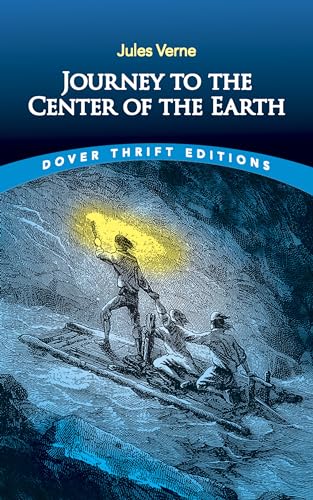
An adventurous geology professor chances upon a manuscript in which a 16th-century explorer claims to have found a route to the earth's core. Professor Lidenbrock can't resist the opportunity to investigate, and with his nephew Axel, he sets off across Iceland in the company of Hans Bjelke, a native guide. The expedition descends into an extinct volcano toward a sunless sea, where they encounter a subterranean world of luminous rocks, antediluvian forests, and fantastic marine life — a living past that holds the secrets to the origins of human existence.
Originally published in 1864, Jules Verne's classic remains critically acclaimed for its style and imaginative visions. Verne wrote many fantasy stories that later proved remarkably prescient, and his distinctive combination of realism and romanticism exercised a lasting influence on writers as diverse as Mark Twain, Arthur Conan Doyle, and Jean-Paul Sartre. In addition to the excitement of an action novel, Journey to the Center of the Earth has the added appeal of a psychological quest, in which the sojourn itself is as significant as the ultimate destination.
"synopsis" may belong to another edition of this title.
About the Author
"The reason Verne is still read by millions today is simply that he was one of the best storytellers who ever lived." — Arthur C. Clarke. Jules Verne started out composing librettos, but the French-born author's passion for travel and exploration compelled him to turn to adventure tales, creating the prototype for today's science fiction. One of the most translated authors in the world, Jules Verne is best known for his classics, Journey to the Center of the Earth, Twenty Thousand Leagues Under the Sea, and Around the World in Eighty Days.
From the Back Cover
An adventurous geology professor chances upon a manuscript in which a sixteenth-century explorer claims to have found a route to the earth's core. Professor Lidenbrock can't resist the opportunity to investigate, and with his nephew Axel, he sets off across Iceland in the company of Hans Bjelke, a native guide. The expedition descends into an extinct volcano toward a sunless sea, where they encounter a subterranean world of luminous rocks, antediluvian forests, and fantastic marine life—a living past that holds the secrets to the origins of human existence.
Originally published in 1864, Jules Verne's classic remains critically acclaimed for its style and imaginative visions. Verne wrote many fantasy stories that later proved remarkably prescient, and his distinctive combination of realism and romanticism exercised a lasting influence on writers as diverse as Mark Twain, Arthur Conan Doyle, and Jean-Paul Sartre.
From the Inside Flap
The intrepid Professor Lindenbrock embarks upon the strangest expedition of the nineteenth century: a journey down an extinct Icelandic volcano to the Earth's very core. In his quest to penetrate the planet's primordial secrets, the geologist--together with his quaking nephew Axel and their devoted guide, Hans--discovers an astonishing subterranean menagerie of prehistoric proportions. Verne's imaginative tale is at once the ultimate science fiction adventure and a reflection on the perfectibility of human understanding and the psychology of the questor. As David Brin notes in his Introduction, though Verne never knew the term "science fiction," Journey to the Centre of the Earth is "inarguably one of the wellsprings from which it all began."
"About this title" may belong to another edition of this title.
Search results for Journey to the Center of the Earth (Dover Thrift Editions)

Seller Image
Journey to the Center of the Earth (Dover Thrift Editions)
Seller: Zoom Books Company, Lynden, WA, U.S.A.
Seller rating 5 out of 5 stars

Condition: very_good. Book is in very good condition and may include minimal underlining highlighting. The book can also include "From the library of" labels. May not contain miscellaneous items toys, dvds, etc. . We offer 100% money back guarantee and 24 7 customer service. Seller Inventory # ZBV.0486440885.VG
Stock Image
Journey to the Center of the Earth (Dover Thrift Editions)
Seller: World of Books (was SecondSale), Montgomery, IL, U.S.A.
Seller rating 5 out of 5 stars
Condition: Very Good. Item in very good condition! Textbooks may not include supplemental items i.e. CDs, access codes etc. Seller Inventory # 00095786462
Stock Image
Journey to the Center of the Earth (Dover Thrift Editions)
Seller: World of Books (was SecondSale), Montgomery, IL, U.S.A.
Seller rating 5 out of 5 stars
Condition: Acceptable. Item in acceptable condition! Textbooks may not include supplemental items i.e. CDs, access codes etc. Seller Inventory # 00087135877
Stock Image
Journey to the Center of the Earth (Dover Thrift Editions)
Seller: World of Books (was SecondSale), Montgomery, IL, U.S.A.
Seller rating 5 out of 5 stars
Condition: Good. Item in good condition. Textbooks may not include supplemental items i.e. CDs, access codes etc. Seller Inventory # 00094232505
Stock Image
Journey to the Center of the Earth (Dover Thrift Editions)
Seller: World of Books (was SecondSale), Montgomery, IL, U.S.A.
Seller rating 5 out of 5 stars
Condition: Very Good. Item in very good condition! Textbooks may not include supplemental items i.e. CDs, access codes etc. Seller Inventory # 00096094199
Seller Image
Journey to the Center of the Earth (Dover Thrift Editions)
Seller: Dream Books Co., Denver, CO, U.S.A.
Seller rating 5 out of 5 stars
Condition: like_new. In unread excellent condition. Pages are crisp and clean with no markings. Item may have minor shelf wear on the cover, spine, pages, or dust cover. Item may contain remainder marks on edges. Seller Inventory # DBV.0486440885.LN
Seller Image
Journey to the Center of the Earth (Dover Thrift Editions)
Seller: Goodwill of Colorado, COLORADO SPRINGS, CO, U.S.A.
Seller rating 5 out of 5 stars
Condition: very_good. Item may have minor cosmetic defects marks, wears, cuts, bends, crushes on the cover, spine, pages or dust cover. Shrink wrap, dust covers, or boxed set case may be missing. Item may contain remainder marks on outside edges, which should be noted in Product Details. Item may be missing bundled media. Seller Inventory # COLV.0486440885.VG
Stock Image
Journey to the Center of the Earth (Dover Thrift Editions)
Seller: Evergreen Goodwill, Seattle, WA, U.S.A.
Seller rating 5 out of 5 stars
paperback. Condition: Good. Seller Inventory # mon0000454990
Stock Image
Journey to the Center of the Earth (Dover Thrift Editions)
Seller: Half Price Books Inc., Dallas, TX, U.S.A.
Seller rating 5 out of 5 stars
paperback. Condition: Very Good. Connecting readers with great books since 1972! Used books may not include companion materials, and may have some shelf wear or limited writing. We ship orders daily and Customer Service is our top priority! Seller Inventory # S_460885648
Seller Image
Journey to the Center of the Earth (Dover Thrift Editions)
Seller: Off The Shelf, Antonia, MO, U.S.A.
Seller rating 5 out of 5 stars
Condition: good. The item shows wear from consistent use, but it remains in good condition and works perfectly. All pages and cover are intact including the dust cover, if applicable . Spine may show signs of wear. Pages may include limited notes and highlighting. May NOT include discs, access code or other supplemental materials. Seller Inventory # OSV.0486440885.G