
Synopsis
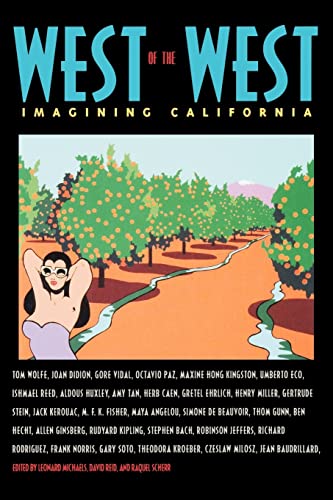
Conceived as a novelistic journey through the worlds of California, West of the West offers a vivid and diverse collection of writings on the state where extremes of every sort are dramatically evident in the weather, geography, and people. This richly fascinating collection represents the experience of California both physical and metaphysical, in fiction, poetry, essays, travel writing, confessions, reportage, and social criticism. The authors are native Californians, born-again Californians, exiles, émigrés, critics, and visitors of every kind―Jack Kerouac, Joan Didion, Amy Tan, Simone de Beauvoir, Carey McWilliams, Tom Wolfe, Gore Vidal, Octavio Paz, Jean Baudrillard, Ishmael Reed, Allen Ginsberg―to name just a few.
"synopsis" may belong to another edition of this title.
About the Author
Leonard Michaels is the author of The Men's Club. David Reid is editor of Sex, Death and God in L.A. (California, 1994). Raquel Scherr is coauthor of Face Value: The Politics of Beauty.
Excerpt. © Reprinted by permission. All rights reserved.
West of the West: Imagining California
By Leonard Michaels, David Reid, and Raquel Scherr, editorsUniversity of California Press
Copyright 1995 Leonard Michaels, David Reid, and Raquel Scherr, editorsAll right reserved.
ISBN: 0520201647
South of Tehachapi
Carey McWilliams
Southern California is the land "south of Tehachapi"south, that is, of the transverse Tehachapi range which knifes across to the ocean just north of Santa Barbara. Once this range has been crossed, as Max Miller has said, "even the ocean, as well as the land structure, as well as the people, change noticeably." In the political parlance of the state, Northern California candidates have always "come down to the Tehachapi" with a certain majority. In the vast and sprawling state of California, most statewide religious, political, social, fraternal, and commercial organizations are divided into northern and southern sections at the Tehachapi line. When sales territories are parceled out, when political campaigns are organized, when offices are being allocated, the same line always prevails. The Tehachapi range has long symbolized the division of California into two major regions: north and south. While other states have an east-west or a north-south division, in no state in the Union is the schism as sharp as in California. So sharp is the demarcation in California that, when statewide meetings are held, they are usually convened in Fresno, long the "neutral territory" for conventions, conferences, and gatherings of all sort.
1. The Region
From San Francisco south, the coastline extends in a north-south direction until Point Conception is reached at latitude 34.30 degrees; then the line swerves abruptly east and the shoreline begins to face almost due south. Once Point Conception has been rounded in an ocean liner, once the Tehachapi range has been crossed by train or car, even the most obtuse observer, the rankest neophyte, can feel that he has entered a new and distinct province of the state. If Southern California is entered from the east, through El Cajon Pass or San Gorgonio Pass, the impression is even more vividly sensed. On the Pacific side, the coast range turns east. The mountains no longer shut off the interior from the sea. The air is softer, the ocean is bluer, and the skies have a lazy and radiant warmth. South of Point Conception, a new Pacific Ocean emerges: an ocean in which you can actually bathe and swim, an ocean that sparkles with sunlight, an ocean of many and brilliant colors. Here is California del Sur, the Cow Counties, subtropical California, the land south of Tehachapi.
Physically the region is as distinct, as unlike any other part of the state, as though it were another country. But this separateness is not accurately reflected in county boundaries. Southern California, properly speaking, is one of the smallest geographic regions in America. It includes part of Santa Barbara County (the portion south of Tehachapi), all of Ventura, Los Angeles, and Orange counties, and those portions of San Bernardino, Riverside, and San Diego counties west of the mountains. It does not include Imperial County, for Imperial Valley belongs, geographically and otherwise, to the Colorado River basin. Southern California is a coastal strip of land"the fortunate coast" as Hamlin Garland once called it275 miles in length and with a depth that ranges from a few miles to nearly a hundred miles from the mountains to the sea. The land area itself embraces approximately 11,729 square miles.
As a region, Southern California is rescued from the desert by the San Bernardino and San Jacinto mountains on the east and is walled off from the great Central Valley by the transverse Tehachapi range which, running in an east-west direction, unites the Sierra Nevada and the coast ranges. Not only do these towering mountain ranges serve to keep out the heat and dust of the desert, but they are high enough to snatch moisture from the ocean winds and to form clouds. The land itself faces west, toward the Pacific, from which the winds blow with great regularity. It is this combination of mountain ranges, ocean breezes, and semidesert terrain that makes the climate, and the climate in turn makes the land.
Offshore are the Channel Islands, definitely a part of the region although traditionally detached from its social life. At one time several of the islands
were thickly populated with Indians, but the Spaniards removed the Indians to the mainland, leaving the islands as deserted as they are today (with the exception of resort-ridden Santa Catalina). To the north, near Point Conception, are the islands of the Santa Barbara group: perennially fogbound San Miguel, the Anacapas, Santa Rosa, Santa Cruz, and San Nicolas well offshore. About a hundred miles south of Santa Barbara are the Catalina Islands: Santa Catalina and San Clemente; while still further south, near San Diego, are the islands of the Los Coronados group.
In all of Southern California, there are no fully mature soils. Stretching from the Sierras to the sea, the lowlands are covered with huge coalescing alluvian fans formed of materials washed down from the mountains. The coastal plains are broken, here and there, by branches of the Sierra Madre range and by three of the driest rivers in America: the Los Angeles, the San Gabriel, and the Santa Ana. It was surely of these rivers that Mark Twain spoke when he said that he had fallen into a California river and "come out all dusty." Today the three rivers carry only a limited amount of surface and drainage waters, although each has an excellent underground flow. Here, in Southern California, as J. Russell Smith has observed, "rain makes possible the homes of man where otherwise there would be only jack rabbits, pastures, a little extensive farming, and a few small irrigated oases."
Basically the region is a paradox: a desert that faces an ocean. Since it is desert or semidesert country, maximum sunshine prevails most of the year. The sunshine makes up for what the soils lacka discovery that both Anglo and Hispano settlers were slow to make. Before man completely changed the ecology of the region, the natural landscape was not particularly prepossessing. The native vegetation consisted of chaparral on the moist mountain slopes and bunch grass on the lowlands. The real richness of the land is not to be found in the soils but in the combination of sky and air and ocean breezes. The wisecrack that Los Angeles is half wind and half water describes a real condition. As a region, Southern California lacks nearly everything: good soils; natural harbors (San Diego has the one natural harbor); forest and mineral resources; rivers, streams, and lakes; adaptable flora and fauna; and a sustaining hinterland. Yet the region has progressed amazingly by a succession of swift, revolutionary changes, from one level of development to another, offsetting natural limitations with an inventive technology. Its one great natural asset, in fact, is its climate.
The climate of Southern California is palpable: a commodity that can be labeled, priced, and marketed. It is not something that you talk about, complain about, or guess about. On the contrary, it is the most consistent, the least paradoxical factor in the environment. Unlike climates the world over, it is pre-
dictable to the point of monotony. In its air-conditioned equability, it might well be called artificial. The climate is the region. It has attracted unlimited resources of manpower and wealth, made possible intensive agricultural development, and located specialized industries, such as motion pictures. It has given the region its rare beauty. For the charm of Southern California is largely to be found in the air and the light. Light and air are really one element: indivisible, mutually interacting, thoroughly interpenetrated. Without the ocean breezes, the sunlight would be intolerable; without the sunlight and imported water, virtually nothing would grow in the region.
When the sunlight is not screened and filtered by the moisture-laden air, the land is revealed in all its semiarid poverty. The bald, sculptured mountains stand forth in a harsh and glaring light. But let the light turn soft with ocean mist, and miraculous changes occur. The bare mountain ranges, appallingly harsh in contour, suddenly become wrapped in an entrancing ever-changing loveliness of light and shadow; the most commonplace objects assume a matchless perfection of form; and the land itself becomes a thing of beauty. The color of the land is in the light and the light is somehow artificial and controlled. Things are not killed by the sunlight, as in a desert; they merely dry up. A desert light brings out the sharpness of points, angles, and forms. But this is not a desert light nor is it tropical for it has neutral tones. It is Southern California light and it has no counterpart in the world.
The geographers say that the quality of Southern California's climate is pure Mediterraneanthe only specimen of Mediterranean climate in the United States. But such words as "Mediterranean" and "subtropical" are most misleading when applied to Southern California. Unlike the Mediterranean coast, Southern California has no sultry summer air, no mosquito-ridden malarial marshes, no mistral winds. A freak of naturea cool and semimoist desertSouthern California is climatically insulated, shut off from the rest of the continent. As Helen Hunt Jackson once said, and it is the best description of the region yet coined, "It is a sort of island on the land." It is an island, however, of sharp contrasts. To William Rose Benet, the land suggests "a flowing life circle cut into contrasting angles . . . hills change over a week from garish green to golden brown; days are hot in the sun and cool in the shade; dense fog and spotless sky; giant trees or bare slopes; burnt sand or riotous flowers."
Traveling west from Chicago, the transition from one landscape to another, although often abrupt, is altogether logical. The rich, black Mississippi bottom lands shade off imperceptibly into the Kansas wheat lands; the Kansas plains lead naturally up to the foothills of the Rocky Mountains; once over the mountains, stretches of desert alternate with high pion-covered plateaus; and, across the Colorado River, the desert climbs slowly to the last mountain range.
Up to this point, the contrasting landscapes have seemed pleasing and appropriate; the eye has not been offended nor the emotions shocked. But, once the final descent has been made from the desert, through Cajon Pass to the floor of the coastal plain at San Bernardino, one has entered a new world, an island tenuously attached to the rest of the continent. "My first impression," wrote L. P. Jacks, "was such as one might receive on arriving in a City of Refuge, or alternatively on entering the atmosphere of a religious retreat. Here, it seems, is the place where harassed Americans come to recover the joy and serenity which their manner of life denies them elsewhere, the place, in short, to study America in flight from herself." Logically Southern California should be several miles offshore, so that one might be prepared for the transition from the desert and the intermountain West. But, if the long train trip is thought of, as it should be, as an ocean crossing, then the island-like character of the region is properly revealed.
Southern California is the land of the "sun-down sea," where the sun suddenly plummets into the ocean, disappearing "like a lost and bloody cause." It is a land where "the Sun's rim dipsat one stride comes the Dark." Of landward rolling mists, but not of clouds; of luminous nights, but not of stars; of evanescent light, but not of sunsets; of rounded rolling hills and mountains without trees. Here the sun glares out of a high blue skya sun that can beat all sense from your brains, that can be "destructive of all you have known and believed": a relentless, pounding, merciless sun. But when the mists roll in at evening, the skies brighten with "blue daylight" and the air is like "a damp cloth on the forehead of the hills." Cool and fragrant and alive, the nights engulf the glaring pavements, the white stucco homes, the red-tiled roofs, the harsh and barren hills. From Mount Wilson, late at night, one can look down on a vast pulsating blaze of lights, quivering like diamonds in the dark. Here, as Frank Fenton notes, the land does not hug the sky; it is the sky that is solid and real and the land that seems to float. At times you feel as though you were far away "on the underside of the earth."
2. The Seasons
Most people believe that there are only two seasons in Southern California: "the wet" and "the dry." But this crude description fails to take account of the imperceptible changes that occur within the two major seasons. Actually, Southern California has two springs, two summers, and a season of rain. The first springthe premature springfollows closely upon the early rains in the late fall. In November the days shorten, the nights become cooler, the atmosphere clears (except when brush fires are burning in the hills), the air is
stilled, and the land is silent. By November people have begun to listen for rain. The land is dry and parched and the leaves of the trees are thick with dust. The dry season has now begun to fray nerves, to irritate nostrils, and to bear down on the people. When the wind blows, it is full of particles of dust and dry leaves, of sand and heat.
And then come the first rains, drifting in long graceful veils, washing the land, clearing the atmosphere: the gentlest baptism imaginable. The people have known to a moral certainty that these rains would come; they have been expecting them; and yet they are forever delighted and surprised when they appear. The earth is reborn, the year starts anew with the rains. James Rorty has perfectly captured the elation aroused by the first rains:
Faultless in wisdom, at my window-pane
Compassionate sweet laughter of the rain.
The cowled hills, rising, met and kissed
The grey-eyed daughters of the mist;
Above the flawed and driven tide
The white gulls flapped wet wings and cried;
High on the slope the cattle lowed and ran,
On every hill the meadow-larks began
Their confident loud chime of Spring's rebirth;
Iris and tooth-wort stirred the fragrant earth . . .
I, too, who let the blown rain whip my face,
Received my portion of the season's grace.
After these first rainswhich fall gently, never in torrentsthe sun is softer: it no longer burns, the air is cool and fragrant, and the hills begin to change. In a miraculously short perioda matter of daysthe country is green and fresh. It is not the "green-dense and dim-delicious" green of the poets of the English countryside. Rather the land is clothed in a freakish greenery, a green so bright that, at times, it is almost sickening. "It is a bright emerald hue," as one observer has noted, "and has a sheen upon it which is like that upon the rind of green fruit, but much stronger. This appearance is very rank, and looks as though it would come off on your hands."
The first spring has now arrived: "the little spring" that only lasts a few weeks. A premonition of spring, it tricks the senses of the people and deludes the plants and flowers which start to bud and blossom out of season. Often called the false spring, it deceives the gullible semitropical plants which sometimes bloom weeks, and even months, in advance of their regular schedule. Jasmine, bougainvillea, privet, hibiscus, oleanders, and trumpet vines, usually
dormant at this time of the year, suddenly start to bloom. Under the illusion that spring has arrived, bare-root roses blossom and the buds of peach and apricot trees begin to swell. But this is not spring, only a conceit of nature, a lovely winter mirage.
And then in January, February, and March come the real rains: heavy, torrential, soggy. These rains do not slant in from the sea, but, like emptied buckets of water, fall straight and level on the earth. The arroyos race with rain waters; the dry river beds overflow; the floods have arrived. The earth now smells wet and the chaparral begins to brighten. The last rains come in April"grasshopper rains" they were once calledshowers and squalls, fitful and intermittent. Before the last rains have fallen, the real spring has arrived. There is a sudden blaze of color on the land. The green has changed from its early vividness to the heavier dense green of the rains, and, as the season advances, the green begins to bleach and fade. This second spring is really an aborted summer.
The second spring ends with the first desert winds, which usually come in May and last for several days. The ocean breezes suddenly cease, as the hot dry desert winds come whirling down the canyons, through the passes, and rush out across the valleys. Harsh and burning winds, they rip off palm leaves, snap branches, topple over eucalyptus trees, and occasionally carry off a flimsy roof. The desert winds bring dust and heat. The mountains stand out in the sharpest possible outline, so clear that you can see the rocks and boulders, so close that you can almost touch them. These are the winds once called "northers," but which the Spanish called "santannas." Doa Magdalena Murrillo, born on the Las Bolsas Rancho in 1848, said that the winds were called "Santa Anas" because they came down the Santa Aria Canyon. They were always very hot, she said, and stirred up a polvareda grande . When the Santa Anas came, no one dared light a fire, even in a stove. Don Jesus Aguilar, of San Juan Capistrano, said the wind was called El Viento del Norte ; but Willa Cather, referring to hot desert winds in New Mexico, called them "santannas." The desert winds often precede the last rain of the season.
After the desert winds comes June: cool and gray, with day-long mists and overcast. The summer flowers are at their loveliest; the lawns are damp and fragrant; and the leaves of the camphor tree, brightest and gayest of all the trees in Southern California, shimmer and dance in the air. But by late May it is already fallin the hills, away from the fountains and the sprinklers. The hills are tawny and the black shade of the live oaks is dense and heavy. The full blaze of summer color has gone by July and the summer that follows is the long summer of the dry season, when the hills are brown as umber. August is "only the longlingering afternoon of a long-lingering summer day." In late August the sea
breeze dies and once again the desert winds sweep across the land. This is the hottest spell of the year: baking hot, desert-hot, oppressive. Brush fires break out in the foothills just as they often do when the Santa Anas come in May. Heat from the brush fires, smoking and blazing in the foothills, makes the inland districts writhe and burn.
"Where had been a lush thicket of ferns," writes Steward Edward White, "now the earth lay naked and baked, displaying unexpected simplicities of contour that had before been mysteriously veiled. So hard and trodden looked this earth that it seemed incredible that any green thing had ever, or could ever again, pierce its steel-like shell. The land was stripped bare. In the trees the wind rustled dryly. In the sky the sun shone glaringly." The fog banks, however, prevent the summers from being oppressive throughout the season. Forming beyond the islands, they can be seen moving in toward the coast "in long attenuated streamers and banners, as night comes on, filling up the valleys of the coast with great tumultuous seas." With the morning sunlight, the mists obligingly roll out to sea. Throughout the summer, one can see this fog bank, about a thousand feet thick, lying offshore on the water. It has the strange feature, wrote Van Dyke, "of moving in against a breezethe land-breezeand moving out against anotherthe sea-breeze."
Toward the end of the long summer, when the unirrigated sections of the land are a gray, sunbaked tan, one can see, as James M. Cain has observed, that "the naked earth shows through everything that grows on it." It is then that one notices the sparseness of leafage in relation to the land. The earth is naked and exposed in Southern California. It is like the skin of a suntanned body with the few indigenous trees standing out sharply, like the hairs on the body, and not, as in other areas, like a thick mat of hair on the head. There is no carpet on the earth. Everywhere exposed, the earth is brown and gray and only seldom green. Today the appearance of the region is deceitful and illusory, for essentially it is a barren, a semiarid land.
Continues...
Excerpted from West of the West: Imagining California by Leonard Michaels, David Reid, and Raquel Scherr, editors Copyright 1995 by Leonard Michaels, David Reid, and Raquel Scherr, editors. Excerpted by permission.
All rights reserved. No part of this excerpt may be reproduced or reprinted without permission in writing from the publisher.
Excerpts are provided by Dial-A-Book Inc. solely for the personal use of visitors to this web site.
"About this title" may belong to another edition of this title.
Other Popular Editions of the Same Title

Search results for West of the West: Imagining California

Stock Image
West of the West: Imagining California
Published by
University of California Press (edition First Edition), 1995
ISBN 10: 0520201647
ISBN 13: 9780520201644
Used
Paperback
First Edition
Seller: BooksRun, Philadelphia, PA, U.S.A.
Seller rating 5 out of 5 stars

Paperback. Condition: Very Good. First Edition. It's a well-cared-for item that has seen limited use. The item may show minor signs of wear. All the text is legible, with all pages included. It may have slight markings and/or highlighting. Seller Inventory # 0520201647-11-1
Stock Image
West of the West: Imagining California
Published by
University of California Press, 1995
ISBN 10: 0520201647
ISBN 13: 9780520201644
Used
Paperback
Seller: ThriftBooks-Atlanta, AUSTELL, GA, U.S.A.
Seller rating 5 out of 5 stars
Paperback. Condition: Fair. No Jacket. Readable copy. Pages may have considerable notes/highlighting. ~ ThriftBooks: Read More, Spend Less. Seller Inventory # G0520201647I5N00
Stock Image
West of the West
Published by
University of California Press, 1995
ISBN 10: 0520201647
ISBN 13: 9780520201644
Used
paperback
Seller: Bookmonger.Ltd, HILLSIDE, NJ, U.S.A.
Seller rating 5 out of 5 stars
paperback. Condition: Good. Bumps on corners* Crease on a few pages*. Seller Inventory # mon0000632981
Stock Image
West of the West: Imagining California
Published by
University of California Press, 1995
ISBN 10: 0520201647
ISBN 13: 9780520201644
Used
Paperback
Seller: Midtown Scholar Bookstore, Harrisburg, PA, U.S.A.
Seller rating 5 out of 5 stars
Paperback. Condition: Very Good. Very Good - Crisp, clean, unread book with some shelfwear/edgewear, may have a remainder mark - NICE Standard-sized. Seller Inventory # M0520201647Z2
Stock Image
West of the West : Imagining California
Published by
University of California Press, 1995
ISBN 10: 0520201647
ISBN 13: 9780520201644
Used
Softcover
Seller: Better World Books, Mishawaka, IN, U.S.A.
Seller rating 5 out of 5 stars
Condition: Good. Reprint. Former library copy. Pages intact with minimal writing/highlighting. The binding may be loose and creased. Dust jackets/supplements are not included. Includes library markings. Stock photo provided. Product includes identifying sticker. Better World Books: Buy Books. Do Good. Seller Inventory # 11094780-20
Stock Image
West of the West: Imagining California
Published by
University of California Press, 1995
ISBN 10: 0520201647
ISBN 13: 9780520201644
Used
Paperback
Seller: Midtown Scholar Bookstore, Harrisburg, PA, U.S.A.
Seller rating 5 out of 5 stars
Paperback. Condition: Good. Good - Bumped and creased book with tears to the extremities, but not affecting the text block, may have remainder mark or previous owner's name - GOOD PAPERBACK Standard-sized. Seller Inventory # M0520201647Z3
Stock Image
West of the West: Imagining California
Published by
University of California Press, 1995
ISBN 10: 0520201647
ISBN 13: 9780520201644
Used
Paperback
Seller: Midtown Scholar Bookstore, Harrisburg, PA, U.S.A.
Seller rating 5 out of 5 stars
Paperback. Condition: Acceptable. Acceptable - This is a significantly damaged book. It should be considered a reading copy only. Please order this book only if you are interested in the content and not the condition. May be ex-library. PAPERBACK Standard-sized. Seller Inventory # M0520201647Z4
Stock Image
West of the West: Imagining California
Published by
University of California Press, 1995
ISBN 10: 0520201647
ISBN 13: 9780520201644
Used
paperback
Seller: HPB-Ruby, Dallas, TX, U.S.A.
Seller rating 5 out of 5 stars
paperback. Condition: Very Good. Connecting readers with great books since 1972! Used books may not include companion materials, and may have some shelf wear or limited writing. We ship orders daily and Customer Service is our top priority! Seller Inventory # S_466699362
Stock Image
West of the West: Imagining California
Published by
University of California Press, 1995
ISBN 10: 0520201647
ISBN 13: 9780520201644
Used
paperback
Seller: HPB-Diamond, Dallas, TX, U.S.A.
Seller rating 5 out of 5 stars
paperback. Condition: Very Good. Connecting readers with great books since 1972! Used books may not include companion materials, and may have some shelf wear or limited writing. We ship orders daily and Customer Service is our top priority! Seller Inventory # S_458627844
Stock Image
West of the West: Imagining California
Seller: AwesomeBooks, Wallingford, United Kingdom
Seller rating 5 out of 5 stars
Paperback. Condition: Very Good. West of the West: Imagining California This book is in very good condition and will be shipped within 24 hours of ordering. The cover may have some limited signs of wear but the pages are clean, intact and the spine remains undamaged. This book has clearly been well maintained and looked after thus far. Money back guarantee if you are not satisfied. See all our books here, order more than 1 book and get discounted shipping. Seller Inventory # 7719-9780520201644
Buy Used
US$ 16.51
US$ 5.43 shipping
Ships from United Kingdom to U.S.A.
Ships from United Kingdom to U.S.A.
Quantity: 2 available